A year after the food delivery wars, Pinduoduo emerges as the most "chill" winner
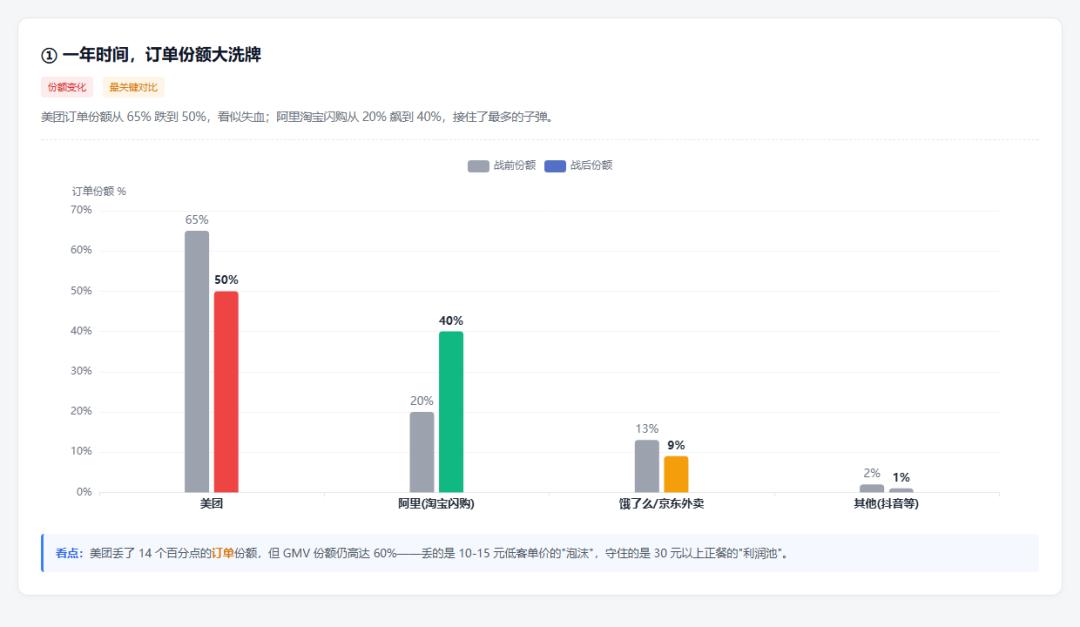
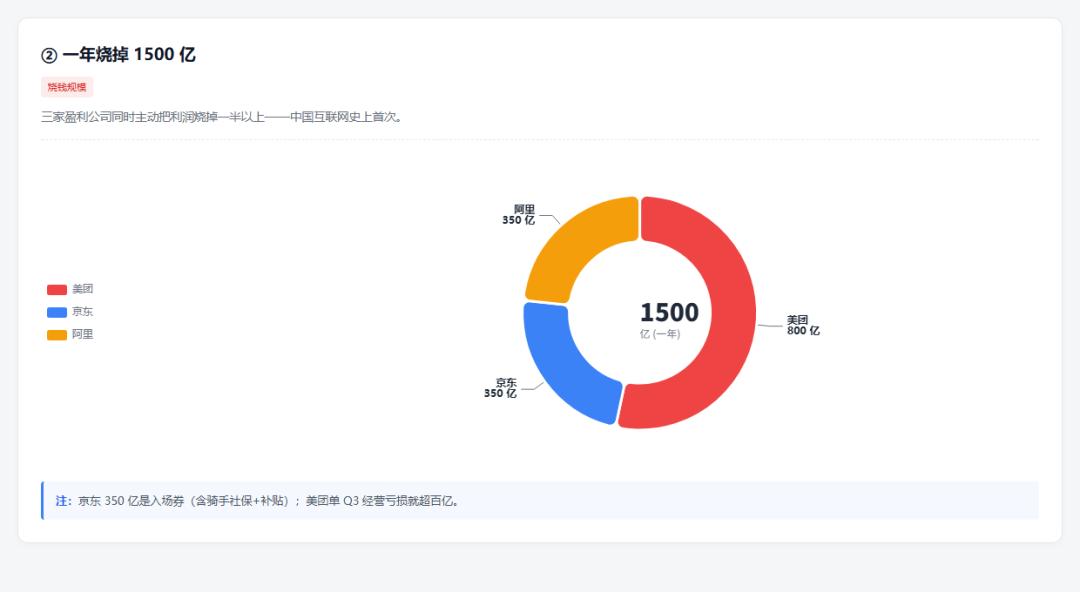
Three companies burned 150 billion yuan in a year, pushing the daily average number of takeout orders from 90 million to 200 million. Meituan's market share dropped from 75% to 50%. However, what was truly changed was not who delivered more takeout, but the underlying coordinates of the entire Chinese e-commerce were reset. Additionally, Pinduoduo, which doesn't engage in the takeout business, has become a "Buddha-like" winner.
The chief believes that the essence of this war has long transcended the shallow competition of "whose takeout is cheaper."
When JD.com entered the market with the slogan of "high-quality takeout," Meituan quickly upgraded "Meituan Flash" to an independent brand in April. The Alibaba Group upgraded its "Same-Day Delivery" service to "Taobao Flash" at the end of April. The actions of the three giants were almost simultaneous - they all understood that food delivery is just an entry point, and full-category instant retail is the real battlefield.
Data doesn't lie. In July 2025, the war reached its peak: Meituan announced that its daily orders exceeded 120 million, and Taobao Flash exceeded 80 million. More importantly, non-food categories began to experience explosive growth - orders for grains, oils, rice, and noodles increased by 335%, household cleaning products by 324%, and 3C digital products by 129%.
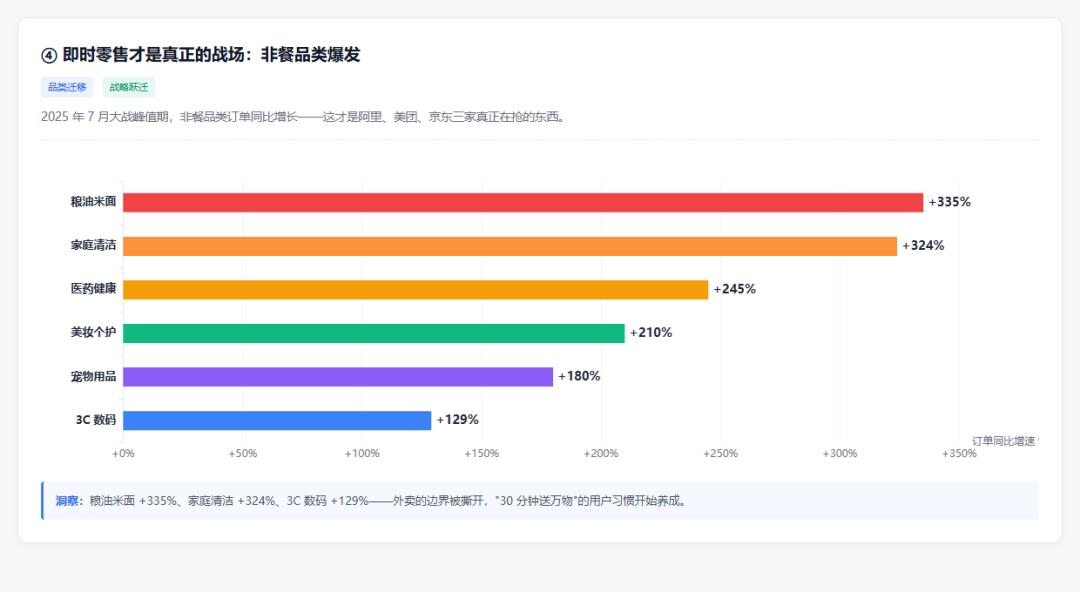
It took less than half a year to make the strategic leap from food delivery to full-category instant retail.
Today, let's review and sort out this war together. It all started last year.
The real change lies not in takeout, but in e-commerce
The takeout market used to be the most boring duopoly game in the world. Meituan held 65%, Ele.me held 33%, and the remaining 2% was just a formality. The two companies tacitly maintained a "gentle competition" - when one raised commissions, the other followed; when one launched a membership program, the other did the same. This market was like a game of Go that had been going on for ten years without a winner, and both sides were too lazy to make a move.
However, not making a move doesn't mean not wanting to. It's just that a catalyst was lacking. JD.com wanted to enter the game, and Alibaba was even more eager to make a move.
In February 2025, JD.com announced the recruitment of food delivery merchants, offering commission-free, high subsidies, and social insurance and housing funds for riders. The daily orders exceeded one million in 40 days and reached a peak of 25 million in June. JD.com's logic was simple and direct: break through with high-quality takeout and expand the market with its logistics network.
Alibaba responded even faster. In April, Taobao's "Same-Day Delivery" was fully upgraded to "Taobao Flash" and was directly given a top-level entry on the Taobao App homepage. Ele.me simultaneously launched the "Over 10 billion subsidies for Ele.me" campaign and announced on May 26 that its daily orders had exceeded 40 million.
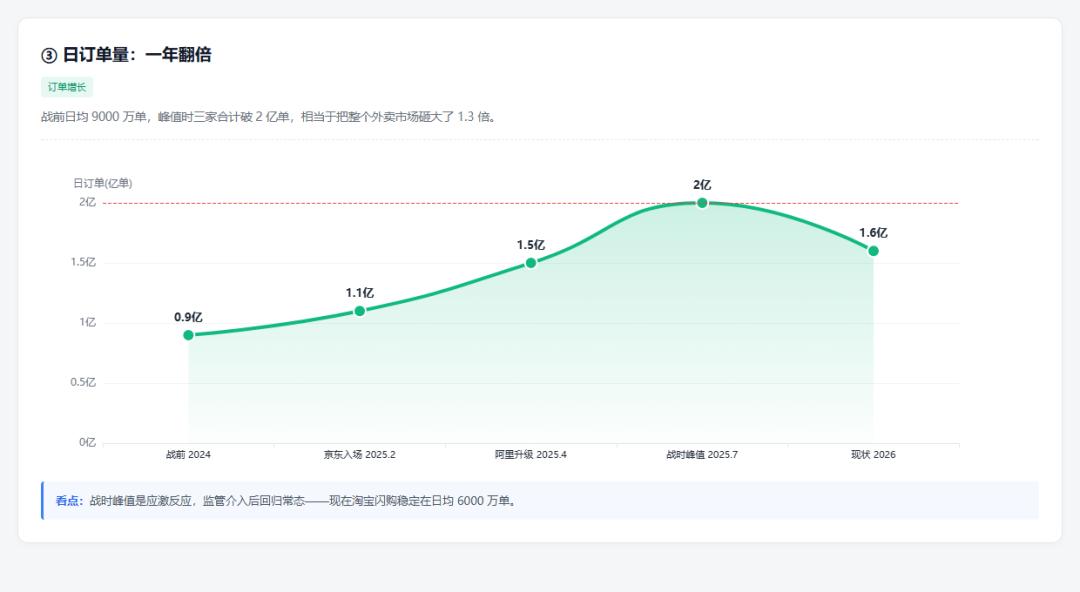
The battle situation quickly got out of control. In July, Taobao Flash's daily subsidies exceeded 1.2 billion yuan, and Meituan followed with 300 - 400 million yuan. In August, taking advantage of the marketing campaign of "the first cup of milk tea in autumn," Taobao Flash's daily order peak reached 120 million. Meituan then pushed its peak to 150 million. The total daily average number of food delivery orders on the three platforms once exceeded 200 million - before the war, this number was only 80 - 90 million.

Source: Internet
How crazy was the rate of burning money? In Q3 2025, the net profits of the three companies in a single quarter were all cut in half year-on-year. Three profitable companies simultaneously burned more than half of their profits, which has never happened in the history of Chinese Internet.
Meituan lost 14 percentage points of its order market share, but its GMV market share still reached as high as 60%. The lost market share was concentrated in the low-price range of 10 - 15 yuan - that was the battlefield with the most intense subsidies and the thinnest profits. In the dinner market with an order price of over 30 yuan, Meituan still maintained absolute dominance.
In other words, Meituan gave up the bubble and held on to the profit pool. It's like a boxing match. The opponent's every punch hits the protective gear. The score is rising, but the chin has never been hit hard.
From the chief's perspective: A war with no clear winner, but each has its own "winning" way
Meituan was on the defensive, but the cost of defense was the highest. In Q3 and Q4 2025, the revenue of Meituan's core local business declined year-on-year for two consecutive quarters - during the most intense period of the takeout war, the revenue growth rate was the most honest indicator of subsidies. The operating loss in Q3 exceeded 10 billion yuan, a figure that had never appeared in Meituan's history.
Meituan initially estimated that an additional 15 - 20 billion yuan in subsidies for this war in a year would be enough. However, it burned this amount in a single quarter. A Meituan insider revealed that the S-team members (who had not participated in the monthly financial meetings for many years) began to attend the meetings together, paying attention to the flow of every penny of subsidies. Meituan underestimated the determination of its opponents. Alibaba executives said very straightforwardly in one-on-one communication meetings that the investment in takeout subsidies has "no upper limit" because "we can't let our competitors know our bottom line."
However, Meituan also got what it wanted most: the barrier in the medium and high-price takeout market did not collapse. The Q1 2026 financial report showed that the unit economics (UE) of pure food delivery (excluding non-food flash delivery) had turned positive in April and May. More importantly, Meituan Flash's GMV reached 262 billion yuan in 2025 and is expected to exceed 400 billion yuan in 2026 - this is Meituan's core bargaining chip to transform from a "food delivery service" to a "service that delivers everything."
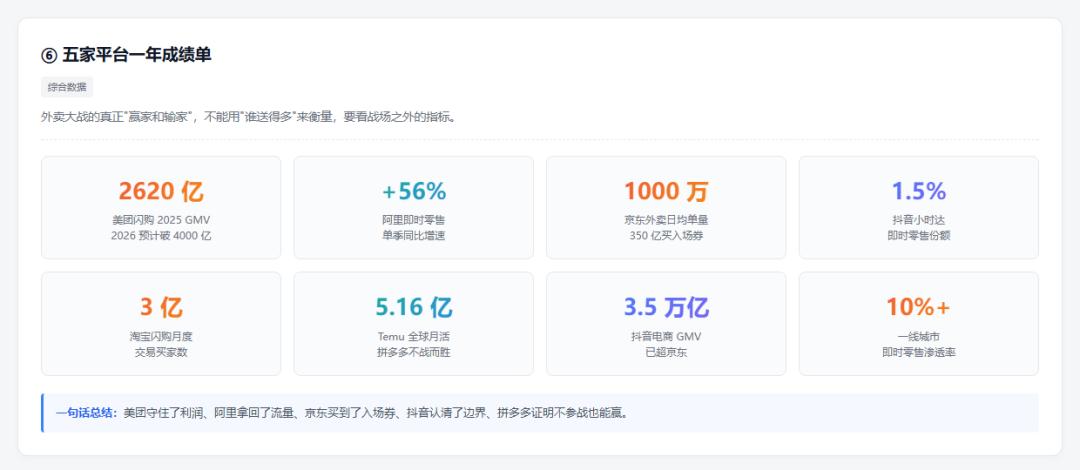
For Alibaba, takeout has never been the goal. Takeout is a lever for e-commerce to acquire customers, and the chief is optimistic about this. Taobao Flash achieved rapid growth in the past year. Its instant retail revenue in a single quarter was 20.842 billion yuan, a year-on-year increase of 56%. The number of monthly transaction buyers once soared to 300 million. More importantly, Jiang Fan clearly stated in the earnings conference call that the synergy between instant retail and traditional e-commerce is reflected in multiple dimensions such as "promoting customer acquisition, increasing user activity, meeting diverse consumption needs, and increasing transaction volume."
Taobao Flash is not waging a takeout war against Meituan but a traffic war for Taobao and Tmall. A 9.9-yuan milk tea subsidy may attract a user to buy clothes, home appliances, and everything else on Taobao. This equation can never be balanced with takeout UE, but it can be with e-commerce LTV (customer lifetime value).
In terms of user perception, the DAU (daily active users) of instant retail has increased from almost zero to a stable over 100 million. These users have developed the habit of ordering takeout, buying fresh produce, and purchasing medicine on Taobao.
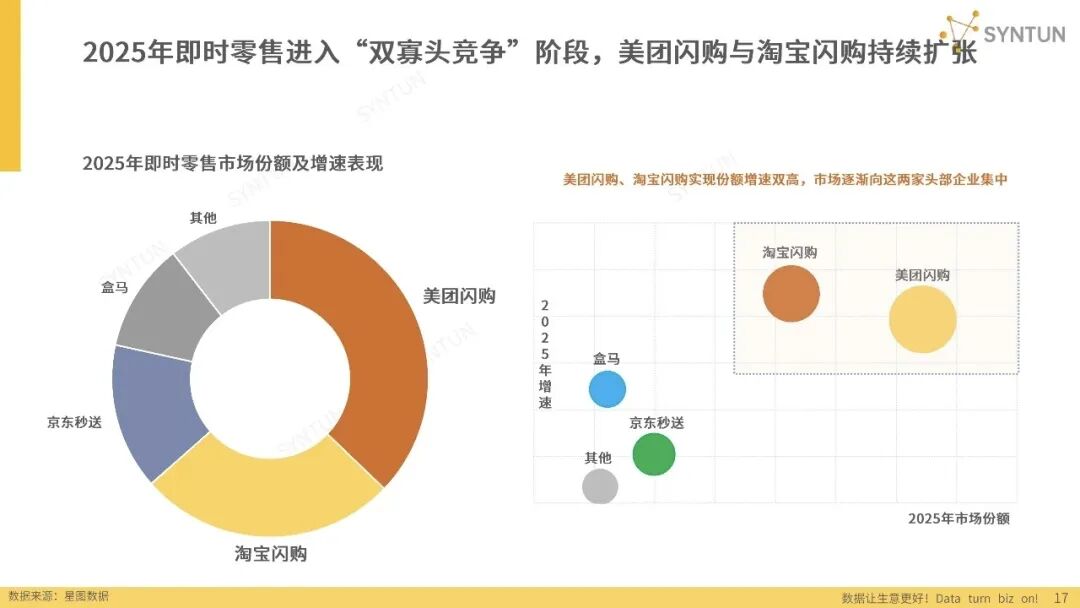
In terms of market share, Taobao Flash currently has a daily order volume of around 60 million (including food and non-food instant retail, including half-day delivery orders from Hema and Tmall Supermarket). Its market share has increased from 20% a year ago to over 40%.
In June 2025, Ele.me and Fliggy were officially incorporated into Alibaba's China e-commerce business group. In December, the Ele.me App was renamed "Taobao Flash." In terms of organizational structure, "distant-field e-commerce" (Taobao and Tmall) and "near-field retail" (Ele.me/Flash) achieved unified command. For the first time, Alibaba integrated instant retail into the engine room of e-commerce, instead of letting it operate as an independent business relying on its own blood-making ability.
Many people say that Alibaba's subsidy intensity has significantly weakened this year, and the takeout war should be coming to an end. However, Alibaba doesn't think so. Taobao Flash has recently launched two more "heavy punches" - Taobao convenience stores plan to open 3,000 stores, and the pace has been accelerated; a cooperation plan for university business districts has been launched, targeting 200 core university business districts in the first batch, aiming at the back-to-school season in September. These two things actually correspond to the same signal: the second stage of Alibaba's instant retail has begun.
Some media believe that JD.com, which ignited this "fire" first, is also the first to exit. Is this really the case?
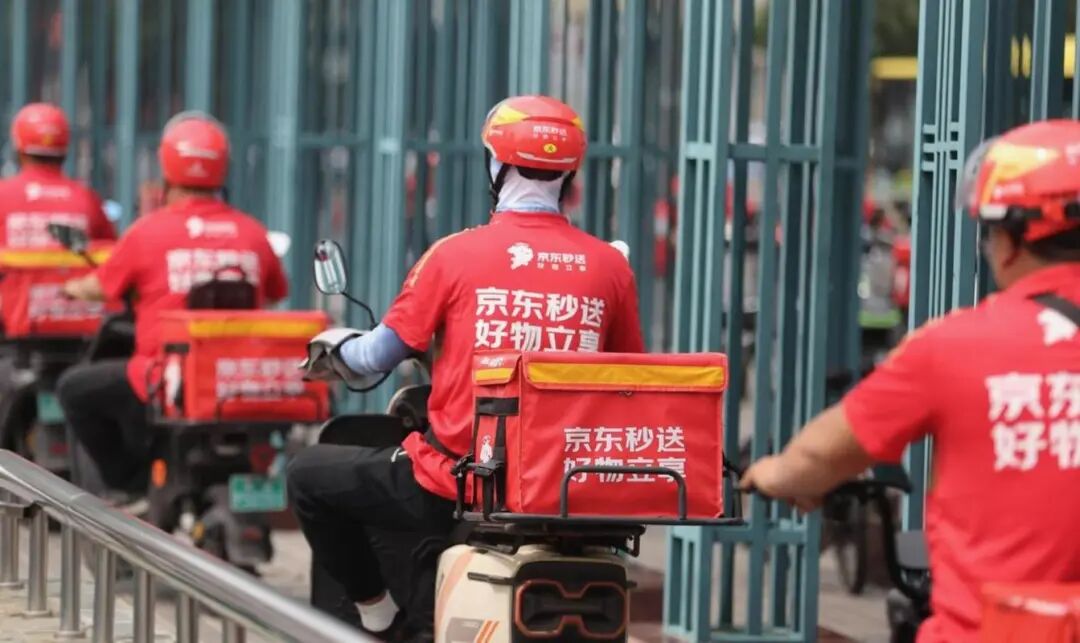
JD.com spent the least amount of money among the three and had the lowest base. With a daily takeout volume of 10 million orders, it is equivalent to half of Ele.me's before the war, which is like getting a standing ticket in the takeout market. Is it expensive to spend 35 billion yuan to buy an entry ticket? It depends on whether you ask the takeout department or the entire JD Group.
For the takeout department, spending 35 billion yuan to achieve a daily volume of ten million orders, the customer acquisition cost can only be described as "terrible." However, for the JD Group, takeout is the last piece of the local life ecosystem - JD Instant Delivery, JD 7FRESH, JD Takeout, and food group buying, together form a complete "home delivery + in-store consumption" map. In April 2026, JD.com launched "Food Group Buying," marking the extension from "takeout delivery" to "in-store consumption," and the local life closed-loop is being completed.
Source: Internet
In the chief's view, JD.com's differentiation lies in the "quality" label. High-quality merchants such as IKEA, Xiaomi, and Walmart have settled in JD Instant Delivery, with the highest average order value in the industry. JD.com is not waging a scale war but a perception war. The act of "ordering takeout on JD.com" itself is a guarantee of quality.
The boundaries of the e-commerce world are starting to blur
First, distant-field e-commerce (traditional e-commerce) is being "intercepted" by near-field retail (instant retail).
In the past, the path for users to buy a bottle of shampoo was: open Taobao → search → compare prices → place an order → wait for the express delivery. Now it has become: open Meituan/Taobao Flash → search for nearby Watsons/supermarkets → place an order → receive the goods in 30 minutes. As the demand for "wanting it right away" increases, and when 3C digital products and daily necessities can be delivered home within half an hour, the weight of the four words "more, faster, better, cheaper" is undergoing a historic shift: the weight of "fast" is increasing sharply, and the relative attractiveness of "cheap" is decreasing.
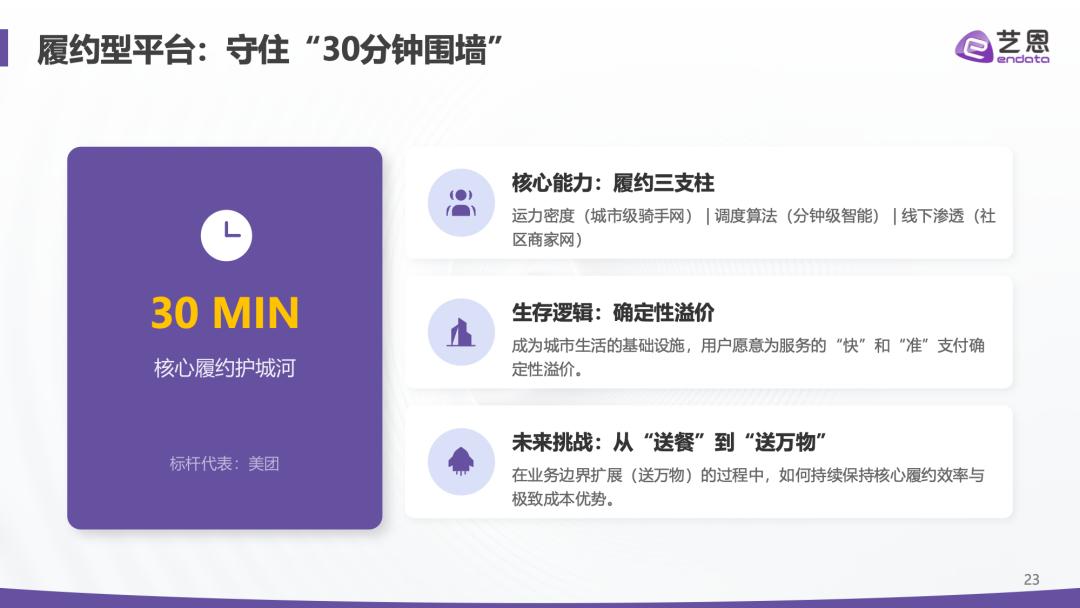
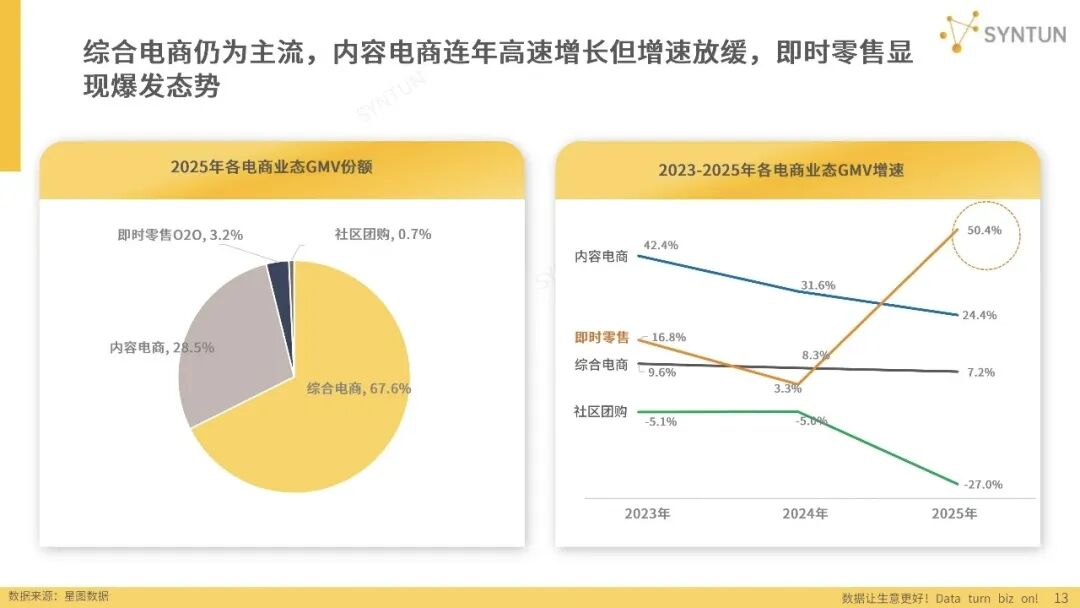
This doesn't mean that the e-commerce foundation of Taobao, Tmall, and JD.com will collapse - distant-field e-commerce still has a huge advantage in long-tail products - but high-frequency, low-decision-cost categories (daily necessities, food and beverages, medicine, beauty products) are accelerating the migration to instant retail. In 2025, the scale of the instant retail market reached 2.9852 trillion yuan, a year-on-year increase of 21.4%, while the growth rate of the overall e-commerce has slowed