Beingmate Welcomes a State-Owned Capital Backer, Founder Steps Down After 2 Billion Yuan Losses in 10 Years
Beingmate (002570.SZ), the "first domestic milk powder stock", has finally reached the moment when its founder exits. In the past, Beingmate was known as the "first milk powder stock", and some netizens described it as an "outdated star", unable to compete with other "big players" in the highly competitive milk powder brand market today.
Yesterday, Beingmate announced that 100% of the equity of its controlling shareholder, Zhejiang Xiaobei Damei Holdings Co., Ltd., will be judicially transferred to Jinhua Zhenhe. The latter is a restructuring investment entity wholly controlled by the State-owned Assets Supervision and Administration Commission of Jinhua City.
With the completion of this transaction, the actual controller of Beingmate will change from founder Xie Hong to the State-owned Assets Supervision and Administration Commission of Jinhua City. The entrepreneur who once shouted "Developed for Chinese babies" will officially hand over the control of the company he founded 34 years ago. Currently, the controlling shareholder, Xiaobei Damei Holdings, holds 12.28% of the company's shares, of which 98.85% are pledged or frozen. According to the restructuring plan, after the court approves the ruling, all these restrictions on rights will be lifted.
What changes will occur to Beingmate after the state-owned assets take over? Jiang Han, a senior researcher at the Pangu Think Tank, analyzed that Beingmate's management style will shift from "founder's personal heroism" to "state-owned assets compliance and risk control orientation". After the state-owned assets take over, the decision-making process will be more rigorous, reducing radical decisions; the strategic focus will shift from simple "scale expansion" to "stable operation and asset preservation". State-owned assets usually require more transparent financial discipline, which means that Beingmate may shrink non-core businesses and focus on the cash flow of the main business; resource synergy will change. The state-owned background may bring local supply chain support or financing convenience to Beingmate, but it may face certain institutional frictions in the flexibility of market-oriented marketing.
As of yesterday's close, Beingmate closed at 5.72 yuan per share, up 10%, with a total market value of 6.178 billion yuan.
Change of Control
On June 3, Beingmate's major announcement was released, and the restructuring of the controlling shareholder, which had lasted for nearly a year, was officially finalized. The company's control rights have undergone a complete change. As the court ruled that the restructuring plan of the controlling shareholder, Xiaobei Damei, took effect, the state-owned assets of Jinhua officially entered the scene to take over. The transfer of Beingmate's actual control rights from founder Xie Hong to the State-owned Assets Supervision and Administration Commission of Jinhua City was successfully completed, and the uncertainty of the equity that had been pending in the market was completely cleared.
This restructuring was first launched on July 16, 2025, when Xiaobei Damei officially launched the pre-restructuring process. After nearly a year of investor selection, plan finalization, and judicial review, this round of restructuring was finally completed, with a steady pace throughout the process and no unexpected risks. Judging from the information disclosed in the announcement, the core entities of this equity change are two major platforms under the state-owned assets of Jinhua. After forming a concerted action relationship, the two parties hold a total of 13.35% of Beingmate's shares, becoming the new actual controller of the listed company.
This change of control only applies to the controlling shareholder level and is completely separated from the operation of the listed company. According to Beingmate's disclosure, the company is completely independent from the controlling shareholder in terms of assets, finance, business, personnel, etc. The controlling shareholder's own debt and restructuring issues will not affect the daily production and operation of the listed company. Throughout the restructuring period, Beingmate did not have any situations that damaged the interests of the listed company, such as the occupation of funds by the major shareholder or illegal guarantees, and the fundamental operation has always remained independent and stable.
The core negative factor that has troubled Beingmate before is the equity risk brought about by the high proportion of equity pledge and judicial freezing of the controlling shareholder. With the completion of this restructuring, all the equity preservation issues of the major shareholder have been resolved, and the uncertainty that has long suppressed the valuation has been completely eliminated. The change of the actual controller from a private founder to local state-owned assets is the focus of market attention. For Beingmate, which is deeply troubled by operating pressure and resource constraints, the entry of state-owned assets means obtaining stronger credit endorsement, industrial resources, and local resources, providing new support for the development of the company's milk powder main business, channel expansion, and brand upgrading.
According to Bai Wenxi, the deputy chairman of the China Enterprise Capital Alliance and the chief economist in the China region, after the State-owned Assets Supervision and Administration Commission of Jinhua City takes over, the most significant changes in Beingmate will be reflected in two aspects: the standardization of the governance structure and the integration of strategic resources. The state-owned background can provide brand credit endorsement for the consumer track with strong trust attributes such as the maternal and infant industry, boosting the confidence of channel distributors and the supply chain.
Overall, this restructuring is a typical case of "clearing negative factors + realizing positive factors". The old equity risks have been completely cleared, and the new state-owned shareholders have officially taken their positions, and the entire process does not affect the company's existing operating system. The operation rhythm of the original business and team remains unchanged. For the capital market, the landing of the restructuring that has lasted for a year has completely repaired the market expectations. Beingmate has officially entered a new development stage supported by state-owned assets. The subsequent synergy and empowerment of state-owned assets and the improvement of operations will also become the core investment highlights of the company.
Fierce Competition in the Milk Powder Industry, Beingmate Lost 2 Billion in 10 Years
The competition in the milk powder industry is fierce, and Beingmate's performance expansion scale has been relatively limited in recent years. This situation can be seen from the performance data: in the past 10 years, the company's revenue growth has almost stagnated, and the operating income has always remained at around 2.7 billion yuan.
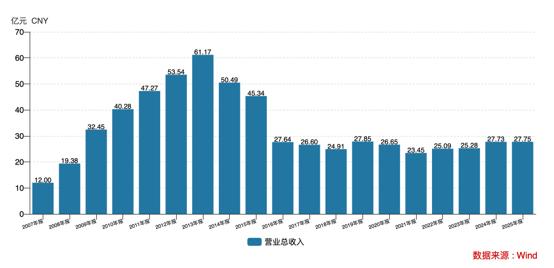
Source: Wind
The profit performance is even less optimistic. From 2016 to 2025, Beingmate was in a loss state for half of the time, and the total net profit attributable to the parent company in 10 years was a loss of 202.3 million yuan.
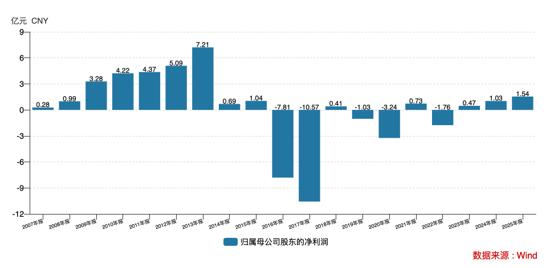
Source: Wind
Regarding the reasons for the weak performance growth, Jiang Han believes that, first of all, the shrinkage of the core basic market is the main reason. Against the background of the decline in the birth rate, the stock competition in the infant formula milk powder market has intensified. Beingmate has failed to effectively capture the high-end market share, resulting in an obvious revenue ceiling; secondly, the channel transformation is lagging behind. Compared with competitors such as Feihe, which have deeply penetrated the maternal and infant store channels, Beingmate has shortcomings in the refined operation of channels, resulting in poor sales; moreover, Beingmate's profit quality is not high. Although the net profit has slightly increased, this is more due to cost reduction and efficiency improvement rather than the natural dividend brought about by business growth. Lacking the support of scale effect, the profit growth is extremely fragile.
The first-quarter report of 2026 shows that Beingmate's weak performance situation has not been improved. The revenue was about 657 million yuan, a year-on-year decrease of 9.67%; the net profit attributable to the parent company was about 38.9549 million yuan, a year-on-year decrease of 8.98%.
Regarding the core reasons that have restricted Beingmate's revenue expansion, Bai Wenxi also believes that, first and foremost, it is the structural shrinkage of the industry. The number of newborns has been continuously declining, and the infant formula milk powder market has entered a stock competition. Beingmate's brand power has been marginalized, and its market share has been declining year by year. It even fell out of the top ten in the industry at one time. The lack of product innovation ability makes it difficult to attract consumers. Beingmate also faces channel difficulties. In 2025, the number of distributors has decreased from 1,765 to 1,579, a decrease of more than 10%. The concentration of the top five customers has increased from 28.23% to 30.47%. The channels have shrunk and are dependent on large customers. In addition, the historical problem of pressuring goods to channels has also overdrawn the subsequent growth potential.
Facing the above challenges, will Beingmate undergo a qualitative change after the state-owned assets take over and reverse the performance decline? Song Liang, an independent dairy analyst, believes that after the change of the actual controller, Beingmate's strategy will definitely change greatly. In the past five years, Beingmate has made some relatively radical or risky moves to repay debts and relieve pressure. After the state-owned assets acquisition, its strategy may tend to be more stable and conservative. Beingmate currently has a lot of pressure to expand. In fact, in the past few years, it has "become similar to a 'quasi-contract manufacturing' model", so a large amount of profits have been taken away by downstream agents or brand owners of contract manufacturing brands, resulting in unsatisfactory profits.
Beingmate also has a plan for the future. The company has long been focusing on the maternal, infant, and child food industry. The 2025 annual report once emphasized that it is accelerating the expansion of new product categories such as children's milk powder, adult milk powder, diapers, wet wipes, tissues, and skin care products, promoting the optimization of the product structure, coordinating multiple categories, and continuously promoting the implementation of the strategy of a professional consumer goods company driven by advanced technology.
Bai Wenxi believes that from a strategic perspective, after the state-owned assets take over, the company is expected to accelerate the transformation from "maternal and infant nutrition" to "family-wide and full-cycle health", and obtain support in aspects such as dairy industry integration, industry-university-research cooperation, and the expansion of people's livelihood consumption through the state-owned assets platform. However, the decision-making process of state-owned assets is relatively stable, which may weaken Beingmate's original market flexibility and radical marketing style in the short term.
In any case, with the successful entry of state-owned assets this time, it is a substantial positive for Beingmate. This change has completely cleared the hidden dangers of the controlling shareholder's historical equity pledge, and the company's governance structure has become more stable. Relying on the advantages of the state-owned assets platform, the company's financing, channel cooperation, and resource docking capabilities will be optimized, and the uncertainty that has suppressed the operation in the early stage has been completely resolved. However, in terms of performance, it is difficult to achieve a rapid increase in performance in the short term. The current milk powder industry is in fierce stock competition, and the pressure from leading brands continues. The company's existing operating team maintains the original operating rhythm. The state-owned assets mainly focus on resource empowerment and reducing operating costs. The performance will probably maintain a steady recovery trend, and there is a lack of industry and fundamental support for explosive growth.
The Founder's Farewell, with Merits and Faults
Xie Hong, who is 61 years old this year, may not have expected that the domestic milk powder giant he created with his own hands would eventually bid farewell. "After the state-owned assets acquisition, this money can be used to help Xie Hong repay the debts in the capital market. After the repayment is completed, Xie Hong and his wife will basically be out of trouble and no longer restricted." Song Liang analyzed.
When Xie Hong returned in 2018, Beingmate was on the verge of a cliff. The company suffered a huge loss of 960 million yuan in 2017. If it continued to lose money in 2018, it would be subject to delisting risk warnings due to negative net profits for two consecutive years. At that time, Xie Hong urgently took up the position of general manager. Through a series of "slimming" actions such as divesting non-core assets, shrinking the front line, and clearing inventory, he barely pulled the company out of the delisting quagmire. However, what the outside world didn't notice is that this self-rescue did not touch the root - the debt mine of the parent company, Beingmate Group (note: renamed "Xiaobei Damei Holdings" in 2025) had already been buried.
According to public information and judicial documents, as the controlling shareholder, the equity pledge ratio of Beingmate Group has been consistently high. As the deleveraging process accelerated after 2018, the liquidity crisis at the group level was quickly transmitted to the listed company. Before this judicial restructuring, almost all of the shares of the listed company held by Beingmate Group were pledged or frozen, and there were multiple debt disputes involved. This means that even if the listed company temporarily stopped the bleeding, the controlling platform was no longer able to maintain control over the listed company.
Coincidentally, just before the state-owned assets took over, on May 19, Beingmate issued an apparently unremarkable announcement: Fang Luyao, the company's director, deputy general manager, and board secretary, applied for resignation due to "personal reasons". This "post - 80s" executive left in a hurry after only eight months in office, becoming the latest footnote to the frequent turmoil in Beingmate's management in recent years. Subsequently, the company announced that founder Xie Hong would temporarily act as the board secretary.
Why did the board secretary choose to resign at this time? According to Jiang Han's analysis, this is a routine personnel "clean - up" before the transfer of control rights. There are three reasons. First, before the official entry of state - owned assets, the original actual controller's team usually cleans up or adjusts key positions to facilitate the smooth handover of new shareholders; second, to avoid compliance risks. As the first responsible person for information disclosure, the board secretary's resignation during the sensitive period of the change of control rights may be to clarify the past information disclosure responsibilities and avoid compliance defects during the transition period; third, due to strategic differences. Facing the new governance structure after the entry of state - owned assets, the original management team may be uncertain about the future positioning and choose to leave in advance.
According to Song Liang's analysis, the original board secretary had been in Beingmate for less than a year. His purpose was to help the state - owned assets invest in Beingmate, conduct research and assessment on Beingmate, and then pave the way for the entry of state - owned assets. Now that the state - owned assets have completed the acquisition, his task is over, and it is normal for him to withdraw.
Looking back at Xie Hong's entrepreneurial history, it is a typical story of a Zhejiang businessman's counterattack. In 1992, with the self - developed "Beingmate Infant Nutrition Rice Noodles", he started in Hangzhou and managed to break through the market dominated by foreign brands such as Heinz and Nestle. In 2011, Beingmate was listed on the Shenzhen Stock Exchange, becoming the "first domestic milk powder stock". At its peak, the annual revenue exceeded 6.1 billion yuan, and the market share was closely following Feihe. However, after 2013, due to frequent changes in management, an aggressive credit sales policy, and extensive channel expansion, the company buried hidden dangers of huge bad debts. From 2013 to 2016, the company's revenue declined from 6.1 billion to 2.7 billion, almost halving.
What are Xie Hong's main contributions and management mistakes to Beingmate? According to Bai Wenxi's analysis, his important contributions include founding Beingmate in 1992, seizing the market gap after the trust crisis of domestic milk powder, and building the company into the "first domestic milk powder stock"; adhering to the bottom line in product safety and becoming one of the few domestic dairy enterprises that were not involved in the melamine incident