Starting with zero venture capital and now boasting a market value of one trillion dollars, he has become the most expensive lesson for Silicon Valley VCs.
In the development history of venture capital spanning half a century, "Sand Hill Road" is a totemic existence. This 3-kilometer road is densely populated with over 300 venture capital institutions, managing nearly one-third of the liquid funds in the entire venture capital industry. Almost every milestone entrepreneurial story in the history of the technology industry, such as those of Microsoft, Apple, Yahoo, Netscape, and Facebook, germinated here. More importantly, Sand Hill Road is located in Menlo Park, just over a mile from Stanford University, right in the heart of Silicon Valley. When Sequoia was founded on Sand Hill Road more than 50 years ago, it set a strict rule: "We only invest in companies that can be reached by bike."
It can be said that it is Sand Hill Road that has created the Silicon Valley model of "venture capital cluster + university technology transfer + entrepreneurial ecosystem", making people believe that venture capital is not just a "financial product", but is naturally related to "dreams". In theory, this is also the beginning of the AppLovin story.
In 2012, Adam Foroughi, the founder of AppLovin, came to Sand Hill Road with the goal of getting a $1 million seed round of financing. He was also very confident in achieving this. Before founding AppLovin, Adam Foroughi had several entrepreneurial experiences, and all of them ended well. For example, Lifestreet Media and Social Hour. Lifestreet Media is still active today and is one of the most mainstream advertising placement platforms in the United States. Social Hour was acquired by the mobile game community PlayPhone for a total price of $51 million. When founding AppLovin, Foroughi was already a successful person with financial freedom and occasionally made personal angel investments.
Moreover, Foroughi was only 32 years old at that time, very young. Looking back further, Foroughi graduated from the top-ranked University of California, Berkeley, with a bachelor's degree in business administration. His entire profile perfectly fits the aesthetic of Silicon Valley venture capital, being a standard "genius + serial entrepreneur".
Foroughi did prove his investment value at the fastest speed. After getting a $4 million angel investment in 2012, AppLovin achieved profitability in the same year and has since started to grow at a high speed. After becoming a listed company on the NASDAQ in 2021, AppLovin even started an aggressive expansion mode, achieving "double-speed" revenue growth every year. It was so popular that it was said that the whole Google was discussing "how to stop AppLovin". The stock price of AppLovin also truly reflects the ferocity of its rise: since the beginning of 2024, the stock price of AppLovin has soared by more than 600% in total.
In recent trading days, AppLovin has once again stood at the forefront of the market, and its market value has reached around $200 billion again. Therefore, a semi-joking saying has started to circulate in the market: If AppLovin starts to rise, you definitely won't be able to get on the bandwagon.
In fact, the more complete story is like this: Back then, Foroughi didn't gain the trust of any VC. The $4 million investment in 2012 came from his angel investor friends. The reason why AppLovin was able to achieve profitability in 2012 was essentially because they didn't get any "venture capital" and couldn't bear more losses. They had to support themselves as soon as possible. There is a saying in the investment industry: "What's more terrifying than losses is missing out on opportunities." Missing out on Foroughi's success is exactly the most expensive lesson for the entire Sand Hill Road and the entire Silicon Valley.

The collective mistake of VCs
Normally, venture capitalists usually have two reasons for rejecting a "serial entrepreneur". One is that the serial entrepreneur "fails again and again" and doesn't achieve any results in each attempt, so their ability is questionable. The other is that the serial entrepreneur intends to leave their "comfort zone" and enter a completely different field, which brings a lot of uncertainties.
As mentioned at the beginning, the first logic doesn't apply to Foroughi. LifeStreet Media has developed into one of the most mainstream advertising placement platforms in the United States. Social Hour was sold to the game community Playphone for $51 million in 2012. These two successful exits have made Foroughi financially free and given him the ability to make some angel investments in Silicon Valley. And the second logic also doesn't apply to Foroughi.
AppLovin is positioned as a platform that provides end-to-end technical solutions for enterprises to help them reach precise audiences and achieve monetization and growth marketing. Foroughi's LifeStreet Media is also positioned as a technology-driven advertising placement platform. Mitchell Weisman, another co-founder of LifeStreet Media, once corrected a reporter's description of them in an interview, saying that "LifeStreet Media is a technology company... because advertising networks usually just outsource sales teams. They sell advertising spaces but don't create any proprietary value, while LifeStreet is truly responsible for the creation and optimization of advertisements themselves and maximizes revenue by using the optimization algorithms we developed."
Social Hour is the same. Its core business is to help advertisers acquire users efficiently and measurably. It is an advertising technology company focusing on transactions and optimization. After the acquisition in 2012, Playphone officially commented that "they have a very mature mobile device marketing and lead generation solution".
In short, from the perspective of the technical path, AppLovin is in line with Foroughi's previous successful entrepreneurial cases and can be completely regarded as a masterpiece after accumulating a lot of successful experiences.
Then why did the top venture capital institutions on Sand Hill Road still miss AppLovin? The most reasonable explanation may be the "general environment".
In 2012 when Foroughi founded AppLovin, it was the second year after the 4G communication standard was confirmed and suppliers like MTK and Qualcomm started to prepare for the new generation of mobile phone platform solutions. Although the concept of "mobile Internet" had been put forward at that time, two years were not enough for its popularization. It was still hard for people to imagine that their future daily lives would revolve around "mobile phones" and that countless products would support their daily life in terms of food, clothing, housing, and transportation. Most people were more used to calling that era the "social network era" and thought that the core function of the Internet for most people was "socializing".
Under this premise, people instinctively thought that the dominance of "Internet advertising" should be in the hands of social websites like Facebook and Twitter, or search engines like Google and Yahoo. For many years later, Foroughi still clearly remembered the embarrassment at that time. In a round-table discussion in 2025, Foroughi thought that the biggest challenge since his entrepreneurship was that in the initial stage, it was very difficult to convince investors that an "advertising company" that "would neither become Facebook, Google, nor Amazon" could develop into a large-scale enterprise.
Moreover, the general environment not only brought a lag in "concepts". In 2012 when the mobile Internet hadn't become an infrastructure, most of the mobile advertising placements were operated by telecom service providers like AT&T or local information consulting integration platforms like CityGrid. There was no concept of personalized customization, let alone precise targeting. New Internet companies like Facebook also mainly focused on the web version and hadn't launched any advertising placement products for the mobile version.
There was a serious lack of comparable products, so it was really hard for venture capitalists to imagine the future development space of AppLovin. Finally, Foroughi visited the entire Sand Hill Road but still "couldn't find anyone who was willing to invest in us at the initial valuation he thought was reasonable (about $4 million or $5 million)."
Of course, if it weren't for this "lagging general environment", AppLovin might not have been born. In fact, after the entrepreneurial experiences of LifeStreet Media and Social Hour, Foroughi had developed a serious aesthetic fatigue towards the advertising industry, and his emotions even developed to the point of "hating advertising and not planning to return to this circle". His initially chosen new entrepreneurial projects were also a dating product and a fashion product.
But the problem was that his previous entrepreneurial experiences made him realize that the market traffic was migrating to the mobile end at an amazing speed, and developing mobile products would have a better future. When he developed a new product and was ready to promote it, he found that there was no targeted "mobile product" in the market, no promotion platform that could precisely target "mobile Internet users". Foroughi thought this was extremely absurd. Because the advertising industry "should be highly programmatic and measurable", but the reality was that after we entered the so-called "higher-tech era", developers "spent a dollar but didn't know where this dollar went", which was really "too sad".
The prototype of AppLovin was thus born. The first version was an "exchange community where netizens recommend mobile applications to each other", similar to the "Dianping in the APP circle". After a period of trial operation, AppLovin adjusted its functions and product structure and launched the official version in March 2012, positioning itself as a "marketing distribution platform" for mobile product developers.
And this is how the story at the beginning came about. After constantly hitting walls on Sand Hill Road, Foroughi decided to temporarily give up the "venture capital" path and put all his energy into the business to "support himself" as soon as possible. As Foroughi predicted, AppLovin precisely hit the pain point of the entire industry at that time and achieved profitability in its first year of establishment, with a monthly revenue of over $1 million. After achieving such results, Foroughi decided to restart the financing process and specifically gave up venture capital institutions, instead choosing friends like Maynard Webb, the then chairman of Yahoo, and Eduardo Vivas, his entrepreneurial partner during the Social Hours period.
In an interview many years later, Foroughi explained his choice like this: "I gathered a round of angel investors not because we were short of money, but because I thought they were all influential people who could help us grow and expand."
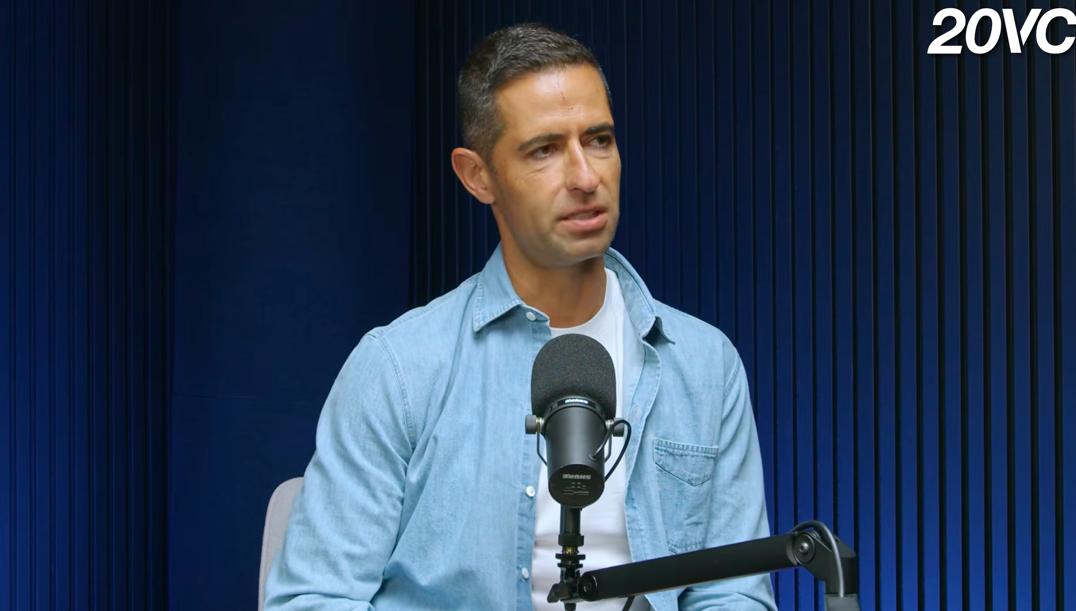
(Foroughi was a guest on 20VC)
The counter-intuitive Silicon Valley entrepreneur
Strictly speaking, venture capital institutions still had a chance to "catch up" at this point. After all, "a precise insight into pain points" can make a startup company successful, but it can't make a listed company with a trillion-dollar market value. After establishing a business model through "pain point insight", whether AppLovin wants to expand its scale or maintain its advantage, it needs continuous investment and planning. These are all opportunities for venture capital institutions. In fact, the AppLovin we see today is indeed the result of multiple strategic transformations.
After its official launch in 2012, AppLovin quickly locked its main category in "mobile games". Users could invite friends to try their favorite games on this platform. As the number of users increased, AppLovin also became one of the most important marketing platforms in the game industry. By July 2014, AppLovin's annualized revenue had reached the milestone of $100 million. It was also at this time that Foroughi thought that AppLovin shouldn't just be an "advertising distributor". The ideal state was that "advertisements should be more like content and recommendations, rather than annoying ads that have nothing to do with the consumer group".
With this idea in mind, AppLovin took an important step in 2018. They established their own game distribution department, Lion Studios, and acquired game studios such as Machine Zone and PeopleFun, becoming game developers.
In 2020, AppLovin started planning its second transformation. In that year, AppLovin's annualized revenue had exceeded $1 billion, with 300 million daily active users, and it maintained a double-digit percentage high-speed growth. However, during that period, Facebook, Apple, Amazon, Netflix, and Google also gradually began to pay attention to the operation of "private domain traffic" and developed their own advertising and marketing platforms, which brought very direct growth pressure to AppLovin. Therefore, AppLovin first launched its own advertising and marketing platform, MAX, and then acquired the marketing system Adjust and Twitter's automated advertising trading platform, MoPub, trying to get rid of the single label of "games" and upgrade to an advertising and marketing platform for all categories.
In 2022, AppLovin carried out its third strategic transformation and launched the first-generation Axon. Axon is positioned as an AI-driven advertising engine that uses machine learning (ML) for advertising targeting, thus improving the effectiveness and efficiency of advertising campaigns. The Axon 2.0 engine launched this year further tries to be applied in non-game fields such as the automotive and insurance industries.
These transformations require a large amount of cost investment and resource demand, and they also correspond to the "uncertainty" that the market least welcomes. The third transformation in 2022 is particularly typical. Now, from a God's-eye view, we can fully understand the necessity of AppLovin's acquisition of MoPub and the launch of the AI advertising engine Axon. The facts also prove the importance of the transformation. According to the previous financial report released in March this year, the AI-driven business centered on Axon 2.0 created a net profit of $836 million, a 92% increase compared to the same period last year.
But at that time, AppLovin was already a listed company on the NASDAQ. For investors in the public market, such a transformation was directly translated into "an important adjustment of the business portfolio", full of uncertainties about "whether the new advertising technology strategy can quickly take effect to support its market value". At this time, just as the US dollar ended the era of large-scale quantitative easing and entered an interest rate hike cycle, AppLovin's stock price plummeted by 92% throughout the year, and its overall market value dropped from $40 billion to less than $4 billion. In that year, Foroughi was so depressed that he suffered from "anxiety somatization". He was under so much pressure that he couldn't sleep, drank eight cups of coffee a day, lost his hair, his physical fitness declined, and he felt that all the things that could make him focus were disappearing.
In other words, Foroughi and AppLovin actually needed help, but no one expected that the solution Foroughi finally chose was to manage the company in a smaller, tighter, and more competitive way.
Now, AppLovin's market value has exceeded $170 billion, ranking among the top 60 in the United States. But compared with other companies of the same scale, AppLovin's size seems a bit too "tiny": the whole company has about 900 employees, more than half of whom come from new business acquisitions such as MoPub; the core business team that contributes about 98% of EBITDA has only about 400 people.
Foroughi also hopes to maintain this "tiny" state. Since he took over the team building again in 2023, the team expansion pace of AppLovin has been extremely compressed, dropping sharply from recruiting 250 new employees per year to 25. The executive team also maintains a distinct "minimalist style". So far, except for Foroughi, the founder and CEO, AppLovin's C-Level executives only include a CTO and a CFO, and positions such as CRO, COO, CMO, and CPO have never been set up.
Behind this business model is Foroughi's pursuit of a "fighting spirit". For many years, he has woken up at around 5:30 every day, and the first thought in his mind is "We're going to go bankrupt. Someone is going to squeeze us out. We're going to go out of business." Then he starts planning his day's work with this feeling. He believes that in a highly competitive ecosystem, once you think you're successful, you'll become a target, and it will be difficult to work as hard as before.
Behind this mindset is Foroughi's view on talent. He hopes that the team is composed of the "best" and "most goal-oriented" people, and at the same time, he requires candidates to find the most suitable position for themselves. The so-called "suitable" doesn't mean putting a smart person into a certain position, but that this position can allow him to continue to grow and become stronger. Only in this way can those real A-level players not be dragged down by procedural work, bloated organizational structures, and weaker people around them