Tencent AI, how did you get so bold?
Tencent, known to the outside world for being “cautious” and even “a step behind,” is adopting an unprecedented offensive stance when it comes to AI.
On June 2nd, three pieces of news related to Tencent's AI were successively exposed. First, Wang Xing, the founder of Meituan, announced at the earnings conference that Meituan's AI assistant, “Xiaomei,” will be connected to Tencent's Yuanbao. Users can complete services such as ordering and delivery on Meituan Takeaway within Yuanbao.
Second, according to the Financial Times, Tencent is testing a prototype of an autonomous AI agent and plans to start the compliance process as soon as this month. This means that WeChat can directly call mini - programs.
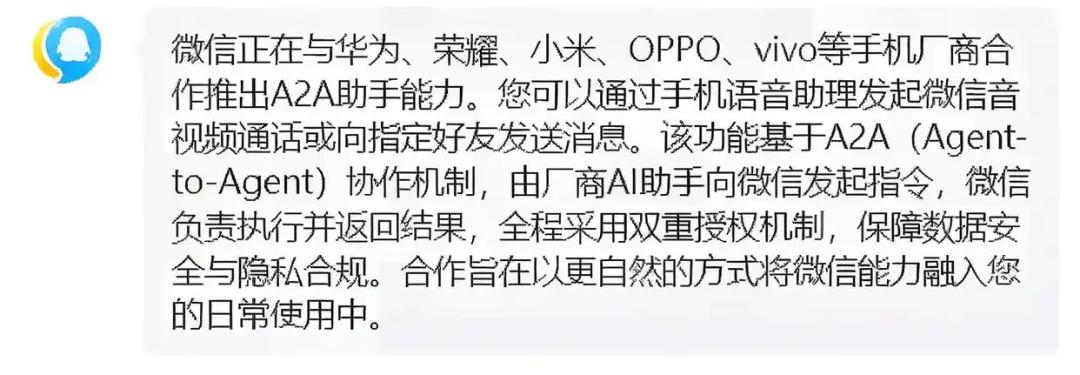
Third, IT Home found that WeChat is collaborating with mobile phone manufacturers such as Huawei, Honor, Xiaomi, OPPO, and vivo, enabling the manufacturers' AI assistants to directly initiate WeChat voice and video calls or send messages to specified friends.
A series of positive news has caused Tencent's Hong Kong - listed shares to soar by more than 10%, with a single - day market value increase of approximately HK$415.8 billion, setting a record for the highest single - day increase since January 2021.
Individually, these actions may just seem like product iterations. However, when placed in Tencent's strategic map over the past year, a clear thread emerges. Tencent, which used to deliberate carefully in the AI track and was extremely cautious even when adding an entry to WeChat, seems to be actively breaking boundaries.
Why has Tencent become bolder in its AI strategy?
01 From Following to Reconstruction
Tencent's “boldness” in the AI field is not achieved overnight. Over the past year or so, its investment rhythm in AI has become increasingly “aggressive.”
In 2025, Tencent's R & D investment reached 85.75 billion yuan, a year - on - year increase of about 21%. Among them, the investment related to AI was 18 billion yuan. The annual capital expenditure reached 79.2 billion yuan, hitting a record high. In the first quarter of 2026, the quarterly Capex has risen to 31.9 billion yuan, almost all of which was invested in AI computing power and model iteration. The company's senior management also announced that the AI - related investment in 2026 will at least double.
Corresponding to the capital investment was the organizational structure adjustment at the end of 2025. On December 17th, Tencent announced the establishment of the AI Infra Department, the AI Data Department, and the Data Computing Platform Department. At the same time, it recruited core researcher Yao Shunyu from OpenAI to serve as the Chief AI Scientist, reporting directly to President Liu Chiping.
This reporting line is highly unusual within the large - company system. Usually, technical experts belong to specific business groups, but this time, the large - model project has been directly elevated to the “company - level No. 1 project.”
Yao Shunyu also serves as the head of both the AI Infra Department and the Large Language Model Department, which means that Tencent aims to completely integrate “algorithms” and “computing power.” It is no longer satisfied with creating a “modified version” with Chinese characteristics and emphasizes the Co - design model that combines its own business scenarios.
Ma Huateng later admitted at the 2026 employee conference that Tencent had made significant optimizations and adjustments to its AI talent structure in the past year, increasing the attraction of “native AI talents in the industry.”
This level of talent introduction is rare in Tencent's history. In March of the same year, Tencent abolished the AI Lab, which had been established for nearly a decade. The AI business line has entered the “commercialization era” from the “laboratory era.” This “radical” adjustment from a research institution inclined to academic exploration to a business department directly bearing commercial value reflects Tencent's eagerness for the implementation speed of AI.
The changes in the Hunyuan large model itself may be the most intuitive example. After DeepSeek became extremely popular at the beginning of 2025, Tencent chose a very practical path and fully embraced DeepSeek. As a result, the priority of self - developed Hunyuan was lowered. In the eyes of the outside world, this was almost a gesture of admitting defeat, and the view that “Tencent's AI has fallen behind” was endless.
However, by the end of 2025, after Yao Shunyu joined, Hunyuan was “completely rebuilt,” with pre - training, reinforcement learning, and infrastructure all reconstructed. At the end of April 2026, the Hy3 preview model was officially released and open - sourced, with a total of 295 billion parameters and only 2.1 billion active parameters. It uses a mixture - of - experts architecture and is specifically optimized for inference, long - context, tool - calling, and agent scenarios.
After its launch, the Token call volume quickly exceeded that of the previous - generation model by 10 times, topping the weekly and overall charts on the OpenRouter platform for three consecutive weeks. Ma Huateng said at the shareholders' meeting: “After the new model was trained, we became more and more confident.”
From organizational reconstruction to model iteration, Tencent completed the reshaping of its AI capability system in less than a year. The real intention of this round of internal energy - gathering is by no means simply to make Yuanbao smarter.
After all, increasing investment, adjusting the organization, and introducing talents are all “standard actions” for giants when facing technological waves.
Tencent's special feature is that it has chosen a different path from ByteDance and Alibaba. Instead of betting on independent AI apps, it embeds AI agents into the WeChat ecosystem, which is an infrastructure - level platform.
ByteDance's Doubao has accumulated more than 340 million monthly active users, and Alibaba's Tongyi Qianwen is deeply integrated with Taobao and Alipay to create a “consumer agent.” The competition between the two companies for the C - end AI entry is becoming increasingly fierce. Although Tencent's Yuanbao has also exceeded 100 million monthly active users, it still lags behind Doubao and Qianwen.
In this situation, Tencent did not choose to “struggle” for user scale on Yuanbao but turned its attention to the underlying ecosystem of WeChat. After all, a super - app with 1.4 billion monthly active users covers all aspects of Chinese people's social, payment, travel, and daily life.
Embedding an AI agent that can call millions of mini - programs in WeChat has potential user reach and scenario coverage far beyond any independent AI app. Alibaba and ByteDance are trying to “bypass” WeChat in the competition for the AI entry, while Tencent's strategy seems to be to “hold on to” WeChat and nest AI capabilities in an ecosystem that users cannot avoid.
02 Avoiding the Home Turf of Doubao and Qianwen
In this regard, the cooperation between Meituan's “Xiaomei” and Yuanbao confirms the same logic. Wang Xing clearly stated at the earnings conference that Meituan's real moat lies in its full - category local services, verified real - time information, real user reviews, and a strong fulfillment infrastructure.
“By combining these structural advantages with AI, we will provide users with the best AI - powered local life service experience.” In other words, Meituan provides fulfillment and data, while Tencent provides the conversation entry and user reach.
The two are connected through the Agent - to - Agent method, and users can complete the entire process from “What do I want to eat” to “The takeaway has been ordered” within the Yuanbao conversation interface. This not only avoids direct competition between Meituan and Tencent but also allows both parties to find new positions in their “comfort zones” in the AI era.
Some industry insiders believe that the interconnection process between Yuanbao and Xiaomei is, to some extent, a “rehearsal” for WeChat's own AI agent.
The A2A cooperation with mobile phone manufacturers extends this “ecosystem alliance” strategy to the hardware level. WeChat actively opens its interfaces to mobile phone manufacturers such as Huawei, Honor, Xiaomi, OPPO, and vivo, enabling the manufacturers' voice assistants to directly call WeChat's capabilities to send messages and initiate calls.
In terms of product form, this is just a convenient feature. Users don't need to unlock their phones and open WeChat. They can send messages to friends by simply calling the phone assistant. However, from a strategic perspective, this action means that WeChat is changing from a “super - app” to a “service capability pool” that can be called by external AI agents.
This is in sharp contrast to Alibaba and ByteDance's idea of using their own AI apps to replace WeChat's functions. Tencent has chosen not “closed - door defense” but “open connection,” making other AI assistants also rely on WeChat's capabilities.
This “boldness” also means daring to face its own shortcomings. Ma Huateng admitted at the 2026 shareholders' meeting: “We can't just see others doing well and then casually cross over to grab their territory. We need to determine the right direction before taking steady steps.”
Rather than having a head - on confrontation in the C - end AI entry battlefield where Doubao and Qianwen have an advantage, it is better to return to Tencent's most proficient fields - social connection and ecosystem collaboration.
The picture formed by the three clues of WeChat's AI agent, the A2A interconnection between Yuanbao and Meituan, and the A2A cooperation with mobile phone manufacturers is: Tencent does not position itself as a “disruptor” in the AI era but as a “connection hub.”
It doesn't necessarily have to create the smartest AI large model or the AI independent app with the largest user base. Instead, it tries to make all AI agents unable to bypass Tencent's ecosystem when connecting to real - world services.
Of course, this “bold” game also comes with risks. The cost of fully launching the AI agent on WeChat is extremely high, and it is still unclear whether it can generate enough revenue in the short term to cover the investment cost. Computing power supply is also a real problem. Tencent was conservative in its layout before the U.S. chip export ban, and the production capacity of domestic self - developed chips is still tight.
According to financial news, Tencent said that it is currently unable to determine the launch time of the WeChat AI agent. The launch time largely depends on the approval progress of the agent by the regulatory authorities. Due to WeChat's user base of 1.4 billion, the compliance process may be more strict than that of other products.
Tencent's first - quarter financial report in 2026 also shows that its revenue and operating profit increased by only 9% year - on - year, and the growth rates of core businesses are diverging. The quarterly capital expenditure of 31.9 billion yuan accounts for about 42% of the current Non - IFRS operating profit of 75.6 billion yuan. The cost of this “big bet” is being borne by the current income statement.
Meanwhile, Alibaba and ByteDance are also making large - scale investments. Tongyi Qianwen's penetration in e - commerce and local life scenarios is accelerating, and Doubao is accelerating the integration with Douyin e - commerce to recommend stores and group - buying packages and complete transactions directly.
The “interception” effect of the AI entry on the traditional app service ecosystem is becoming a real threat that Tencent must face. If the WeChat AI agent cannot build a deep enough moat in terms of user experience and scenario coverage, this “bold” adventure may turn into a costly defensive battle.
But at least for now, Tencent has chosen to take action. Ma Huateng's self - deprecating words “changing the boat while it's leaking” also tell a fact that in the face of new technological waves, giants also need to constantly make trial - and - error and adjustments.
All of Tencent's “bold” actions in AI in the past year are essentially to complete a strategic shift, from using application scenarios to drive model capabilities to using the underlying model to drive ecosystem collaboration.
03 Conclusion
It took Tencent about a year to shift from being “too slow” to intensively promoting AI strategic transformation.
From Hunyuan to Yuanbao, and then to the WeChat AI agent, Tencent's AI product matrix is forming a clear hierarchy. Hunyuan serves as the large - model base, Yuanbao as the general C - end assistant, the WeChat AI agent as the ecosystem execution hub, WorkBuddy as the productivity tool, and the A2A capability as the cross - platform connection channel.
If Tencent's previous “slowness” was more due to careful consideration of the security of the WeChat ecosystem, then today's actions indicate that driven by external competitive pressure and internal strategic awareness, Tencent has chosen a bolder AI path.
The cost of this bet is huge, but the potential rewards cannot be underestimated.
What kind of AI operating system can a WeChat ecosystem support? Whether Ma Huateng's expectation of “speeding up the boat” can finally bring the huge “national flagship” WeChat into a new era may soon be revealed.
This article is from the WeChat official account “Super Focus Foci”, author: Fang Wensan. Republished by 36Kr with permission.