He, who started as a secretary in the capital, has become the head of a 400-billion-yuan semiconductor empire.
In May 2026, Shanghai.
Huawei released Tao's Law, using a brand - new logical folding technology to rewrite the global semiconductor rules overnight, causing a huge stir.
This transformation that reshapes the industrial landscape is destined to change the fates of many people and enterprises. One of the biggest beneficiaries may be a former secretary in Beijing.
01 Counterattack
Before Huawei released Tao's Law, the game rules dominated by the West for decades had begun to shake.
As the chip manufacturing process is approaching the physical limit, simply relying on lithography machines to shrink transistors is becoming increasingly difficult. Advanced packaging has become the key to break through the computing power bottleneck.
The most exciting arena in the global semiconductor industry has quietly shifted from wafer fabs to packaging factories.
On this new battlefield filled with smoke of gunpowder, a Chinese semiconductor packaging factory is emerging as a dark horse.
Shenghe Jingwei, a somewhat unfamiliar name to the public, has seen its stock price skyrocket like a rocket since its listing in April this year. By the end of May, its total market value was approaching 400 billion yuan.
It should be noted that Changjiang Electronics Technology, the largest packaging factory in China and the third - ranked in the world, has been listed for more than 20 years, and its market value is only 140 billion yuan so far.
The capital frenzy is not without reason.
The reason why Shenghe Jingwei, which was established five years ago and has been listed for only a little over a month, far exceeds its senior counterparts in terms of market value is the capital's recognition of its scarcity.
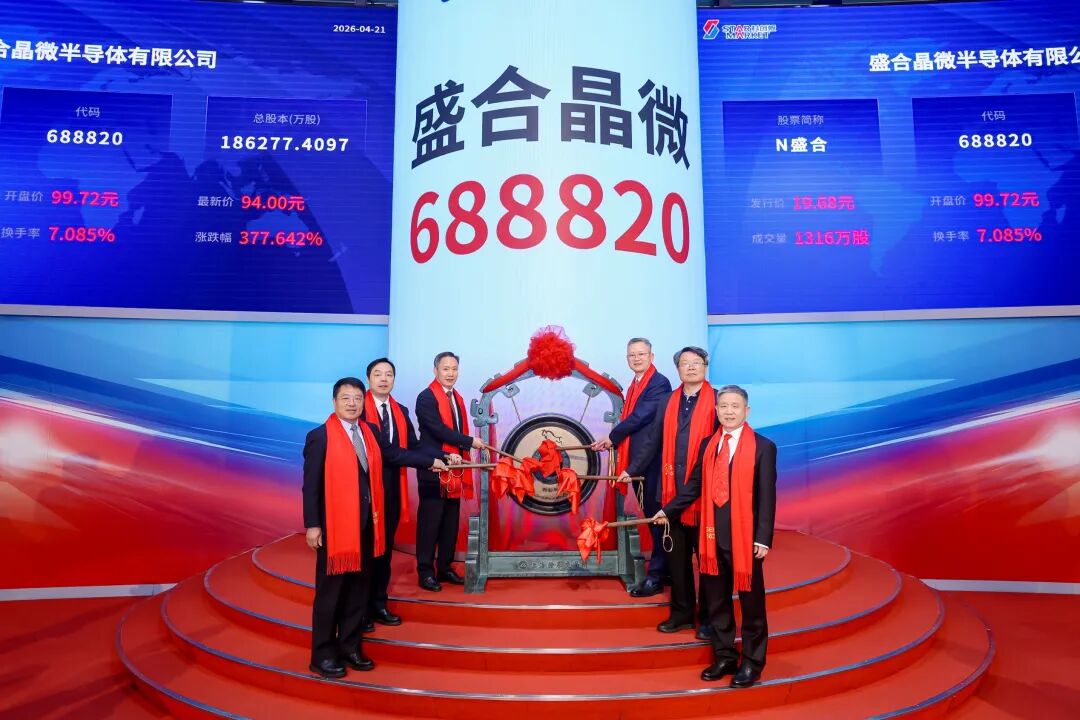
▲On April 21st,
When advanced packaging becomes the key to break through the computing power bottleneck, Shenghe Jingwei occupies an extremely special ecological niche:
According to industry analysis, Shenghe Jingwei is one of the few leading domestic and global players with the large - scale mass - production capacity of silicon - based 2.5D advanced packaging.
Who are the other players? TSMC, Samsung Electronics, and Intel. Those familiar with the semiconductor industry know the weight of this list.
Multiple media reports indicate that Shenghe Jingwei has a market share of up to 85% in the domestic 2.5D advanced packaging field.
However, Cui Dong, the leader of this billion - level battleship, seems to have faded into the background.
Under the spotlight, you can hardly find his high - profile speeches; there are also very few high - definition frontal close - up photos of him in the publicly available online materials.
But this little - known invisible figure not only guessed one of the most crucial breakthrough directions in the semiconductor industry but also pushed all his remaining chips onto the table when everyone thought he was about to leave, and then created a 400 - billion super battleship.
The starting point of all this begins with a thrilling takeover.
02 Takeover
In 2021, in Jiangyin, Jiangsu, a semiconductor company was on the verge of collapse.
At that time, it was not called Shenghe Jingwei but Zhongxin Changdian, which was jointly established in 2014 by SMIC and Changjiang Electronics Technology, two of the most important companies in China's wafer manufacturing and packaging and testing fields.
Zhongxin Changdian was born with a silver spoon in its mouth and should have had a bright future.
But the reality was just the opposite.
At the end of 2020, SMIC was included in the U.S. Entity List, and Zhongxin Changdian, as a related party, was affected.
The heavy - asset, long - cycle advanced packaging, combined with the shadow of external sanctions, forced the two giants to make a painful decision: both withdrew their investments and divested.
The sudden change put the enterprise under great pressure.
The outside world generally predicted that Zhongxin Changdian, having lost the backing of its two major shareholders, would face a catastrophic situation of capital depletion, team dissolution, and customer loss.
At a critical moment, Cui Dong, the company's CEO, stepped forward.
At that time, Cui Dong was not a well - known entrepreneur. He was a low - key person and rarely appeared in public. Few people outside the industry knew his name.
But his resume is quite special: he worked as a secretary in the General Office of the Ministry of Electronics Industry in his early years, then went to Huahong and SMIC, and also engaged in industrial investment in Silicon Valley.
All in all, he understands policies, industries, and capital.
More importantly, he realized earlier than many others that future chip competition may not just be about process technology.
Because Moore's Law is becoming increasingly difficult to follow. After the 7 - nanometer process, the cost of advanced processes has skyrocketed exponentially, and the global semiconductor industry has reached a new consensus:
Rather than continuing to shrink transistors, it is better to stack multiple chips together.
This is advanced packaging. Simply put, it is to assemble different chips into a super - chip through 2.5D, 3D, and Chiplet technologies.
Later, almost all of NVIDIA's GPUs and SK Hynix's HBM high - bandwidth memories took this path.
But in 2021, this was still a bold gamble. Although advanced packaging was showing signs of potential at that time, no one could predict how far it was from a real explosion.
In April 2021, after an equity restructuring, Zhongxin Changdian was officially renamed Shenghe Jingwei.
At the beginning of the takeover, Cui Dong was faced with a life - or - death choice: should he start with mature packaging or go all - in on the extremely difficult advanced packaging?
The former has a low threshold and quick profits, but it is a red - ocean market with thin margins; the latter is a blue - ocean market, but it has high technical barriers, and a single misstep could lead to disaster.
Cui Dong did not hesitate to choose the latter. He gambled on the fact that in the future computing power era, advanced packaging will no longer be a supporting role but half of a wafer fab.
03 Breaking Through
The local government of Jiangyin has given firm support to this newly - born enterprise.
Not only did it invest real money and become a new shareholder, but in 2024, it also joined hands with Wuxi state - owned assets to inject 2.5 billion yuan into Shenghe Jingwei and promised not to reduce its holdings within five years.
"Patiently accompanying the enterprise is to cultivate future potential through current efforts."
From the perspective at that time, such an investment was somewhat risky. After all, Shenghe Jingwei at that time was more like a money - consuming beast with an uncertain future.
But what Jiangyin values is not the immediate profit but the future of the industry.
Although Jiangyin has Changjiang Electronics Technology and dominates the domestic packaging and testing industry, it lacks a key piece in the 2.5D/3D advanced packaging field for AI computing power.
Shenghe Jingwei just fills this gap.
In the following years, the company entered a real life - or - death moment.
On the one hand, there were technical difficulties.
20 - micron bumps, silicon interposers, silicon bridge solutions... With each process iteration, the yield rate and cost were like climbing a slope, getting steeper and steeper.
Especially for silicon interposers, ultra - high - density wiring needs to be completed on extremely thin silicon wafers. Any mistake in any link will lead to a complete failure.
Moreover, the larger the chip, the higher the difficulty. Because the challenges of heat accumulation, wafer warping, and interconnection density will increase exponentially.
There has always been a saying in the industry: Advanced packaging is like building blocks on the tip of a nanometer - level knife.
On the other hand, there were customers.
Advanced packaging is not consumer electronics. It must be tied to leading customers. Without the demand for high - performance AI chips and data centers, this business cannot thrive.
To break the deadlock, Cui Dong did something rare in the industry: opened the factory.
Customers can enter the production line, jointly develop processes, and define the technical route together. His logic is to make customers consider packaging as a whole from the chip design stage.
In this way, Shenghe Jingwei is not just a packaging factory but more like an engineering technology platform.
But such in - depth collaboration requires high - level customers, and Cui Dong's strategy is clear: first target international leading customers and use first - class customers to force technological upgrading.
Some media have reported that at a critical stage, an important customer sent an engineering team to Jiangyin to conduct joint research with Shenghe Jingwei.
Although this statement has not been officially confirmed, it is not surprising from an industrial logic perspective because advanced packaging is not simple OEM but system - level collaborative development.
Especially for high - performance AI chips, the interconnection, power consumption, and thermal design between different chips often need to be jointly completed by customers and packaging factories.
On this basis, Shenghe Jingwei gradually established a complete 2.5D advanced packaging system through years of perseverance.
Then, the times began to change.
ChatGPT triggered the global demand for AI computing power, while advanced processes became more and more expensive and difficult.
Chip giants had to look elsewhere. Overnight, advanced packaging, which was just a supporting role in the past, became one of the most scarce resources in the semiconductor industry.
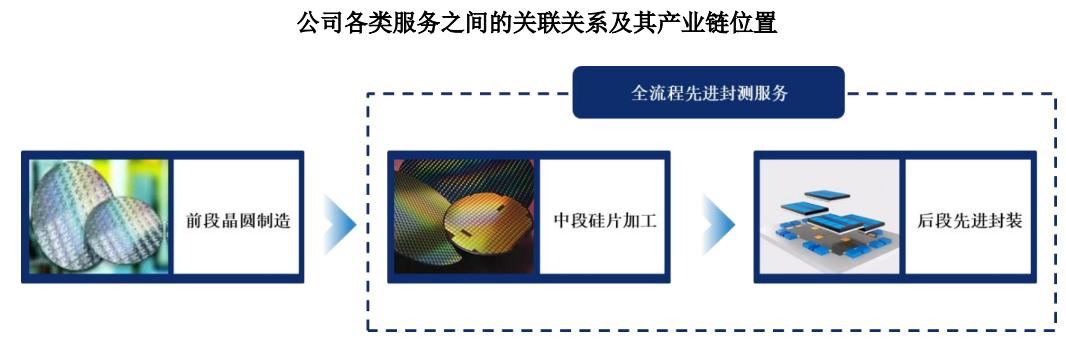
Only then did people realize that Shenghe Jingwei had already been here!
04 Hidden Card
The advanced packaging industry has gathered many outstanding people.
Why was it Cui Dong who bet on the key card in the AI era? The answer lies in his experience.
In 1996, 25 - year - old Cui Dong entered the General Office of the Ministry of Electronics Industry as a secretary. During his time in Beijing, he shuttled between government departments and the industry and witnessed one of the most difficult periods in China's electronics industry.
This experience had a profound impact on him later, giving him a strong sensitivity to where China's semiconductor industry is truly restricted.
Later, after leaving the system, he entered the industry and capital fields, successively working in large enterprises such as Huahong and SMIC and participating in overseas venture capital business.
Compared with many professional managers who only understand technology or finance, Cui Dong understands three things at the same time: Which direction will technology evolve? What does the industry really lack? What are investors willing to pay for?
And these three things converge in advanced packaging.
From 2021 to the present, as the strategic mastermind, Cui Dong has led Shenghe Jingwei to complete multiple rounds of financing, including introducing state - owned assets from Shanghai and Wuxi in 2025 as a stabilizing force and successfully listing on the Science and Technology Innovation Board in 2026.
The sensitivity of a former ministry secretary allowed Cui Dong to spot the right direction; his venture capital experience enabled him to find the right leverage. In addition, he has the courage to bet at critical moments:
When SMIC and Changjiang Electronics Technology withdrew their investments and others cut their losses, he chose to take over; when many enterprises were relying on mature packaging for profits, he chose to bet all his assets on the uncertain advanced packaging field.
This all - out bet finally paid off handsomely.
Today, Shenghe Jingwei, with a market value of nearly 400 billion yuan, stands out in the industry.
When Huawei's Tao's Law rewrites the rules of the semiconductor industry and pushes advanced packaging to the center of computing power competition, Cui Dong, who placed a bet at a critical moment, still stands in the quiet dust - free workshop:
Only this time, he turned his all - out takeover in the face of adversity into a hidden card to rewrite the industry landscape.
This article is from the WeChat official account "Huashang Taolue", author: Huashang Taolue, published by 36Kr with authorization.