Instant retail battles fiercely in the air conditioner market: Can Meituan, which entered the market with high-profile moves, disrupt the home appliance channel landscape?
Under strong supervision, this year's 6·18 bid farewell to the cut - throat price war and the intense GMV competition. The atmosphere of the fierce low - price battle during the big promotion has cooled down, but the industry involution is still everywhere.
In the home appliance sector, the air - conditioning market has a scale of nearly 300 billion yuan. With the dual benefits of national subsidies and the promotional activities at the start of the new cooling season, the big promotion every year is a must - fight territory for businesses.
Meituan, originally from the food delivery industry, is also making a full - force sprint into the air - conditioning sector during this 618.
At a recent industry summit, Meituan Flash officially released its exclusive strategy for major home appliances during the 6·18 in 2026. It decided to tilt the platform's top - level traffic and core resources towards air - conditioners and fully implement the integrated service of disassembly, delivery, and installation.
According to Meituan, the company aims at the industry pain points of the complex fulfillment process of traditional home appliances and the long waiting time for users. It compresses the full - link fulfillment of home appliances to half - day delivery to optimize the instant purchase experience.
Meituan hopes to make "ordering an air - conditioner" a reality.
Meituan uses air - conditioners as an entry point to explore the incremental home appliance market
Ji Chao, the person in charge of Meituan Flash's home appliance business, gave a keynote speech titled "Trillion - scale Instant Retail - The 'Certain Growth' Code for the Home Appliance Industry" at a recent industry summit.
In his view, the domestic home appliance industry has entered the stage of stock competition. The growth of traditional offline stores and regular e - commerce is becoming increasingly weak. Relying on the high - speed growth trend of the industry, instant retail has become a new growth breakthrough for the home appliance market.
According to Ji Chao, Meituan has more than 500 million platform users. In 2025, more than 120 million users actively searched for home appliance products on the platform throughout the year. During the peak sales season of air - conditioners, the search volume of a single category can reach 8 million person - times. Relying on the massive user behavior data accumulated, the platform can accurately capture users' scene - based needs such as temporary replacement and emergency due to breakdown, opening up new incremental sources for the home appliance industry with slowing growth.
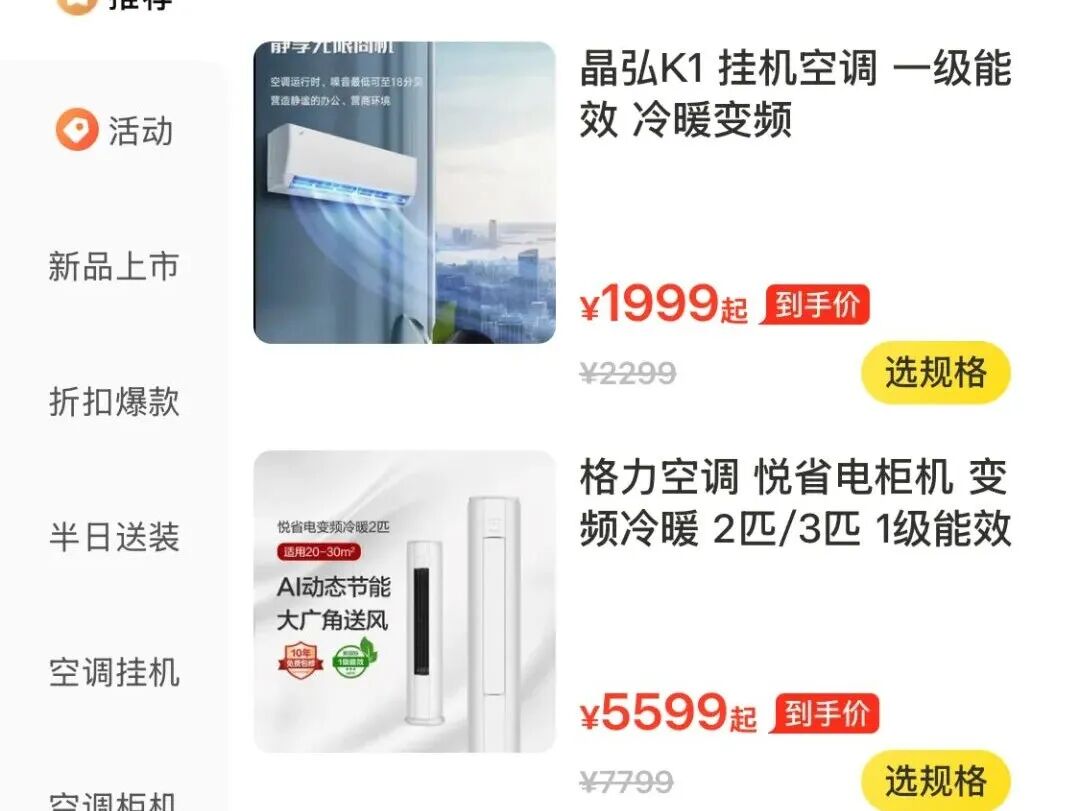
Meituan realizes "ordering an air - conditioner" by relying on the offline stores of home appliance enterprises. According to the platform's vision: when a user places an order, the staff of the partner store can visit the user's home to complete the removal and recycling of the old machine, the delivery of the new machine, and the installation and debugging in one - stop service. The goal is to complete the whole set of services in the afternoon after the order is placed in the morning, compressing the waiting period.
It can be seen that Meituan's strategy, relying on its high - frequency traffic and mature same - city delivery capacity, focuses on meeting the scattered rigid demands such as seasonal replacement and sudden breakdown of electrical appliances.
Objectively speaking, the service innovation of half - day disassembly, delivery, and installation does fill the gap in emergency home appliance procurement and has rigid demand in terms of consumption scenarios.
Why is the home appliance sector a must - fight territory?
It is not accidental that home appliances are regarded as core layout categories by Meituan and Tmall Flash. It is a long - term choice made by the platform based on product attributes and profit returns.
Firstly, home appliances are essential products for household use, which are suitable for the business logic of instant retail's nearby delivery. Secondly, large - sized home appliances have a high unit price and a relatively low fulfillment rate, which can directly boost the platform's revenue and profit level.
JD.com has long dominated the mainstream online home appliance market, holding most of the industry share. Tmall, Douyin, and Kuaishou have successively laid out home appliance flash sales, aiming to get a share of the stock market.
In terms of layout rhythm, Tmall launched a home appliance instant flash sales zone in 2024 and implemented a two - hour delivery service, connecting far - field online shopping and same - city near - field retail. In June of the same year, Meituan joined hands with Suning to launch a two - hour delivery and installation service for major home appliances and established brand lightning warehouses, introducing a number of leading small home appliance and 3C brands in batches.
According to an insider close to Meituan, the cooperation between instant retail platforms and home appliance enterprises is not based on the competitive thinking of "changing and leveraging the existing market". The platform's cooperation with multiple home appliance brands stems from the practical considerations of both ends of the industry. From the brand side, the growth of the main business distribution and online official channels has reached a bottleneck. Manufacturers need channels to digest idle production capacity and store inventory. By connecting to Meituan and fulfilling orders through existing stores, brands do not need to build additional factories and stock up. They only need to use the surplus manpower and idle storage in the stores to accept scattered orders within a three - kilometer radius of the store.
From the consumer side, the fragmented demand for home appliances in case of emergency objectively exists. Meituan Flash data shows that during the peak season in 2025, the emergency orders for small appliances such as fans, air - conditioners, and purifiers increased.
Finally, in terms of platform profitability, focusing on home appliances is the key to solving the inherent pain points of instant retail. The entire instant retail industry generally faces the problem of high fulfillment costs. The comprehensive fulfillment cost per order is between 10 and 16 yuan, accounting for 30% to 50% of the total order cost. The average unit price of Meituan Takeaway is 22 - 34 yuan, and that of fresh food is 80 - 100 yuan. The average delivery cost per order is close to 7 yuan. The low unit price continuously squeezes the profit margin.
According to the data of Aowei Cloud Network in April, the average offline price of air - conditioners is 4,195 yuan. Even with the full set of delivery and installation services, the overall delivery rate is only 2% - 3%, which can effectively reduce the fulfillment cost. Instead of spending a lot of money to build its own front - end warehouses for large - sized home appliances, Meituan relies on the existing offline stores and storage resources of Midea and Haier to jointly build more than 30,000 lightning warehouses, reusing the mature supply chains of the brands. This not only saves the warehouse rent and site renovation costs but also avoids the business risk of inventory backlog during the off - peak and peak seasons of home appliances. From the perspective of cost - benefit, the fixed storage and system costs shared by a 5,000 - yuan home appliance order are similar to those of fifty 100 - yuan fresh food orders, but the revenue and profit created far exceed the latter.
In addition, home appliance flash sales can also help the platform accumulate high - quality users. Consumers who purchase home appliances online traditionally pay more attention to price discounts and are willing to wait for long - distance logistics, so their user value is limited. The customers who choose to place instant orders for large - sized home appliances have stronger consumption power. They prioritize delivery timeliness and are not sensitive to price, so their user lifetime value is higher. Once these users recognize the one - stop delivery and installation service, they will continue to repurchase other high - unit - price products on the platform, helping the platform get rid of the low - margin dilemma and promoting the high - end upgrade of the business.
Moreover, home appliances are JD.com's core business. If Meituan can divide the market from JD.com's advantageous field, this matter itself has extremely high strategic significance.
Is instant retail of air - conditioners a false proposition?
The "Report on the Development of the Instant Retail Industry (2025)" released by the Research Institute of the Ministry of Commerce predicts that the overall market scale of domestic instant retail will exceed 1 trillion yuan in 2026.
However, as the wave of instant retail of major home appliances rises, market doubts also emerge: Can large - sized home appliances such as air - conditioners and refrigerators really be ordered at any time and delivered quickly like takeaways? Is instant retail of major home appliances just a hype?
In terms of product attributes, the service life of air - conditioners and refrigerators is generally 5 to 10 years. They are durable consumer goods. Consumers are used to comparing prices and screening products repeatedly when making purchases. However, the core of instant retail is instant ordering and rapid fulfillment, and there is a natural contradiction between the two underlying consumption logics.
Most users with replacement needs don't care about the one - or two - day installation time difference. They are more willing to take their time to select suitable products. The timeliness advantage of instant delivery is difficult to impress rational consumers.
There are also many obstacles at the practical operation level. The foundation of instant retail fulfillment is offline physical stores, but the display area of stores is limited, and it is difficult to have a full range of product models like online e - commerce.
The market performance in the summer of 2025 also confirms this. The high - temperature weather can only bring short - term pulsed sales. In June of that year, the turnover of air - conditioners on Meituan Flash increased by 7 times year - on - year. The year - on - year growth rate in Beijing was the same as the overall market, and the growth rate in Chongqing exceeded 30%. The orders for half - day delivery and installation also increased simultaneously.
However, it is worth noting that most of these orders are emergency purchases during the hot summer, which are sporadic demands. After the temperature drops, consumers still return to their traditional shopping habits, comparing models, waiting for promotional activities, and carefully placing orders. The consumption impulse generated by emergencies is difficult to turn into regular consumption.
The shortage of installation resources is a key shortcoming restricting the implementation of instant retail of home appliances. According to on - the - spot interviews by "Wall Street Technology Eye", major e - commerce platforms do not have priority in air - conditioner installation resources. Offline stores give priority to users who purchase in - store. It is difficult for Meituan to fulfill its promise of priority installation. The whole industry has been facing a shortage of installation masters for a long time. During the high - temperature peak season in Northeast China in 2025, consumers in some electrical appliance stores in Harbin had to wait up to a week for air - conditioner installation. Major home appliance brands had to temporarily transfer technicians from all over the country for support.
Jiang Han, a senior researcher at the Pangu Think Tank, analyzed that the primary problem of instant retail of home appliances is the issue of consumer trust. Large - sized home appliances have a high unit price and a long service cycle. Users pay more attention to reliability rather than simply pursuing delivery speed. They have concerns about the quality of store goods and the professionalism of outsourced installers. At the same time, the interest mechanism of multi - party cooperation is still in the running - in stage. Regional distributors have to bear the pressure of platform commissions. Problems such as poor system connection and disordered order priority occur frequently. The platform needs to continuously optimize the rules to achieve a win - win situation for all parties.
Why are home appliance manufacturers silent?
The attitudes of small and large home appliance manufacturers towards instant retail are very different.
Small home appliances have a relatively low unit price, and brands generally are willing to deeply explore the instant retail channel. A channel manager of a small home appliance enterprise in Jiangsu and Zhejiang said in an interview with "Wall Street Technology Eye" that diversifying channels can avoid being tied to a single channel and enhance their bargaining power. This is also the core reason why small home appliance brands generally embrace instant retail.
In contrast, leading large - home appliance enterprises such as Midea, Haier, and Gree have successively opened their stores to join Meituan and piloted half - day delivery and installation. However, in their corporate financial reports and official strategic statements, they have not mentioned the flash - sale model as a key point. Their channel strategies focus more on expressions such as all - channel collaboration and supply - chain optimization. This implicit attitude hides industry differences.
The root cause of the manufacturers' split attitude comes from the inherent conflict between the attributes of home appliance channels and the flash - sale model.
Firstly, large - sized home appliances involve a full - chain service including pre - sales survey, in - sales installation, and long - term after - sales warranty. The transaction logic of flash sales, which is more about one - time transactions, cannot support the whole service chain.
Secondly, home appliance production has a long cycle and high inventory costs. It needs to rely on traditional large - scale channels to balance production and sales. Instant on - demand stockpiling is likely to disrupt the overall inventory rhythm of the brand.
Thirdly, leading home appliance brands hold more than 60% of the market share and firmly control the supply chain and offline service outlets. The platform cannot replicate the strategy used for fast - moving consumer goods to change the existing home appliance pattern through flash sales.
A number of leading home appliance enterprises focus on improving supply - chain efficiency, abandon short - term traffic competition, and implement the "one - stock" strategy to integrate online and offline inventory, aiming at long - term operation and avoiding the short - term approach of using platform subsidies to increase sales volume.
