Der Kampf im Echtzeit-Handel um die Klimaanlagen: Kann der mit großem Aufwand eingestiegene Meituan die Vertriebslandschaft für Haushaltsgeräte umkrempeln?
Under strict regulation, this year's 6·18 has bid farewell to the fierce price battles and the intense competition for GMV (Gross Merchandise Volume). The atmosphere of massive price pressure during the big sales has cooled down a bit, but the industry competition is still ubiquitous.
In the household appliances sector, air conditioners have a market of nearly 300 billion yuan. With government subsidies and the start - up promotion of the new cold season, every big sale is always a fiercely contested area.
Meituan, originally from the delivery service, is also vigorously storming into the air - conditioner market with this 618 sale.
At a recent industry conference, Meituan Flash Shopping officially presented the special strategy for household appliances for the 6·18 in 2026. It was determined that the platform's peak traffic and core resources would be focused on air conditioners to fully develop the integrated service of disassembly, delivery, and installation.
According to Meituan, the company aims at industry problems such as the complicated handling processes of traditional household appliances and the long waiting times for users. It has reduced the entire handling chain of household appliances to half a day to improve the instant shopping experience.
Meituan hopes to make "ordering an air conditioner" a reality.
Meituan uses air conditioners as an entry point to explore the growing household appliances market
Ji Chao, the head of Meituan Flash Shopping's household appliances business, gave a speech at the recent industry conference titled "The Billion - scale Market Segment of Instant Retail - The 'Safe Growth' for the Household Appliance Industry".
In his view, the Chinese household appliance industry has entered the stage of stock market competition. The growth of traditional offline businesses and conventional e - commerce platforms is becoming increasingly weak. Instant retail has developed into a new growth focus in the household appliance market due to the strong industry development.
According to Ji Chao, Meituan has over 500 million platform users. In 2025, over 120 million users actively searched for household appliances on the platform. During the air - conditioner sales season, the search volume for this product category can reach 8 million times per season. With the collected data on the behavior of millions of users, the platform can precisely capture the demand - oriented requirements of users, such as temporary replacement or emergency repair, and open up new growth sources for the household appliance industry with slow - growing growth.
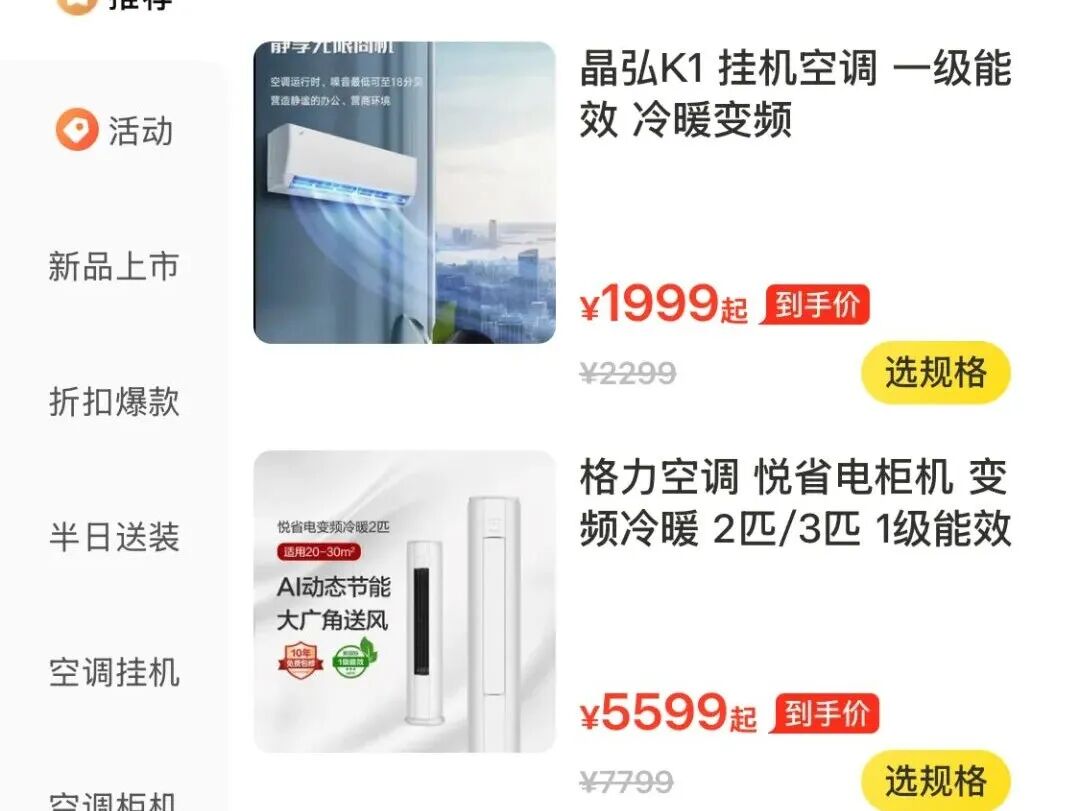
Meituan realizes "ordering an air conditioner" with the help of offline businesses of household appliance companies. According to the platform's concept, after a user places an order, the employees of partner stores can arrive on - site and handle the entire process of disassembling and taking back the old device, delivering the new device, and setting up and commissioning it all at once. The goal is to place the order in the morning and complete the entire service in the afternoon to shorten the waiting time.
It can be seen that Meituan's strategy is based on its own high - frequency users and mature same - city delivery capacity, and it especially focuses on scattered and urgent needs such as seasonal replacement or sudden device malfunctions.
Objectively speaking, the half - day disassembly - delivery - installation service innovation actually fills the gap in the emergency purchase of household appliances and meets the urgent needs from the consumption scenario.
Why are household appliances a fiercely contested area?
It is no coincidence that Meituan and Tmall Flash Shopping choose household appliances as the core category. It is a long - term decision of the platforms based on the combination of product specifications and profit opportunities.
On the one hand, household appliances are necessary products for households and fit well with the business logic of instant retail with short - distance delivery. On the other hand, large household appliances have a high unit price and a relatively low handling commission, which can directly increase the platform's turnover and profit margin.
JD.com has long dominated the online household appliance market and has the largest market share. Tmall, Douyin, and Kuaishou have successively established the household appliance flash - shopping area to capture a part of the stock market.
In terms of establishment speed, Tmall launched an area for instant household appliance shopping in 2024 and implemented a two - hour delivery service to connect long - distance e - commerce and short - distance retail in the city. Meituan, in June of the same year, launched a two - hour delivery and installation service for large household appliances together with Suning and opened brand - lightning warehouses to introduce a series of leading small household appliance and 3C brands.
According to insiders close to Meituan, the cooperation between instant retail platforms and household appliance companies does not have the idea of "changing or moving the existing market". The platforms were able to cooperate with several household appliance brands, which is due to the real considerations of both sides of the industry. From the perspective of brands, the growth of the main sales channels and online official channels has reached a limit. Manufacturers need channels to sell the excess production capacity and inventory in stores. By connecting with Meituan and using the existing businesses, brands do not need to build additional factories or store goods. They can simply use the excess employees and unused inventory in stores to serve scattered orders within a three - kilometer radius around the store.

From the perspective of consumers, there is objectively a fragmented demand for household appliances in case of sudden needs. Data from Meituan Flash Shopping shows that during the peak season in 2025, the emergency orders for small devices such as fans, air conditioners, and air purifiers increased.
Finally, focusing on household appliances is also the key to solving the existing problems of instant retail. The entire instant retail segment is facing the problem of high handling costs. The total handling cost per order is between 10 and 16 yuan, which accounts for 30% to 50% of the total cost per order. The average unit price of Meituan Delivery is between 22 and 34 yuan, and that of fresh food is between 80 and 100 yuan. The average delivery cost per order is nearly 7 yuan. The low unit prices are squeezing the profit margin further and further.
Data from Aoweiyunwang in April shows that the average price of an air conditioner in the offline market is 4,195 yuan. Even if the entire delivery and installation service is added, the total delivery commission is only 2% to 3%, which can effectively distribute the handling costs. Meituan has not built expensive forward - storage warehouses for large household appliances. Instead, it has relied on the existing offline businesses and warehouse resources of Midea and Haier. Together, they have built over 30,000 lightning warehouses and reused the mature supply chains of the brands. This saves the warehouse costs and the costs of renovating the warehouse space and avoids the operational risk of over - stocked warehouses in peak and off - peak seasons. From a cost - benefit perspective, the distribution of fixed warehouse and system costs for a 5,000 - yuan household appliance order is similar to that for fifty 100 - yuan fresh food orders, but the achieved turnover and profit are much higher than the latter.
In addition, household appliance flash - shopping can also help accumulate high - quality users on the platform. Traditional online buyers of household appliances pay more attention to price discounts and are willing to wait a long time for delivery. The value of these users is limited. Buyers who order large household appliances instantly have stronger purchasing power. They mainly value the delivery time and are not so price - sensitive. The life - cycle value of these users is higher. Once these users accept the integrated delivery and installation service, they will continue to repeatedly buy other high - unit - price products on the platform in the future, which helps the platform get out of the situation of low profit margins and raise the business to a higher level.
In addition, the household appliance area is the core business of JD.com. If Meituan can carve out the market from JD.com's strong area, this in itself has very high strategic significance.
Is instant retail for air conditioners a false statement?
The "Development Report of Instant Retail (2025)" by the research institute of the Ministry of Commerce predicts that the total market of Chinese instant retail will exceed the 1 - trillion - yuan mark in 2026.
With the emergence of the wave of instant retail for large household appliances, doubts about the market have also emerged: Can large household appliances such as air conditioners and refrigerators really be ordered at any time and delivered quickly like a delivery service? Is instant retail for large household appliances just a form of propaganda?
From the product specification perspective, air conditioners and refrigerators usually have a service life of 5 to 10 years and belong to durable consumer goods. Consumers are used to comparing prices and products in detail before making a purchase. However, the core of instant retail is spontaneous ordering and extremely fast handling. There is a natural contradiction between these two consumption patterns.
Most users who need a new device don't care so much about an installation period of one or two days. They are more willing to take their time to find the right product. The advantage of instant delivery has a hard time convincing rational consumers.
There are also many obstacles at the practical implementation level. The foundation of instant retail is offline businesses. However, the exhibition area of stores is limited, and it is difficult to provide the entire product range like online e - commerce platforms.
The market data in the summer of 2025 confirms this. The high temperature only increased the sales volume in the short term. In June of the same year, the turnover of air conditioners on Meituan Flash Shopping increased seven - fold compared with the previous year. In Beijing, the increase was average compared with the market, and in Chongqing, the increase reached over 30%. The orders with half - day delivery and installation also increased.
However, it should be noted that most of these orders were emergency purchases in extreme heat and represent random needs. After the temperature cools down, consumers return to their traditional shopping habits. They compare models, wait for special offers, and place their orders carefully. The purchasing impulse triggered by emergencies is difficult to turn into a normal consumption habit.
The lack of installation resources is the decisive bottleneck for the implementation of instant retail for household appliances. According to an on - the - spot interview by "Wall Street Technology Eye", various e - commerce platforms do not have priority rights to air - conditioner installation resources. Offline stores give priority to users who shop in the stores. The priority installation promised by Meituan is difficult to implement. The entire industry has long suffered from a shortage of installers. During the hot period in North China in 2025, consumers in some electrical appliance stores in Harbin had to wait up to a week for the installation of their air conditioners. Various household appliance brands had to call in mechanics from different parts of the country.
Jiang Han, a senior researcher at the Pangu Institute, analyzes that the first problem of instant retail for household appliances is the trust issue of consumers. Large household appliances have a high price and a long service life. Users pay more attention to reliability than delivery speed when making a purchase. They have concerns about the quality of goods in stores and the professional knowledge of external installers. At the same time, the interest mechanism of multi - party cooperation is still in the adjustment phase. Regional dealers have to bear the platform's commissions. Problems such as poor system connection and incorrect order prioritization often occur. The platform must continuously optimize the rules to achieve a multi - party interest - win scenario.
Why do household appliance manufacturers remain silent?
The attitudes of large and small household appliance manufacturers towards instant retail are significantly different.
The unit prices of small household appliances are relatively low. Brands are generally willing to deepen the instant retail channel. A channel manager of a... (The text seems to be incomplete here)