Why are Chinese cars getting bigger and bigger?
Recently, XPeng (XPEV.US) GX was officially launched. The starting price with limited-time offers dropped to 269,800 yuan, a significant plunge from the previously announced pre-sale price of 399,800 yuan. Besides the exclamations from investors and the media in the audience, there was another voice saying, "The LeDao L90 is in trouble."
A month ago, the redesigned LeDao L90, which features a large three-row layout, was launched with a starting price of 265,800 yuan. However, in terms of body parameters, compared with the XPeng GX, which has a length of 5.3 meters and a wheelbase of 3.1 meters, the LeDao L90 does not have an advantage. Coupled with the highly overlapping price ranges of the two models, a head-to-head battle has instantly begun.
This is just a microcosm of the intensifying involution in the large car segment since 2026.
Just two days after the launch of the XPeng GX, VOYAH officially released the Taishan X8 and emphasized its positioning as the "new king of five-seaters." The next day, the Dongfeng Yipai M8 entered the market as the "gold standard for large six-seaters of the Chinese school," with a length of 5 meters and a wheelbase of over 3 meters. On May 27th, NIO (NIO.US) launched the ES9, a technological administrative flagship SUV with a length of nearly 5.4 meters and a wheelbase of 3.25 meters, with a starting price of 498,000 yuan.
In just a few days, multiple behemoths over 5 meters in length have been intensively launched into the terminal market. According to an incomplete statistics by Caijing, in the first five months of 2026, there have been 31 new and redesigned models that meet the "532" standard (length over 5 meters, wheelbase ≥ 3 meters, and width ≥ 1.997 meters), nearly four times the total number in 2025.
Moreover, this grand "big car wave" is entirely dominated by new energy vehicles.
In the era of fuel vehicles, full-size SUVs of the "532" specification were basically monopolized by luxury imported brands such as the Land Rover Range Rover Long Wheelbase, Mercedes-Benz GLS, Maybach GLS, and Lincoln Navigator Long Wheelbase.
At that time, the guiding prices of such new cars generally started at 850,000 yuan, with the mainstream prices ranging from 1 million to 2 million yuan. The ultra-luxury versions even exceeded 2 million yuan. Few original mass-produced vehicles from domestic and ordinary joint-venture brands could meet the standards.
Entering the new energy era, domestic flagship models such as NIO, Wenjie, and Wei brand easily reach a length of over 5.3 meters and bring the landing prices into the range of 300,000 - 600,000 yuan, breaking the barrier of luxury cars in the fuel era for full-size body specifications.
The latest statistical data disclosed by the Passenger Car Association (hereinafter referred to as the "Passenger Car Association") shows that from January to April 2026, the total market of passenger cars in China declined by 18.5% year-on-year, and the overall new energy market also declined by 17.2%. The mainstream SUV market in the range of 100,000 - 200,000 yuan was even more severely hit, with a decline of 19.3%.
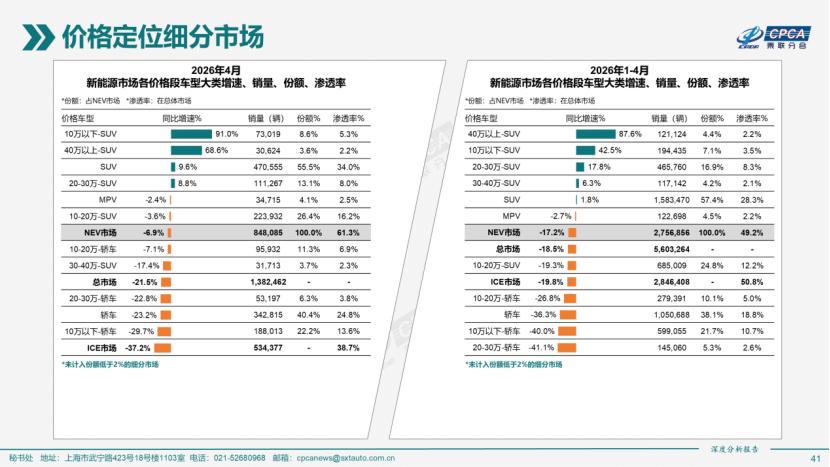
Against this background, the SUV segment above 400,000 yuan has shown an upward curve against the trend. The cumulative sales in the first four months reached 121,000, a year-on-year surge of 88%. In April alone, the growth rate of this segment reached 68.6%.
Under the real pressure of narrowing profits and declining sales in the mainstream compact car market, the performance of high-end large SUVs in attracting funds against the trend has prompted car companies to flock to the full-size segment.
Moreover, since the second quarter, the entry prices of multiple "532" specification models have dropped to the 200,000 yuan level. At the same time, the sedan and MPV categories have also successively followed up with the layout of large-size models.
It is worth noting that the dilution of terminal sales has made some high-premium leading models show signs of fatigue. On the other hand, the self-weight of new energy vehicles, which often exceeds two tons or even three tons, is continuously increasing the load on urban road networks, creating an irreconcilable real contradiction among vehicle resources, ecological environment protection, and the bearing capacity of urban infrastructure.
A Flock of Big Cars Enter the Market
According to statistics, in 2025, only 8 new cars (including redesigned models) of the "532" specification were officially launched in China. In the first five months of 2026, the number of new and redesigned models that reached this standard has soared to 31, 3.9 times that of the whole year of last year.
With the significant acceleration of the launch rhythm, full-size models have evolved from the flagship altars of a few brands to the standard configuration for car companies to seize the high-margin segment. In this size competition, SUVs have become the absolute main force.
In April, the LeDao L90 was the first to be redesigned and launched, followed by the Leapmotor D19 and LeDao L80. A group of new cars have lowered the purchase threshold of 5.2-meter-class big cars to 220,000 yuan, collectively rewriting the pricing in the mid-range market.
In May, new cars of the "532" specification continued to pour in. On May 20th, the XPeng GX was officially launched, with a limited-time starting price of 269,800 yuan, and it offers two technical paths: pure electric and extended-range. Immediately afterwards, the VOYAH Taishan X8 showed its determination to be more cost-effective than the flagship SUV and targeted the large five-seater segment. Then, similar to the product ideas of most "532" specification products, the Dongfeng Yipai M8, which focuses on family-use six-seaters, entered the 250,000 yuan price range with a high wheelbase-to-length ratio of 60.3%, hoping to seize market share in the mid-range market with large space and high configuration.
On May 27th, NIO released the ES9 with a length of nearly 5.4 meters. At the same time, the Li L9 Livis and the 2026 Wenjie M9 were successively unveiled, filling the high-end camp. Thus, full-size products have completed the overall layout from 200,000 to 500,000 yuan.
The sedan and MPV segments are also expanding at an accelerated pace. Since the beginning of 2026, high-end MPVs in China have undergone concentrated redesigns. The Denza D9 and the new Zeekr 009 have been launched one after another, and the wheelbases of the main models have all exceeded 3.1 meters, continuously raising the size threshold of domestic large MPVs.
In the sedan camp, the lengths of multiple new cars such as the NIO ET9, Xiaomi SU7 Ultra, BYD Han L, Yangwang U7, and Lynk & Co 10 have exceeded 5 meters, and domestic brands have collectively broken through the size ceiling of traditional fuel executive sedans.
In addition to the flagship models getting bigger and bigger, the mid- and low-end models are also closely following in the size involution. Two years ago, in the 100,000 - 150,000 yuan compact car market, domestic brands relied on products with a length of nearly 4.8 meters and a wheelbase of over 2.7 meters to form a dimensionality reduction competition against traditional joint-venture Class A cars.
Joint-venture car companies such as Volkswagen and Toyota had to start a lengthening strategy in the mid-size car camp, relying on redesigned models with a wheelbase of over 2.9 meters to defend the 150,000 - 250,000 yuan market.
New car-making forces have taken root in the high-end market of 400,000 - 600,000 yuan, using full-size bodies and high-level intelligent configurations to continuously erode the inherent market share of traditional luxury brands.
Only One Model Sells Over 10,000 Units per Month
When the number of giant new cars in the market has soared from a single-digit in 2025 to more than 30, the bearing capacity of the terminal market has not increased proportionally.
According to the sorting by Caijing, in 2025, there were still 3 models of the "532" specification with stable monthly sales of over 10,000 units. However, as of April 2026, among the dense army of new cars, only the NIO ES8 can maintain monthly sales of over 10,000 units.
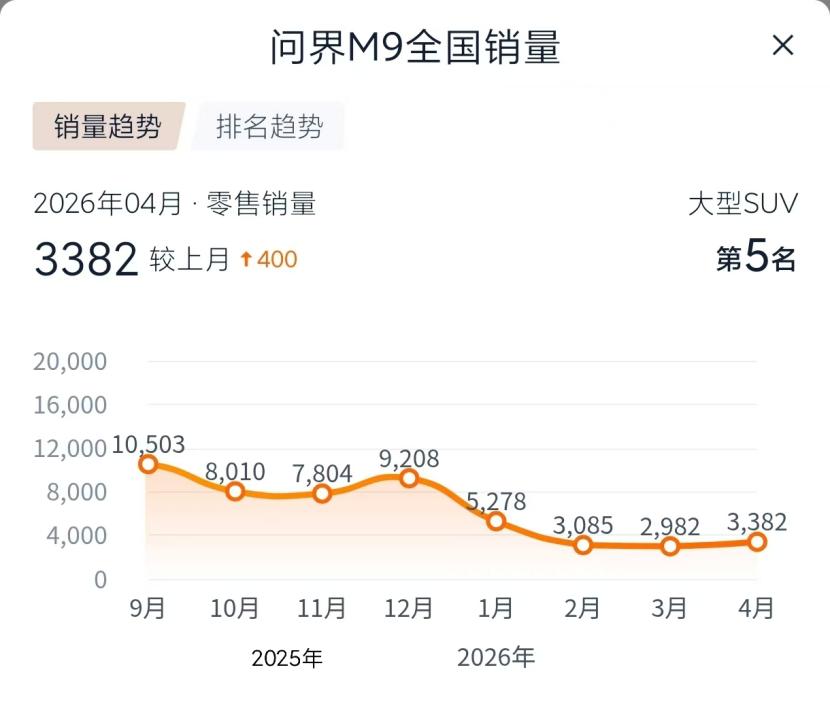
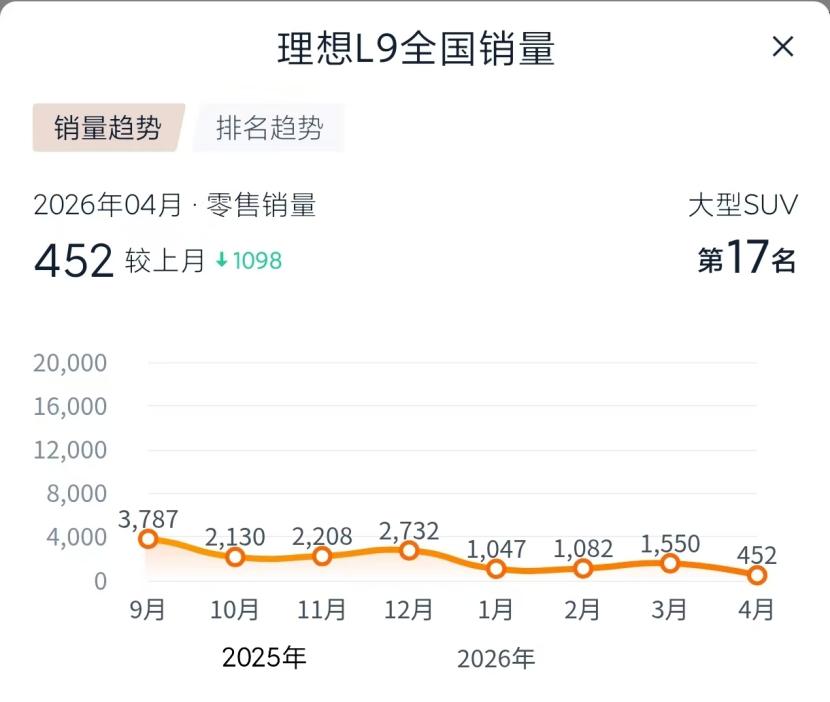
Previously, the Wenjie M9, the sales champion in this segment, saw its average monthly sales drop from 13,000 units in 2024 to 9,686 units in 2025, and further dropped to an average of 3,794 units in the first four months of 2026, a year-on-year decline of more than 50%. The performance of the Li L9 was even more dismal, with only 452 units sold in April. Obviously, the single-car share in the full-size segment is being significantly diluted.
Data source: Autohome
Even the leading models still in the high-end range are showing signs of fatigue in growth.
Data shows that after the NIO ES8 set a historical monthly delivery high of over 22,000 units at the end of 2025, its average monthly sales in the first four months of 2026 have dropped to 14,500 units. In April, its monthly sales have fallen back to 13,000 units, a month-on-month decline of nearly 20%. The situation of the Wenjie M8, which also belongs to the "532" specification, is even more difficult.
This car was launched in April 2025, with a cumulative sales volume of over 150,000 units last year and an average monthly sales volume of over 17,000 units. In the first four months of 2026, its average monthly sales have plummeted to 5,778 units. Despite the support of Huawei, this car has failed to maintain its hot sales momentum.
By analyzing the parameters and pricing of the three high-end SUVs, it is not difficult to find the homogenization dilemma in this market. The NIO ES8, Wenjie M9, and Li L9 are in a highly homogeneous state in terms of length and wheelbase, with only slight differences in size. However, in terms of price positioning, the main price range of the Wenjie M9 is significantly higher than that of its two competitors.
As high-end consumers become more rational in their price perception, it is obviously difficult to bridge the gap in cost-performance ratio with just the brand halo.
On the premise of the same body size, the higher pricing strategy weakens the terminal competitiveness of the product, causing potential orders to flow to competitors of the same size with more favorable prices. The entire large car market is falling into a cycle of "multiple cars competing for customers and high prices suffering setbacks."
The Profit Dilemma Behind the High-Margin Appearance
The most realistic driving force behind car companies' intensive layout in the full-size segment comes from the severe pressure on the overall profit margin of the industry.
Data shows that from January to April 2026, although the total revenue of the Chinese automobile industry increased slightly by 1.1% to 3.3129 trillion yuan, the total cost climbed by 2% to 2.9404 trillion yuan, directly leading to a year-on-year decline of 17% in profits. The overall profit margin of the industry during this period has dropped to 3.4%, significantly lower than the average level of 6.1% of industrial enterprises above the national scale.
Under the heavy pressure of a 12.1% year-on-year decline in the gross profit per vehicle to 12,000 yuan, car companies must find a new way out. The rising prices of upstream raw materials have further intensified the cost control test at the manufacturing end.
In the first four months, the profits of the mining industry increased by 26% year-on-year, and the profits of the non-ferrous metal smelting industry related to automobiles nearly doubled. The high prices of raw materials such as lithium carbonate, nickel, and cobalt have led to an increase of over 10,000 yuan in the manufacturing cost per vehicle. Coupled with the high purchase price of power batteries, which account for 30% - 40% of the total vehicle cost, the bargaining space of car companies has been compressed to the limit.
The data from the Passenger Car Association also confirms this dilemma. Statistics show that as of April, the sales volume of mainstream SUVs in the range of 100,000 - 200,000 yuan has dropped significantly by 19.3% year-on-year. The loss of the basic market has completely forced car companies to shift to the high-profit area.
In this context, building big cars has become an effective means to combat rising costs. According to industry insiders, the stacking cost of configurations such as "refrigerators, color TVs, and big sofas" in new energy vehicles is actually limited, but it can support a premium space of more than five times in the terminal market. Therefore, the core business logic of car companies has become "big cars first, big cars make money."
The big car category naturally has a higher book gross profit margin, and it has also been the core segment that the entire industry has focused on in the past two years. However, the high gross profit only remains on the books and has not been able to prevent the shrinkage of profits caused by homogeneous involution.
It is not difficult to see the industry's hidden concerns from the latest financial report of Li Auto. Affected by the concentrated launch of peer competitors and the price cuts of old models to clear inventory, this company, which has been making stable profits for many years with its L-series big cars, saw its comprehensive gross profit margin in the first quarter of 2026 drop significantly from the previous level of 20% to 7.9%, and the gross profit margin of the whole vehicle was only 6.1%.
Affected by the lower-than-expected sales volume of the high-end 9-series models and the relatively high proportion of low-end volume models, XPeng Motors is facing a more severe survival test. As its 9-series flagship, this time, the limited-time starting price of the XPeng GX directly drops the threshold of 5.2-meter-class big cars to the 270,000 yuan level, significantly lower than the traditional pricing of over 400,000 yuan for competitors such as the Li L9 and Wenjie M9. Behind this is the urgent profit anxiety to break the situation.
Financial data shows that although XPeng Motors achieved a phased inflection point with a net profit attributable to the parent company of 380