Tencent's strongest asset is also the biggest lock in the AI sector.
On June 2nd, according to multiple media reports, WeChat is about to launch an AI assistant. Users can enter the chat window by swiping right on the main interface and input commands to call millions of mini-programs in WeChat.
Ordering a taxi, ordering food, buying groceries, booking tickets... Theoretically, any long-tail service in the WeChat ecosystem can be activated with a single sentence.
This is the first time in fifteen years that WeChat has placed an AI agent on a nearly equal footing with "messages".
Throughout the past year, this product has been the biggest mystery in Tencent's AI narrative. The outside world has been eager to know whether WeChat, with 1.4 billion monthly active users, will allow an AI agent to enter its chat interface.
It wasn't until the morning of June 2nd that the answer began to surface for the first time.
Less than three weeks ago, on May 13th, 2026, at Tencent's general shareholders' meeting, someone asked Pony Ma if Tencent's AI was falling behind.
Pony Ma's response was widely quoted later. He said that he thought he had boarded the ship a year ago, but later found it was leaking; now he feels he's on it but can't sit comfortably, hoping the ship can go faster.
When he said this, the monthly active users of Tencent's AI assistant, Yuanbao, had dropped back to just over 40 million after the 1 billion yuan cash red envelope event during the Spring Festival in 2026. According to QuestMobile data, the gap between this scale and ByteDance's Doubao is about six times.
Following Tencent's path over the past twenty years - entering late and then gradually catching up with product experience and distribution capabilities - this situation shouldn't have occurred.
What the outside world is more concerned about is its next move.
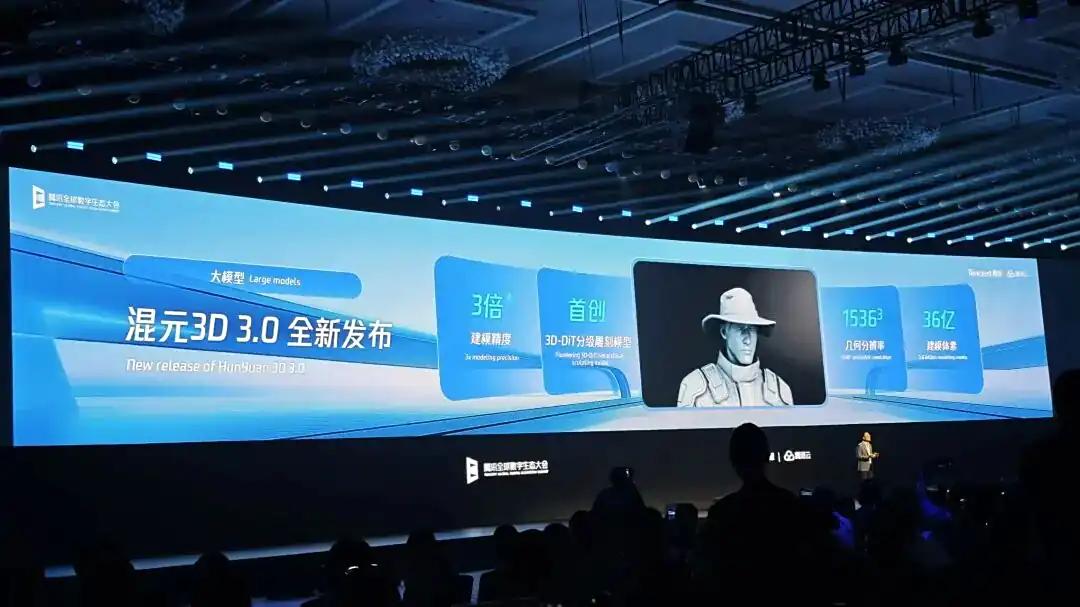
It didn't continue to invest more in Yuanbao. In April this year, Tencent released the almost completely rebuilt self-developed large model, Hunyuan 3.0. The person in charge is Yao Shunyu, a young scientist Tencent recruited back from OpenAI. According to public reports, he reports directly to President Liu Chiping. More than a month ago, in March, Tencent disbanded the AI Lab that had been established for a full ten years, and its personnel were incorporated into the Hunyuan system.
A company good at applications, after slowing down the pace of its application products, didn't chase after products but instead went back to improve an underlying model that users can't even see.
What happened in the twenty days between Pony Ma's candid statement on May 13th and the emergence of the WeChat AI assistant on June 2nd almost epitomizes Tencent's AI strategy over the past year and more.
Strengthen the foundation, figure out which battle to fight, and then start to tackle the most difficult challenge.
In the First Stage of AI, Tencent Finds Its Rhythm
Tencent has almost never been the first company to master underlying technologies.
QQ wasn't the first instant messaging software in China, and WeChat wasn't the first mobile social product. A large part of its game business is based on agency. What it's really good at is something else.
It waits for a new technology or a new scenario to take shape gradually, and then uses traffic, relationship chains, and equity investment to integrate it into its ecosystem.
The WeChat red envelope during the Spring Festival in 2015 was the cleanest demonstration of this approach. At that time, mobile payment was almost dominated by Alipay. Tencent didn't invent any new technology but simply used a red envelope function to bring WeChat Pay to more users through the social relationship chain.
Tencent's application-driven thinking was clearly stated in Pony Ma's early judgment. He said that a lot of China's Internet development is driven by applications rather than technology.
In 2015, he summarized this approach as "entrusting half of our business to partners". Tencent focuses on equity investment, turns partners in new tracks into part of its ecosystem, and uses the traffic pools of WeChat, QQ, and game content as support, and has obtained entry tickets in almost every new track.
This method worked for twenty years until the emergence of AI. In the first wave of AI, Tencent clearly slowed down its pace.
According to public information, from 2023 to 2025, Tencent invested in large model companies, chip computing power, and the application layer - it invested in several leading model companies such as Minimax, Zhipu, and Yuezhianmian, but more for strategic positioning and observation rather than going all in.
The problem is that this time, almost all innovations are centered around the same thing - large models. And it's progressing so fast that it changes its appearance every few weeks, leaving almost no "stable shape" to wait for.
Tencent's once-proud patience didn't translate into an advantage this time. Its two main competitors didn't wait.
Alibaba bet on the foundation. It almost fully open-sourced its Tongyi large model, aiming to attract a developer ecosystem like Android, and announced an investment of about 380 billion yuan in AI computing power and infrastructure construction in three years. The logic is: not necessarily to make the most user-friendly AI, but to be the foundation for all AIs.
ByteDance bet on C-end apps. It made Doubao a national AI assistant aiming to enter everyone's mobile phones and replicated this growth methodology to multiple products such as Jianying, Jimeng, Feishu, and Trae.
As of March 2026, QuestMobile data shows that Doubao has about 226 million monthly active users, ranking second after DeepSeek's 135 million, with a significant lead; Yuanbao has about 41 million, ranking third.
Tencent's situation is much more delicate.
In the first-quarter financial report on May 13th, AI-driven advertising recommendations increased the revenue of marketing services by 20% year-on-year, and the AI-optimized algorithm increased the total user time on Video Accounts by more than 20% year-on-year.
More notably, Tencent specifically disclosed the financial impact of five new AI products, including Yuanbao, Hunyuan, CodeBuddy, WorkBuddy, and QClaw, in the financial report - including them, the non-IFRS operating profit increased by 9% year-on-year; excluding them, it increased by 17%. The difference of about 8.8 billion yuan is the visible cost Tencent actively bore for AI this quarter.
From the perspective of financial disclosure, the core business is accelerating. AI has been integrated into existing businesses and brought substantial benefits, and the cost of new AI products is controllable and calculable.
However, the market response isn't enthusiastic. An analyst who has been tracking Tencent for a long time told the media that the problem isn't the numbers but the perception. In investors' minds, Alibaba's story is about cloud and the foundation, ByteDance's story is about Doubao, but Tencent's AI story can't be summed up in one sentence.
It has everything but doesn't occupy a prominent position in the AI era.
Yuanbao Isn't the Answer, Hunyuan Is the Patch
Tencent is, of course, also trying.
During the Spring Festival, Yuanbao launched a 1 billion yuan cash red envelope event, which was a relatively large-scale cash event for a single product since the WeChat red envelope in 2015. Ads were all over WeChat, Xiaohongshu, and Bilibili. According to QuestMobile data, Tencent's proportion of hard advertising investment in AI applications once reached as high as 38%, the highest in the industry, and even appeared on rural walls.
There was a short-term effect. Yuanbao's monthly active users briefly reached 114 million, and its DAU exceeded 50 million. Then, after the red envelope event ended, the data declined.
This incident made the outside world realize one thing: in AI products, the effect of the traffic approach isn't as sustainable as before. The core of an AI assistant lies not in the marketing budget but in the capabilities of the underlying model. Chatbots like Yuanbao and Doubao aren't the foundation of AI competition in essence but product forms derived from model capabilities - whether they can grow depends on the underlying model itself.
According to public reports, Pony Ma mentioned at Tencent's annual meeting in January 2026 that Tencent's AI "moved slowly", and the problem might lie in insufficient infrastructure, the need to improve the model iteration frequency, and platform capabilities.
After that, a quiet organizational adjustment began.
In the first-quarter financial report, Tencent's capital expenditure was about 37 billion yuan, mainly used to support AI-related investments. R & D expenses increased by about 19% year-on-year, reaching 22.5 billion yuan, of which more than 70% was employee welfare expenses - simply put, it increased investment in talent.

According to public reports, Tencent recruited Yao Shunyu and appointed him as the chief AI scientist of the President's Office, concurrently in charge of AI Infra and large language models, reporting directly to Liu Chiping. In March, Tencent disbanded the AI Lab established in 2016, which had gathered many top scientists in the past ten years, and its personnel were incorporated into different sections of Hunyuan, such as pre-training, post-training, and Baseline Infra.
An insider told the media that the attribution, assessment, and research direction of the AI Lab had been unclear for a long time, and its disbandment wasn't a sudden move but more like a timely integration.
The Hunyuan 3.0 launched in April deliberately didn't aim to compete with the most cutting-edge models. Its design philosophy can be summarized in four words: sufficient and cost-effective.
It has a total of 295 billion parameters and 21 billion active parameters, not chasing the trillion-scale. It focuses on inference efficiency and cost optimization. Its external positioning is to participate in the intelligent agent market; its first internal task is to gradually reduce the core products like QQ Browser and WeChat Search's dependence on external models.
Since April 28th, according to Tencent's disclosure, in terms of token consumption, Hy3 preview has become one of the most widely used models on OpenRouter.
Strengthening the foundation is to take control of its own destiny.
Embed AI into the Ecosystem
After strengthening the foundation, what kind of building will Tencent build on it? The answer lies in a widely discussed "conflict".
During Yuanbao's 1 billion yuan red envelope event, when the sharing links filled the Moments, WeChat restricted the relevant links.
There are many interpretations from the outside world. It can be understood that WeChat was worried that Yuanbao would seize its ecological niche; it can also be understood that Zhang Xiaolong was guarding WeChat's rules of low interference and high trust.
Both explanations are correct. But the real significance of this incident is that it brought an internal contradiction in Tencent's AI strategy to the surface for the first time - if even its own WeChat isn't willing to let an independent AI app leverage its social relationship chain, then the path Tencent tried to replicate a "Doubao-style" independent app might be flawed from the start.
According to multiple media reports, after the Spring Festival, Tencent started to let Yuanbao enter WeChat in a different way. Using the "Yuanbao Red Envelope Cover Assistant" as a carrier, it gradually entered the WeChat chat interface in the form of an "AI version of the File Transfer Assistant" and obtained the rights to be pinned, shared, and interacted with.
By late March, users could search for Yuanbao in WeChat, add it as a friend, and interact with it in the chat interface.
Yuanbao is no longer an independent app trying to leverage the relationship chain from the outside but has been incorporated as a controlled AI assistant in WeChat.
Behind this is a quiet shift in Tencent's AI strategy. It no longer tries to replicate a Doubao or bet on a blockbuster hit. What it's really doing is something else - embedding AI into every existing old business line: advertising recommendations, Video Accounts, WeChat Search, AI customer service, games, and Enterprise WeChat.
The unremarkable numbers in the financial report are the real results of this strategy.
The revenue of marketing services increased by 20% due to AI advertising recommendations; the time spent on Video Accounts increased by 20%; the AI intelligent advertising product AIM+ empowered about 30% of the advertising investment amount; according to Tencent's disclosure, WorkBuddy has become one of the most widely used efficiency-oriented AI intelligent agent services in China in terms of daily active users.
A research report from Great Wall Securities pointed out the logic: embedding DeepSeek and Yuanbao into WeChat Search is essentially using AI as a super hub to connect the entire WeChat ecosystem, reaching billions of user data and making WeChat evolve into an AI operating system.
These AI achievements aren't like independent AI victories but more like improvements in old businesses. So the market doesn't pay much attention to them. But this is the real shape of Tencent's AI strategy.
It's not about going all in on an AI app but going all in on a Tencent ecosystem reinvented by AI. It's shaped by the existing ecosystem of WeChat, QQ, games, and payment.
Agent Gives WeChat a Home-field Ticket
If the Chatbot battlefield in the first stage wasn't in Tencent's comfort zone, then the Agent wave since March 2026 is pulling it back to its home field.
At the beginning of March, an open-source AI assistant called OpenClaw quickly became popular in China. It's different from chatbots - it can call tools, stay online for a long time, and complete tasks for you step by step. After being homophonically called "lobster" by netizens, using OpenClaw is also called "raising lobsters".
Tencent's reaction was much more active than usual. On March 6th, it held an offline event in Shenzhen to help citizens install OpenClaw for free. Originally planned to be a small-scale event, more than 800 people showed up, some coming from as far as Hangzhou.
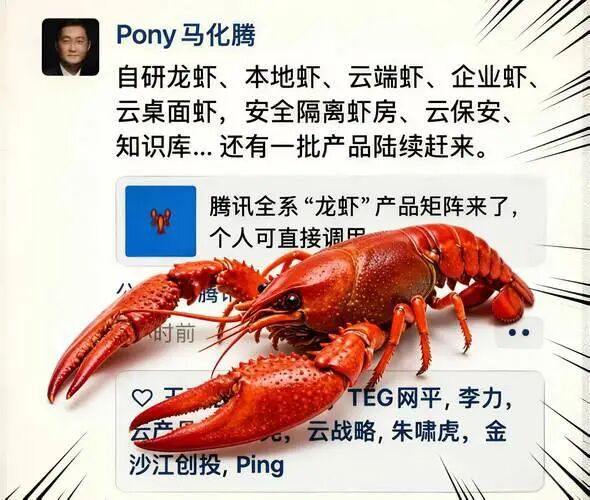
On March 9th, Tencent launched WorkBuddy. At dawn on March 11th, Pony Ma himself listed Tencent's "lobster" product matrix in his Moments - self-developed lobsters, local lobsters, cloud lobsters, enterprise lobsters, and cloud desktop lobsters.
Statistics show that at least three business groups in Tencent have more than 10 Claw-like products that have been launched, are in beta testing, or are under development.
Ding Ning, the person in charge of Tencent Cloud's developer AI products, later said at a media communication meeting that the development of the WorkBuddy product started on the weekend of January 17th, and several product and operation teams worked overnight to create the MVP version.
Zhong Yucheng, the product director of Tencent's lightweight cloud, also said that they originally planned to release it on March 16th. Seeing the high enthusiasm for "raising lobsters" outside and the difficulty of installation, they advanced the release by a week.
This kind of