Major mobile phone manufacturers are eyeing DJI's cash cow.
Major mobile phone manufacturers are eyeing gimbal cameras.
Gimbal cameras, hailed as the ultimate tool for Vlogging, have long been dominated by the DJI Pocket series. The total sales of the Pocket 3 have exceeded 10 million.
Now, vivo, OPPO, Xiaomi, and Honor have entered the market with capital and distribution channels.
Vlog Creation Drives DJI's Market
In March 2024, Wu Yi, a girl from Shenzhen, first encountered the DJI Pocket 3 and instantly became a die - hard fan.
During a trip to Tap Mun Island in Hong Kong, a boy in the same group lent his Pocket 3 to Wu Yi after seeing her taking pictures with her phone while walking.
What first impressed Wu Yi was the Pocket 3's portability, followed by the intelligent follow function: once a person is locked by the camera, they will always stay in the center of the frame no matter how they move, which is much more stable than using a phone.
She also found that when taking pictures of people with a phone, the distance is usually quite close, which makes the subjects feel stiff and nervous. The Pocket 3 allows for a greater shooting distance, eliminating the "artificiality" when facing the camera.
Later, the boy who lent her the Pocket 3 became her husband. The couple has traveled to many places, and all these experiences have been recorded in Wu Yi's Vlogs. Especially in Yili, Xinjiang, Wu Yi shot for more than 20 hours. These long - length footages can be previewed on the phone via Bluetooth and then turned into a complete video with one click in DJI's app.

Image | Wu Yi's Vlog shot with POCKET 3
Equipped with a 1 - inch sensor, it supports a maximum of 4K/60fps in landscape mode, with an effective pixel count of approximately 12 million, which is sufficient for most daily shooting scenarios and has won the favor of many professional practitioners.
Jia He is a media worker in Beijing. In May 2021, he and his team went to Yunnan to shoot a documentary and used the DJI Pocket 2 for the first time.
Jia He found that the mobile time - lapse function of gimbal shooting is particularly outstanding: when using a DSLR to shoot clouds, auxiliary equipment such as sliders and three - axis stabilizers are required, and the process is complicated with no real - time monitoring available. With the Pocket, it is simple and easy to use, with extremely low learning and operating costs.
When shooting an empty well, you can simply extend the Pocket down with an extension rod. Jia He joked that in the past, a cameraman would have to be sent down to the bottom of the well with a rope to take the shot.
"Unless it's for movies, TV shows with very high imaging requirements, or the professional needs of top bloggers, most shooting scenarios can be replaced by a gimbal like the DJI Pocket," Jia He said.

Image | Jia He's shot of the sky and clouds with the Pocket
Ji Xi, who used to work in an entertainment company, also believes that the Pocket 3 is a revolutionary imaging device. "In the past, when the company was shooting variety shows, if the stars were running outdoors, the photographers had to carry heavy equipment and run after them, which was very tiring. Now, you can just use the Pocket 3 for follow - up shooting."
Some dating shows even use gimbals on fixed positions to replace cameras. "But there are still some situations that can't be replaced. Close - up shots of a single person still require a telephoto lens," Ji Xi introduced.
In April this year, DJI launched the Pocket 4, upgrading the sensor, dynamic range, and recording specifications. The initial price is even lower than the previous generation, starting from 2,999 yuan.
In addition to the standard version, there is also a Pro version planned, which features a telephoto dual - camera setup and targets advanced users. With the launch of the new product, the price of the Pocket 3 has now dropped to 2,299 yuan, further lowering the entry threshold.
Major Mobile Phone Manufacturers Enter the Gimbal Camera Market
The popularity of short - videos is continuously driving up the sales of handheld imaging devices. According to a research report by Zheshang Securities, for every 100 million increase in short - video users, the shipment of handheld intelligent imaging devices will increase by 5.06 million units.
Meanwhile, the global smartphone shipment in 2026 is estimated to decline by 13.9% year - on - year. On one hand, the smartphone market has reached its peak, while on the other hand, the gimbal camera market is a rapidly growing new blue ocean. Naturally, entering the gimbal camera market has become the second growth curve for mobile phone manufacturers to seek growth.
Moreover, it is a high - margin business. The gross profit margin of leading handheld imaging manufacturers is generally around 50%, while the hardware gross profit margin of domestic mobile phones is mostly just over 10%. With fast growth and high profitability, no businessman can resist the temptation.
vivo is developing a handheld gimbal camera to compete with the DJI Pocket, with a team of nearly a hundred people. Recently, it launched an experience recruitment campaign for the gimbal camera in Shenzhen.
Supply chain sources claim that the product will start mass - production in October, to be manufactured by Luxshare Precision. It is expected to be launched between November and December, with a current inventory forecast of around one million units.
A person familiar with the matter revealed: "The vivo Pocket was originally planned to be launched in the third quarter, but after other companies entered the market, vivo postponed the launch to the fourth quarter, planning to wait and see how the products of its competitors perform before releasing its own."
OPPO has also initiated a handheld gimbal camera project internally, codenamed "Fuyao", and its related products will also be launched in the fourth quarter.
Xiaomi has also collaborated with Hohem on a gimbal camera, also targeting the Pocket. It is positioned as a "pocket camera" in the mid - to - low - end market.
In addition to handheld gimbals, mobile phone manufacturers have another approach: integrating gimbal functions into mobile phones.
Recently, OPPO launched the Reno 16 Pro, which is advertised to have a gimbal function, equipped with a 200 - million - pixel ultra - clear gimbal main camera and a built - in professional gimbal anti - shake structure.
Recently, Li Jian, the CEO of Honor, officially announced that the Robot Phone will be officially launched in the third quarter of this year. Honor's idea is to directly integrate the gimbal into the phone.
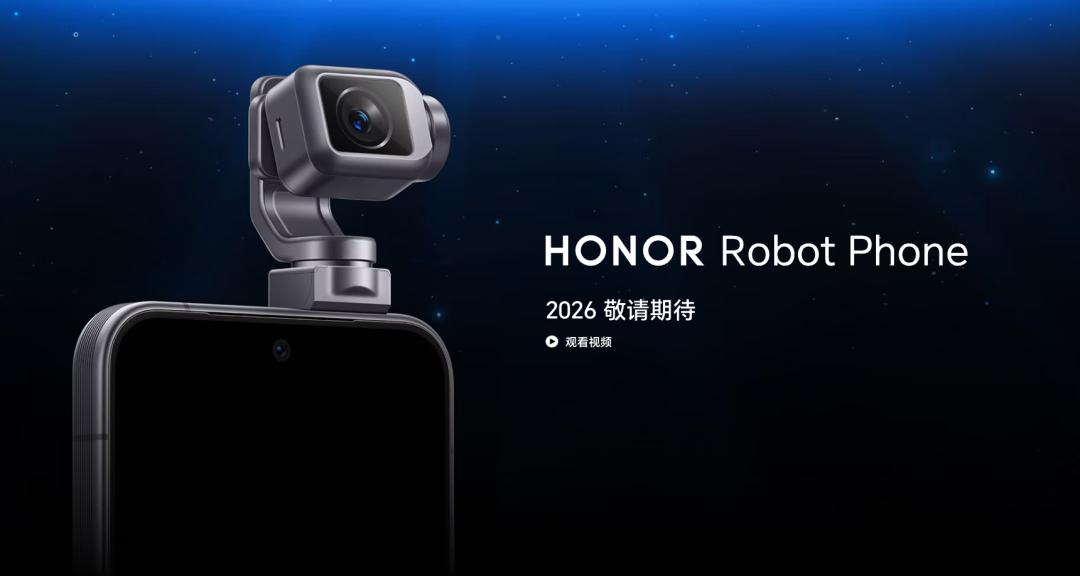
Image | Official image of Honor's Robot Phone
The entry of major mobile phone manufacturers into the gimbal camera market is based on a well - considered business judgment. Although it seems like a cross - border move, they actually have inherent advantages.
In terms of technology, imaging has long been a competitive area for domestic mobile phones. The portrait shooting, color performance, focusing, anti - shake, and even AI algorithms of mobile phones can be directly reused. Moreover, they have cooperation resources with imaging companies, which can serve as an endorsement.
In the supply chain, the raw materials such as optical modules, chips, and structural components of handheld intelligent imaging devices can also be shared with mobile phone products, so there is no need to start from scratch.
In terms of scale, vivo, OPPO, etc. have more than 300,000 offline stores, far outnumbering DJI's less - than - 1,000 stores. Especially in the sinking market, their coverage far exceeds that of DJI, attracting a larger customer base and having an advantage in after - sales service.
In addition, even if you shoot with a DJI Pocket, the generated videos will eventually be posted on mobile phones. If the gimbal and the mobile phone are integrated at the underlying level, the process from shooting, creation to sharing will be smoother, which may also attract more content creators.
However, these advantages may remain more on paper.
The Pocket series has years of technological accumulation from DJI. In terms of supply chain integration, the camera sensor is from Sony, the lens is customized, and the entire camera module is encapsulated and manufactured by DJI itself, forming a complete closed - loop from accessories to software, which is difficult to imitate.
A person from a mobile phone manufacturer once estimated that there would be almost no gross profit in making a product similar to the Pocket 3: "If you use a 1 - inch sensor, you can't be cheaper than DJI; if you don't use a 1 - inch sensor, the performance can't be better than DJI."
Jia He said that regardless of the shooting performance, the Pocket 3 is not expensive now. You can buy it for about 1,700 yuan in the second - hand market. The gimbals launched by mobile phone manufacturers may not be able to enter the market through price competition.
He believes that gimbals are not a necessity. "If you really need to use a gimbal camera for shooting, you can just rent one!"
On Taobao and Xianyu, there are already many merchants renting out DJI Pocket series, with a daily rental fee of about 20 yuan.
Who Will Define the Next - Generation Portable Imaging Entrance?
It's not just major mobile phone manufacturers eyeing this market. The professional imaging camp is also targeting DJI: Insta360's Luna gimbal camera will be launched in June, featuring a dual - camera setup, Leica imaging, and a modular design with a detachable screen, aiming to avoid the intense competition with high - end configurations. Even camera giant Canon has publicly disclosed a gimbal camera patent this year, envisioning an integrated three - axis gimbal that can fold automatically.
According to IDC data, in 2025, the global shipment of handheld intelligent cameras reached 16.65 million units, a year - on - year increase of 83%, with DJI accounting for 62% of the market share.
The gimbal camera, a category defined and almost monopolized by DJI, is now being challenged from all directions by mobile phone manufacturers, panoramic camera manufacturers, and traditional camera manufacturers.
The market may shift from DJI's dominance to a hierarchical situation of "1 + N", giving consumers more choices. At the same time, it also raises a question: Who will define the next - generation portable imaging entrance? Will we still need an independent gimbal camera in the future, or will it eventually become a function in mobile phones?
Jia He believes that it is an inevitable trend for all professional imaging devices to have gimbal functions. However, the combination of a mobile phone and a gimbal puzzles him. Due to the physical thickness limitation of mobile phones, the improvement of sensors and apertures has almost reached its limit. It is not realistic to achieve professional - level image quality.
"Just use the mobile phone for daily use. There's no need to add gimbal - like functions. A gimbal - enabled mobile phone is not needed by ordinary people and is looked down upon by professionals. It's very strange," he said.
As a popular Vlog creator, Wu Yi has a similar attitude: unless there is a revolutionary improvement in image quality, she won't consider a gimbal - enabled mobile phone.
Regarding Honor's Robot Phone collaborating with century - old movie equipment giant ARRI for endorsement, Wu Yi said that the performance suitable for consumers' usage scenarios is the top priority. There are too many marketing gimmicks now, and we still need to see the real feedback from the public after its launch.
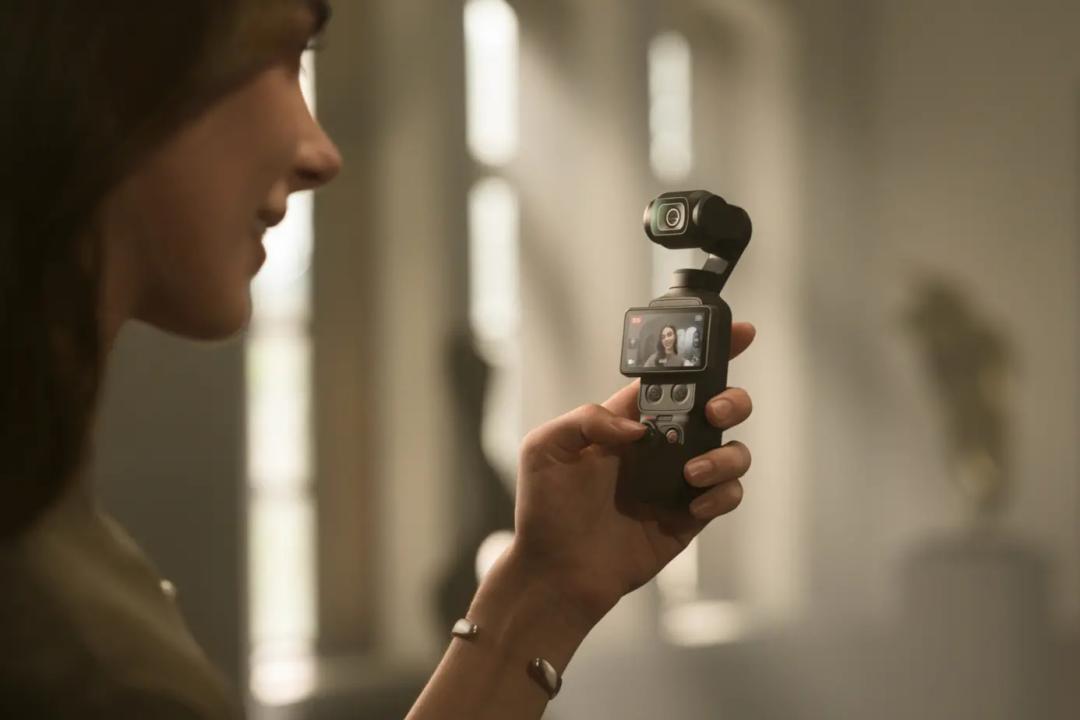
Image | DJI Pocket 4
Now, Ji Xi, who is a full - time self - media person, shoots with an iPhone. "If I use a professional gimbal camera to shoot, it seems a bit aggressive. But if you use a mobile phone to shoot, people will just assume you're recording your life."
However, he is optimistic about the approach of integrating gimbal functions into mobile phones. He believes that independent handheld gimbal devices may gradually be phased out as mobile phones evolve.
In the history of imaging devices, there has never been a shortage of stories about "once - dominant players being left behind by the times".
GoPro was once the absolute leader in handheld imaging, but now it is on the verge of being sold. Due to technological stagnation and a failure to understand users, it lost its market share to DJI and Insta360 with their new product forms during the peak of demand.
Different from action cameras, the gimbal camera market is large enough to accommodate both DJI and new players.
DJI has already won over a group of creators who are used to the Pocket. Once this usage habit is formed, it is difficult to change.
This article is from the WeChat official account "Zhengu Research Lab" (ID: zhengulab), author: Liang Xiang, editor: Zhang Duo. Republished by 36Kr with authorization.