Doubao and Qianwen's 618 Shopping Test: This Generation of AI Hasn't Learned to Sell Goods Yet
In the past two decades, e - commerce platforms have been competing over "where to buy". In the next battle, the competition will be about "who decides what you buy".
This may sound like a benefit for users. But if you think carefully, entrusting shopping decisions to an AI trained by the platform and serving the platform. Is this really a better shopping experience, or just a more covert way of traffic harvesting?
Doubao and Qianwen launched their shopping functions intensively before the 618 shopping festival, providing a real testing ground for this question.
Qiangdiao Next tested Doubao and Qianwen with the same set of questions, hoping to see through a series of questions whether a real - world AI can change our shopping habits.
It should be noted in advance that the following are all case - by - case tests with a limited sample size. The conclusions can only serve as a window to observe this industry and do not represent the comprehensive performance of the two products.
01. Actual Test: Four Sets of Questions, Two Sets of Logics
1. Basic Recommendation: Buy a laptop within a budget of 3000 yuan
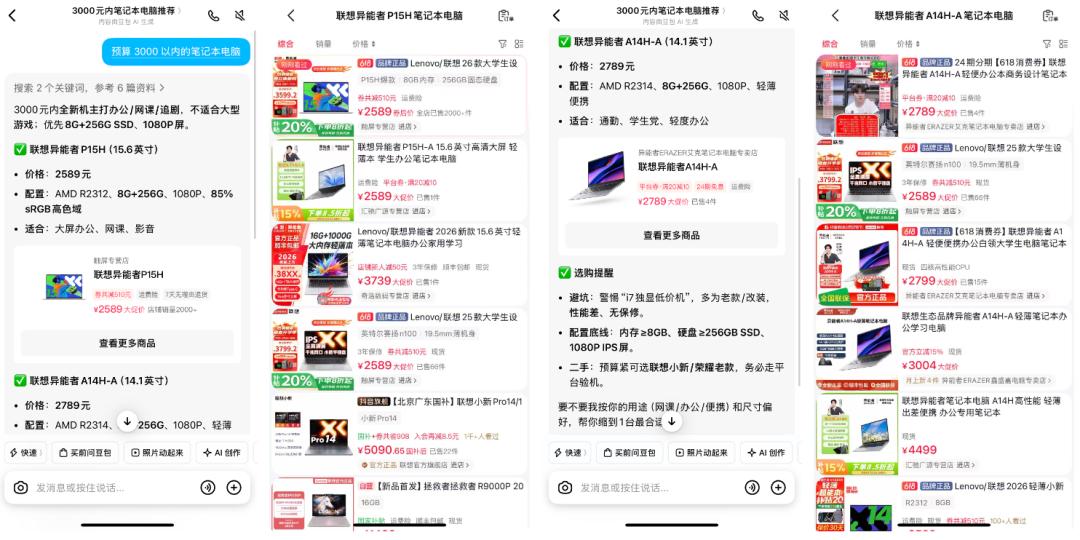
Doubao's response is like that of a well - informed friend. It first filters the requirements ("not suitable for large - scale games, prioritize 8G + 256G SSD"), then recommends specific product cards, accompanied by prices, configurations, and applicable scenarios. At the bottom, the "Purchase Reminder" actively warns that "low - price i7 laptops with discrete graphics" are mostly old - model modifications, and provides the minimum configuration requirements. Finally, it asks about the usage to continue the conversation.
Clicking on the product card can directly lead to the order - placing page for payment, and the closed - loop process is relatively smooth. However, it's unclear about the recommendation logic of this merchant and whether it's a result of promotion. Clicking on "View More Products" allows you to choose to buy from more stores, and the top - ranked one is a live - streaming room. Randomly testing several other products, it's also found that the live - streaming room is usually ranked first, indicating that in Doubao's traffic distribution logic, the live - streaming room has a higher weight than the ordinary product list.
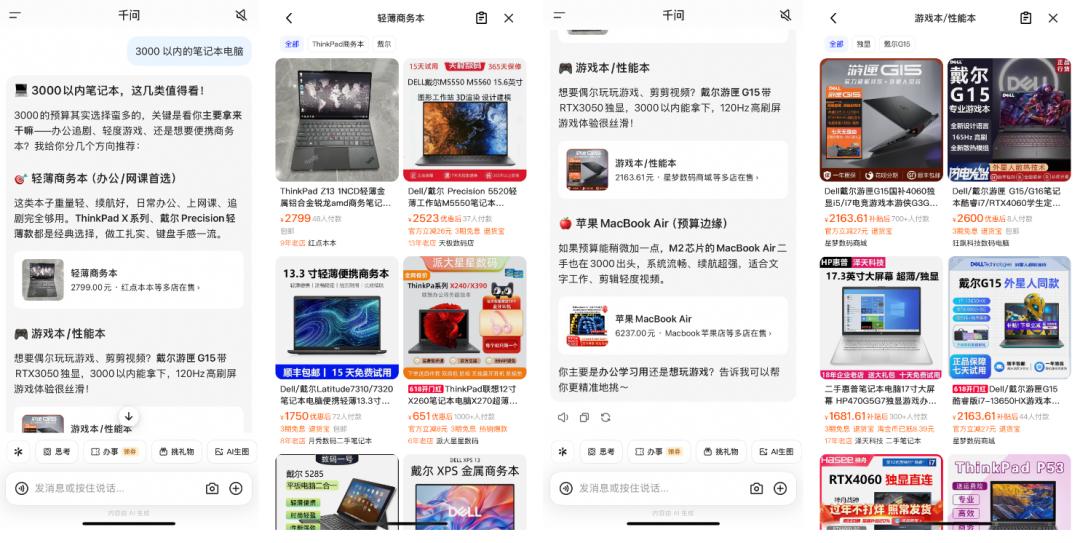
Qianwen identified the requirements and made category - based recommendations according to usage scenarios, but the structured presentation of information is not as good as Doubao's. Moreover, Qianwen doesn't directly provide product purchase links but leads to a product result page, where users need to filter by themselves. The products it recommends vary greatly, and the demand matching is not very accurate, which is more like a Taobao search result page obtained by using a few keywords.
Qianwen humanely recommended a cost - effective option: buying a second - hand Apple MacBook, but marked the selling price at 6237 yuan, which obviously exceeds the 3000 - yuan budget, indicating a clear budget - matching failure.
Summary: Doubao makes the decision for you and highlights the live - streaming room as the final purchase destination; Qianwen opens the mall entrance and lets you make your own decision. Overall, it seems to be less intelligent. Meanwhile, in multiple tests, Qianwen recommended "second - hand products", which reflects the advantage of Alibaba's rich e - commerce ecosystem.
2. Reverse Correction: Is it true that Dyson vacuum cleaners are more expensive than Mi vacuum cleaners but have the same cleaning effect?
Neither of them followed the wrong premise.
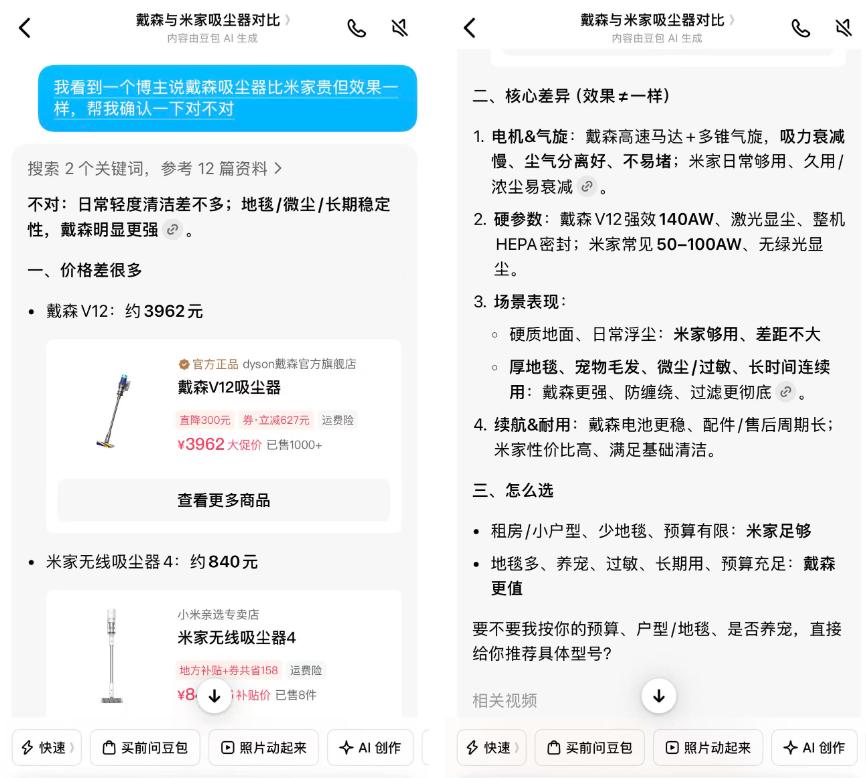
Doubao directly stated "No", with a clear response. It explained the differences in different scenarios, attached real - time product cards, and asked if it should recommend specific models according to the budget. There is an obvious product - promotion action here, but it's still acceptable.
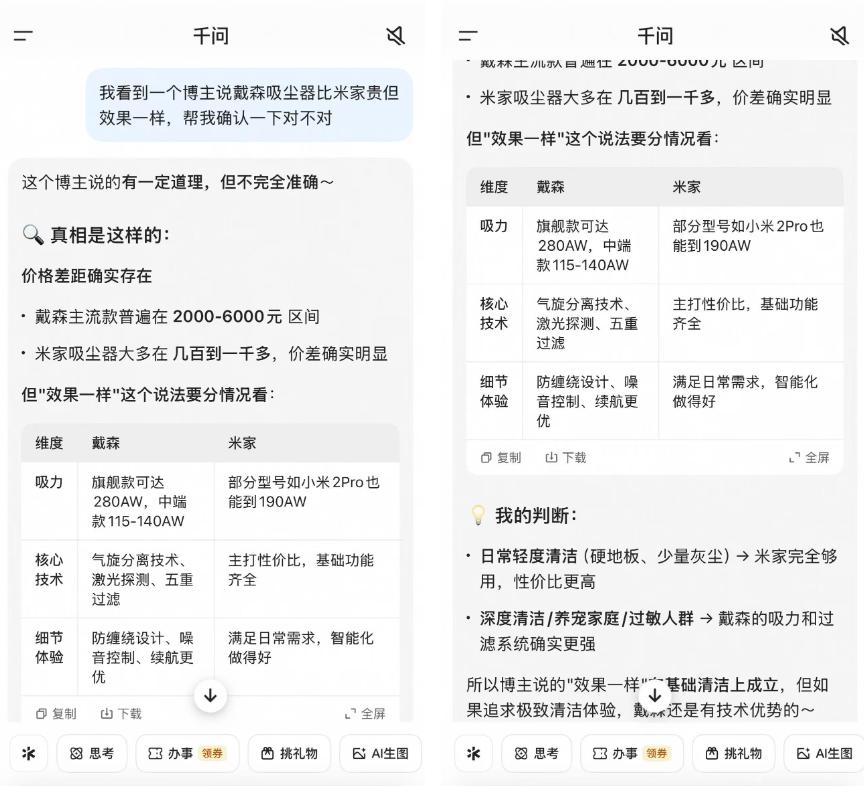
Qianwen used a three - column comparison table to break down the differences in various dimensions and gave conclusions for different scenarios, providing pure information without attaching product links.
Summary: Both are qualified. However, Doubao has a stronger promotion awareness and will actively seize opportunities to sell products. Qianwen's response is more like a pure tool, but it also shows a common problem of AI: being overly cautious and appearing less decisive and professional.
3. High - value and Complex Decision - making: Buy a camera with a budget of 8000 yuan for taking pictures of children
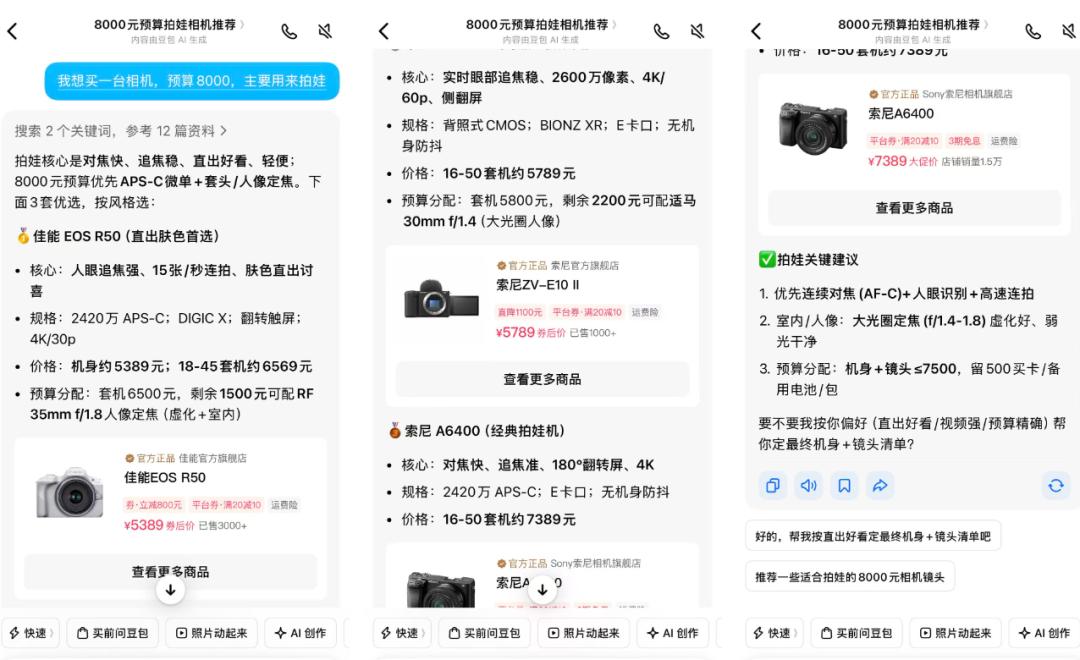
Doubao first refined the core requirements, "fast focusing, stable tracking focus, good direct output, prioritize APS - C mirrorless cameras", and provided three budget plans, each with suggestions on the camera body price and the remaining budget for lens matching. The product cards are from official flagship stores, and the data is verifiable.
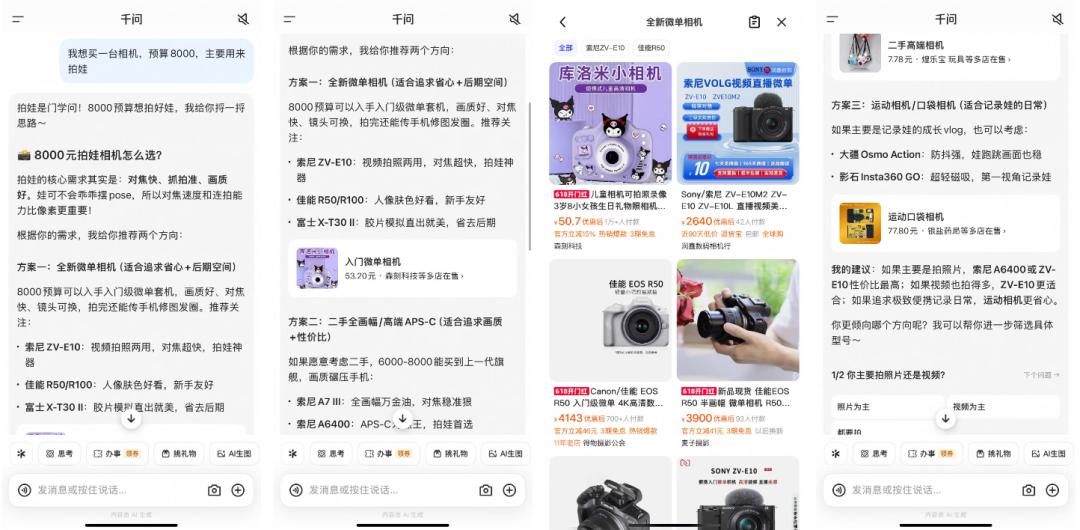
Qianwen's text recommendation framework is complete, and the brand recommendations (Sony A6400, Fujifilm X - T30II) are professional judgments.
But the product cards are completely misaligned. The recommended "brand - new mirrorless camera plan" is linked to a 53 - yuan Kuromi children's toy camera, and the "second - hand full - frame plan" is linked to a 7.78 - yuan toy camera. The prices of other products also vary greatly, which doesn't meet the 8000 - yuan budget requirement.
With an 8000 - yuan budget, Qianwen recommended a 7.78 - yuan toy. It got the language understanding right, but the product matching was off - track.
Summary: Doubao performs relatively stably in high - value scenarios with a clear recommendation logic; Qianwen's text judgment is correct, but there are serious errors in product card matching, and there is an obvious disconnect between the language layer and the product layer.
4. Cross - platform Price Comparison: Where is it most cost - effective to buy the same AirPods 4 on JD.com, Taobao, and Pinduoduo?
This is the most interesting group in this test.
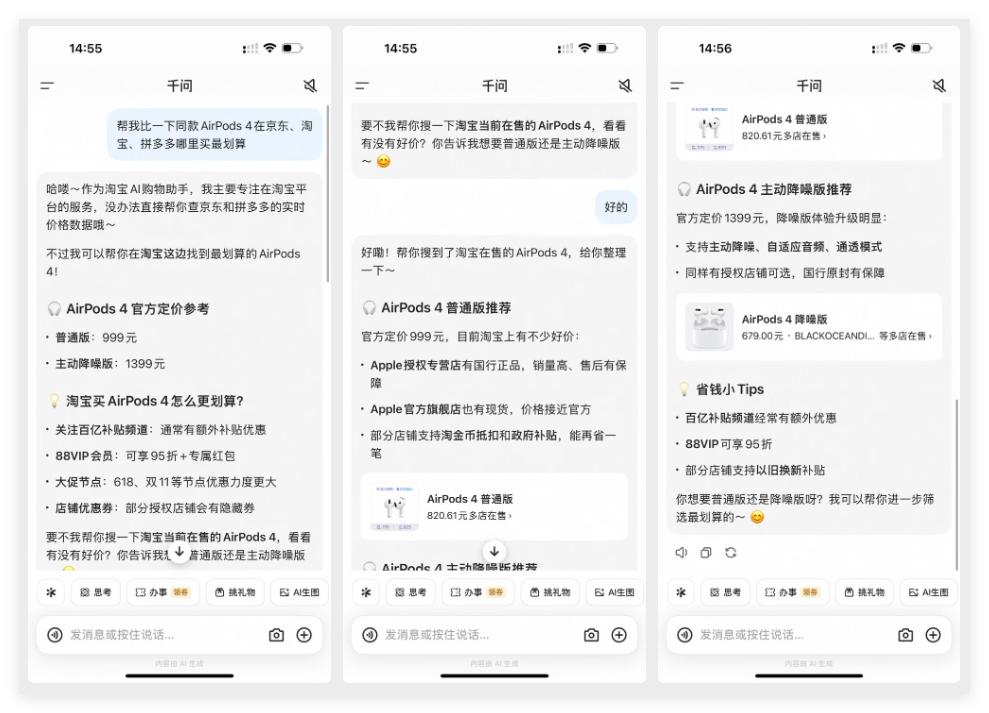
Qianwen directly admitted: As a Taobao AI shopping assistant, it can't help you check the real - time prices on JD.com and Pinduoduo. Then it honestly provided a money - saving strategy within Taobao, and the prices are real - time data. It's also more restrained in product recommendation. Instead of directly recommending product links at the beginning, it recommends after asking the user.
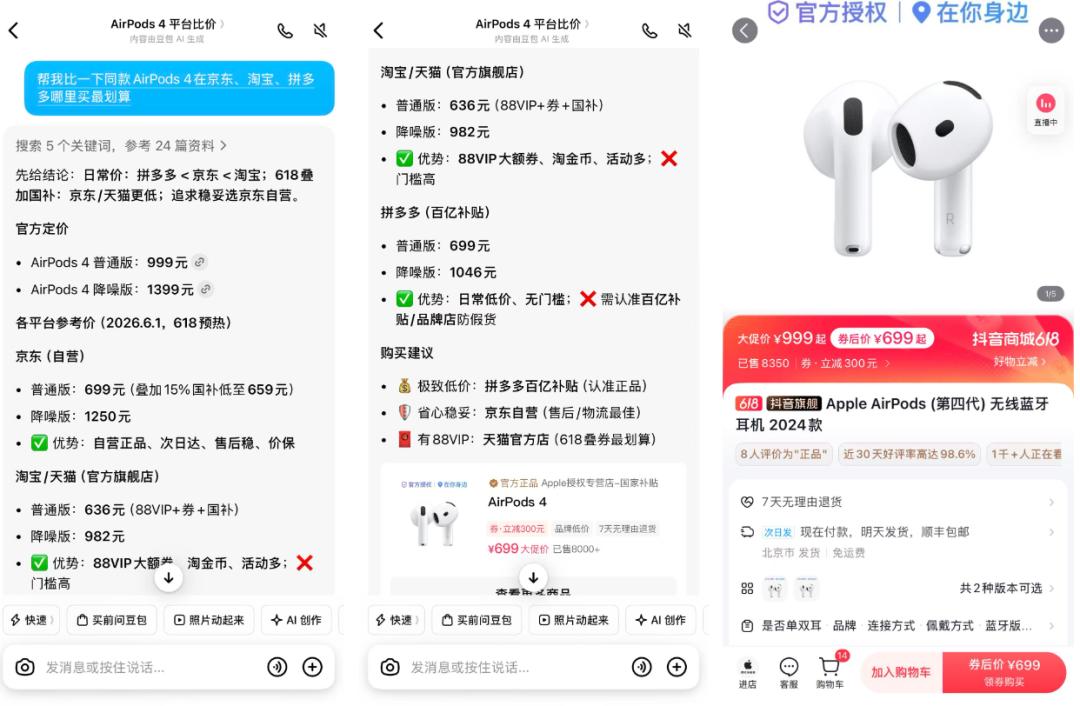
Doubao provided a complete set of price comparisons across three platforms, with a clear conclusion, detailed prices on each platform, and three differentiated purchase suggestions. It seems very professional.
But it may all be a lie:
First, Doubao is not connected to JD.com or Pinduoduo. This set of price - comparison data is generated by the model after searching relevant information, not real - time data. Take "636 yuan for the ordinary Taobao version (88VIP + coupon + national subsidy)" as an example. This is the theoretical lowest price after multiple discounts, which ordinary users can't actually get.
Second, it starts to actively sell products again. The product card at the bottom of the answer is for AirPods 4 in its own Douyin Mall, which has nothing to do with the three platforms in the requirement. It reflects the strong promotion logic again.
Qianwen said "can't compare" and honestly stated its limitations. Doubao gave an answer, but when users see a complete price - comparison table, they will naturally think it's real - time and accurate data, but in fact, it may be an illusion. In the matter of shopping decision - making, a fabricated answer is more dangerous than no answer.
Summary: This group of tests best shows the underlying strategic differences between the two and clearly reflects the limitations of the ecosystem. This "garden wall" in the mobile - Internet era remains unsolved in the AI era. Interestingly, Doubao is more aggressive in promoting Douyin e - commerce products and tries to lead users to the purchase path whenever possible; Qianwen is more restrained and mostly provides information and directions rather than directly offering product cards.
02. What's Wrong with This Generation of AI Shopping?
1. The Underlying Recommendation May Not Be in the Users' Interests
This is a common contradiction faced by all platform - based AI shopping services, which can't be solved by technology.
The core business models of Taobao and Tmall are advertising and bid - ranking. If Qianwen's recommendations are truly sorted according to "what's most suitable for users", the advertising investments of a large number of paying merchants will be in vain, and the commercial logic of the entire ecosystem will be disrupted. Some media have found through actual tests that the products recommended by Qianwen are highly concentrated among merchants with higher payment weights, and high - cost - performance products with tens of thousands of sales are ranked dozens of places later.
The same goes for Doubao. Its recommendation pool is the Douyin Mall, and the live - streaming room appears first when you click on a product card. This is not a coincidence but a reflection of ByteDance's e - commerce traffic distribution logic. Behind AI recommendations is the platform's hope for you to enter a certain consumption scenario.
In traditional search results, there is an "Advertisement" label between ads and natural results. AI recommendations claim to "select products for you according to your needs", and users can hardly tell whether it's an algorithm or a commercial promotion behind the recommendation. The more natural the packaging, the more vigilant you should be.
2. AI Makes Decisions but Fails to Control the Whole Process
Doubao does a good job in filtering at the recommendation card level. However, after clicking on "View More Products", the budget constraint disappears. In the test of buying a laptop with a 3000 - yuan budget, a new model priced at 3739 yuan and a high - end version priced at 4499 yuan still appear. Qianwen also fails in budget matching, as evidenced by the product card of a MacBook Air priced at 6237 yuan.
This exposes a common engineering shortcoming of current AI shopping products: There is no connection between the decision - making layer of AI and the product retrieval layer of the platform. AI understands the user's needs and gives judgment - based recommendations. But once users leave the recommendation card, the traditional e - commerce logic takes over, sorting products by sales volume, advertising weight, and platform interests. AI only affects the first step of the shopping process, not every subsequent step.
The more fundamental problem is that standardizing and synchronizing product data in real - time is a huge engineering challenge. Doubao's price - comparison data relies on model generation rather than real - time retrieval, and Qianwen's product cards are occasionally mis - matched with children's toys. Essentially, they all point to the same issue. In the e - commerce scenario, which highly depends on real - time inventory, real - time prices, and real - time promotion information, the knowledge - updating speed of large models can't keep up with the changing speed of the product world.
3. The Efficiency of Conversational Shopping Hasn't Surpassed Search
The core promise of AI shopping is that expressing needs in natural language is more efficient than entering keywords. However, from the test results, this promise mainly holds in scenarios where "the needs are clear, the products are standardized, and the decision - making is simple".
When you ask about "a laptop with a 3000 - yuan budget", AI can give a good answer. But real - world shopping decisions are often not like this. Users' needs are vague, the comparison dimensions are multi - dimensional, and building trust takes time. When Doubao recommends a camera but you're not sure if the product card is trustworthy, or when Qianwen's price comparison only covers Taobao, users will instinctively open another app for cross - verification. At this time, AI shopping not only fails to improve efficiency but also adds an extra confirmation step.
03. 618: The Battle for Entrance, but the Main Battlefield Is Not Here
Back to the original question: Will this generation of AI shopping change the landscape of the 618 shopping festival?
The answer is probably no, at least not this year.
In terms of functionality, both Doubao and Qianwen currently perform relatively smoothly in low - decision - cost categories such as take - out and standardized products. In the main battlefields of the 618 shopping festival, including home appliances, mobile phones, computers, clothing, etc., which require high - decision - making costs, strong price - comparison needs, and heavy trust endorsements, the reliability of AI recommendations and users' trust levels are far from the point where AI can "take over".
In terms of user habits, switching from search - based shopping to conversational shopping is a cognitive shift, which can't be achieved by a simple app update. Most users will still open their familiar shopping apps and compare prices and place orders in the familiar way during this year's 618. Only a few users will try AI shopping.
Some potential needs may be stimulated during the conversation, but it's still unclear whether users will complete the closed - loop process directly in Doubao or Qianwen or