White Paper on Insight into Cross-border E-commerce Market Opportunities in South Korea in 2026
The South Korean e - commerce market ranks among the top in the world in terms of scale, with leading digital infrastructure. Consumers have a high level of maturity in online shopping and strong purchasing power. The user base is mainly composed of young people, who highly value logistics timeliness. More than 60% of them consider timeliness as the key factor when placing orders. The South Korean e - commerce market has low competition and better profit margins than other mature markets, and is still in the operational dividend period. The market is dominated by local platforms, with a significant head - effect.
Overview of the Global Economic and Trade Environment and the Development of China's Cross - border E - commerce
Global Economic and Trade Environment
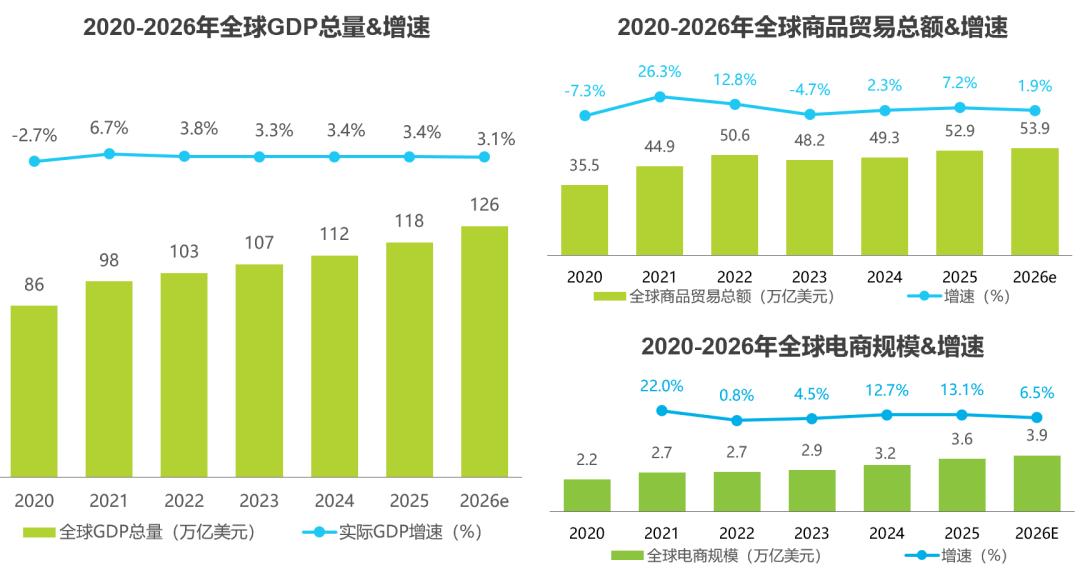
Against the backdrop of the global economic slowdown and the pressure on trade activities, the e - commerce industry has shown resilience and steady growth.
In recent years, the global economic growth rate has declined year by year, and international trade activities have also slowed down. Traditional trade channels are facing growth bottlenecks. However, the global e - commerce market has demonstrated strong anti - cyclical resilience. The reason is that despite the pressure from the macro - environment, consumers' online shopping habits have become ingrained, driving the steady increase in e - commerce penetration. From 2020 to 2025, the global e - commerce market scale has maintained steady development amidst fluctuations. In 2026, the expected growth rate is projected to be 3.4 times that of global commerce, and it is accelerating to become a new driving force for trade.
Source: IMF, WTO, and self - research and drawing by iResearch Institute.
Overview of China's Cross - border Export E - commerce
Cross - border export e - commerce is the general trend and in line with policy directions, and is a key engine for stabilizing foreign trade.
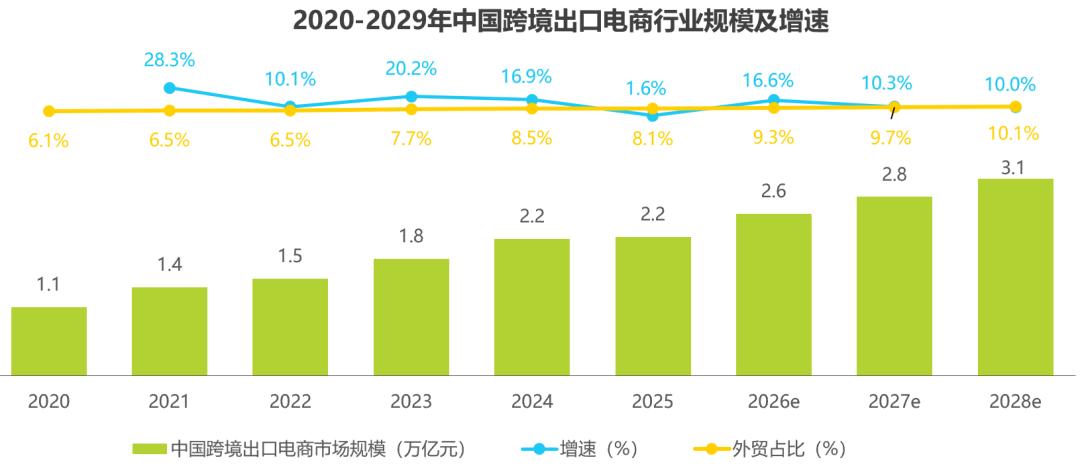
In recent years, China's cross - border export e - commerce has developed rapidly. The market scale has steadily increased from 1.1 trillion yuan in 2020 to 2.2 trillion yuan in 2025, and it is expected to exceed 3 trillion yuan in 2028. Despite the complex and changeable external environment, China's cross - border export e - commerce industry still shows strong momentum. Its proportion in foreign trade exports has been rising steadily, becoming an important force driving China's foreign trade growth. This is both the general trend of digital trade and the clear direction of national policies. However, the era of extensive growth has passed, and the industry is entering a new period of diversified layout and quality breakthrough.
Characteristics of the 3.0 stage of going global: It is a period of rapid expansion, focusing on in - depth operation in core markets such as Europe and the United States, strengthening local layout, and the brand awareness is gradually emerging, and brand - building has started.
Characteristics of the 4.0 stage of going global: It has entered a transformation period of high - quality development. The market structure is transforming from relying on a single market in the past to exploring diversified markets, and the product structure is extending to high - value - added products. The trends of branding and differentiation are prominent.
The "2026 Government Work Report of the State Council" proposed to "accelerate the development of digital trade, cultivate new driving forces for foreign trade development, and guide enterprises to optimize their global market layout."
Source: General Administration of Customs, IMF, China International E - commerce Center, expert interviews, and self - research and drawing by iResearch Institute.
Target Market Analysis
Repeated trade frictions and geopolitical disputes have made the diversified market layout a must - choose for cross - border e - commerce export enterprises.
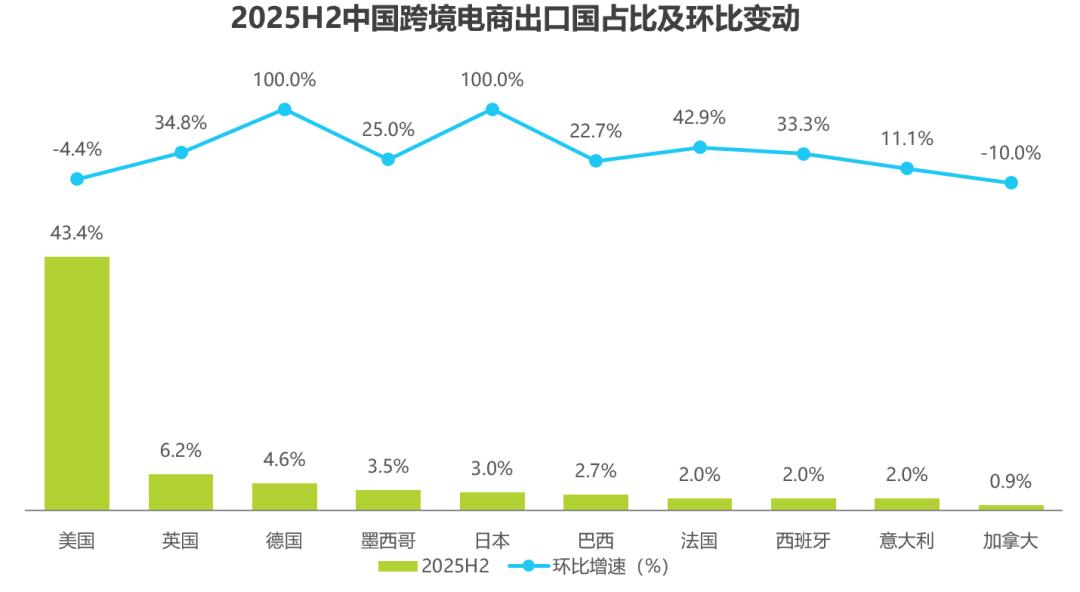
China's cross - border e - commerce exports are accelerating from single - dependence to multi - pronged development. Data from the second half of 2025 shows that although the United States is still the largest export destination, its scale has declined month - on - month in the second half of the year. Except for the North American market, exports to other countries have increased, and the scale of some markets has doubled, further strengthening the pattern of "one super and many strong." This also reflects that Chinese cross - border e - commerce enterprises are accelerating the exploration of export regions and reducing their dependence on a single market. This is not only a strategic choice to disperse risks but also the only way to find incremental space. For sellers, following the national diversified strategy and pre - occupying high - potential markets in advance will be the key to achieving continuous growth in the next three to five years.
Source: Shangzhizhen, and self - research and drawing by iResearch Institute.
South Korea has become a potential market for sellers' diversified layout due to its scale, growth potential, and advantages in standardization and efficiency.
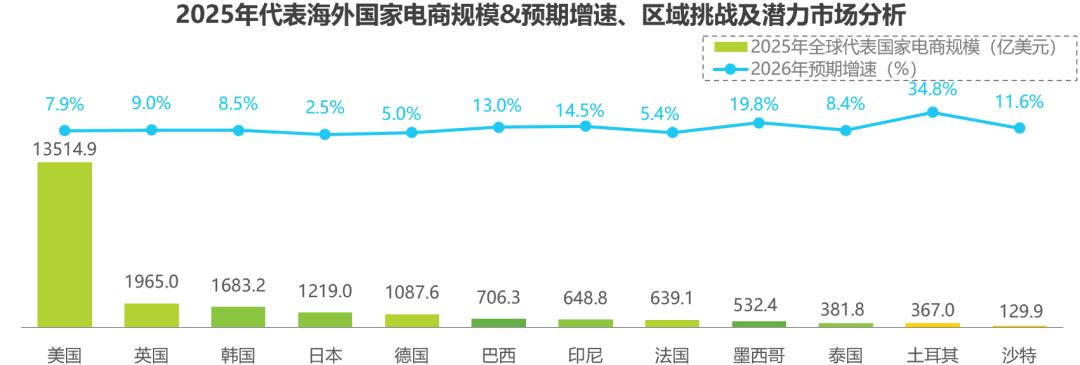
Generally speaking, e - commerce markets in different regions around the world have their own structural characteristics and challenges. In contrast, the South Korean market presents different combination characteristics: In 2025, its e - commerce scale reached 168.3 billion US dollars, making it the third - largest overseas e - commerce market for China; the certification system is relatively standardized. Although it requires upfront investment, the rules are clear and the implementation is stable, which easily forms a compliance barrier; the logistics system is mature, with a cross - border transportation time of about 3 - 5 days, and a high proportion of same - day or next - day delivery has been achieved in the local market. Overall, South Korea is a mature market with strong standardization and high logistics efficiency, and it is worthy of being a target market for sellers to carry out diversified layout.
Source: Euromonitor, and self - analysis and drawing by iResearch Institute.
United States: It has the largest scale, but the competition is extremely fierce, the operating cost is high, and the policy compliance requirements are getting stricter, squeezing the profit margin.
Europe: Taxation in many countries is cumbersome, consumer data protection is strict, the return rate is relatively high, and the market is approaching saturation.
Southeast Asia: The average order value is low, the price war is fierce, and the cash - on - delivery model leads to a high refund rate.
Japan: Consumers have high requirements for products and services, and the platform rules are complex with fierce competition.
South Korea: The market awareness is low, and the requirements for localization and quality are relatively high, raising the entry threshold.
Latin America: Customs clearance is difficult, tariffs are adjusted repeatedly, the compliance risk is high, and the logistics cycle is long.
Middle East: Due to geopolitical risks and fluctuations in the local currency exchange rate, the business stability is weaker than that of mature markets.
Potential market - South Korea: 1. Large market scale and stable growth rate, ranking third among global target markets, with a growth rate higher than that of core countries in Europe and the United States; 2. A standardized compliance environment. Although the certification threshold is high, it is easy to form a competitive barrier and filter out low - quality sellers; 3. Stable logistics efficiency. The logistics cost is on par with that of Southeast Asia, but the delivery time only takes 3 - 5 days. The local logistics infrastructure is mature, and same - day/next - day delivery has become the standard.
Insight into the South Korean E - commerce Market
Market Scale and Potential
The scale is steadily increasing, and high network penetration and strong purchasing power together create a mature consumption high - ground.
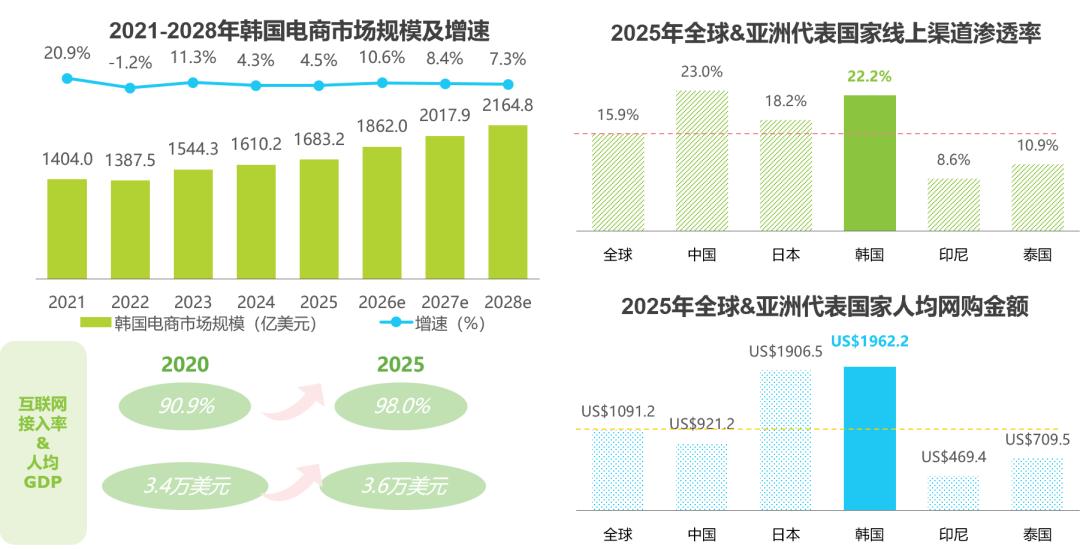
The South Korean e - commerce market has performed well in terms of both scale and growth rate, and it is expected to exceed 200 billion US dollars in 2027. At the same time, South Korea has the world's leading digital infrastructure, with an Internet penetration rate as high as 98% and a per capita GDP of 36,000 US dollars, providing a solid user base and economic support for the development of e - commerce. More notably, South Korean consumers' online shopping behavior has become highly mature, and the penetration rate of online channels and the per capita annual consumption amount far exceed the levels of the world and other Asian countries. This means that South Korean consumers are not only used to online shopping but also have a strong willingness and ability to pay. The relatively high maturity of online shopping and consumption ability also enable sellers in the South Korean market to obtain stable returns with reasonable quality and price, rather than getting involved in the involution competition of low - quality and low - price products.
Source: Statistics Korea, IMF, World Bank, UN, Euromonitor, Statista, and self - research and drawing by iResearch Institute.
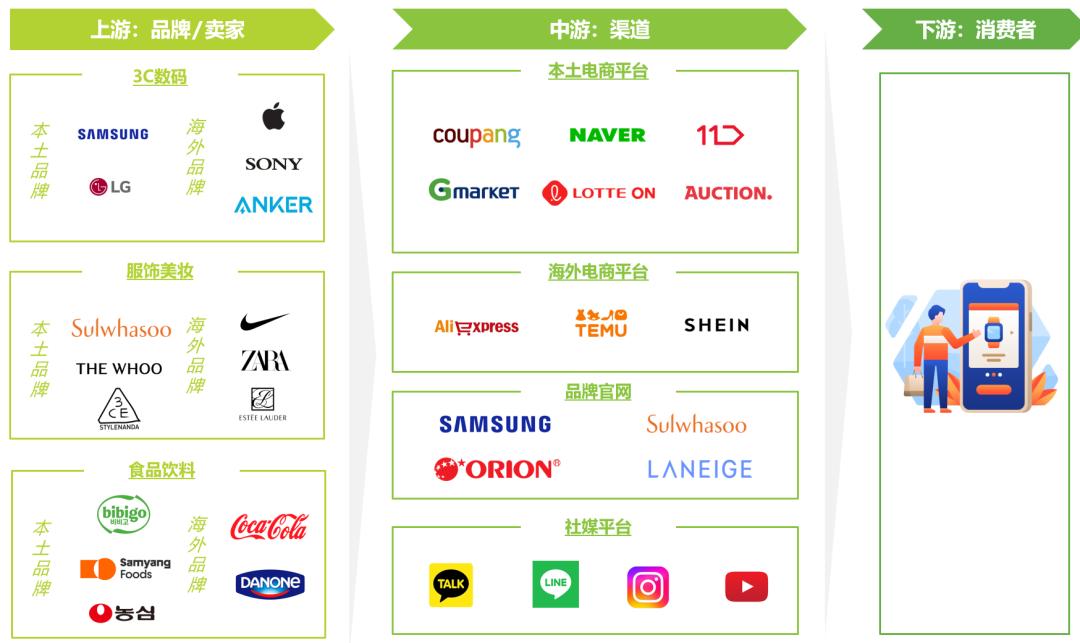
South Korean E - commerce Industry Chain Map
User Portrait
Dominated by millennials, with a trend of high - frequency and medium - to - high average order value, and strong consumption power.
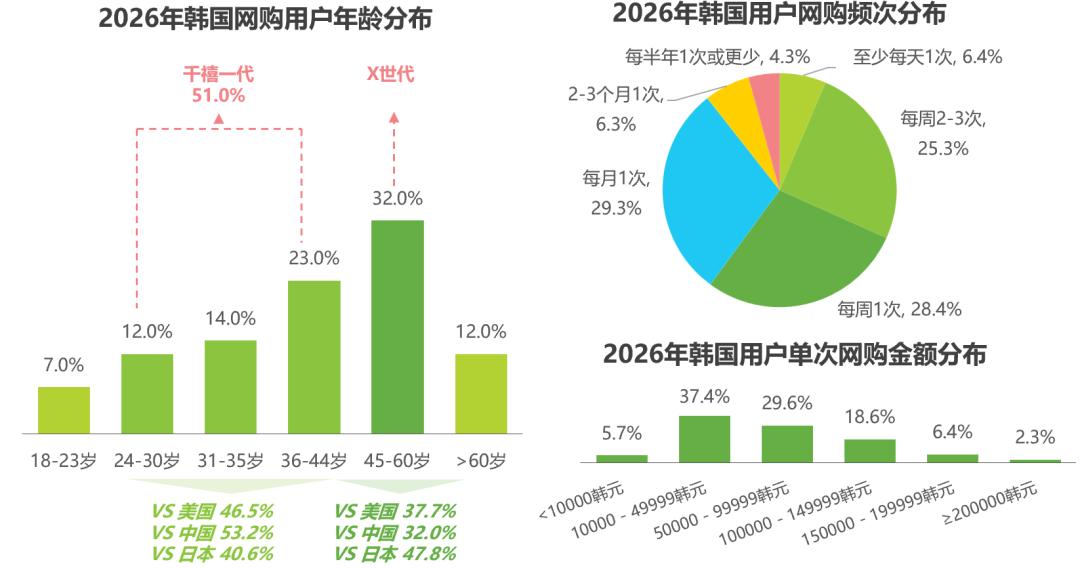
Surveys show that among the online shopping consumer groups in South Korea, millennials account for more than half, and together with the middle - aged group represented by Generation X, they account for more than 80%. Compared with the United States and Japan, the age structure of online shopping users in South Korea is younger, and it is similar to that of Chinese online shopping users, mainly composed of middle - aged and young people. The main group focuses on consumption quality and service efficiency. In terms of purchase frequency, South Korean users show extremely high stickiness to online shopping, with more than 60% of users shopping online at least once a week. The high - frequency online shopping habit has deeply penetrated into daily life. In terms of the average order value, South Korean consumers also perform outstandingly. 48.2% of users have a single - purchase amount in the medium - to - high range of 50,000 - 149,999 Korean won (equivalent to 230 - 690 yuan). This means that South Korean consumers not only shop frequently but also are willing to pay medium - to - high prices for quality products, with solid consumption ability and prominent market potential.
Source: N = 700; obtained through an online questionnaire survey in May 2026. Statista, and self - research and drawing by iResearch Institute.
Decision - making Factors
Efficiency is paramount. Logistics speed is not only a competitive barrier but also a basic element for reaching and retaining users.
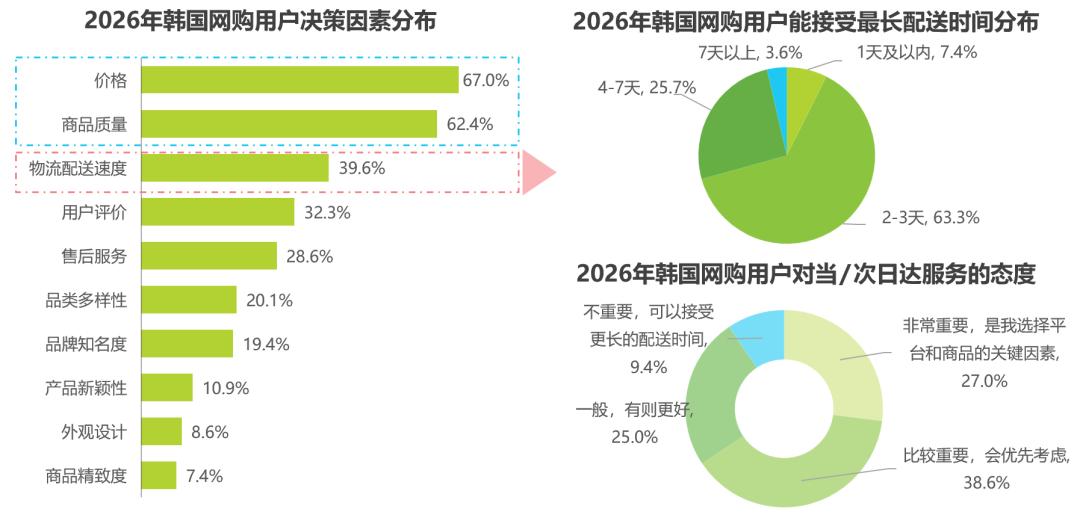
In the factors influencing online shopping decisions, price and quality are the basic thresholds. Logistics delivery speed ranks third with 39.6%, significantly higher than factors such as after - sales service and brand awareness. This shows that South Korean consumers regard fast delivery as a core part of their shopping decisions rather than an additional item. From the perspective of the acceptance of delivery time limits, most users can accept a maximum delivery time of 2 - 3 days, and 7.4% of users can accept same - day delivery at most. It can be seen that South Korean consumers have relatively high requirements for timeliness. In addition, it is worth noting that users have a rigid demand for same - day/next - day delivery. 65% of users regard same - day/next - day delivery service as a prerequisite for order - placing decisions and platform selection. This also means that if same - day/next - day delivery service cannot be provided, more than 60% of potential consumers may be lost.
Sample: N = 700; obtained through an online questionnaire survey in May 2026.
Category Preferences
South Korean people prefer to buy daily household items, fashion clothing, and health and technology consumer products online, which are highly consistent with China's export advantages.
Among the categories that South Korean consumers buy online, food and beverages, as daily basic consumption, account for the highest proportion, followed by fashion clothing, daily household items, and health and technology consumer products. This preference is also highly consistent with China's export advantages. China has obvious advantages in exporting clothing, shoes, hats, and daily necessities, followed by electronic and electrical products. It is also worth noting that the demand for sports and outdoor products in South Korea has reached a certain scale, but China's export share is relatively low, and there is still room for improvement. In addition, the current online shopping share of auto and motorcycle parts in South Korea is still low, while China has a supply - chain advantage. As the habit penetrates and the access threshold is cleared, this category is also expected to become a high - growth track in the future. Generally speaking, due to the close trade between China and South Korea, most consumer goods in South Korea are imported from China, and China is leading the trend in the field of AI and high - tech related consumer products. Therefore, Chinese goods have the dual advantages of natural supply - chain and trend - leading, which can better meet the needs of South Korean consumers.
