Google borrows another 80 billion. Is it a continuation of the market trend or a touchstone for the bubble?
The full-stack AI star stock, Google (GOOGL.US), has seen a recent slump in its stock price. Just then, the company announced a new external fundraising of $80 billion to be invested in AI infrastructure. In the past year, Google raised over $85 billion through bond issuances in six different markets, but this fundraising amount is the largest in a single round.
As for how the money will be used, the company has given a general idea: The new $80 billion fundraising will mainly be used to expand the scale of AI infrastructure, purchase call options to partially hedge the future equity dilution impact of convertible preferred stocks, and pay taxes on behalf of employees when their stock options vest.
Ultimately, the essence of the fundraising is to invest in AI to maintain a smooth cash flow for daily operations. Regarding this financing, Dolphin Research believes there are several points worth discussing:
1. What is the maximum budget for the “significant increase” in Capex in 2027?
As a giant with a quarterly operating cash flow (OCF) of $40 - $50 billion, $126.8 billion in cash + short - term investments on the books, $25 billion in short - term commercial paper, and $77.5 billion in long - term interest - bearing debt, and a net cash of $25 billion under strict standards, theoretically, it can barely afford a Capex of up to $250 billion a year.
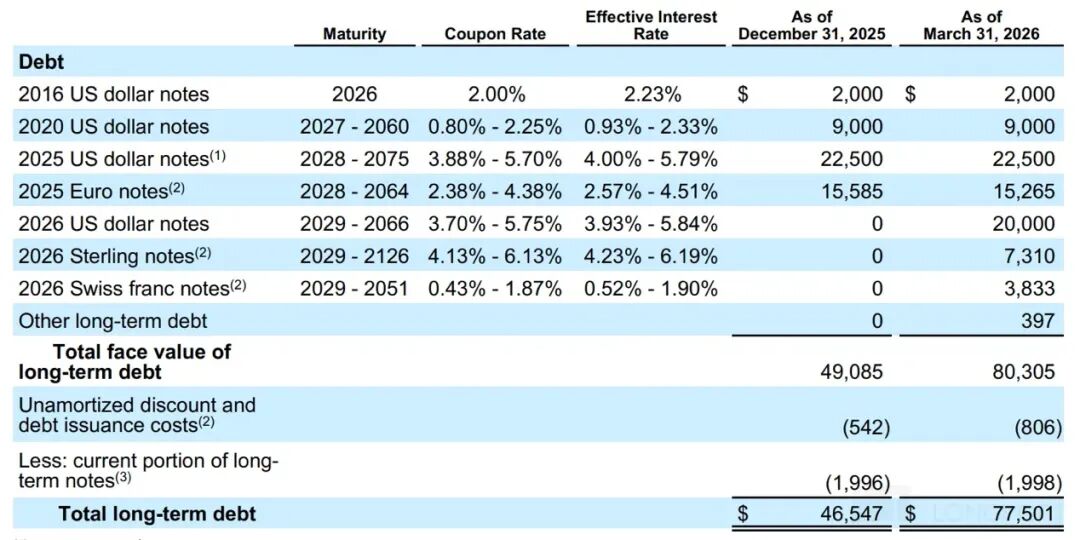
Unless Google's investment budget for next year exceeds $250 billion, then the company's reserves are running low, and the urgency for financing arises. In the Q1 earnings report, management guided that the Capex target for 2026 is between $180 - $190 billion, and it is expected that the investment in 2027 will “significantly increase.”
After this $80 billion fundraising, assuming no further financing in the future, the maximum theoretical space available for next year's Capex is —
That is, $240 billion in OCF in 2027 (expected to increase by 20%) + $80 billion in fundraising = $320 billion, and if we add the $25 billion in net cash at full throttle, that's nearly $350 billion in funding. This is almost double the 2026 budget.
2. Why does Google need to continue to increase investment?
It is necessary for Google to increase investment in AI basic computing power. In the AI giant battle, Google's full - stack AI strategy has reaped dividends, but at the same time, it has made enemies on all fronts — cloud services (Amazon, Microsoft, and Neocloud); AI chips (Nvidia, Amazon); large models (Anthropic, OpenAI), and also in the AI application scenario of autonomous driving, where Waymo competes with Tesla.
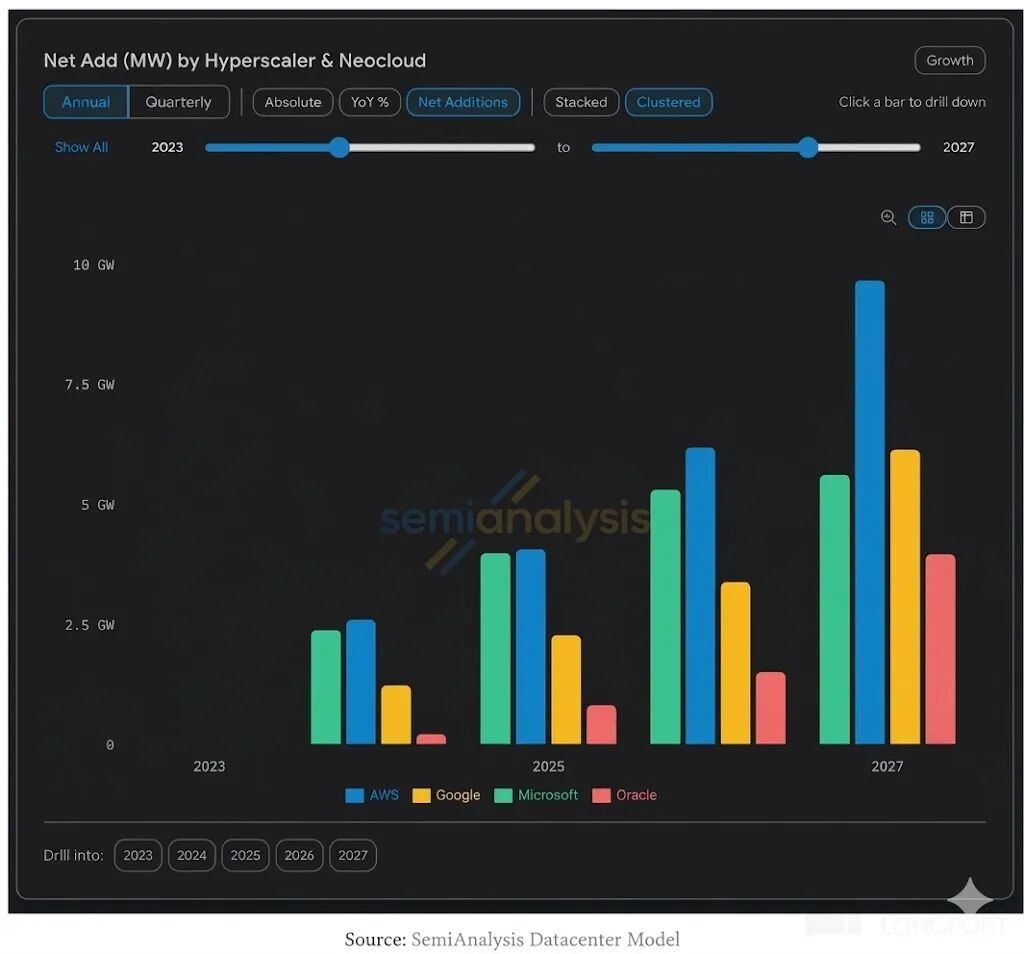
However, judging from the current data center investment, Google's investment and construction capacity cannot keep up with its ambitious goals. According to SemiAnalysis' statistics at the end of May (as shown in the figure below), based on the current progress, the incremental data center computing power in 2027 is estimated. Google's new capacity (3GW and 6GW will be added in 2026 and 2027 respectively). Although it has accelerated compared to previous years, it still lags behind Amazon (6GW and 10GW will be added in 2026 and 2027 respectively).
However, the latter is not obsessed with the full - stack AI strategy. For example, in the fields of self - developed large models and autonomous driving, Amazon has not been deeply involved. Currently, Trainium still lags behind the first - tier chips in performance, and the signed orders are limited.
In contrast, Google has a total of $460 billion in outstanding orders for its cloud + chip business. Therefore, from a strategic perspective, taking Amazon's computing power capacity as a reference, Google still needs to increase its investment in basic computing power.
3. Will the $8 billion financing dilute the equity value?
Finally, let's take a look at the specific details of the $8 billion financing plan. This financing is divided into three parts:
(1) An ongoing $3 billion share offering + ($450 million over - allotment): It includes $1.5 billion in convertible preferred stocks (issued in two batches and convertible into common stocks after three years) and a $1.5 billion share offering of Class A/C common stocks. This money will mainly be used for AI investment and purchasing call options.
The company has granted the underwriters participating in the Class A/C common stock offering a 30 - day over - allotment option to purchase an additional $2.25 billion worth of stocks. At the same time, it has also granted the underwriters participating in the convertible preferred stock offering an equivalent $2.25 billion over - allotment option within 13 days after the issuance.
(2) A $4 billion share offering to be gradually implemented in the future: A sales agreement has been signed with Goldman Sachs, JPM, and MS. It is expected that starting from the third quarter of 2026, Class A/C common stocks will be issued on the secondary market at market prices through the above - mentioned brokers on an irregular basis.
This money will mainly be used for tax withholding when employees' stock options vest. When Google provides equity incentives to employees, it will deduct the tax value corresponding to a portion of the shares and then use its own cash to pay the taxes on behalf of employees. The $4 billion to be gradually raised in the future can make up for the cash shortfall.
(3) A private placement of $1 billion: Berkshire Hathaway subscribed for $1 billion at a 6.5% discount to yesterday's closing price, including $500 million in Class A stocks and $500 million in Class C stocks. (Class A stocks have voting rights, while Class C stocks do not)
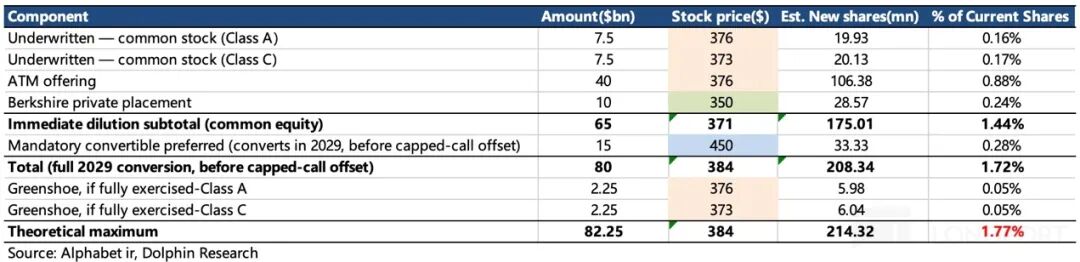
When calculating the dilution rate, for the $1.5 billion Class A and C common stock issuance in part (1) above, we calculate the issuance price based on yesterday's closing price (Class A: $376 per share; Class C: $373 per share). For the convertible preferred stock part, the conversion price is calculated at $450 per share (a general market premium rate of 20%).
The $4 billion in part (2) is calculated based on the current price (yesterday's closing price); for part (3), since the issuance price is set, Class A at $351.8 per share/Class C at $348.2 per share, that is, an average of $350 per share.
As shown in the figure below, when the Q1 earnings report was released on April 22, Google had 5.824 billion Class A + 836 million Class B + 5.456 billion Class C, a total of 12.1 billion shares. Under the above - mentioned financing plan, the current dilution ratio is 1.44%. Including the potential conversion of shares in the future, the dilution ratio reaches 1.72%. However, if the two $225 million over - allotments are fully utilized by the brokers, the total dilution ratio reaches 1.77%. If we consider that the company is simultaneously purchasing call options for hedging, then theoretically, the total dilution ratio should be less than 1.77%.
4. When everyone is on board...
Last year, several software giants among the “Magnificent Seven” started the path of raising tens of billions of dollars. Of course, for these trillion - dollar giants, the theoretical dilution ratio of their individual multi - billion - dollar financings is not high, and the impact is negligible. On the contrary, there are only a few Chinese concept stocks with a market value of over $50 billion.
The key issue is the scale of the incremental funds absorbed from the market. When other giants start to gradually increase their bond issuances from $10 - $20 billion to $50 - $100 billion, it will only siphon off small and medium - cap stocks in the outer ring of AI.
Regarding whether there is a bubble in AI investment, both the bulls and the bears have their own reasons. Without delving into whether there is a bubble in the industry itself, when more and more end - enterprise customers can't figure out the AI accounts, the sentiment still doesn't seem to be ebbing.
It's true that currently and even in the next 1 - 2 years, the performance and orders of AI hardware are real, which has doubled the stock price while the valuation doesn't seem to have increased too exaggeratedly. But the key question is, when the most cautious investors also give in and get on board, where will the incremental funds come from?
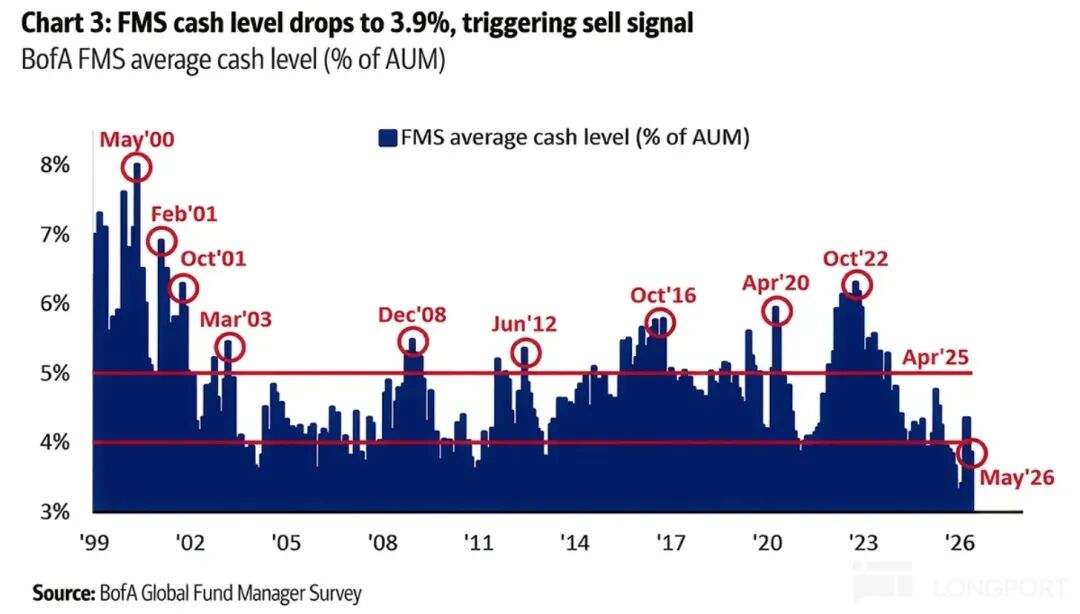
As is well - known, there will be even greater siphoning in the future. SpaceX will take the lead next week (with a latest valuation of $1.8 trillion), Anthropic next month (with a latest valuation of $0.965 trillion), and OpenAI at the end of the year (with a latest valuation of $0.852 trillion).
When the concentration of giants exceeds one - third, and the US stock market with a total value of $70 trillion (a 10% increase compared to last year, but the interest rate outlook is not conducive to continuously attracting incremental funds) needs to accommodate three more trillion - dollar giants, a deeper reshuffle and contraction will come:
On the one hand, more assets outside the winning circle will become the “blood bags” to be abandoned. On the other hand, after the extreme sentiment reverses, some funds will seek re - balance from high - to - low.
This article is from the WeChat official account “Dolphin Research” (ID: haituntouyan), author: Dolphin Research. It is published by 36Kr with authorization.