220 US unicorns can't hold on anymore.
According to a report by CNBC yesterday, a list exclusively provided to it by private - market data firm PitchBook shows that nearly half of the 857 unicorn startups in the United States have not raised new funds in three years. More than 220 companies that once reached a valuation of $1 billion (approximately 6.77 billion yuan) are now considered "fallen unicorns" due to a significant shrinkage in valuation.
Most of these companies were founded before the emergence of ChatGPT in 2022. Now, they are rejected by venture capital due to inflated valuations and outdated technologies, and fail to meet the listing threshold due to insufficient profits, thus falling into a dilemma.
What drives this reshuffle is the transformation of software development methods by generative AI. Investors told CNBC that the work that used to require 500 engineers can now be done by 50. Venture capital institutions have to re - evaluate the value of these companies. According to PitchBook's estimates, the average valuation of companies that completed their last round of financing in 2021 has shrunk by 68%; for those that last raised funds in 2022, the average decline is 52%.
For most "fallen unicorns", the most likely outcome is to be acquired at a price far lower than their peak. There have been several cases of discounted mergers and acquisitions this year, and enterprise - level software (SaaS) companies, which are most affected by autonomous AI agents, are the largest group on this list.
01 The logic of venture capital has been completely rewritten after the emergence of ChatGPT
Five years ago, venture capital institutions rushed to invest in various startups in the United States, covering many categories such as underwear subscription and schedule management software. Most of these enterprises were given valuations in the billions of dollars even before they made a profit.
Investors told CNBC that it was a bubble period created by cheap capital and the surge in demand during the pandemic. Even after the Federal Reserve started raising interest rates in 2022 to squeeze the industry bubble, many founders still believed they could digest the inflated valuations through business growth.
Then, an application called ChatGPT emerged. Samir Kaul, a partner at venture capital firm Khosla Ventures and an early investor in OpenAI, said that the emergence of ChatGPT made people realize that the programming language for the next - generation entrepreneurs is spoken English. He mentioned that now 50 engineers can do what used to require 500 people five years ago, so they have to completely rearrange the valuations of these companies.
Meanwhile, the stock prices of listed software companies such as Salesforce, ServiceNow, and Workday have been under pressure this year due to AI threats. In the private market, a quieter liquidation is underway. Driven by this round of AI boom, more than $250 billion (approximately 1.69 trillion yuan) has flowed into OpenAI and Anthropic, promoting the two companies to prepare for a giant IPO this year. Hundreds of startups founded before the birth of ChatGPT have been neglected.
Early this morning, Anthropic issued a brief statement announcing that it had secretly submitted a draft S - 1 to the U.S. Securities and Exchange Commission. This marks its official launch of an IPO (Initial Public Offering).
02 Nearly half of the unicorns have not received new financing in three years, and the valuations of more than 220 have significantly shrunk
PitchBook data shows that nearly half of the 857 U.S. unicorns have not received new financing in the past three years, and their original valuations have become invalid. Based on the growth of personnel scale and comparison with listed companies, the company believes that more than 220 companies that once reached a valuation of $1 billion have become "fallen unicorns".
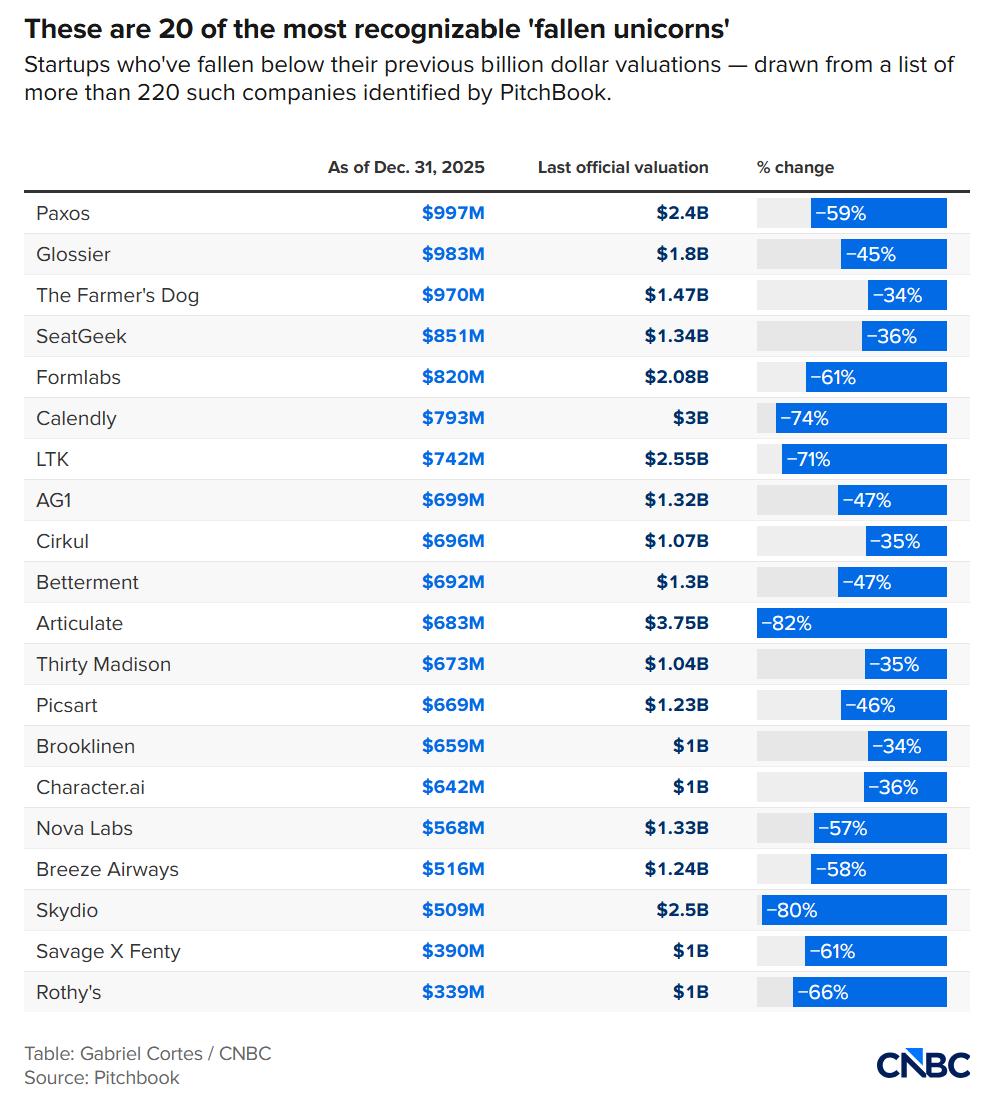
▲ Details of valuation changes of 20 representative "fallen unicorns" with shrinking valuations (Source: CNBC)
This list includes well - known brands, such as beauty brand Glossier, pet food company The Farmer's Dog, women's shoe brand Rothy's, home textile brand Brooklinen, and lingerie brand Savage X Fenty founded by singer Rihanna. Nutrition powder supplement brand AG1, pioneer of robo - advisors Betterment, and online ticketing platform SeatGeek, which are frequent guests in podcast advertisements, are also on the list.
These enterprises belong to the DTC (Direct - to - Consumer) startup wave. Their original intention was to rely on online retail to achieve high profit margins comparable to those in the software industry. During the growth stage of these enterprises, the industry gave sky - high growth valuations based on two major predictions: interest rates would remain low, and the companies could always be acquired because of their engineering teams.
Samir Kaul of Khosla Ventures said that during the bubble period, large companies acquired startups mainly to absorb R & D personnel. Calculated at about $2 million (approximately 13.54 million yuan) per programmer, a company with 100 engineers could have a minimum valuation of $200 million to $300 million (approximately 1.35 billion to 2.03 billion yuan).
However, after the emergence of AI programming tools, small teams can develop products independently. This acquisition logic that underpinned the valuation no longer exists, and the exit channels for enterprise mergers and acquisitions have been significantly narrowed.
The arrival of generative AI has reshaped the venture capital landscape. Capital continues to flow to AI - native enterprises, and many established startups can no longer support their previous high valuations.
Immad Akhund, CEO of Mercury, which provides banking services to one - third of early - stage venture - capital - backed startups in the United States, told CNBC that these enterprises were born before the popularization of AI, and their cost structures and product designs are outdated. He said that all the attention of capital is now on AI. If a non - AI - native enterprise wants to raise funds, it has to show very impressive operating data to get the money. Mercury just completed a $200 million (approximately 1.35 billion yuan) financing last month.
03 As the tide of the bubble recedes and AI disrupts, enterprise - level software companies have become the hardest - hit area of "fallen unicorns"
The most affected are enterprise - level software companies, such as U.S. online scheduling software company Calendly. Such companies form the largest category of "fallen unicorns". There are 75 SaaS (Software as a Service) companies on the PitchBook list, twice the number of fintech companies in second place.
This situation not only reflects the sky - high valuations of software startups during the 2021 financing bubble period but also shows that generative AI has shaken the business logic on which the industry depends.
David Zhu, former engineering director of food delivery platform DoorDash, said that after the emergence of ChatGPT, he examined the entire software landscape from startups, medium - sized enterprises supported by private credit to the largest listed SaaS companies and saw an impending upheaval. His judgment is that all enterprise - level SaaS companies driven by workflows will either be disrupted or die in the next decade.
The SaaS model, which charges users by the number of users and embeds itself in employees' workflows, is being threatened by the rise of autonomous AI agents. David Zhu led more than 200 engineers at DoorDash and founded AI platform Reevo for automating enterprise sales and marketing teams after leaving.
He believes that companies established in the pre - generative AI era are dragged down by bloated personnel models and outdated software, and the resistance to transformation is huge. In his opinion, unless they completely change direction and reconstruct products from scratch, these enterprises will gradually decline. Capital is more willing to invest in new entrepreneurs at a low price rather than add to established startups.
04 The crisis of "fallen unicorns": plummeting valuations, drying - up financing, and discounted acquisitions as the last resort
Most of the 20 "fallen unicorns" highlighted by CNBC either did not respond to requests for comments or refused to comment.
According to PitchBook's estimates, the valuation of drone manufacturer Skydio has dropped from $2.5 billion (approximately 16.93 billion yuan) to $509 million (approximately 3.45 billion yuan). A spokesman for the company said that this third - party valuation is baseless and does not match the company's actual business situation of high - speed revenue and customer growth. A few weeks later, Skydio announced that it had completed a $110 million (approximately 740 million yuan) financing through existing investors, and its valuation rose to $4.4 billion (approximately 29.79 billion yuan).
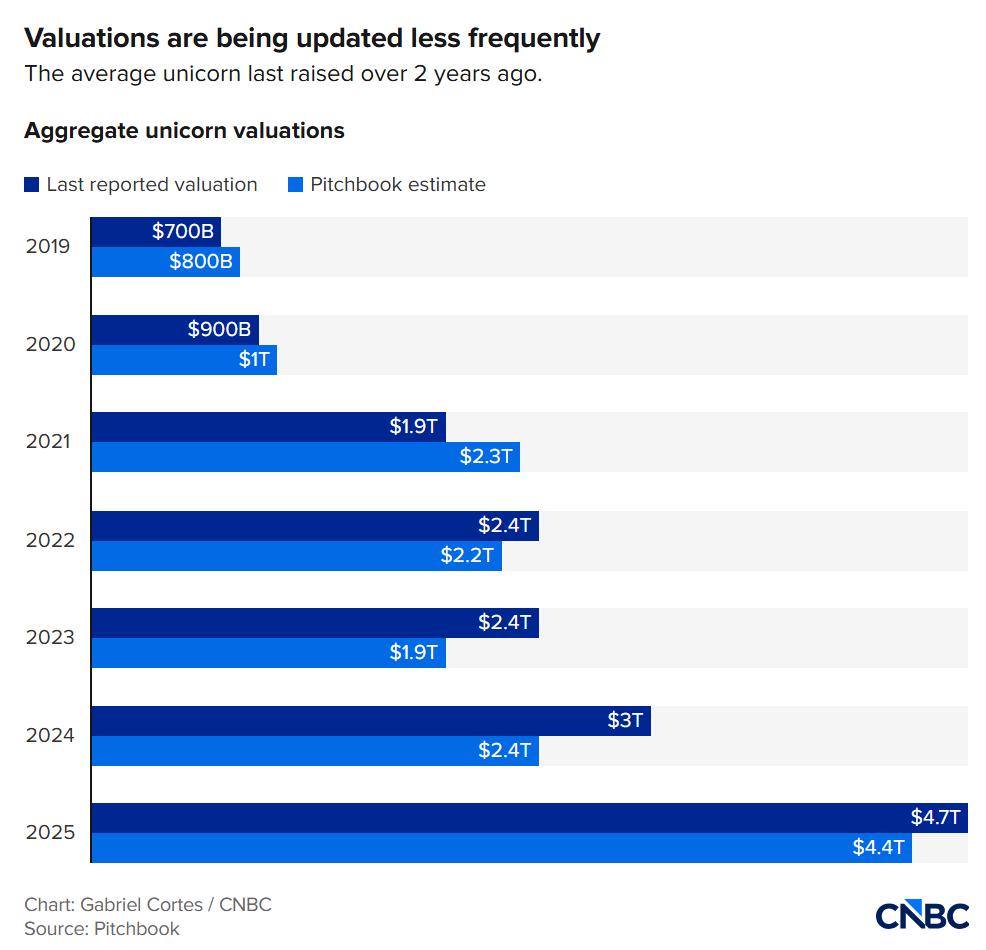
▲ Comparison of the overall valuation changes of U.S. unicorn enterprises over the years. Dark blue represents the last officially announced valuation of the enterprise, and light blue represents the valuation estimated by PitchBook (Source: CNBC)
Nutrition powder supplement brand AG1 refused to comment, but after CNBC's inquiry, Reuters reported that the company is seeking to sell part or all of its business at a valuation of $2 billion (approximately 13.54 billion yuan).
Industry investors and founders said that if a company has not raised funds since 2021 or 2022, it is likely that it won't be able to raise funds in the future. In the absence of venture capital and a viable IPO path, the most likely exit way for most "fallen unicorns" is to be acquired at a fraction of their peak valuations.
Andrew Akers, an analyst at PitchBook, said that a company's halt in financing is a dangerous signal, usually indicating stagnant growth or even a decline in revenue. Although some companies don't need to raise funds because of high profits, that's an exception. He judged that there are still many "dominoes" that will fall below the surface.
This year, there have been signs of valuation reset for some startups. In February, financial savings app Stash was acquired by Singaporean super - app Grab at an enterprise value of $425 million (approximately 2.88 billion yuan), lower than the approximately $660 million (approximately 4.47 billion yuan) invested by investors during its life cycle.
In the same month, fintech company Step was acquired by YouTube influencer MrBeast for an undisclosed amount. Investors speculated that the transaction price was far lower than the approximately $500 million (approximately 3.39 billion yuan) previously raised by this startup.
Ryan Falvey, a partner at Restive Ventures, which specializes in fintech investment, said that the actual value of such enterprises has shrunk significantly, so they can only be acquired at a discount.
Falvey told CNBC that the industry valuation has shrunk by five - sixths from the peak of 50 times the forward revenue in 2021. Enterprises with the same revenue volume now have a valuation about 85% lower than they did five years ago.
05 Conclusion: The storm is far from over. AI's reconstruction of the industry has just toppled the first domino
Falvey said that startups founded after the birth of ChatGPT have developed far better than established competitors. The investments in new AI projects in the past three years have been the most profitable layout for institutions. Falvey said that in 2023, they found that the projects invested in after ChatGPT had already made more profits than most of the early - stage existing projects. Generative AI may significantly lower the threshold for startup capital of high - quality software enterprises and shake the core logic of the venture capital boom in the past decade.
This reshuffle may have just begun, and the impact of AI is spreading along the entire financing chain from venture capital, private credit to listed giants. Kaul said that established software companies still rely on the model of charging customers by the number of users, and this model will be weakened by AI as enterprises automate more white - collar jobs. He believes that software service providers need to switch to pricing based on implementation results and build an AI - native underlying architecture to survive.
This article is from the WeChat official account "Zhidongxi" (ID: zhidxcom). The author is Chen Jia. It is published by 36Kr with authorization.