Kuaishou and ByteDance are gearing up for a second battle.
In the first quarter of 2026, Kuaishou's live - streaming revenue was 8.49 billion yuan, a year - on - year decline of 13.5%.
This is the lowest level in 16 quarters, almost returning to the level at the beginning of its listing.
Like other live - streaming platforms, Kuaishou's users also don't like to give tips anymore.
The stagnant growth of its second - largest business has brought new changes to Kuaishou's ecosystem. Kuaishou has to break out and break through ByteDance's encirclement.
The Declining Live - streaming Business
The live - streaming business is on a downward trend, which can be seen from many platforms.
Momo's revenue has declined for six consecutive years, Douyu for five consecutive years, YY for four consecutive years, and Huafang Group has delisted. Whether it's live - streaming of talent shows or games, the fact that viewers are reluctant to give tips is a common phenomenon.
Kuaishou is no exception. In the first quarter of 2026, Kuaishou's live - streaming revenue dropped significantly. The live - streaming revenue of 8.49 billion yuan is the lowest since the second quarter of 2022.
Even if we exclude the first quarter, looking at the past revenues, Kuaishou's live - streaming business has remained between 9 and 10 billion yuan in recent years, with little change.
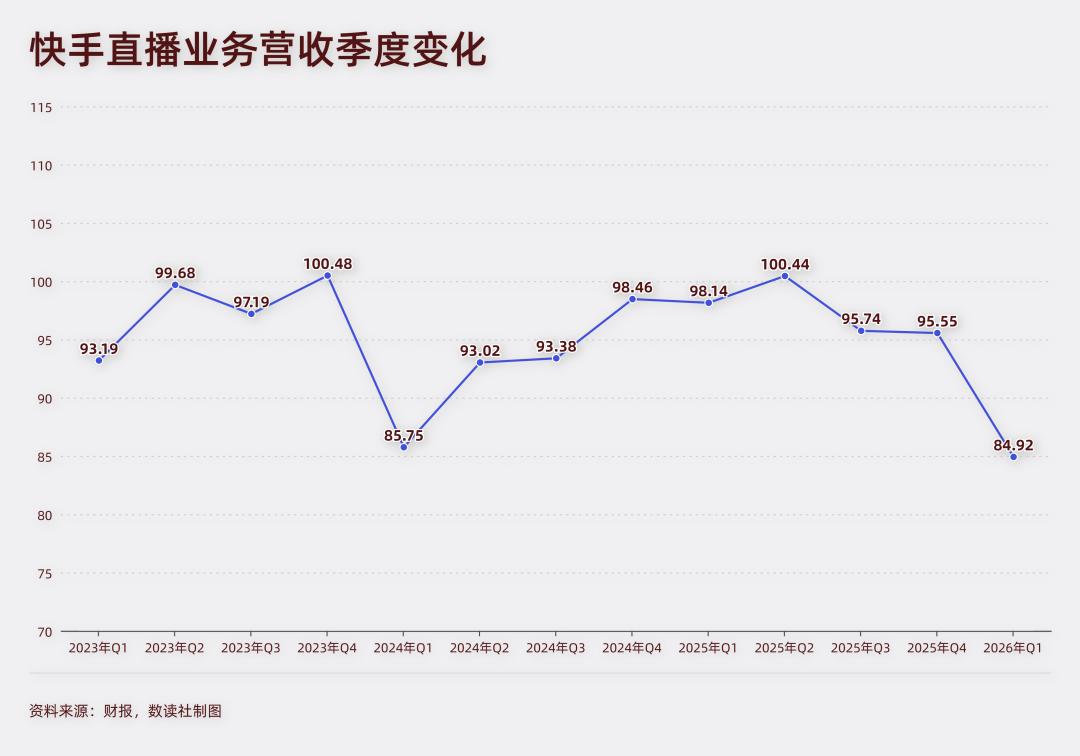
This is the general trend of the industry. Users don't have much money to spend, and the live - streaming business model has become less novel after years of operation.
However, Kuaishou also has its own unique situation.
On the evening of December 22nd last year, a large amount of vulgar content suddenly appeared on the Kuaishou platform. Obscene pictures and vulgar language spread wantonly, and some live - streaming rooms had tens of thousands of viewers.
This incident ultimately led to Kuaishou being fined 119.1 million yuan.
This will lead to an obvious direction - Kuaishou will strengthen the rectification of its live - streaming ecosystem. This will in turn lead to the convergence of chaotic phenomena such as late - night "borderline" live - streaming.
In a good way, this is beneficial to Kuaishou's ecological governance, but in a bad way, it will affect Kuaishou's revenue in the short term. Kuaishou mentioned in its financial report that the decline in live - streaming revenue is due to "continuous efforts to build a rich and healthy live - streaming ecosystem and diversified high - quality content."
To put it bluntly, "borderline" content is a key factor to stimulate users to give tips. The crackdown on this gray area has largely led to the decline in live - streaming business revenue.
Previously, platforms like Kuaishou and Bilibili largely relied on this model to maintain their live - streaming business revenue.
Xinhuanghe once reported on the chaos of late - night "borderline" live - streaming. Among them, Kuaishou and Bilibili were highlighted. On Kuaishou, some anchors used "borderline" live - streaming to attract traffic, implying that they would provide porn - related or nude performances and videos.
In addition, Kuaishou was ordered by the court to compensate 89.1 million yuan for unauthorized broadcasts of the first and second seasons of "Deyun Douxiao Club" and the first season of "Longing for You".
The unworkable gray area has affected Kuaishou's revenue. But it's not just that. The peak of the live - streaming ecosystem will also affect the entire creator ecosystem.
Ecosystem Synergy
Kuaishou tells a story of an ecosystem driving business.
The traffic generated by the content ecosystem, centered around traffic, generates revenue through online marketing services and the live - streaming business.
Online marketing relies on the payment of multiple roles such as creators and merchants. Kuaishou divides it into e - commerce and non - e - commerce parts. The e - commerce business mainly includes live - streaming e - commerce, etc., and the non - e - commerce business includes content consumption, life services, and the AI application industry.
Kuaishou's traffic ecosystem is at the end of its expansion stage.
The daily active users are growing slowly. In the first quarter, the number of daily active users was 413 million, a year - on - year increase of 1%. The growth rate has been slowly declining. The number of monthly active users was 772 million, a year - on - year increase of 8%. This quarter's data is impressive, but looking back at more quarters in the past, the general trend is still a decline in the growth rate.
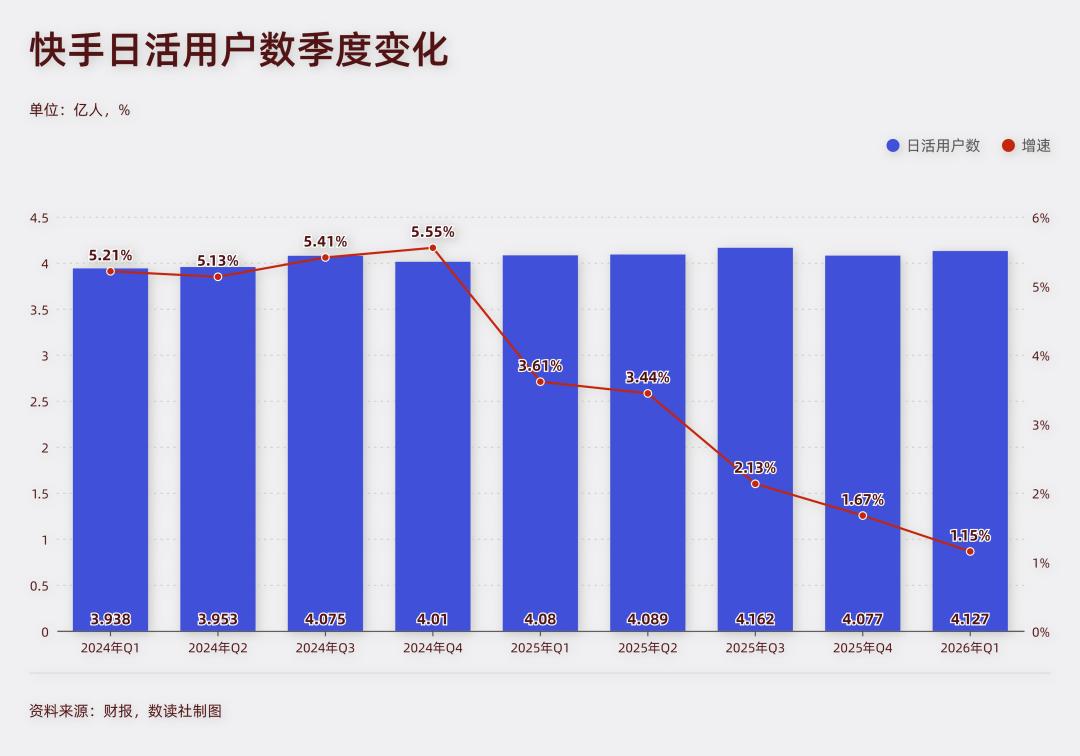
This is a problem that all platforms need to face at a certain stage of development. Once the growth stagnates, it will have an all - around impact on the ecosystem.
The growth rate of live - streaming e - commerce has declined. Since this quarter, Kuaishou has stopped announcing the GMV of its e - commerce business. Considering the previous development status, Kuaishou's e - commerce is still growing at a double - digit rate, but the growth rate has dropped to 12.9% in the fourth quarter of last year.
In January this year, Kuaishou's independent entrance for takeout was officially taken offline, exiting less than a year after its launch. The local life service business has always been difficult to compete with Meituan and Douyin, and it's even more difficult to break through in the context of stock competition.
Content marketing is the last stronghold. The revenue in the first quarter was 19.64 billion yuan, a year - on - year increase of 9.3%, and the growth rate has dropped to single - digits.
The willingness to pay for content has a key prerequisite. Each paying entity needs to obtain an ROI that meets its ideal expectations.
For many content creators, as the traffic pool gradually shifts from incremental to stock, it's more difficult to obtain traffic than before, and the ROI will decrease accordingly.
The decline of the live - streaming tip business is a signal that further puts pressure on the ecosystem. Although the live - streaming tip business only accounts for 25% - 30% of the revenue, the main players in this part of the business are the guilds with the most content productivity and the anchors with the strongest marketing willingness.
Kuaishou has a revenue - sharing model for live - streaming tips. The decline from 10 billion to 8.5 billion means that the guilds and anchors receive fewer tips. The introduction of guilds is an important means for Kuaishou to stabilize the live - streaming business. However, if the live - streaming revenue sharing continues to decrease, it will hit the survival of the guilds and then affect the survival of the anchors.
A speck of dust on the platform may be like a "mountain" of a significant income reduction for an individual.
The contraction of the live - streaming ecosystem may result in anchors leaving or guilds facing difficulties, which will affect the short - video ecosystem and the live - streaming e - commerce ecosystem. Therefore, in the first quarter, although Kuaishou achieved growth, the growth rate of 3.4% is a new low.
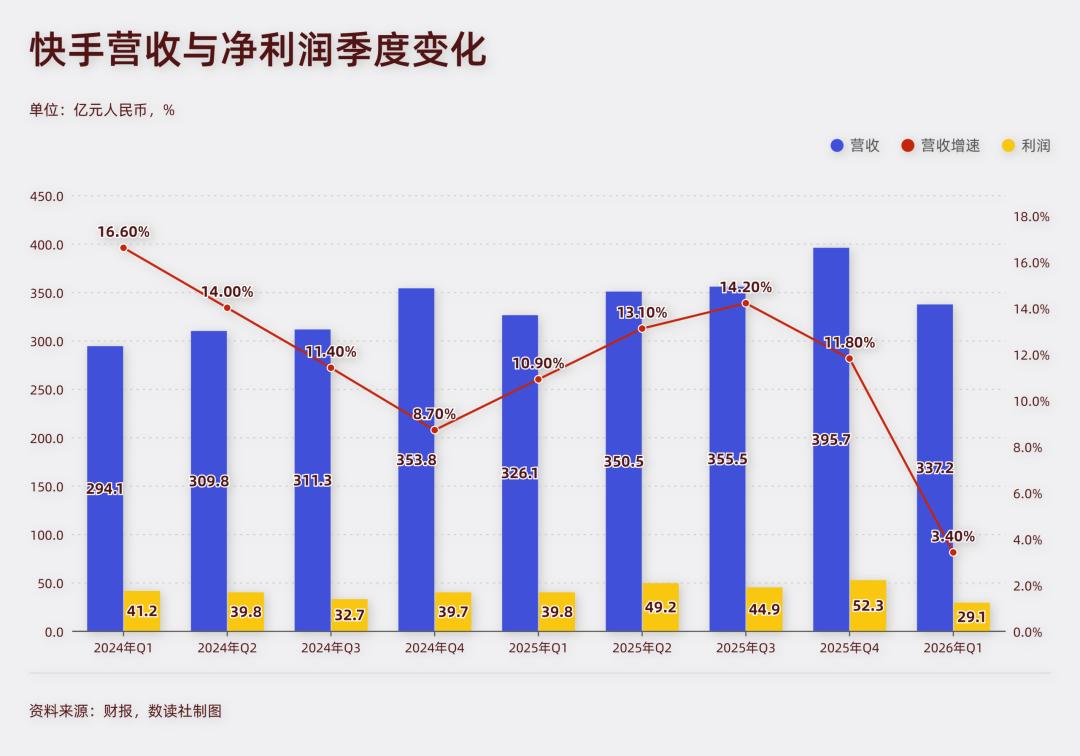
The core of all this is the slowdown of overall traffic growth. The fuse of the ecological problem is that the money earned from live - streaming tips has decreased, which will in turn lead to the survival problems of guilds and anchors.
Going Head - to - Head with ByteDance
In the stage of transition from incremental to stock, increasing the amount of user payment is an important countermeasure for the platform.
Kuaishou has been relatively successful in this regard. The average revenue per daily active user has always maintained a year - on - year increase. In the first quarter, it was 47.6 yuan, an increase of 3.5 yuan year - on - year, still maintaining a relatively high growth rate.
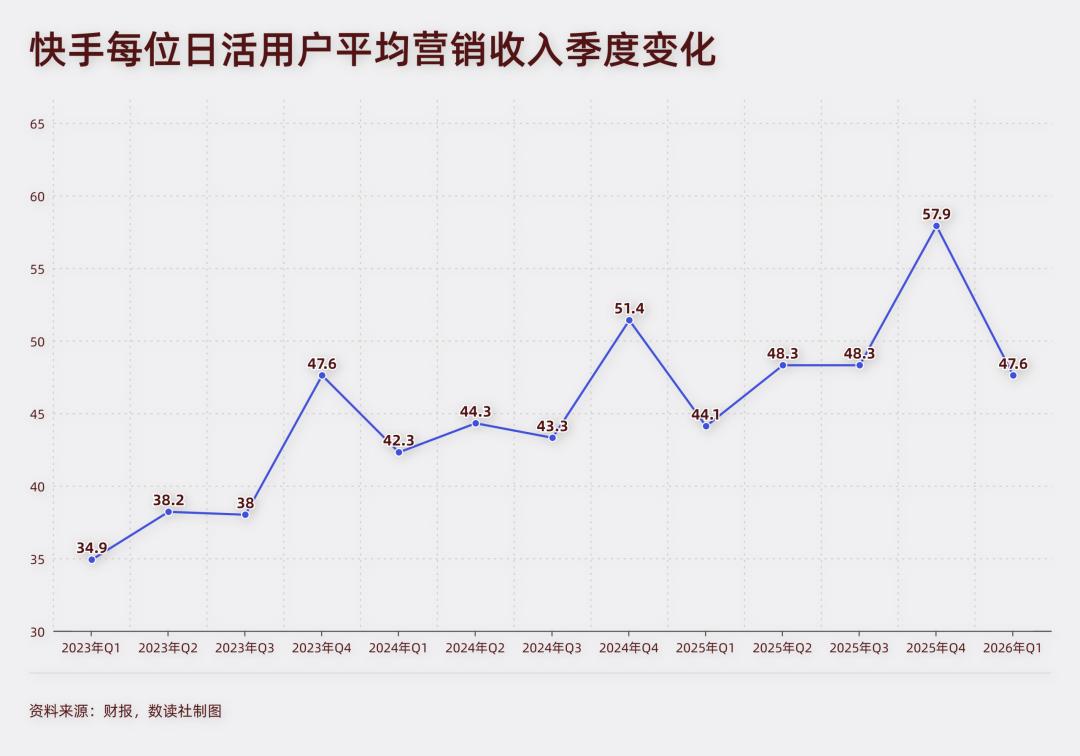
The key to the growth of this indicator is AI.
The main mechanism of AI is to serve as a tool and penetrate all aspects of the business. For example, in terms of content, it lowers the threshold of content production and enriches content forms (such as AI comic dramas and AI virtual scenes). As the content supply increases, the marketing demand will also increase. In marketing services, AI empowers the entire cycle of marketing investment, reduces the labor consumption of merchants, and improves service efficiency. In live - streaming, AI assists anchors in interacting and provides digital avatars to enrich the gameplay.
At present, Kuaishou's AI does not directly generate revenue. It's not based on the Token logic, but provides more solutions for the platform through AI, enriches the platform's content supply and service supply, and thus enhances the willingness to pay.
However, such an effect is still too slow to provide substantial support for Kuaishou.
Kuaishou is also trying to break out of the inherent thinking. Keling is the most important breakthrough.
In June 2024, Keling was officially launched. Its technical route is benchmarked against Sora, with functions such as text - to - video and image - to - video, and provides creative tools such as video continuation and multi - modal editing. Keling adopts a direct - charging model. The platform has set three categories and charges according to the generated videos, breaking the old business model.
In the first quarter of 2026, the revenue generated by Keling AI exceeded 650 million yuan, a year - on - year increase of more than 300%. In March 2026, the annualized revenue run - rate (ARR) of Keling AI was nearly 500 million US dollars. It's already very successful to achieve such a scale in two years. However, the current ARR is only about 2% of Kuaishou's annual revenue. Keling needs more freedom.
According to previous media reports, Kuaishou is considering spinning off Keling AI and starting financing at a valuation of 20 billion US dollars. Kuaishou subsequently announced that the board of directors is evaluating the plan to restructure the relevant assets and business of Keling AI, which may involve external financing, but it's still in the preliminary stage and no final agreement has been signed.
This indicates that Kuaishou has transformed from a short - video platform to an AI - focused one.
At this point, Keling and ByteDance are once again on the opposite sides of the competition.
In February this year, ByteDance released Seedance 2.0, which became popular from overseas to China and was the hottest AI product during the Spring Festival. Kuaishou took advantage of the situation to launch the Keling 3.0 series of models. The two together set off a national creative wave of the "AI director revolution".
It's difficult for Keling to compete with Seedance 2.0. ByteDance's advantages lie in its broader market appeal, larger user base, and stronger large - model foundation. In contrast, Kuaishou's technical ability is not strong enough to be in the first echelon.
This is also the case in the long run. According to the information previously released by Kuaishou, in 2026, Kuaishou's capital expenditure is expected to be 26 billion yuan. In contrast, ByteDance's capital expenditure is as high as 200 billion yuan, and the two are not in the same order of magnitude.
However, it's not bad for Kuaishou's own development. On the one hand, Keling is really making money directly through AI and growing rapidly, and may become a new growth point for Kuaishou in the future. On the other hand, Keling can expand Kuaishou's imagination. While making Kuaishou an AI concept stock, it may also achieve breakthroughs overseas with AI tools. In the financial report, Kuaishou has mentioned that Keling has topped the App Store charts in 42 countries and regions such as Brazil and Germany.
When the short - video landscape has been settled, the ceiling of Kuaishou's closed ecosystem is already visible. Currently, users' willingness to pay is decreasing, and the growth of the traffic pool has reached its peak. Finding a new support point is Kuaishou's top priority. From product experience and service support to business model innovation, AI is highly expected. Even if it has to go head - to - head with ByteDance and its technology is still lagging behind, this is Kuaishou's best way out.
This article is from the WeChat official account "Shudushe", author: Rousseau, published by 36Kr with authorization.