Zhipu issued a late-night announcement that its twin large models are vying to enter the A-share market.
Last night, Zhipu issued an announcement on the Hong Kong Stock Exchange, stating that the company's board of directors has approved a proposal to issue A-shares. It plans to apply to relevant Chinese regulatory authorities for the allotment and issuance of A-shares and to the Shanghai Stock Exchange for the listing and trading of A-shares on the Science and Technology Innovation Board.
This means that after initiating the A-share listing guidance process in April 2025 and re-filing in February 2026, Zhipu has officially disclosed its A-share issuance plan after its Hong Kong listing.
A few days ago, MiniMax also announced on the Hong Kong Stock Exchange that its board of directors has resolved to explore a preliminary proposal for the issuance of RMB shares and has signed a listing guidance agreement.
Two large model companies that have already listed on the Hong Kong Stock Exchange are pushing their A-share listing plans to the forefront at the same time.
Zhipu Announces Plan to Raise 15 Billion Yuan in the Middle of the Night
At around 11 p.m. last night, the official website of the Hong Kong Stock Exchange updated an announcement, which can be summarized as: Zhipu proposes to issue A-shares and apply for listing on the Science and Technology Innovation Board.
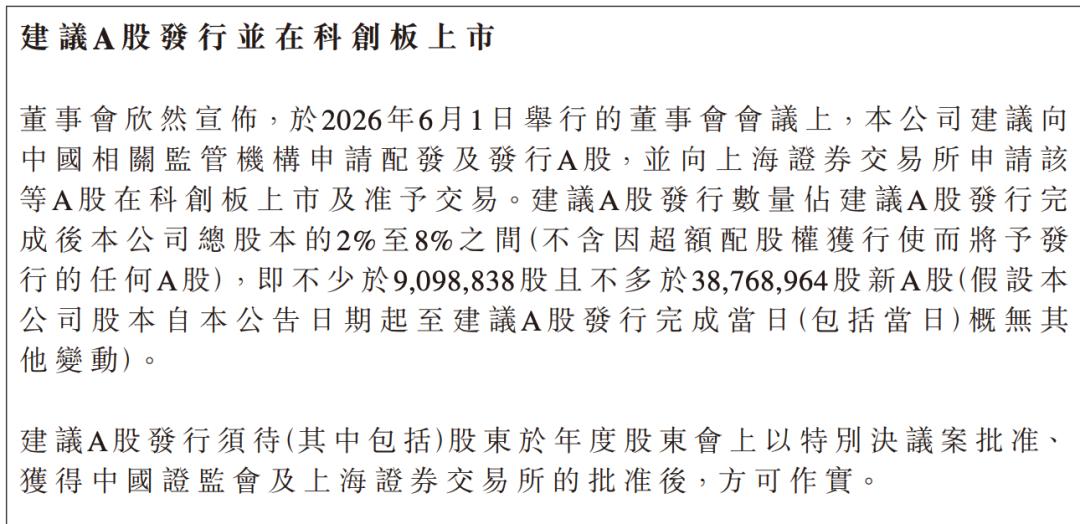
The A-shares Zhipu plans to issue this time are RMB-denominated common stocks listed in the Chinese mainland, with a par value of 0.10 yuan per share. According to the announcement, the number of shares to be issued is estimated to be between 9.1 million and 38.77 million, accounting for 2% to 8% of the total share capital after the issuance. If the over-allotment option is fully exercised, the total number of shares issued can reach up to approximately 44.58 million.
The over-allotment option can be simply understood as, if the market subscription demand is strong, the company and the lead underwriter can issue an additional portion of shares beyond the original issuance scale.
In terms of the issuance target, Zhipu plans to issue the shares to eligible strategic investors, inquiry objects, and domestic investors who have opened science and technology innovation board securities accounts. The issuance methods include offline placement to inquiry objects, online fixed-price issuance to public investors, and placement to strategic investors.
The issuance price will be determined through preliminary inquiry and negotiation by the board of directors and the lead underwriter, or by other methods recognized by the regulatory authorities.
According to the announcement, Zhipu will handle the issuance within 12 months from the date of obtaining the registration document for the A-share issuance from the China Securities Regulatory Commission (CSRC) and will apply for the listing and trading of the shares on the Science and Technology Innovation Board as soon as possible after the issuance is completed. The relevant issuance resolution will be valid for 12 months from the date of approval by the annual general meeting of shareholders. That is to say, this is still a plan that needs to be further promoted by the shareholders' meeting and regulatory review, and it does not mean that the A-share listing has been completed.
In terms of the use of funds raised, Zhipu plans to invest the net proceeds from the A-share issuance in three directions: 12 billion yuan for the general-purpose large model of artificial intelligence, 2 billion yuan for the one-stop service platform for large model MaaS, and 1 billion yuan for working capital, totaling 15 billion yuan.
Among them, the base model accounts for 80% of the fundraising plan, indicating that most of the funds will be invested in the model base rather than general operational replenishment.
When Zhipu listed on the Hong Kong Stock Exchange previously, the use of funds raised also mainly revolved around model R & D, MaaS platform, and commercial infrastructure. In this A-share plan, the base model and MaaS platform still occupy the core position, continuing the investment direction disclosed previously.
From the financial data, Zhipu is still in a stage of high R & D investment. Its revenue in 2025 was 724 million yuan, while its R & D expenditure was 3.18 billion yuan, indicating that the R & D investment was significantly higher than the revenue scale.
Zhipu's annual report shows that its service models mainly include cloud deployment and local deployment. The former corresponds to API calls and the MaaS platform, while the latter is more targeted at the private deployment needs of government and enterprise customers, which is also one of the backgrounds for the plan to invest 2 billion yuan in the "one-stop service platform for large model MaaS".
For base model enterprises, losses mainly come from R & D and computing power investment rather than traditional market expansion costs. Therefore, Zhipu's submission of the plan to bear the accumulated unremitted losses and the impact of diluting the immediate return to shareholders for review is also part of the supporting arrangements for the A-share listing.
Zhipu has also been continuously updating its model capabilities recently, mainly focusing on coding capabilities, long-range Agent tasks, and adaptation to domestic computing power.
Public reports show that Zhipu's GLM - 5 is close to Claude Opus 4.5 in some coding benchmark tests and exceeds Gemini 3 Pro in some benchmarks. The inference process of this model uses domestic chips such as Huawei Ascend, Moore Threads, Cambricon, and Kunlunxin.
Subsequently, the new-generation model GLM - 5.1 ranked first among open-source models in the Coding Agent test. Zhipu then raised the subscription price of the GLM Coding Plan, citing the rapid increase in user scale and call volume.
In the announcement, Zhipu explained that the proposed listing on the Science and Technology Innovation Board will help the company establish an "A + H" dual equity market channel, broaden the financing channels, and enhance the flexibility of long-term capital planning.
In addition, Zhipu also plans to change its English name from "Knowledge Atlas Technology Joint Stock Company Limited" to "Z.AI Co., Ltd." and revise its articles of association accordingly.
The announcement also reminds that the proposed A-share issuance still requires the approval of a special resolution of the shareholders' meeting and the approval of the CSRC and the Shanghai Stock Exchange. As of the date of the announcement, the company has not entered into a final agreement on the proposed A-share issuance, and there is no guarantee that the issuance will definitely take place.
The Race between MiniMax and Zhipu from Hong Kong Stocks to A-shares
Just before Zhipu's announcement, MiniMax, the other star of the Hong Kong - listed AI companies, has just disclosed its actions related to A-shares.
Recently, MiniMax issued an inside information announcement on the Hong Kong Stock Exchange, stating that its board of directors has resolved to explore a preliminary proposal for the issuance of RMB shares. The announcement said that this preliminary proposal may involve entering into an agreement with professional consultants and consulting and consulting with relevant securities or other regulatory authorities.
MiniMax's announcement also mentioned that after the company's successful listing on the Hong Kong Stock Exchange, it has been continuously evaluating the capital market, including evaluating a listing on the Science and Technology Innovation Board. As of the date of the announcement, the company has hired professional consultants to provide advice on whether it meets the listing conditions of the Science and Technology Innovation Board and has signed a guidance agreement.
This announcement did not disclose the issuance scale, the amount of funds to be raised, the investment projects, the issuance target, the issuance method, and the schedule. MiniMax emphasized in the announcement that if the proposed issuance of RMB shares takes place, it will depend on market conditions and necessary regulatory approvals. Any specific plan and expected time still need to be further approved by the board of directors and/or the shareholders' meeting and obtain regulatory approvals, so it may or may not be implemented.
Public reports show that MiniMax signed a listing guidance agreement with CITIC Securities on May 29, officially launching the guidance work for its first public offering of A-shares and listing. However, as of now, MiniMax has not disclosed a more complete A-share issuance plan like Zhipu, including the specific issuance scale, the amount of funds to be raised, and the investment projects.
Although both MiniMax and Zhipu are large model companies, their business structures are not exactly the same. MiniMax disclosed in its 2025 annual report that its revenue in 2025 was 1.0346 billion yuan, a year-on-year increase of 207.2%, and its gross profit margin reached 53.8%. In its revenue structure, AI native applications and multimodal products account for a relatively high proportion.
Compared with Zhipu, MiniMax's product layout also covers the consumer - grade and multimodal directions, including AI applications such as Conch AI and Talkie/Starry Field.
According to the financial report, more than 70% of MiniMax's revenue comes from overseas markets. In contrast, in the business structure disclosed by Zhipu, government and enterprise customers, local deployment, and the MaaS platform account for a higher proportion. Although both companies are promoting the A-share listing path, their underlying business models are different.

From the public timeline, Zhipu started promoting its A-share listing earlier. In April 2025, Zhipu filed for listing guidance with the Beijing Securities Regulatory Bureau, with China International Capital Corporation (CICC) as the guidance institution.
Since then, the discussion about whether Zhipu would promote both Hong Kong and A-share listings has never stopped. Finally, Zhipu listed on the Hong Kong Stock Exchange in January 2026, ringing the bell in the same week as MiniMax, becoming one of the first large model companies to complete a Hong Kong listing.
After the Hong Kong listing, Zhipu did not stop promoting its A-share listing. In February 2026, the official website of the CSRC updated the guidance filing information, showing that Zhipu withdrew its previous filing and re - filed. The guidance institution was adjusted from CICC to a joint guidance by Guotai Haitong Securities and CICC, and the listing direction still points to the Science and Technology Innovation Board.
After the Hong Kong listing, both companies have received high market attention and have become one of the AI companies with the highest market value in the Hong Kong stock market.
From the wording of the announcements of the two companies, the differences are also clear. MiniMax said it is "exploring a preliminary proposal for the issuance of RMB shares" and stated that it is still evaluating the listing conditions of the Science and Technology Innovation Board. The title of Zhipu's announcement is "Proposal for A-share Issuance and Listing on the Science and Technology Innovation Board", and it discloses several core terms of the A-share issuance plan.
However, Zhipu has not completed the A-share issuance yet. According to the announcement, its A-share issuance still requires the approval of a special resolution of the shareholders' meeting, the CSRC, and the Shanghai Stock Exchange. MiniMax also emphasizes that the proposed issuance of RMB shares depends on market conditions, regulatory approvals, and subsequent approvals from the board of directors or shareholders.
In other words, neither company has truly completed the A-share listing yet.
The Hong Kong Stock Market Enters the Index Adjustment Period, and the A-share Market Awaits the First Large Model Company
The recent concentrated disclosure of the capital actions of Zhipu and MiniMax also occurs during the window period after the rapid revaluation of their Hong Kong stock valuations.
After listing on the Hong Kong Stock Exchange at the beginning of this year, both Zhipu and MiniMax have experienced a round of rapid growth. According to a report from the Securities Times, on May 29, Zhipu's stock price once reached HK$1,993 per share during intraday trading, and its market value once reached approximately HK$880 billion. MiniMax once reached a high of HK$1,330 on March 18. As of the close on May 29, its stock price had still risen by more than 400% compared with the issue price, and its total market value was approximately HK$263.5 billion.
An important background for the rapid rise of the stock prices of the two companies is that the Hong Kong stock market has long lacked a real base model company. In the past, AI trading in the Hong Kong stock market was more concentrated in Internet platforms, cloud services, computing power, and application companies. After the listing of Zhipu and MiniMax, the market finally has a public market sample of pure large model companies for the first time.

One of the catalysts for this round of growth is the adjustment of the Hang Seng Tech Index. On May 22, the Hang Seng Index Company announced the results of its quarterly review, and Zhipu and MiniMax were included in the Hang Seng Tech Index. The relevant changes will take effect on June 8.
Index inclusion means that the two companies will enter the tracking scope of more passive funds, and the market also begins to pay attention to the subsequent inclusion rhythm of the Hong Kong - Stock Connect.
Morgan Stanley also previously provided a capital calculation. After Zhipu and MiniMax are included in the Hang Seng Tech Index, it may bring a total of US$1.25 billion to US$1.75 billion in passive capital inflows.
However, after the index inclusion, the stock prices of the two companies have also begun to show obvious fluctuations. Yesterday, the stock prices of MiniMax and Zhipu once dropped by double - digits during intraday trading.
For large model companies that have been listed for a short time, index adjustment, passive capital expectations, and market sentiment will all magnify stock price fluctuations.
On the other hand, compared with the Hong Kong stock market, which already has base model companies like Zhipu and MiniMax, the A-share AI market has previously been more concentrated in the industrial chain segments.
In the field of AI chips, Moore Threads listed on the Science and Technology Innovation Board in December 2025, raising nearly 8 billion yuan in its IPO. Its stock price opened 468% higher on the first day of listing, and its intraday market value exceeded 300 billion yuan. Changxin Technology, the leading memory company, recently announced that it has passed the IPO review on the Science and Technology Innovation Board and plans to raise 29.5 billion yuan, which is expected to be the largest IPO in the A-share market since 2026.
In the field of computing power, public data shows that as of June 5, 2025, the total A-share market value of AI computing power stocks was 2.76 trillion yuan, an increase of more than 1 trillion yuan compared with the end of 2023. Among them, the market values of five companies, including Foxconn Industrial Internet, Hygon Information, Cambricon, ZTE Corporation, and Zhongji Innolight, all exceeded 100 billion yuan.
In the field of robotics, Yushu Technology passed the IPO review on the Science and Technology Innovation Board yesterday and plans to raise 4.202 billion yuan. The investment projects include the R & D of intelligent robot models, the R & D of robot bodies, the development of new intelligent robot products, and the construction of an intelligent robot manufacturing base.
If successfully listed, Yushu Technology will become the first general - purpose robot company in the A-share market.
These cases show that the A-share market does not lack AI industrial chain targets.