"Check the SK Hynix stock price as soon as I get up every day," sighed a Goldman Sachs partner. "People are full of greed and have no fear."
A partner at Goldman Sachs has warned that market sentiment has entered a state of extreme greed, with momentum trading exposure reaching a record high. Multiple signals indicate that the pattern dominated by a single AI narrative may be approaching a turning point.
Mark Wilson, a partner at Goldman Sachs, wrote in his latest weekly report that his morning routine has changed. Previously, he would check the headlines about the Middle East situation first thing in the morning. Now, the first thing he does after getting up is to check the stock price of South Korea's SK Hynix.
This detail reflects a collective shift in market attention: The wave of AI computing power investment has completely overshadowed geopolitical risks and become the core narrative driving global asset pricing.
Wilson stated bluntly in the report that the current market state is "All Greed, No Fear."
Market greed indicators are at full throttle, and momentum trading hits a record
Wilson listed three prominent technical features of the current market, pointing to overheating risks.
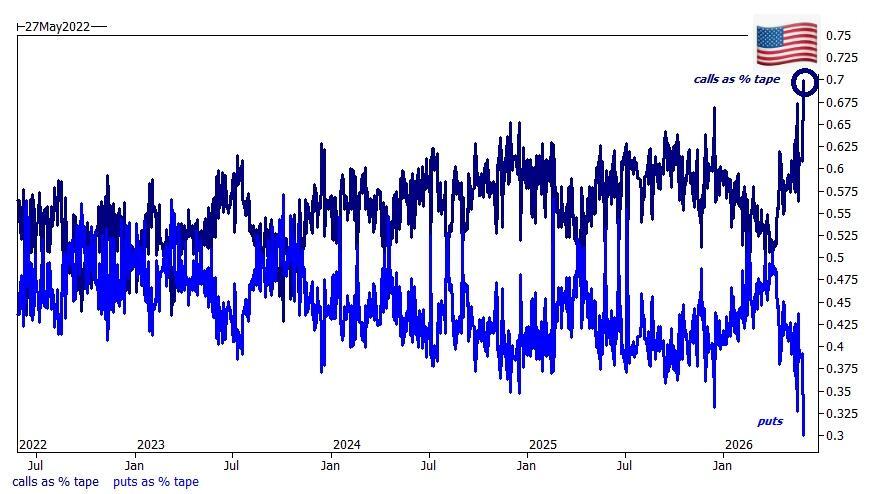
First, the sentiment indicator is extremely skewed towards greed. The call/put ratio in the U.S. stock options market is in the historical extreme range.
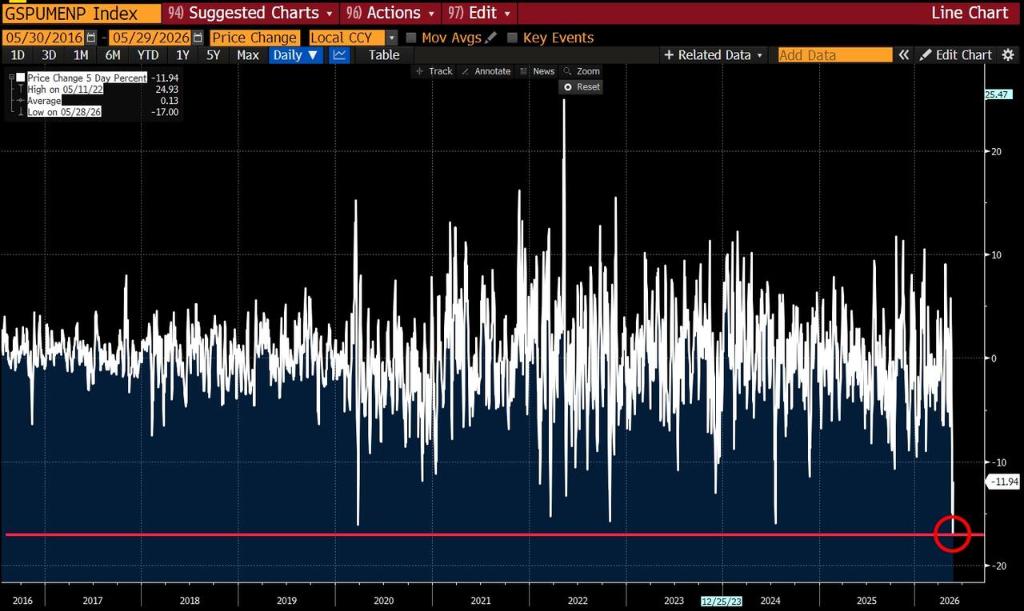
The five - day drawdown difference between large - cap tech stocks and Goldman Sachs' "unprofitable tech stock basket" has reached or exceeded the level of the most frenzied period in 2021.
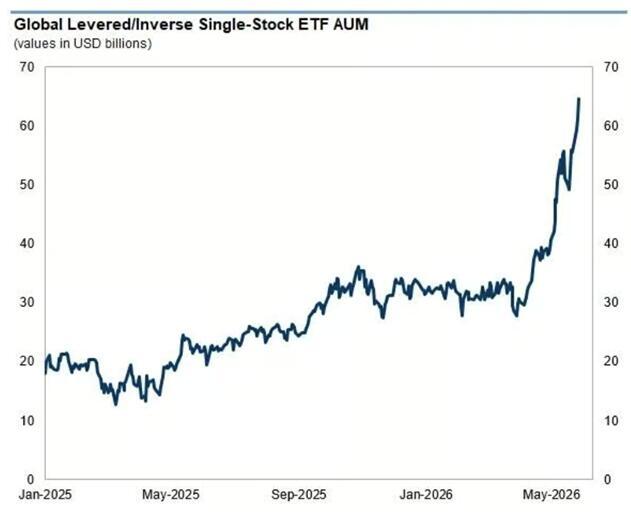
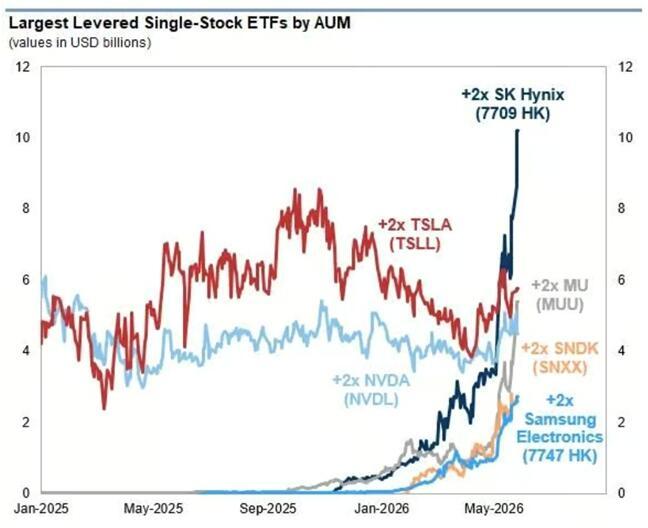
Second, leveraged funds are pouring in on a large scale. The asset management scale of single - stock ETFs with 2x or higher leverage has risen significantly, especially in the memory chip sector.
Wilson wrote in a half - joking tone:
I'm not the only one who checks Hynix's stock price early in the morning every day.
Third, the momentum factor has become the most dominant force currently. In Goldman Sachs' global prime brokerage business books, the exposure of momentum strategies has hit a new record.
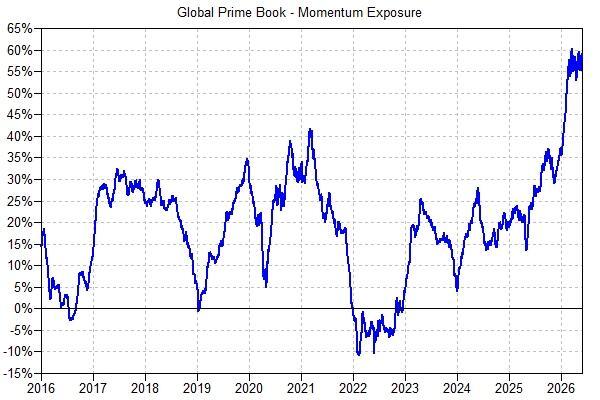
Fundamental EPS growth supports the rally, but it's almost stagnant outside of AI
In addition to the highly exuberant sentiment indicators, the fundamental level still provides a considerable degree of support at present.
Since the beginning of this year, the S&P 500 index has risen by about 10%. Meanwhile, the EPS forecast has been raised by about 15%, and the price - to - earnings ratio has actually contracted by 4%.
Wilson believes that outside the most speculative corners of the market, earnings growth can basically provide a reasonable basis for the upward movement of stock prices. Wilson emphasized:
Surprisingly, although the earnings growth rate in the first quarter has been quite strong, the expected earnings growth rate in the next two quarters is actually accelerating.
At the nominal pricing level, changes in the prices of semiconductor products are also worthy of attention.
Since the mid - 1990s, the U.S. semiconductor and hardware PPI index has been on a long - term deflationary track until a turn occurred in the past 12 months.
Wilson described the jump in the year - on - year growth rate of South Korea's semiconductor export prices in the past nine months as "staggering."
However, Wilson also pointed out a key counter - argument: If the AI infrastructure and energy sectors are excluded, the EPS forecast of the S&P 500 has hardly grown since the beginning of the year.
In other words, the current earnings - driven logic is highly concentrated, and the market is actually betting on a single theme.
The market is starting to brew a "second narrative"
Wilson believes that there are increasing signs that the market is accumulating conditions and gradually moving out of the single - pattern of "trading only one theme."
At the policy level, Fed Chairman Wash has just started his first week in office.
Wilson cited historical data and pointed out that among the six Fed chairmen since 1970, Bernanke and Yellen each experienced about a 10% market drawdown in their first year of tenure, while the other four suffered drawdowns ranging from 20% to 36%.
At the earnings rhythm level, the second - order derivative of the EPS growth rate is expected to slow down starting this summer. Coupled with the fading of the front - loaded pulling effect of the "Big Beautiful Act" on capital expenditures, capital expenditures may decline significantly after summer.
At the geopolitical level, the negotiation framework for the Iran cease - fire agreement has taken shape, involving a 60 - day cease - fire extension, reopening of the strait, mine - sweeping, and gradual lifting of blockades or sanctions.
Both Wilson and Bloomberg macro strategist Michael Ball emphasized that once this framework is implemented, it will be a real - sense easing of the situation.
If the Iran agreement becomes a reality, the AI - energy dumbbell strategy will face challenges
Bloomberg macro strategist Michael Ball sorted out the potential market trends after a possible U.S. - Iran agreement.
The current dominant market trade is to hold both AI computing power stocks with limited production capacity and energy stocks that supply energy to them, forming a dumbbell structure of "AI capital expenditure + energy."
Once a credible Iran agreement emerges, a drop in oil prices will drive down inflation expectations, which in turn will lower yields and the dollar. Global financial conditions will tend to ease, and energy - importing countries will benefit the most.
Michael Ball emphasized that this is particularly beneficial to emerging markets, European stocks, as well as a broader range of value stocks and cyclical stocks.
Particular attention should be paid to the European market. Given Europe's lack of energy independence, it can be said to be the biggest beneficiary of the end of the Iran conflict. The unique capital expenditure cycle in Europe is currently underestimated, as evidenced by Germany's fiscal expenditure data.
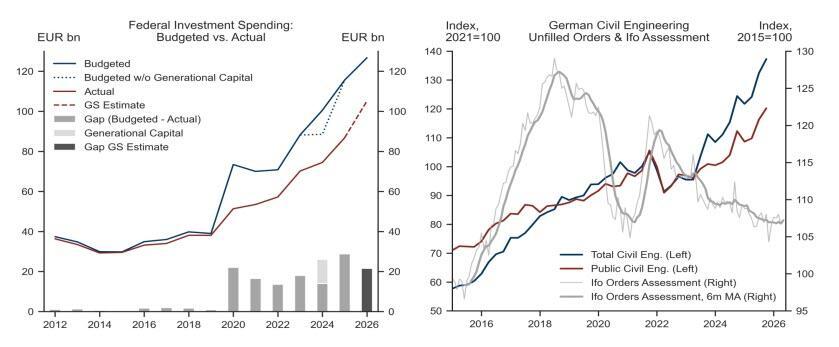
Technically, the volatility of individual U.S. stocks is about 3.5 times that of the index, while in Europe, it is only about 50% higher. This means that the cost - effectiveness of capturing individual stock - specific opportunities in Europe is relatively higher.
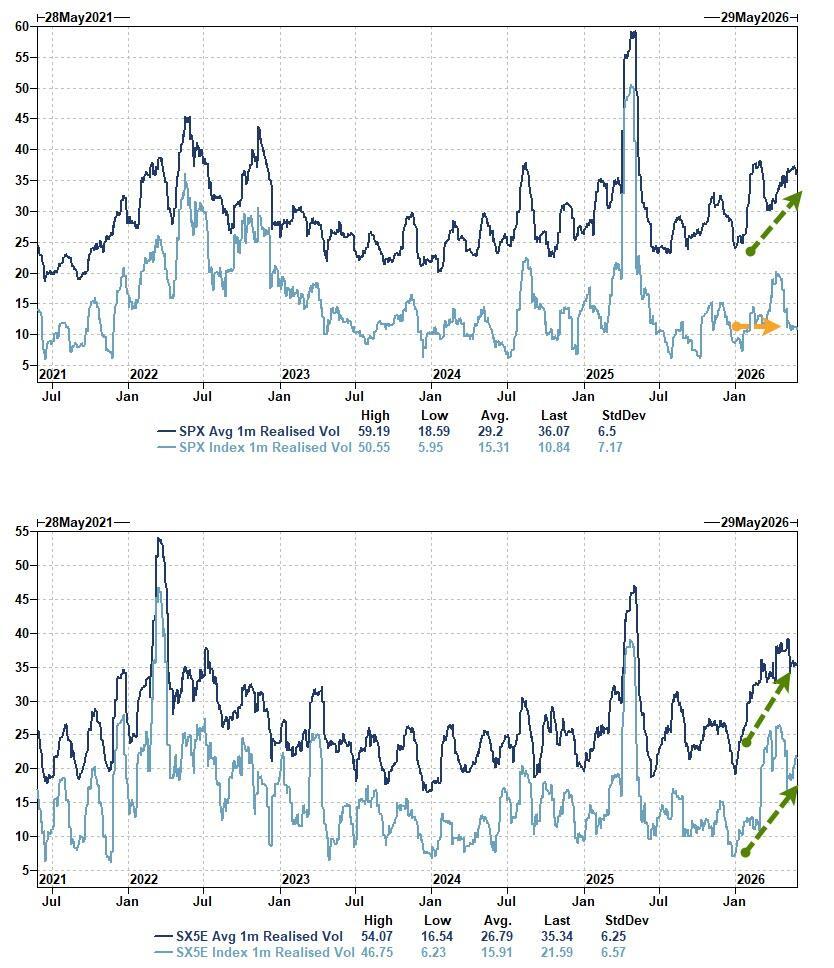
(Comparison of the trends of individual stock and index volatility. The first chart is for the United States, and the second is for Europe)
This article does not constitute personal investment advice and does not represent the views of the platform. The market is risky, and investment should be made with caution. Please make independent judgments and decisions.
This article is from the WeChat official account "Wall Street Insights", author: Bao Yilong. It is published by 36Kr with authorization.