Jensen Huang joined hands with Unitree to create a humanoid robot base
On June 1st, Unitree's official website released the humanoid robot H2 Plus and disclosed detailed information about this robot in terms of its body structure, computing power, dexterous manipulation, and development ecosystem.
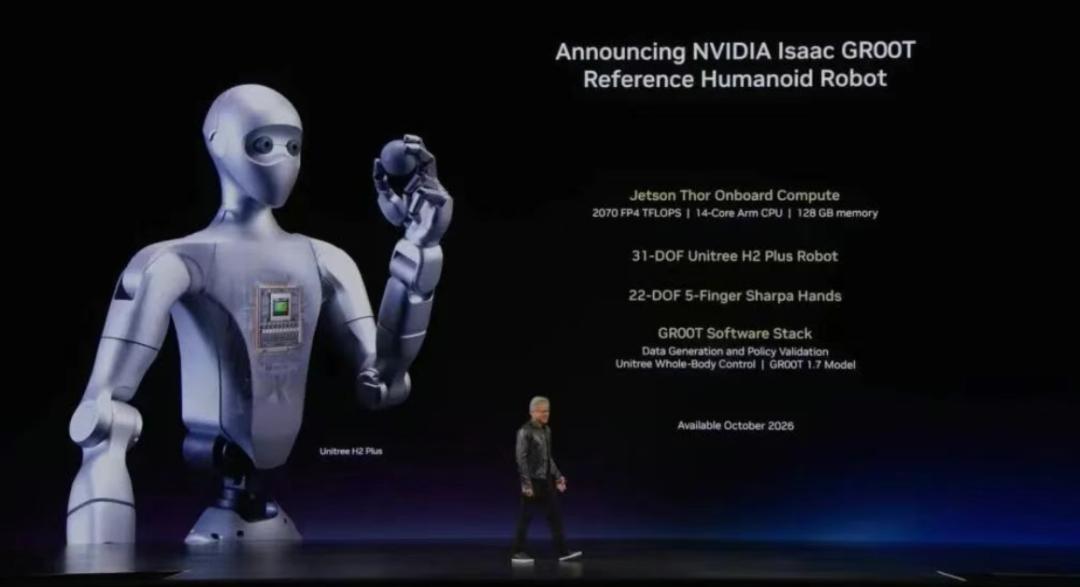
Additionally, at today's GTC Taipei, Jensen Huang released the NVIDIA Isaac GR00T reference humanoid robot.
This robot integrates the Unitree H2 Plus humanoid robot, the Sharpa Wave tactile five-fingered dexterous hand, on-board computing powered by NVIDIA Jetson Thor, as well as the Isaac GR00T software and workflow into a single integrated reference design.
The NVIDIA Isaac GR00T reference humanoid robot will be officially launched into the market by Unitree at the end of this year. It is mainly targeted at higher education institutions and university researchers, aiming to lower the thresholds for hardware integration, data collection, simulation training, strategy deployment, and real-machine verification in cutting-edge humanoid robot research.
According to the information on Unitree's official website, the basic information of the H2 Plus is as follows:
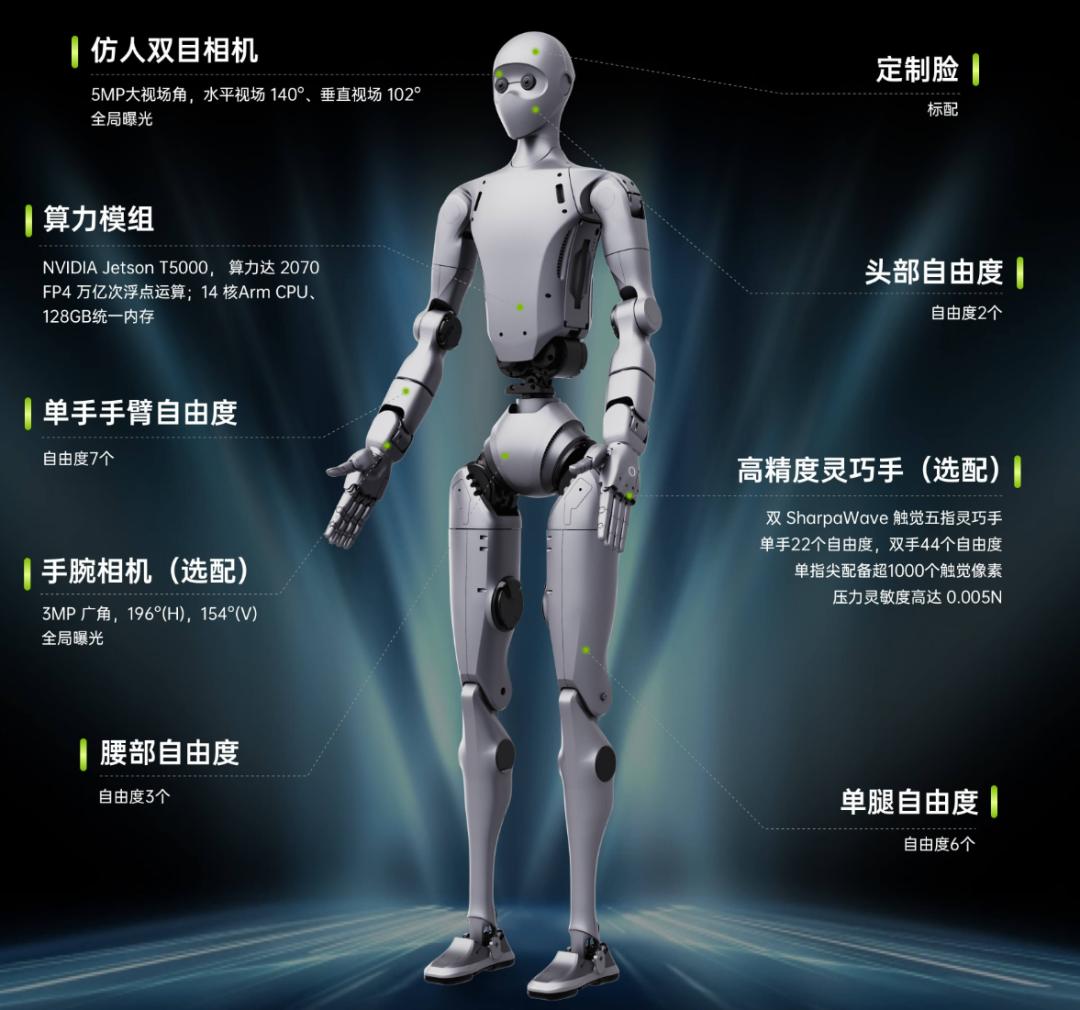
Torso: The H2 Plus is 182 cm tall, weighs approximately 70 kg with the battery, and has a battery life of about 3 hours. The body has a total of 31 degrees of freedom, including 6 degrees of freedom for each leg, 7 degrees of freedom for each arm, 3 degrees of freedom for the waist, and 2 degrees of freedom for the head.
Dexterous hand: When paired with a pair of Sharpa Wave tactile five-fingered dexterous hands (22 active degrees of freedom for each hand), the total degrees of freedom of the robot will reach 75.
The Sharpa Wave has more than 1000 tactile pixels at each fingertip, with a pressure sensitivity of 0.005N; it can carry a load of up to 30 kg, with a grip force of 150N and a fingertip force of 20N.
Power output: The maximum peak torque of the H2 Plus's arm joints is 120 N·m, and that of the leg joints is 360 N·m; the rated load of the arm is approximately 7 kg, and the peak load is approximately 15 kg.
Perception system: The H2 Plus is equipped with a 5MP wide-field-of-view humanoid binocular camera on its head. The horizontal field of view reaches 140°±3, and the vertical field of view is 102°±3. It has the ability of global exposure, and the depth of field ranges from 0.4 m to infinity.
The robot can also be optionally equipped with a wrist camera, which is a 3MP wide-angle camera and also supports global exposure.
Computing power: The H2 Plus is equipped with the NVIDIA Jetson T5000 high-computing-power module. This module is based on the NVIDIA Blackwell architecture GPU, and its AI computing power reaches 2070 TFLOPS (FP4 — sparse), which can meet the needs of real-time sensor processing and robot inference.
It is worth noting that the H2 Plus is also clearly connected to the NVIDIA Isaac-related ecosystem. The Unitree official website page shows that the H2 Plus is equipped with the NVIDIA Isaac GR00T model and is equipped with an open-source model, a simulation framework, and a reference workflow from data to deployment.
In terms of interaction and connection capabilities, the H2 Plus supports Ethernet, Wi-Fi 6, Bluetooth 5.2, and USB connections. It is equipped with an array microphone and a high-power speaker, which can support voice interaction.
Additionally, the H2 Plus also has a remote emergency stop function, which supports quickly and safely cutting off the robot's operation.
Conclusion: The humanoid robot gets a standard base
From Unitree's launch of the H2 Plus to NVIDIA's creation of the Isaac GR00T reference humanoid robot based on it, the humanoid robot industry has for the first time developed a set of reference platforms.
In the past, many robot companies often had to handle the integration of the robot body, dexterous hands, computing power, models, and simulation training processes on their own. Each robot was like an independent project.
The value of the reference platform lies in completing the most difficult and repetitive basic integration work in the industry, allowing more teams to continue to innovate on the same set of standardized bases.
This also means that the industry competition is shifting from individual companies building complete machines independently to innovation based on standard platforms. The emergence of this reference design may be a key node for the industry to move from early exploration to a mature ecosystem.
This article is from the WeChat official account "Robot Outlook". Author: Xu Lisi, Editor: Mo Ying. Republished by 36Kr with permission.