The "AI transformation tax" of software giants is here.
For a long time, the SaaS industry has adhered to a classic growth formula. It is widely believed that to increase revenue, the number of employees in sales, R & D, and customer service must also increase.
A large team, especially those in lead generation and basic support positions, has gradually become a heavy cost burden for traditional software companies.
However, Neuters has found that global enterprise software giants are breaking this tradition, achieving a remarkable leap in labor efficiency where revenue growth is completely decoupled from the size of the workforce.
Salesforce's Radical Restructuring
Over the past three years, Salesforce has conducted an organizational restructuring experiment. From its financial report data, we can clearly see the efficiency improvement curve driven by the Agent leverage.
In fiscal year 2023 (ending in January 2023), Salesforce's total global workforce approached the historical peak of 80,000.
Subsequently, as we all know, the company laid off approximately 10% of its employees at once. By fiscal year 2024, the total number of employees dropped significantly to just over 72,000.
What's more interesting is in fiscal years 2025 and 2026. Although the total number of employees gradually increased to around 76,000, there was a high - intensity structural reshuffle behind this.
Salesforce even carried out a net restructuring operation of laying off 1,000 employees and then re - hiring 1,000 employees.
Most of those leaving the business lines were traditional lead follow - up and basic customer service staff, while the newly added positions were almost all given to Agent architects and cutting - edge technology experts who can handle AI and large models.
With this wave of staff reduction and reshuffle, Salesforce's operating profit margin showed an extremely steep upward curve.
In the traditional SaaS era, the profit margin of this giant hovered around 20% for many years. For example, in fiscal year 2023, it was 22.5%.
However, after vigorously promoting organizational streamlining and internal silicon - based transformation, the profit margin in fiscal year 2024 jumped directly to 30.5%, and in the latest disclosed data for fiscal year 2026, it further reached 34.1%.
This has directly broken through the profit ceiling of the past B2B business model!
Where is the underlying engine of the soaring profit? You can find the answer by listening to the earnings conference calls in the past two years. The focus of the executives' narrative has completely shifted to the Agentforce digital labor platform.
When explaining the company's internal cost - reduction and efficiency - improvement measures to shareholders, Mark Benioff, the CEO, said bluntly that with the full launch of the AI customer service agents, the size of a certain support team in the company was directly reduced from the peak of nearly 9,000 to about 5,000. Enterprises really need fewer employees now.
Currently, the AI agents deployed within Salesforce can independently handle about 50% of customer interaction tasks.
In the front - end of sales, the numerous and complex leads that used to require a large number of SDRs to call one by one and pursue for a long time are now being screened, communicated with in multiple rounds, and their intentions judged on a large scale by Agentforce.
After the machines have sifted through the leads, only the highest - quality business opportunities are accurately provided to senior account managers.
Salesforce has proven that enterprises can achieve a profit explosion without increasing the number of employees, and this is exactly the extreme leverage ratio that Wall Street values most in the new era.
Microsoft Has Overcome the Scale Trap
Over the past three years, Microsoft has maintained a spectacular high - speed growth in its cloud business, but the curve of its total number of employees and back - office expenses has shown an extremely restrained and low - level change.
By comparing the core data slices of Microsoft in the past few years, a constantly steepening curve of revenue per employee emerges clearly.
In fiscal year 2022, at the peak of the classical expansion period, Microsoft's total global workforce soared due to the pandemic dividend, and the revenue per employee at that time remained at about $900,000. The beginning of 2023 became a historical watershed. Satya Nadella clearly announced the arrival of the next - generation computing wave in an internal letter announcing the layoff of 10,000 employees.
After removing the redundant labor force, Microsoft has achieved a real spectacle of extreme labor - efficiency leverage.
According to its latest disclosed financial report data for fiscal year 2025, Microsoft's total annual revenue reached a record $281.7 billion (a year - on - year increase of 15%), and its operating profit soared to $128.5 billion (a year - on - year increase of 17%).
Behind this extremely large - scale growth report card, the growth rate of its total number of employees was firmly locked at a very low level, which directly pushed Microsoft's revenue per employee to a historical high of over $1.2 million.
When the growth rate of revenue and profit continuously outpaces the speed of employee expansion, it means that this technology giant has overcome the scale trap of the traditional software era.
This organizational evolution is also reflected in the change of Microsoft's SG&A (Sales and General & Administrative) expense ratio.
In the traditional enterprise - level software service model, to support Azure's annual revenue of over $75 billion and maintain high double - digit growth, it is necessary to proportionally expand the global sales network, legal, and back - office administrative teams.
However, Microsoft's financial records show a completely opposite trend:
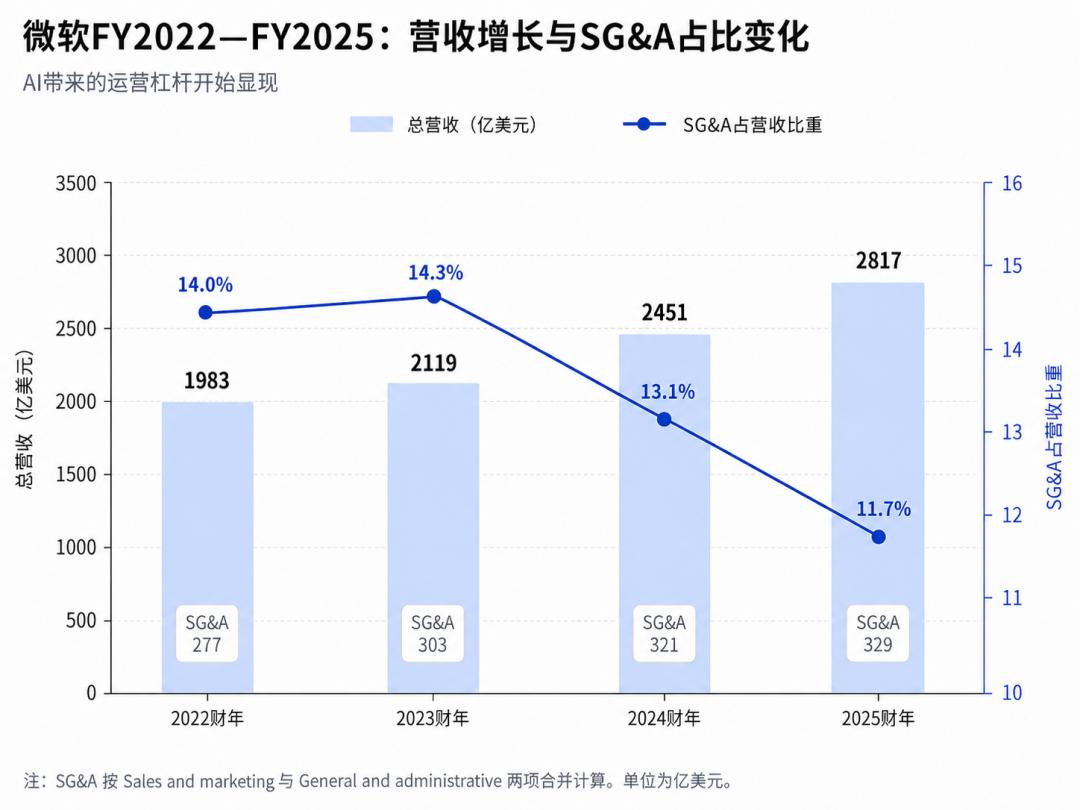
Fiscal year 2022 (Peak of classical expansion): Microsoft's SG&A expenses were approximately $27.7 billion, accounting for about 14.0% of the total annual revenue of $198.3 billion.
Fiscal year 2023 (Restructuring and pain): With the short - term inclusion of restructuring expenses such as layoff severance pay, the SG&A ratio slightly increased to 14.3%, which was the last cost of cleaning up the old production capacity.
Fiscal year 2024 (New leverage): As the AI platform gained momentum, with the total revenue soaring to $245.1 billion, the SG&A expenses only slightly increased to about $31.5 billion, and the ratio was significantly reduced to 12.8%.
Fiscal year 2025 (Scaled - up realization): During the soaring growth of the total revenue exceeding the $281.7 billion mark (a 15% increase), the absolute value of its management and back - office expenses almost "stagnated", and the SG&A ratio further dropped to about 11.8%.
The revenue maintains a 15% growth rate, while the growth rate of back - office and sales expenses is firmly kept in the low single - digits. The huge "funnel" formed by these two curves is the extreme operational leverage released by AI.
How can Microsoft achieve a sharp increase in its business scale without expanding its back - office? The answer is that the whole company "eats its own dog food". Microsoft not only sells Copilot globally, but it is also the world's largest enterprise - level AI efficiency - improvement test field.
Nadella repeatedly mentioned a core concept in his letter to shareholders, that is, AI is "democratizing professional skills".
Taking the R & D team as an example, the financial reports and internal texts have repeatedly cited representative quantitative indicators: GitHub Copilot can help top - notch developers (such as Andrej Karpathy, the former head of Tesla's AI) automatically write about 80% of the code.
This silicon - based pair - programming model has enabled Microsoft's internal engineering team to achieve a qualitative leap in code output and iteration speed without increasing the number of junior programmers.
On the back - office administrative and business operation side, the full - scale deployment of Microsoft 365 Copilot has also triggered a chemical reaction.
The contract review cycle of the legal department has been significantly shortened, and the standardized accounting work of the human resources and finance departments has been taken over in batches by agents.
In the past, the back - office departments in large companies, which were most prone to overstaffing and lengthy processes, have now become highly automated operation hubs under the reshaping of AI.
Microsoft's financial report shows a new normal to the entire To B industry. With the in - depth penetration of AI platforms and agents, the expansion of the organizational scale no longer requires an equivalent number of logistics, administrative, and junior technical personnel to support it.
In the past, when evaluating whether a technology giant was dominant, we often looked at the size of its global workforce.
However, Microsoft's SG&A data proves that in the era of generative AI, what really enables a giant to dance lightly is to equip the existing core team with technological wings and use an extremely restrained "carbon - based" scale to leverage an infinite silicon - based leverage ratio.
Alternative Strategies of ServiceNow and Adobe
If the giants mentioned above chose to make cuts to their internal staff, ServiceNow and Adobe have shown us a completely different approach.
As the absolute leaders in the fields of digital workflow and creative software, they successfully used generative AI to strengthen their moats during the AI wave from 2024 to 2025. While their business volumes soared, they extremely restrainedly controlled the total number of employees and back - office expenses.
The core of ServiceNow is to help enterprises break data silos and automate complex processes. Looking at its latest financial records, a very steep "labor - efficiency breakthrough" curve is clearly visible.
In fiscal year 2025, ServiceNow's subscription revenue successfully exceeded the $12.88 billion mark, with a year - on - year growth rate as high as 21%. At the same time, the expansion of its total number of employees was extremely restrained.
Data shows that in 2023, its total number of employees was 22,668, and it gradually increased to 29,187 in 2025. The year - on - year growth rate of the number of employees in 2025 was only 11%. The subscription revenue growth rate of 21% was almost twice the growth rate of the number of employees, perfectly widening the "funnel" of labor efficiency.
Previously, ServiceNow's management detailed its internal AI strategy called "Now on Now", clearly stating that the generative AI agents can currently independently handle up to 90% of internal IT support requests and 89% of customer service requests.
The machines have taken over a large amount of structured and repetitive operation and maintenance work, so that 54% of the internal employee service work orders are intercepted through self - service.
This sharp reduction in internal IT operation and maintenance and customer service expenses has directly created a cost - reduction and efficiency - improvement value of over $500 million for the company, completely breaking the old myth that "scale expansion must increase the number of employees".
Adobe's evolution path is also extremely impressive.
After fully integrating the Firefly generative AI matrix and launching AI - first applications, the market was once worried that the promotion of large models and the consumption of computing power would lead to out - of - control marketing and operation expenses. The final financial report data completely dispelled this concern.
Digging deep into Adobe's ratio of three major expenses in the past three years, we can find that in fiscal year 2023 (before the era of large models), its marketing and sales expenses accounted for 28% of the total revenue (the absolute value was $5.35 billion).
In fiscal years 2024 and 2025, when Firefly and generative tokens were fully promoted, with the total revenue soaring to $23.77 billion (in 2025), the proportion of its marketing and sales expenses unexpectedly decreased slightly and was firmly locked at 27% (the sales and management expenses in 2025 were $6.488 billion).
Neuters found in its official documents that Adobe's management gave a clear qualitative explanation for the cost reduction.
By implementing the "Product - Led Growth (PLG)" strategy and using generative AI to empower internal and customer business processes, the company has significantly reduced content marketing and customer acquisition costs.
The management particularly emphasized the power of Adobe GenStudio and custom models in reducing content production and compliance review expenses.
With the help of generative AI, enterprises can automate content production at a very low marginal cost and strictly control brand consistency through customized models, eliminating the large and cumbersome manual compliance review process in the past.
This silicon - based content supply chain that seamlessly integrates creativity, distribution, and compliance has enabled Adobe to attract new users crazily while successfully avoiding the traditional consumption war of investing in advertising and expanding the sales force.
Therefore, in the era of generative AI, the To B moat has bid farewell to large sales teams and lengthy operation and maintenance teams.
We can look at the following "Comparison Chart of Labor - Efficiency Improvement of Global SaaS Giants". By making a horizontal comparison, we can see that the labor - efficiency improvement of these giants actually presents three different paths:
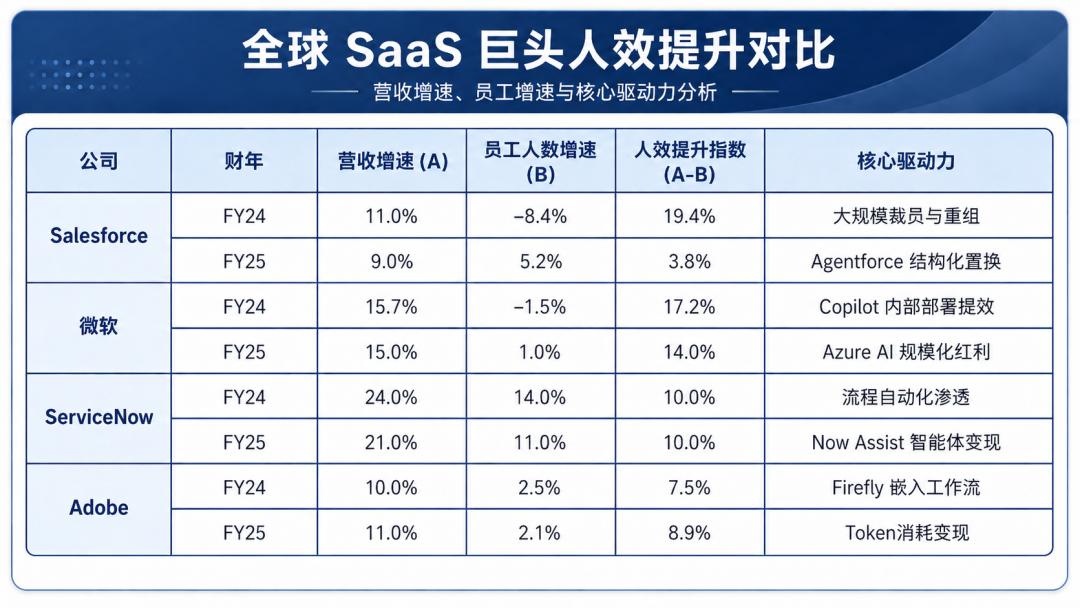
Salesforce's labor - efficiency index in FY24 was as high as 19.4%, mainly due to the "shrinking denominator" caused by layoffs and $988 million in restructuring expenses. In fiscal year 2025, it dropped to 3.8%, indicating that the restructuring dividend has faded, and Agentforce has begun to undertake structural replacement.
Microsoft has achieved efficiency improvement through its platform. In fiscal years 2024 and 2025, it still maintained improvements of 17.2% and 14.0%, reflecting the systematic leverage of Copilot in internal R & D, sales, and operations.
ServiceNow and Adobe are more stable. By consuming Now Assist, Firefly, and tokens, they have embedded AI into the workflow and continuously released labor efficiency without radical layoffs.
The Cost of Restructuring
If we only look at the rising profit margin and the soaring stock price, it is easy to fall into the blind optimism that "AI can turn stones into gold".
Neuters looked through the financial reports of these four technology giants and found that in the unremarkable footnotes and management discussions, there were heavy costs hidden behind the organizational restructuring.
The improvement of AI leverage is not free. In essence, it is to replace "human capital" with "computing - power capital". There are both real - money severance costs and a long - term cycle of continuously injecting funds into the computing - power black hole. This is also called the "transformation tax".
Let's first look at Salesforce.
In fiscal year 2024 alone, Salesforce once included restructuring expenses as high as $988 million.
The vast majority of these expenses were used to pay severance pay to thousands of employees, terminate office space lease contracts in advance, and reset business processes.
For a sales - oriented company, this means that the management must have great financial courage to sacrifice the net profit in the short - term financial statements to forcibly reduce the long - term human - resource burden.
Now let's look at Microsoft.
In its financial report for fiscal year 2023, Microsoft included $800 million in severance expenses at once to accelerate the full - scale transformation to the AI platform. This approach was not only to clean up redundant employees but also to release a "cash pool" that could be invested in AI R & D within the organization.
If the restructuring expenses are the painful cost of organizational restructuring, then the soaring capital expenditure is the "long - term bill