Die "AI-Transformationssteuer" der Softwareriesen ist da.
For a long time, the SaaS industry has relied on a classic growth formula. It is generally recognized that in order to increase sales volume, one must increase the number of employees in the sales, research and development, and customer service areas.
Large teams, especially those involved in lead generation and basic support, have gradually become a heavy cost burden for traditional software companies.
However, Neuters has found that global enterprise software giants are breaking this tradition and achieving a leap in labor productivity, where sales growth is completely decoupled from the number of employees.
The radical restructuring of Salesforce
Salesforce has conducted an organizational restructuring experiment in the past three years. Based on their financial report data, we can clearly see the efficiency improvement curve driven by the Agent - Leverage.
In fiscal year 2023 (until January 2023), the total number of Salesforce employees worldwide almost reached the historical high of 80,000 people.
Then, we all know the story: The company laid off about 10% of its employees at once. In fiscal year 2024, the total number of employees dropped drastically to a little over 72,000.
It gets more interesting in fiscal years 2025 and 2026. Although the total number of employees has gradually increased to about 76,000 people, there is an intensive structural adjustment behind this.
Salesforce even carried out a net restructuring measure, laying off 1,000 employees and hiring 1,000 new employees.
Most of the employees who left the business areas were traditional lead - follow - up employees and basic customer service employees. The new positions were almost exclusively assigned to Agent - Architects and experts in emerging technologies who are able to use AI and large - language models.
With this reduction and adjustment of employees, Salesforce's operating profitability has shown an extremely steep upward trend line.
In the traditional SaaS era, the profitability of this giant fluctuated around 20% for many years. For example, it was 22.5% in fiscal year 2023.
But after vigorously implementing organizational streamlining and internal silicon - based transformation, the profitability directly increased to 30.5% in fiscal year 2024 and reached 34.1% in the latest published fiscal year 2026.
This has finally broken through the profit barrier of the former B2B business model!
What is the underlying driver for the rapid increase in profits? You can find the answer if you listen to the financial report conference calls of the past two years. The focus of the management's narrative has completely shifted to the digital workforce platform Agentforce.
Mark Benioff, the CEO of Salesforce, directly said when explaining the internal cost reduction and efficiency improvement to shareholders that since the full introduction of AI - customer service agents, the number of employees in a support team has been reduced from almost 9,000 people to about 5,000 people. The company actually needs fewer employees.
Currently, Salesforce's internal AI agents can independently handle about 50% of customer interaction tasks.
At the sales end, the leads that were previously called individually by a large number of SDRs and processed laboriously are now largely taken over by Agentforce for pre - selection, multiple conversations, and intention evaluation.
After the machines have filtered the leads, only the highest - quality business opportunities are precisely forwarded to the leading customer service representatives.
Salesforce has proven that a company can achieve a profit leap without increasing the number of employees. This is exactly the maximum leverage that Wall Street values most in the new era.
Microsoft has overcome the scale trap
Microsoft has achieved impressive high - speed growth in its cloud business in the past three years, while the curve of the number of employees and back - office costs has only increased very modestly.
If we compare Microsoft's core data in recent years, an increasingly steep curve of revenue per employee becomes visible.
At the peak of the classic expansion in fiscal year 2022, Microsoft's global number of employees increased significantly due to the pandemic dividend. The revenue per employee was about $900,000 at that time. At the beginning of 2023, it was a historical turning point. Satya Nadella clearly announced the arrival of the next computing wave in an internal letter about laying off 10,000 employees.
After eliminating the labor over - capacity, Microsoft has experienced a real phenomenon of maximum labor productivity.
According to the latest published financial report data for fiscal year 2025, Microsoft achieved a record sales of $281.7 billion (a 15% increase compared to the previous year), and the operating profit even increased to $128.5 billion (a 17% increase compared to the previous year).
Behind this immense growth report, the growth rate of the number of employees was strictly kept at a very low level. This has historically increased Microsoft's revenue per employee to over $1.2 million.
If the growth rates of sales and profit are permanently higher than the growth rate of the number of employees, it means that this technology giant has overcome the scale trap of the traditional software era.
This organizational evolution is also reflected in the change in the proportion of SG&A (sales and administrative expenses) of Microsoft.
In the traditional enterprise - software - service model, in order to support the annual Azure business of over $75 billion and maintain high double - digit growth, one would proportionally expand the global sales network, the legal department, and the back - office management team.
But Microsoft's books show a completely opposite trend:
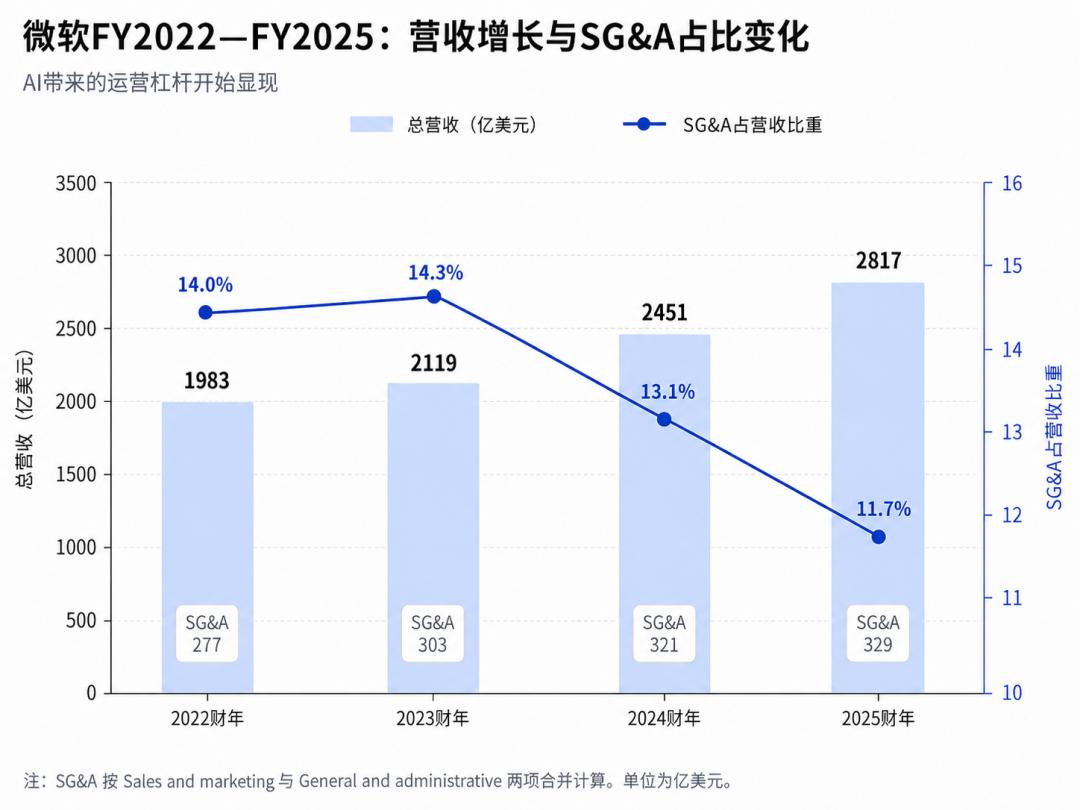
Fiscal year 2022 (peak of classic expansion): Microsoft's SG&A costs were about $27.7 billion, which was about 14.0% of the total sales of $198.3 billion in that year.
Fiscal year 2023 (restructuring and pain phase): With the short - term booking of restructuring costs such as severance pay, the proportion of SG&A slightly increased to 14.3%. This was the last cost for eliminating the old capacity.
Fiscal year 2024 (new leverage): With the strengthening of the AI platform, the total sales increased to $245.1 billion, while the SG&A costs only slightly increased to about $31.5 billion. The proportion dropped drastically to 12.8%.
Fiscal year 2025 (mass - applicable implementation): With the rapid growth of the total sales over the mark of $281.7 billion (15% growth), the absolute value of the administrative and back - office costs almost "stagnated". The proportion of SG&A in sales further dropped to about 11.8%.
The sales are growing at a rate of 15%, while the growth rate of back - office and sales costs is kept at low single - digit numbers. The large "funnel opening" between these two curves is the maximum operating leverage released by AI.
Why can Microsoft expand its business so strongly without the growth of the back - office? The answer is that all employees are "eating the bait". Microsoft not only sells Copilot worldwide but is also the world's largest experimental field for efficiency improvement through enterprise - AI.
Nadella has repeatedly mentioned a core idea in a letter to shareholders, namely that AI brings about the "democratization of expertise".
Take the research and development team as an example. In the financial reports and internal texts, a representative quantitative criterion is often cited: GitHub Copilot can help top - developers (e.g., Andrej Karpathy, the former head of AI at Tesla) automatically write about 80% of the code.
This silicon - based pair - programming model has enabled Microsoft's engineering team to qualitatively improve code production and iteration speed without increasing the number of junior programmers.
At the back - office management and operation end, the comprehensive introduction of Microsoft 365 Copilot has also triggered a chemical reaction.
The contract review time of the legal department has been greatly shortened, and the standardized accounting activities of the human resources and finance departments are taken over by agents in large numbers.
The back - office departments, where over - employment and long processes were most likely to occur in large enterprises in the past, have now become highly automated operation centers under the transformation by AI.
Microsoft's financial report shows a new norm for the entire B2B industry. With the in - depth penetration of the AI platform and agents, the expansion of the organization is no longer dependent on the corresponding number of logistics, administrative, and junior technicians.
In the past, we often looked at the global number of employees of a technology giant to judge whether it was dominant.
But Microsoft has proven with the SG&A data that in the era of generative AI, it is actually the existing core teams that are given technological wings, and one can trigger the unlimited silicon leverage with an extremely modest "carbon - based" size.
The alternative strategies of ServiceNow and Adobe
While the above - mentioned giants have decided to change their internal personnel structure, ServiceNow and Adobe show us a completely different strategy.
As absolute top companies in the fields of digital workflows and creative software, they have successfully used generative AI in the AI wave from 2024 to 2025 to strengthen their competitive advantages. They have kept the number of employees and back - office costs extremely modest while their business volume has grown strongly.
The core of ServiceNow is to help enterprises overcome data silos and automate complex processes. In its latest financial report, an extremely steep curve of "labor productivity decision" is clearly visible.
In fiscal year 2025, ServiceNow successfully exceeded the mark of $12.88 billion in subscription revenues, with an annual growth of 21%. At the same time, the expansion of the number of employees was extremely restrained.
The data shows that the number of employees was 22,668 in 2023 and increased to 29,187 by 2025. The growth rate of the number of employees in 2025 was only 11%. The subscription revenue growth rate of 21% was almost twice as high as the growth rate of the number of employees, which perfectly opened the "funnel opening" of labor productivity.
Previously, ServiceNow's management reported in detail about the internal AI strategy called "Now on Now" and made it clear that the generative AI agents are currently already able to autonomously handle up to 90% of internal IT - support requests and 89% of customer service requests.
The machines have taken over a large number of structured and repeated maintenance tasks, so that 54% of internal employee - service tickets were intercepted through self - service.
This drastic reduction in internal IT - maintenance and customer service costs has directly brought the company cost savings and efficiency improvements of over $500 million and finally broken the old mantra "growth requires more employees".
Adobe's development is also amazing.
Since the full integration of the generative AI matrix of Firefly and the introduction of AI - first applications, the market initially feared that the promotion of large - language models and the consumption of computing power would lead to an uncontrolled increase in marketing and operating costs. The final financial report data has completely dispelled these concerns.
If you examine the proportion of Adobe's three main cost categories in the past three years, you can find that in fiscal year 2023 (before the era of large - language models), the proportion of marketing and sales costs in total sales was 28% (absolute value: $5.35 billion).
In fiscal years 2024 and 2025, when Firefly and generative tokens were comprehensively promoted, the proportion of marketing and sales costs surprisingly decreased slightly, although the total sales increased to $23.77 billion (in 2025). In 2025, the proportion was 27% (sales and administrative expenses: $6.488 billion).
Neuters has found in Adobe's official documents that the management has given a clear qualitative explanation for the cost reduction.
By implementing the "product - driven growth strategy (PLG)" and using generative AI to strengthen internal and customer - side business processes, the company has greatly reduced content marketing and customer acquisition costs.
The management has particularly highlighted the effectiveness of Adobe GenStudio and custom models in reducing content creation and compliance review costs.
With the help of generative AI, a company can automate content creation with extremely low marginal costs and ensure brand consistency through custom...