The manhua drama industry is competing for "AI management trainees": reporting to the CEO and being promoted to director in three years
In the current era of rapid AI iteration, drastic changes in audience demands, and an adjustment period for the industry, what kind of AI talents have become the "hot commodities" for entertainment companies? How do major entertainment companies understand AI? And what exactly are the new businesses emerging in this trend?
The answers are hidden in the latest job recruitment notices of various companies.
After specially launching the "Talent Trend" series (covering iQiyi, Youku, Tencent Video, and Bilibili) during the 2025 summer recruitment season, this year, Entertainment Capital Theory continues to analyze the job openings of major companies in the entertainment industry, with a particular focus on decoding AIGC-related positions. We aim to answer the above questions for readers who want to engage in AI in the entertainment industry.
Following the four long-video platforms, traditional film and television, talent agencies, and MCN companies, in this article, we will focus on short drama and comic drama companies. With live-action drama companies aggressively entering the field of AI dramas and the emergence of native AI comic drama companies, comic drama positions can be regarded as "AI-native" positions. This booming industry is rapidly expanding its scale through a "manpower strategy."
However, it should be noted that on social networks, there are frequent posts complaining about and warning against comic drama companies. Keywords such as heavy workload, repetitive labor, low wages, and even wage arrears often appear. This article by Xiaoyu hopes to start from leading companies, analyze the flow of their popular job openings, so that readers can at least understand in advance whether this is really the job they want and what the career advancement prospects are.
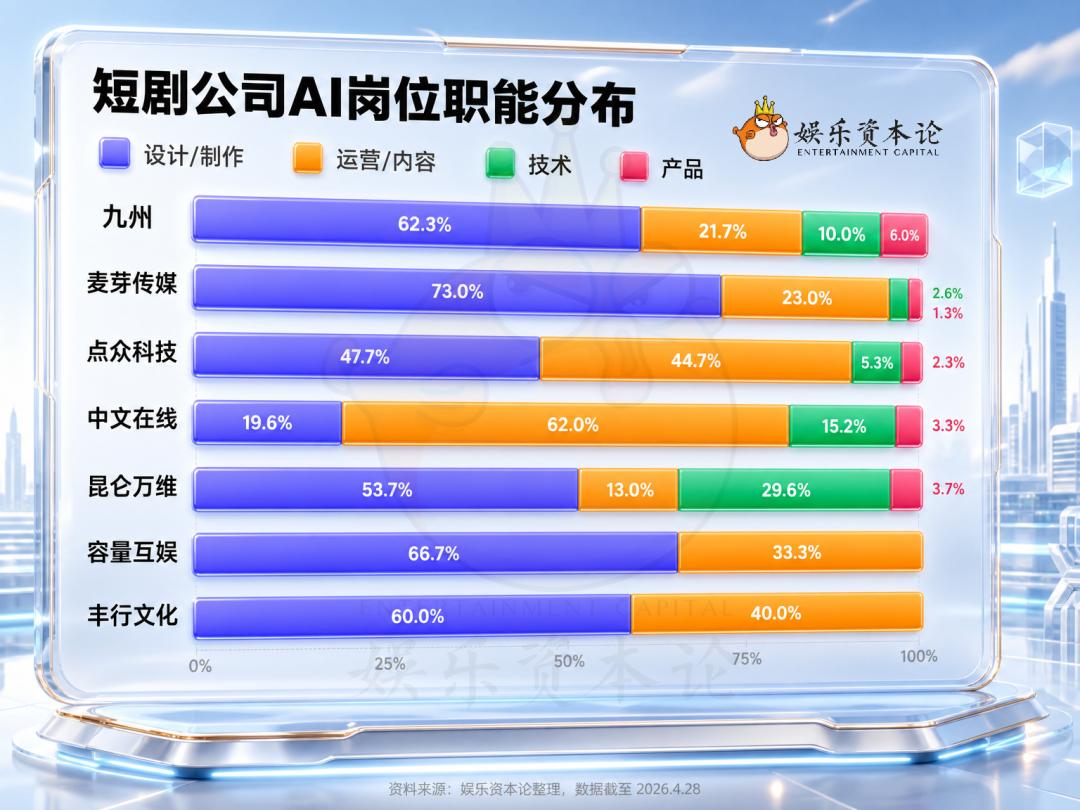
The overall proportion of AI positions in short drama and comic drama companies is 25.6%, and it rises to over 40% after excluding Jiuzhou. The AI penetration rates of Xian Fengxing, Lingman KuaiChuang, and Huasheng Comic Drama are 100%, 87%, and 68% respectively. Small companies are fully committed to AI, while large companies integrate AI modules.
"Physical labor" positions such as card draw artists and tweet generators are the most common, and there are also new job types such as "intelligent agent architects." Shanhai Xingchen has set up an AI management trainee program to systematically cultivate talents.
Simulated live-action dramas and commentary comics have become the mainstream in recruitment. Seven companies have dedicated positions for live-action dramas, and three have dedicated positions for commentary comics. The good performance and high incentives of platform live-action dramas have influenced the job settings.
The overseas market has a high demand, and companies such as Maiya, Jiuzhou, and Shanhai Xingchen all have a large number of "AI + overseas" composite positions. The salaries of entry-level positions are slightly higher than those of domestic-oriented positions. The monthly salaries of chief editors and general editors, which are at the top of the salary scale, can reach up to 70K. These positions are mainly responsible for reviewing scripts.
The proportion of AI positions in Rongliang Entertainment is not large, and it has just started the overall layout of comic dramas. Chinese Online stepped on the Reelshort trend early and is still flexible. The proportion of its AI positions is nearly half. Kunlun Wanwei is a large model company entering the short drama field. Algorithm positions account for the majority of its AI positions, and the salary is 5 - 10 times that of general short drama companies, with a maximum monthly salary of up to 90K.
860 AI positions out of over 3000 positions
As of April 28, 2026, Entertainment Capital Theory sampled 10 short drama and comic drama companies on platforms such as Boss Zhipin, including Jiuzhou, Dianzhong, Maiya, Fengxing, Magic Cube Group, Lingman KuaiChuang, Youhe Culture, Huasheng Comic Drama, Xinghuo Animation, and Shanhai Xingchen.
As of the statistical time of this article, these 10 companies have a total of 3362 job openings, among which 860 are AI-related positions, accounting for 25.6% of the total. Jiuzhou alone contributed 1994 total positions and 214 AI positions. The number of Jiuzhou's employees increased from about 1500 in October 2025 to over 4000 in April this year. However, at the same time, there was a structural adjustment, with "more than half of the production capacity of live-action dramas being cut" to free up the budget for AI creation and computing power costs. Considering that over 75% of the employees joined in the past six months and project-based employment is common, the average tenure of production positions is likely to be less than one year.
After excluding Jiuzhou, the proportion of AI positions in the remaining 9 companies soars to over 40%. In Dianzhong, AI positions in the content/creation direction account for 82%, and those in the design/production direction account for two-thirds. For Huasheng Comic Drama, it is 120 out of 177, accounting for 68%; for Lingman KuaiChuang, it is 13 out of 15, accounting for 87%. Xian Fengxing, which was rumored to cut most of its live-action drama production capacity, has 100% of its positions with the word "AI." It should be noted that the job openings on the Boss Zhipin page are only a part of all the recruitment channels of these companies, and the job information is in a state of rapid change.
Some people may wonder where Jiangxi Jiangyou, a leading comic drama company, is. During this statistical period, the job data of Jiangyou Culture on Boss Zhipin was incomplete, so it was excluded. According to public reports, the number of employees in Jiangyou Culture increased from dozens in the second half of 2025 to over 1200 in April. In March, the founder Huang Haonan announced that 80% of the comic drama team would shift to the direction of AI simulated live-action dramas.
Among the job categories, full-time positions account for the absolute majority, followed by internship positions. Beijing and Zhengzhou are the two major gathering places, and there are also sporadic job openings in Xi'an, Nanjing, Guangzhou, and cities in the Yangtze River Delta.
Behind the "manpower strategy": low threshold and low salary
The so-called "manpower strategy" consists of three key points: a large number of positions, a low threshold, and average salaries. After talking about the large number of positions, let's take a look at the latter two points.
AI positions in large long-video companies generally require a bachelor's degree or above and more than three years of relevant experience. However, many AI positions in short drama companies accept interns, and positions such as the "tweet generator" at Jiuzhou and some internship positions at Huasheng Comic Drama clearly state that "interns can be converted to full-time employees."
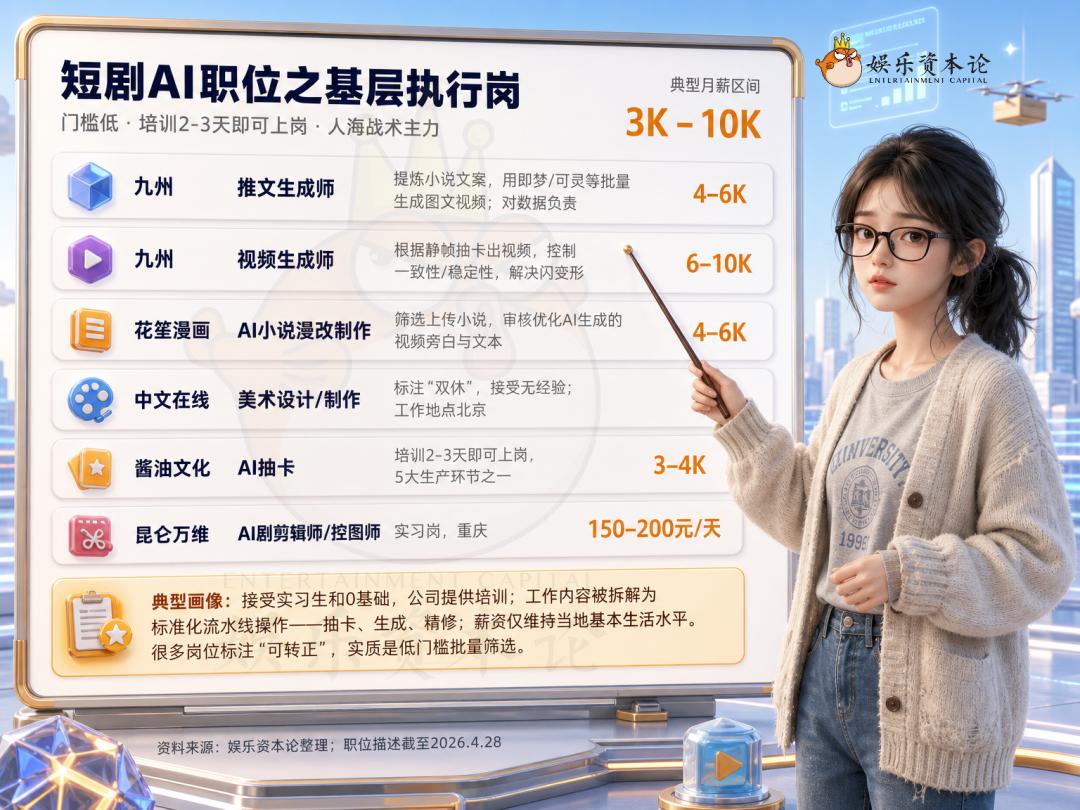
Their work content is also broken down into very simple tasks.
The "tweet generator" at Jiuzhou is responsible for extracting relevant novel copywriting, using tools such as Jimeng and Keling for large-scale and high-efficiency content creation, including copywriting, pictures, videos, etc. They also need to combine AI-generated images to create novel promotion videos and be responsible for the video data. As long as one is familiar with Jianying and AI image and video generation tools, they can do this job. Moreover, according to experience posts on social networks, most companies provide training for those with no experience for varying lengths of time.
The "video generator" can be regarded as a refuge for editors who have received traditional film and television training. They are required to provide a mature AI video portfolio, have basic knowledge of film and television audio-visual language, and be able to understand the requirements for camera movements and rhythms in storyboards. However, there are no requirements for academic qualifications and previous work experience. Their daily work is to create videos based on the static frames drawn by image generators, control consistency, stability, and dynamic effects, solve problems such as flickering, distortion, and deformation, and optimize the final video through techniques such as storyboard cutting and intelligent frame interpolation, similar to Youku's requirement of "AI generation + manual refinement" for similar positions.
As for the salary, these positions only promise a level that can maintain a basic living standard in the local area. For example, the "tweet generator" at Jiuzhou works in Hangzhou/Jiaxing/Beijing, with a full-time salary of 4 - 6K and an internship salary of 120 - 160 yuan per day. The video generator works in Shanghai/Hangzhou/Jiaxing, with a full-time salary of 6 - 10K and an internship salary of 3 - 4K. The media has reported that Jiangyou Culture listed "AI card drawing" as one of the five production links, and employees can start working after 2 - 3 days of training, with a monthly salary of 3 - 4K in Nanchang.
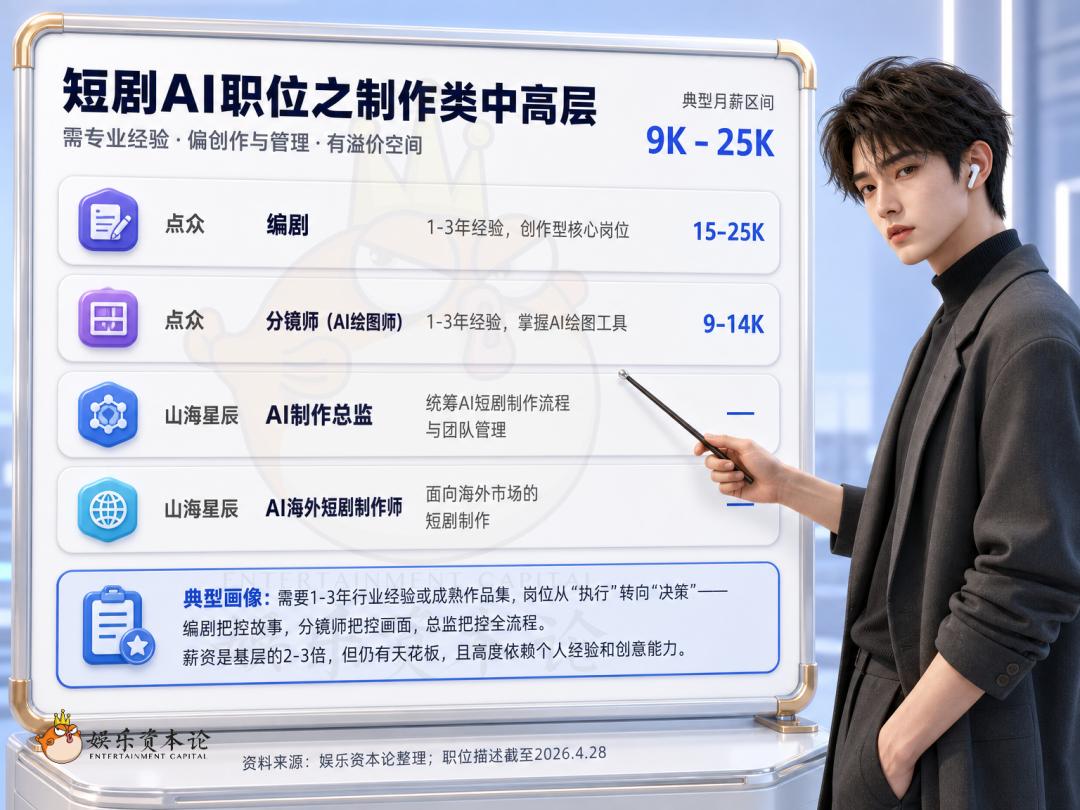
If you gain some experience, you can consider changing jobs. Taking Beijing Dianzhong as an example, screenwriters with 1 - 3 years of experience can get a salary of 15 - 25K, and storyboard artists (AI illustrators) can get a salary of 9 - 14K.
Interestingly, Beijing Chinese Online has prominently marked "two-day weekend" for some junior positions such as art designers and production staff. Compared with many positions in second-tier cities, this can be regarded as an obvious benefit. The salary ranges from 4 - 6K or 8K, and they accept applicants with no experience.
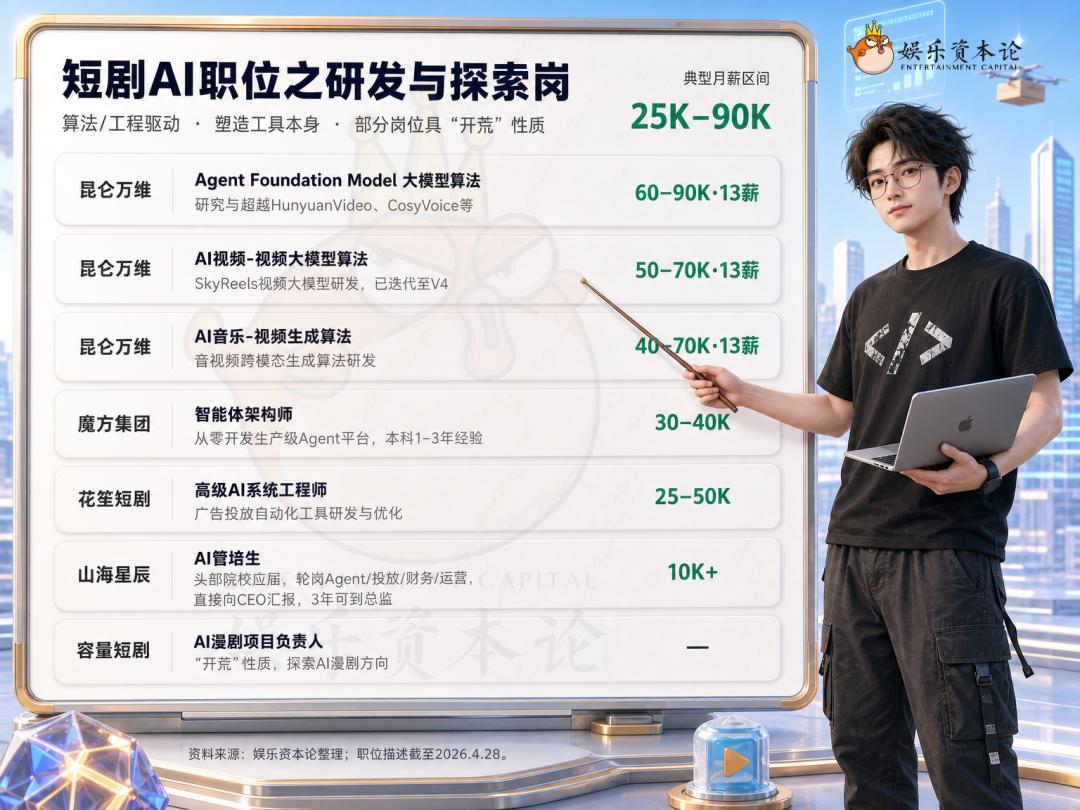
Relatively speaking, after adding some relatively advanced and programming-related positions, the obvious salary gap between the large number of basic positions and the technical engineer positions becomes more obvious.
The "AI novel comic adaptation production" position at Huasheng Comic Drama in Nanjing is responsible for screening and uploading novels that meet the requirements, and reviewing and optimizing the video narration and text generated by AI. It requires a junior college degree and 1 - 3 years of work experience, with a salary of only 4 - 6K. In contrast, its "senior AI system engineer (in the direction of advertising automation)" needs to develop and optimize automated advertising tools for AI training and inference, and expand the automation logic for overseas optimization. The salary for this position reaches 25 - 50K.
The Magic Cube Group is recruiting Agentic architects, test development engineers, etc., indicating that short drama companies already have a demand for Agent architecture. The intelligent agent architect is responsible for developing a production-level Agent platform from scratch. The Magic Cube has publicly stated that it will "build its own" AI comic drama workflow, using large models such as Jimeng, Sora, and Vidu. This position requires a bachelor's degree and 1 - 3 years of experience, and offers a monthly salary of 30,000 - 40,000 yuan in Guangzhou.
The recruitment salary for large-scale engineers at Kunlun Wanwei is even more exaggerated, and River Puffer will introduce it specifically at the end of this article.
The third type of AI positions are exploratory positions that even the employers themselves can't clearly explain what they do. For example, the AI comic drama project leader recruited by Rongliang Short Drama has a "pioneering" nature.
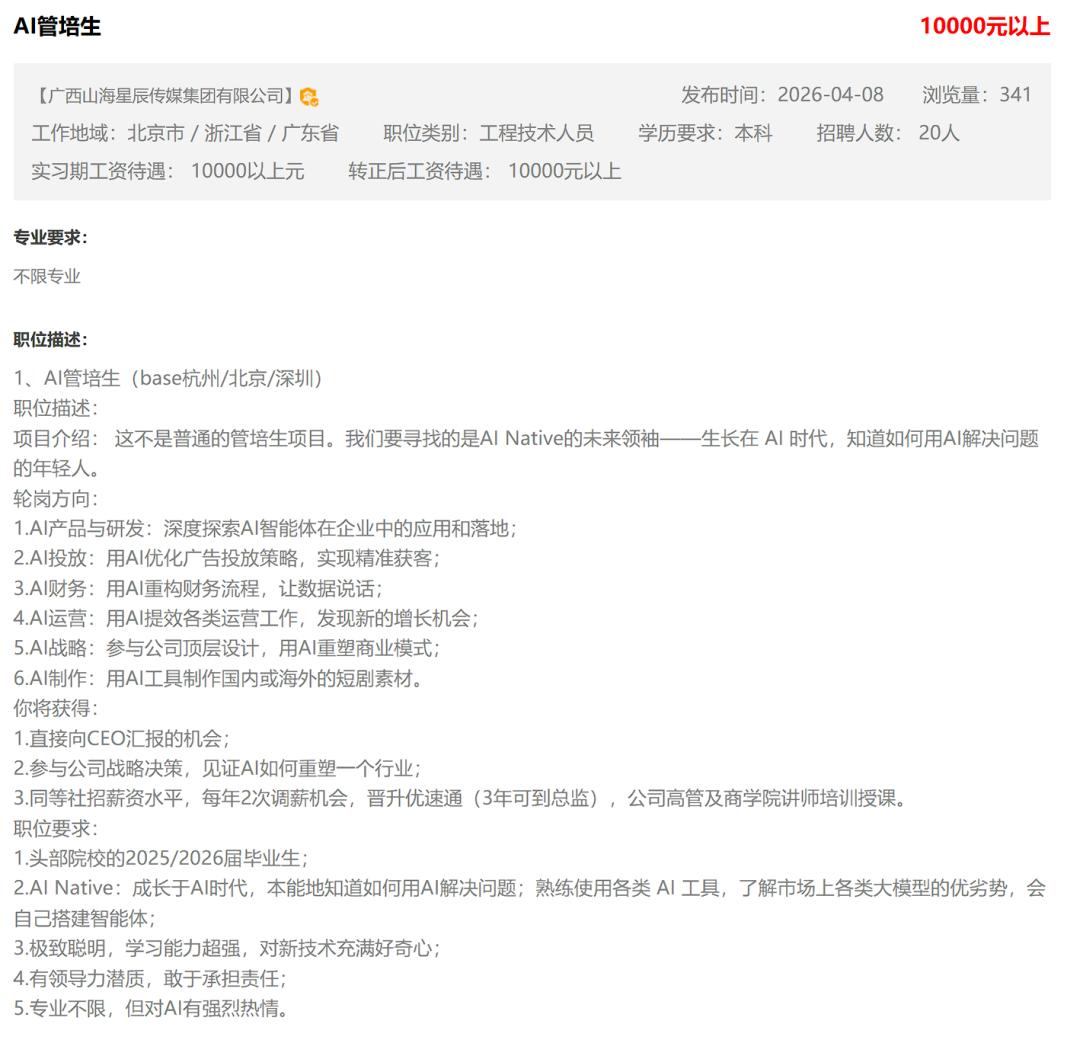
The AI positions at Shanhai Xingchen are also quite diverse, including AI production directors, AI overseas short drama producers, AI product managers, product leaders in the direction of AI live-action & dynamic comics, etc. It also has AI management trainees and AI production management trainees.
It is reported that the "AI production management trainee" mainly focuses on creating short dramas through card drawing, but the "AI management trainee" is much more interesting. It aims to "find the future leaders in the AI-native era - young people who grew up in the AI era and know how to use AI to solve problems."
The rotation directions include intelligent agent AI product development, AI advertising, using AI to restructure financial processes, and improving the efficiency of various operational tasks. Later, they can also "participate in the company's top-level design and reshape the business model with AI." The requirements for this position are fresh graduates from top universities, who "instinctively know how to use AI to solve problems," can build intelligent agents on their own, are curious about new technologies, have leadership potential, and are willing to take responsibility.
The salary for this position exceeds 10,000 yuan, but what is more attractive is that "they report directly to the CEO; participate in the company's strategic decision-making; enjoy the same salary level as social recruitment, with two salary adjustment opportunities per year, and a fast-track promotion path (can reach the director level in 3 years)." Xiaoyu is also very curious whether the future successor of Shanhai will emerge from such positions.
Simulated live-action dramas and commentary comics have become the mainstream in recruitment
Everyone is talking about AI comic dramas, but different companies have different definitions and practices for "comic dramas." From the perspective of job distribution, some positions are marked with specific track types. For example, some positions are specifically for live-action dramas, or specifically for commentary comics, etc.
Dianzhong, Maiya, Lingman KuaiChuang, Youhe Culture, Huasheng Comic Drama, Shanhai Xingchen, and Yaoke Culture have dedicated positions for live-action dramas, indicating that simulated live-action dramas are the current mainstream form of comic dramas. The positions at Maiya, Jiuzhou, and Dianzhong all include dedicated positions for commentary comics. Among them, Maiya's commentary comics and live-action dramas are all targeted at the overseas market. Shanhai Xingchen also has one position for dynamic comics.
It can be clearly seen that the platform's guidance determines the direction of the trend. Currently, AI simulated live-action dramas have become the absolute mainstream in this market. Hongguo Short Drama offers a split coefficient of up to 40 for AI simulated live-action short dramas, which is the highest split type among comic drama categories, directly driving the recruitment demand in this direction.
A chief editor/editor position for live-action dramas at Dianzhong offers a high salary of 25 - 50K. The person in this position needs to lead the team to complete the monthly script creation indicators, be responsible for the monthly consumption KPI, expand the resources of in-office authors, be responsible for the training of editors and authors, and establish the subject selection direction for brain-opening comic dramas for external screenwriters to adapt or create.
Maiya has many overseas positions. The overseas AI live-action drama screenwriter position requires a junior college degree and 1 - 3 years of experience, and offers a salary of 9 - 14K in Hangzhou. They are also recruiting screenwriters, editors, producers, and directors for commentary comics simultaneously. However, from the job descriptions, there is no obvious difference in requirements for the overseas market compared to the domestic market. They also synchronize their job information to LinkedIn to better meet the overseas recruitment needs.