Find the right users, and a free file transfer tool can turn into a money-making business that earns tens of millions per month.
SHAREit is well - known in the overseas market. It has 1.8 billion installations, with a peak MAU of over 500 million. In the past 30 days, it still has over 10 million downloads. However, the subscription revenue of "SHAREit", which started in emerging markets, is less than $10,000.
In terms of commercialization, this overseas product follows the path of large user volume and advertising monetization.
Similarly, as a file - transfer tool, we recently found that the monthly revenue of "WeTransfer" has been rising rapidly in the past year. It has increased from about $900,000 in January 2025 to over $4 million in April 2026.
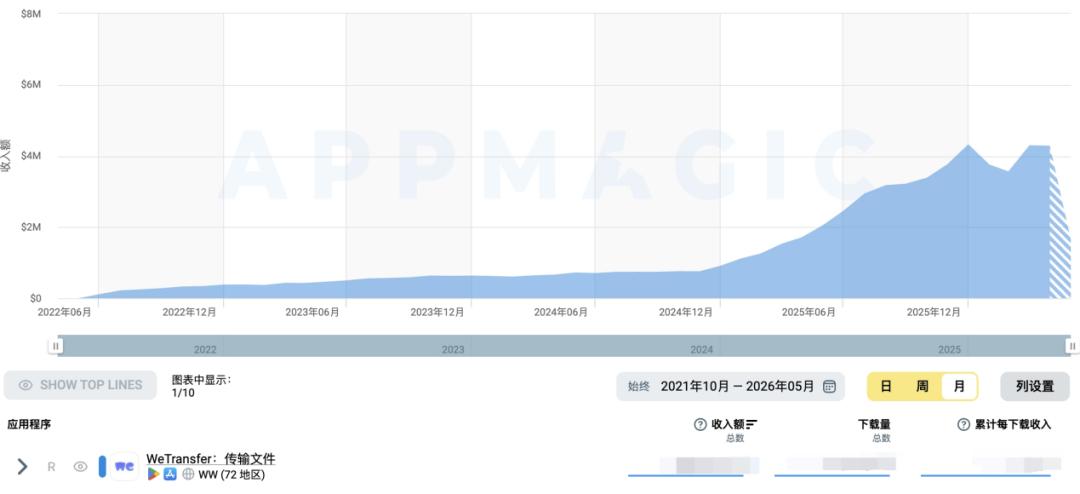
Revenue data of WeTransfer from October 2021 to the present | Image source: AppMagic
How did "WeTransfer" turn a function that people thought couldn't make users pay directly into a high - revenue business?
I. The gap lies not in the tool itself, but in the users' wallets
It should be noted that the four - fold growth of "WeTransfer" mainly occurred after it was acquired by the well - known app factory Bending Spoons in July 2024. However, Bending Spoons continued the tradition of exploring products with proven demand and then amplifying their revenue. The reason why Bending Spoons can "unlock" this "lock" lies in the completely different user profiles of "WeTransfer" and SHAREit.
SHAREit was founded in 2015. Originally developed by a small internal team at Lenovo, it targeted the scenario of providing face - to - face, internet - independent file - transfer capabilities to users in emerging markets with poor infrastructure. This scenario naturally filtered out ordinary users in South Asia and Southeast Asia with poor infrastructure and mainly using Android devices.
Recently, SHAREit has launched functions such as memory cleaning, video compression, and lock - screen animations during charging, and has gradually started to generate some in - app purchase revenue. However, the monthly revenue after revenue sharing is still low.
Different from SHAREit's face - to - face scenario, "WeTransfer" focuses on cloud relay transfer of large files. Users first upload files to the cloud and then share the link with the recipient. The recipient can download the files within the validity period without downloading the app or logging in. They just need to click the link and press the download button to complete the entire transfer process.
In 2009 when "WeTransfer" was first launched, most chat apps did not support the transfer of files larger than 1GB. At that time, cloud storage services were just emerging, and there was a fundamental logical difference between cloud storage and cloud relay transfer. Cloud storage is like "a personal warehouse" centered on the user, while cloud relay transfer is centered on the sending behavior. It doesn't require user registration, doesn't occupy quotas, and doesn't need management permissions, etc. It is more suitable for one - time transfer scenarios of large - volume files.

Both the official website and user reviews show that the main user group of "WeTransfer" is people in the creative industry | Image source: WeTransfer official website, Diandian Data
This transfer behavior is directly targeted at "users in the creative industry" (verified by the official website and user reviews), including video editors, photographers, designers, advertising companies, etc. A wedding photographer may have 40 - 60GB of RAW original photos after a wedding, and the refined JPEG delivery package can easily exceed 2GB. Sending these files to clients or printing factories may be a weekly necessity.
The discovery of this necessity stems from the fact that the founder himself was a user. In 2009, Bas Beerens ran a design company called OY Communications in Amsterdam. He frequently sent large - size pictures to clients, but the existing tools for transferring large files had complex interfaces and unstable transfer experiences. Frustrated, Bas Beerens decided to create his own tool.
Initially, this tool was just an internal FTP server called OY Transfer. The story took a turn when another founder, Nalden, a well - known European fashion blogger, joined. The internal tool was renamed "WeTransfer" and publicly released, positioning itself as a minimalist large - file transfer tool that doesn't require registration and can be used immediately.
Relying on Nalden's influence in the European and American fashion circles, "WeTransfer" penetrated the European and American fashion circles and expanded to a wider range of creative industries such as design and photography without heavy promotion.
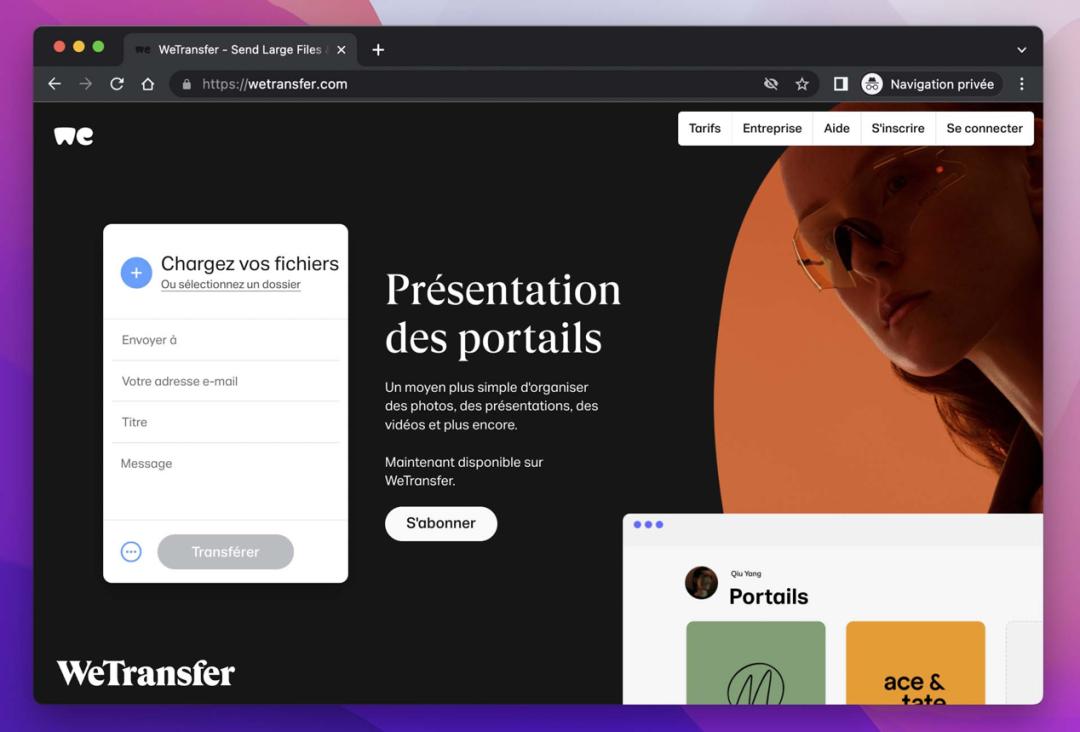
Early interface of WeTransfer | Image source: Google
II. "WeTransfer" went off - track, and Bending Spoons corrected it
By targeting users with real needs and high willingness to pay and adopting a relatively restrained monetization model in the early stage (the free package allows unlimited transfers with an upper limit of 2GB and a 7 - day link validity period, and the upper limit reaches 200GB per transfer after subscription), "WeTransfer" achieved smooth growth in the early stage.
In addition, "WeTransfer" found a rather ingenious advertising monetization method called "wallpaper ads". As shown in the following picture, "WeTransfer" displays ads in the background of the file upload page, and the transfer progress floats above the ads in a window. Since users need to wait for the upload and keep the page open, the stay time and attention are guaranteed, and the high CPM has brought considerable profits to the company.

WeTransfer calls this advertising method "wallpaper ads" | Image source: adweek
As of July 2024, "WeTransfer" had 80 million monthly active users and 600,000 paid subscribers, with an annual revenue of about 132 million euros, of which advertising revenue accounted for more than half.
A long - term and stable money - making machine often gives the team an illusion that the core business is stable enough, and it's time to do something more meaningful.
In 2018, WeTransfer began to expand into the creative content field and launched the digital art platform WePresent. It hired editors, curators, and producers, and collaborated with artists to launch short films, photo collections, exhibitions, etc. In 2022, the short film "The Long Goodbye" co - produced by WePresent even won the Oscar for Best Short Film. Meanwhile, "WeTransfer" also provides financial support to emerging artists every year and offers 30% of its advertising space to artists for free to help them gain exposure.
Although it helps to enhance the industry influence, it also burns a lot of money. At the same time, due to the expansion of the business, by 2024, the team size of "WeTransfer" reached 350 people, far exceeding the scale of a typical tool - making company.
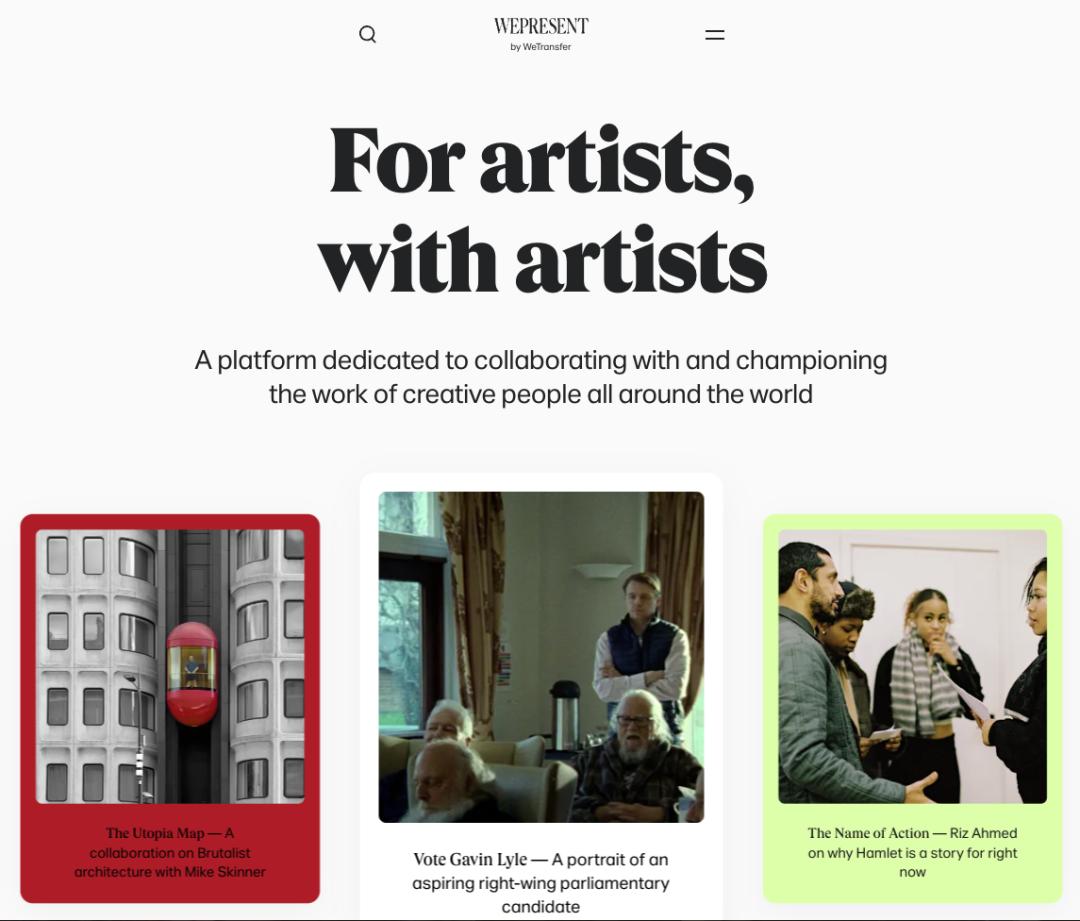
Illustration: WePresent official website
Worse still, while the team focused on art, the product's barriers were being eroded by external competitors. Cloud storage services such as Google Drive and OneDrive gradually matured, reducing the "friction" in the large - file transfer process. Competitors like Dropbox actively transformed into creative collaboration tools, and "WeTransfer" was clearly lagging behind and missed the window period.
After 2020, the user growth of "WeTransfer" gradually stagnated. In 2022, "WeTransfer" attempted an IPO in Amsterdam with a target valuation of 716 million euros, but eventually gave up due to "market fluctuations". In reality, a tool company with stagnant growth, incomplete monetization, and a bunch of creative projects couldn't tell an exciting story.
Having a brand, users, and stagnant growth exactly matches the target profile of the Italian "app factory" Bending Spoons.
III. 15 years later, Bending Spoons opens users' wallets
The "app factory" is the core strategy developed by Bending Spoons. It specializes in finding mature products with brand accumulation, a solid user base but stagnant growth, and potential monetization space. It uses a systematic growth and monetization strategy to re - activate these products. The video - editing product Splice and the photo - editing product Remini are successful examples, both ranking at the top in their respective categories.
So, in July 2024, Bending Spoons acquired "WeTransfer" for a rumored 200 million - 430 million euros (almost half of the previous IPO target valuation).
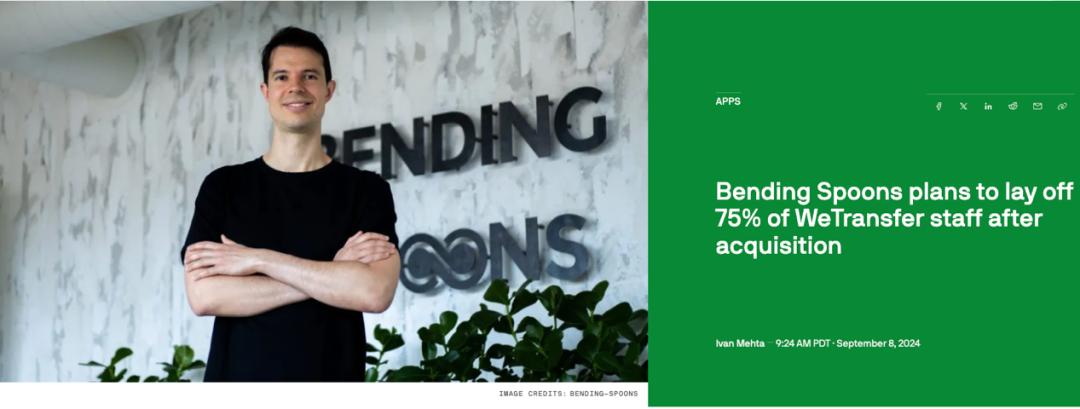
The "surgery" on "WeTransfer" started with the personnel. Less than two months after the acquisition, the CEO of Bending Spoons announced that 75% of WeTransfer's employees would be laid off, and the team size quickly shrank from 350 to 90 people.
In December 2024, the monetization structure was adjusted accordingly.
The free usage restrictions were tightened comprehensively. Previously, free users could transfer files unlimited times with a single - transfer limit of 2GB and a 7 - day file validity period. After the adjustment, not only was a monthly limit of 10 transfers added, but the single - transfer limit of 2GB was changed to a cumulative limit of 3GB, and the file validity period was shortened from 7 days to 3 days.
This adjustment almost blocked all users with productivity needs. Only extremely light users who transfer files 1 - 2 times a month can continue to use the free trial.
The subscription structure was also redesigned. The original multiple options such as Pro and Plus were integrated into three levels: the free version, Starter ($2.99/week, $84.99/year, still limiting the monthly transfer times to 10 and allowing a cumulative transfer of 300GB), and Ultimate ($9.99/week, $229.99/year, with no limit on transfer times and size).
For users with real needs, Starter seems cheap but doesn't meet their needs. It is only suitable for low - frequency users with large - size single - transfer files. The change in the subscription structure is mainly to guide high - frequency users to choose Ultimate.
According to the RPD data from AppMagic, with a stable and slightly increasing download volume, the RPD of "WeTransfer" increased significantly after December 2024, indicating a considerable increase in the average customer price.
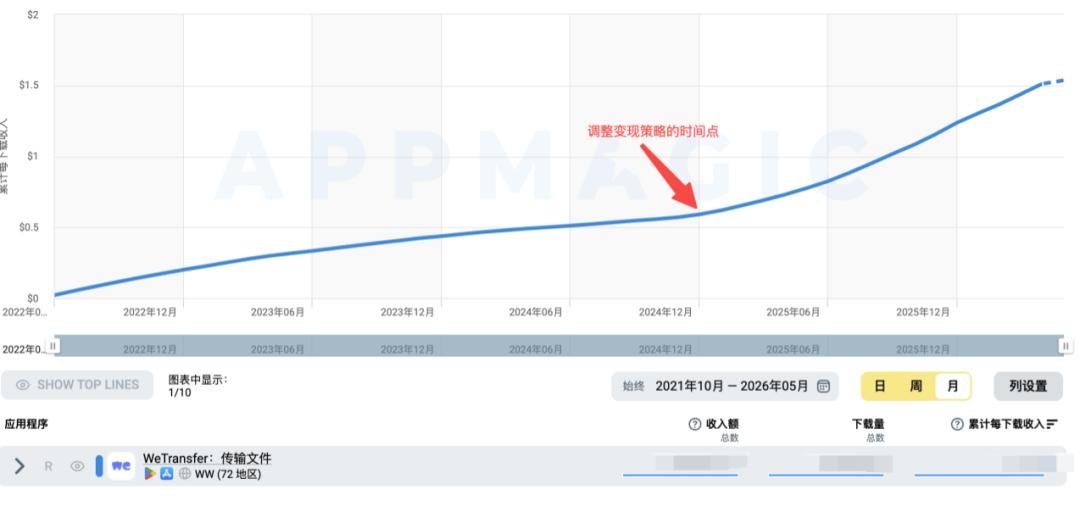
RPD data from October 2021 to the present | Image source: AppMagic
The advertising business with a high CPM and little impact on the user experience was retained. Bending Spoons also promised to maintain 30% of the advertising space for public welfare and creative content to maintain the brand recognition of "WeTransfer" among creative people.
Conclusion
The reason why the minimalist - designed "WeTransfer" can make money with the same transfer tool can be divided into two key points.
The first point determines the ceiling: Who are the targeted users? "WeTransfer" made the right choice in 2009 by targeting users in the creative industry with high willingness to pay. The second point determines whether the ceiling can be reached: How to truly activate users' willingness to pay?
From another perspective, Bending Spoons' acquisition of "WeTransfer" not only brings a monthly revenue of $4 million but also an important piece in its upcoming IPO story.
This article is from the WeChat official account "Baijing Chuhai" (ID: baijingapp), written by Zhang Kairan and edited by Yin Guanxiao. It is published by 36Kr with authorization.