The youngest Chinese professor at Harvard was reported to have joined OpenAI.
On June 1st, according to a post on the overseas social platform X, two Chinese scientists were reported to have recently joined OpenAI. Yesterday, an insider revealed that Yin Xi, a professor in the Department of Physics at Harvard University and an alumnus of the University of Science and Technology of China, has joined OpenAI. Additionally, on May 30th, Su Weijie, a professor in the Department of Statistics and Data Science at the Wharton School of the University of Pennsylvania and an alumnus of Peking University, announced on X that he had joined OpenAI during his sabbatical from the Wharton School and returned to the Bay Area to participate in AI model training.
The two come from the fields of theoretical physics and statistics respectively. Su Weijie's research interests include the statistical foundation of generative AI, watermarking of large language models, alignment, ranking, privacy - preserving data analysis, convex optimization, and high - dimensional statistical inference. Yin Xi has long been engaged in research on string theory, quantum gravity, conformal field theory, etc.
Judging from the movements of these two, OpenAI is attracting talents from basic disciplines. As it becomes more difficult to improve the capabilities of large models, AI companies increasingly need people who can understand and improve models from perspectives such as mathematics, statistics, and physics. For large - model companies, in addition to computing power and data scale, model training methods, evaluation systems, and reliability issues are becoming the key to competition in the next stage.
01. The Youngest Chinese Full Professor at Harvard Reportedly Joins OpenAI
According to a post on the overseas social platform X, Yin Xi, a professor in the Department of Physics at Harvard University, was reported to have joined OpenAI. However, OpenAI, Harvard University, and Yin Xi himself have not publicly confirmed this news.
According to the tweet, Yin Xi believes that AI can increase his research efficiency by 100 times. What might have taken 10 years to achieve in the past can now be completed in a few weeks. He also believes that there is no human intellectual ability that AI cannot reproduce.
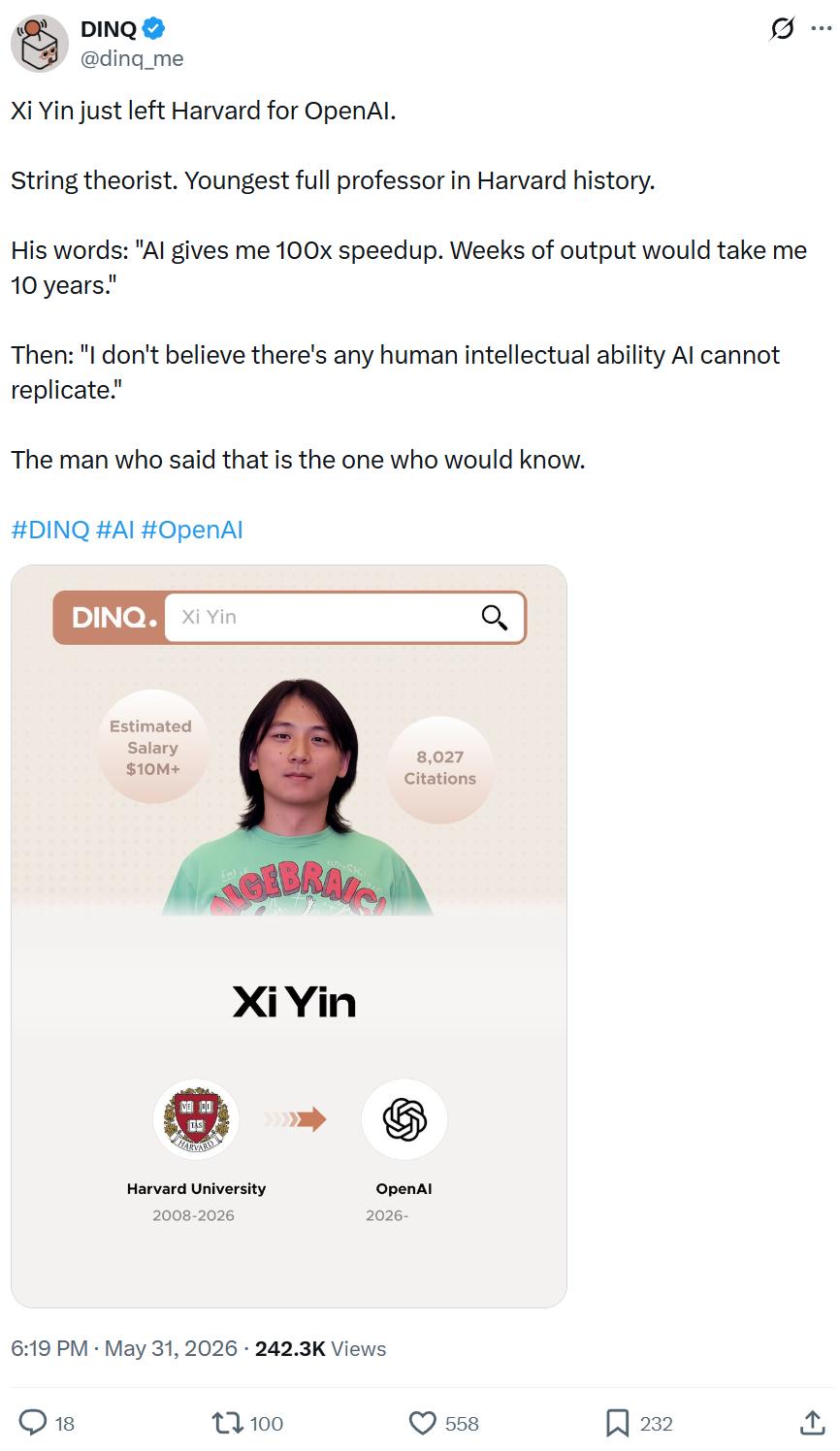
Yin Xi Reportedly Joins OpenAI (Source: X)
The official website of the Department of Physics at Harvard University shows that Yin Xi is currently a physics professor at the university and has long been engaged in frontier research in theoretical physics. His research focuses on fundamental issues in string theory and the inspiration of string theory for other fields of physics and mathematics. His past work has involved black holes, supersymmetric bound states in string theory, three - dimensional conformal field theory, and gauge theory. His current research focuses on low - dimensional quantum gravity and the holographic duality between gauge theory and string theory/gravity.
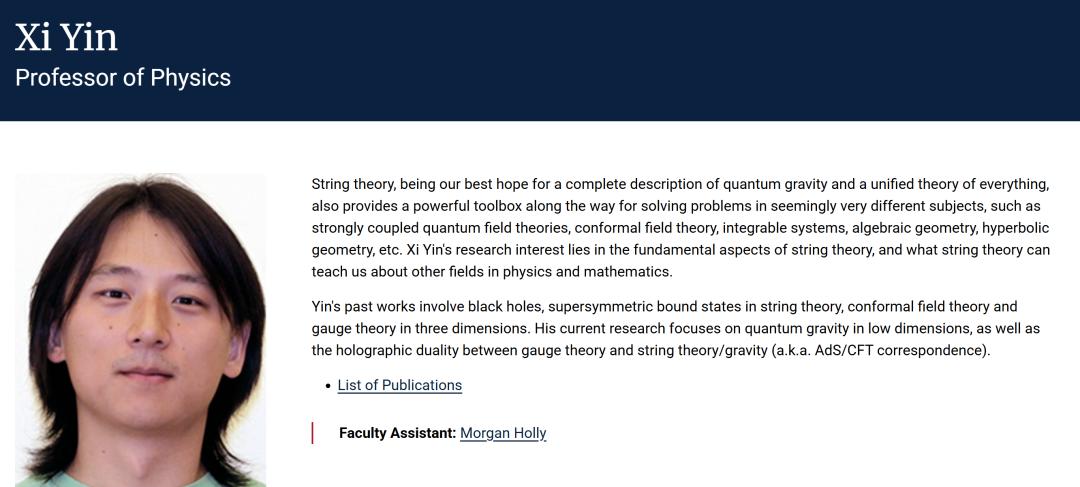
Introduction to Yin Xi in the Department of Physics at Harvard University (Source: Harvard University)
Yin Xi's early experiences have attracted much attention. Public information shows that Yin Xi was born in December 1983. He was admitted to the Juvenile Class of the University of Science and Technology of China before he was 13 years old. After completing his five - year undergraduate program at the University of Science and Technology of China at the age of 17, he went to the United States and became the youngest student to pursue a doctoral degree at Harvard University that year.
In 2006, Yin Xi obtained a doctorate in physics from Harvard University. In 2008, he began to teach in the Department of Physics at Harvard University. In 2015, at the age of 31, Yin Xi was promoted to a full professor at Harvard University, becoming one of the youngest Chinese full professors in the history of Harvard University. In 2016, Yin Xi won the 2017 "New Horizons in Physics Prize" of the Breakthrough Prize in Fundamental Physics for his research in string theory.
02. Su Weijie Officially Announces Joining OpenAI to Participate in AI Model Training
On May 30th, Su Weijie, a scholar in the Department of Statistics and Data Science at the Wharton School of the University of Pennsylvania, announced on his personal account that he had joined OpenAI during his sabbatical from the Wharton School and returned to the Bay Area after a 10 - year absence to participate in AI model training.
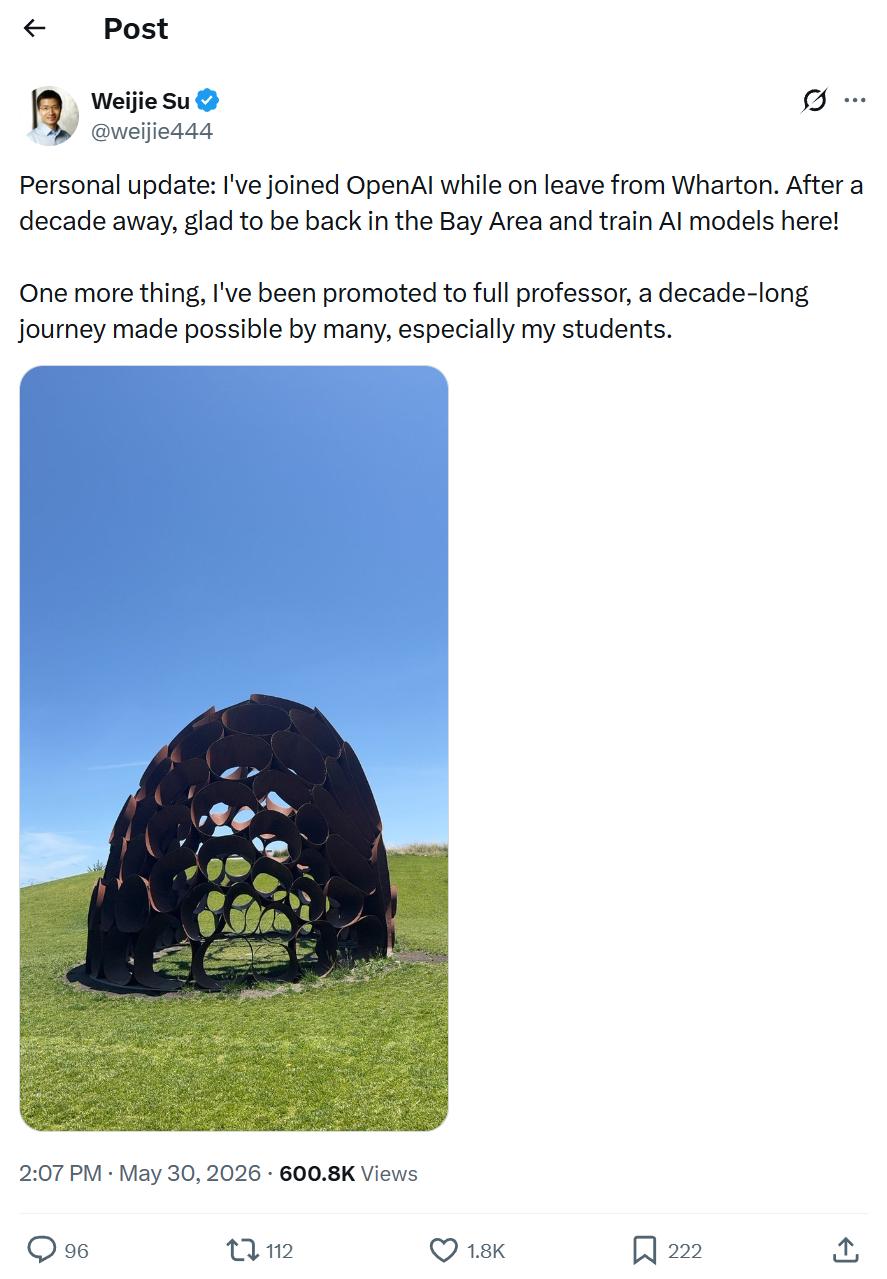
Su Weijie Joins OpenAI (Source: X)
Greg Brockman, the President of OpenAI, then left a message in the comment section to welcome him. When asked by netizens whether he would work part - time at OpenAI while continuing to serve as a professor after the sabbatical, Su Weijie replied that he didn't know yet and was currently focused on his work at OpenAI. In the tweet, Su Weijie also announced that he had been promoted to a full professor in the Department of Statistics and Data Science at the Wharton School.
The official website of the Wharton School of the University of Pennsylvania shows that Su Weijie is a professor in the Department of Statistics and Data Science and also holds positions in computer and information science, mathematics, biostatistics, epidemiology, and informatics. Su Weijie graduated from the School of Mathematical Sciences at Peking University in 2011. He obtained a doctorate in statistics from Stanford University in 2016 and joined the Wharton School to teach in the same year.
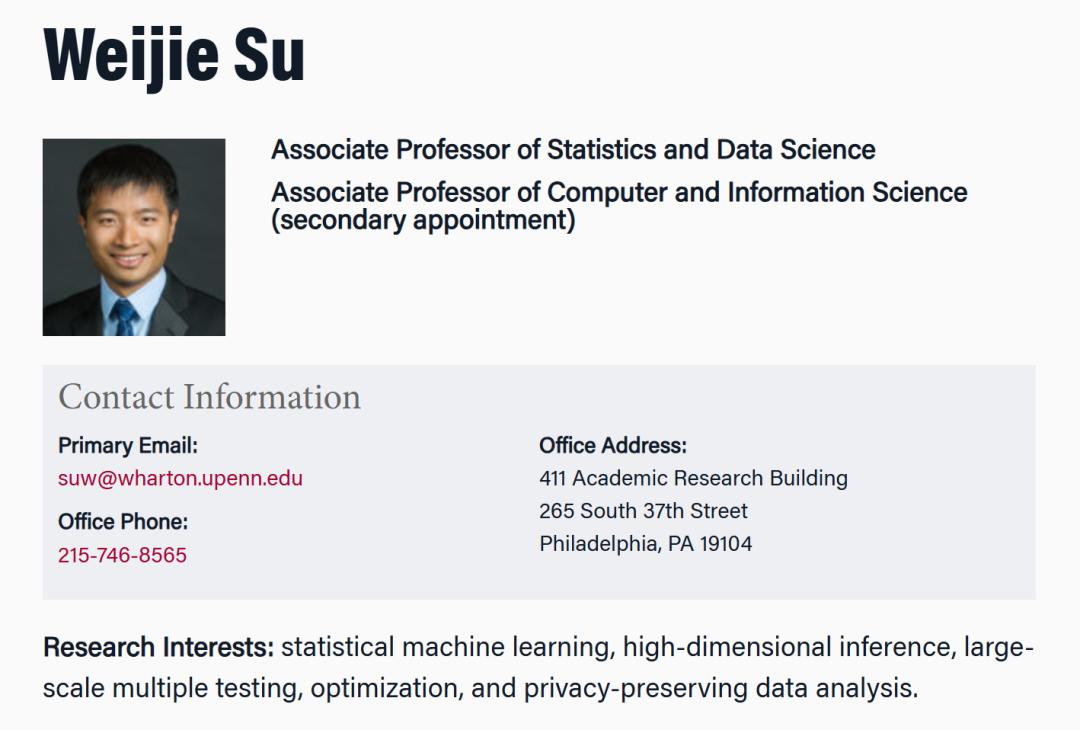
Introduction to Su Weijie on the Wharton School's Official Website (Source: Wharton School)
The Department of Statistics at Stanford University announced in February this year that Su Weijie won the 2026 COPSS Presidents' Award. This award is presented by the Committee of Presidents of Statistical Societies (COPSS), which is composed of several statistical societies in North America. It is awarded to statistical scholars under the age of 41 and is often referred to as the "Nobel Prize of Statistics".
The reason for the award given by COPSS shows that Su Weijie has made outstanding contributions to the statistical foundation of generative AI, and his research involves watermarking, alignment, and ranking of large language models. His breakthroughs in privacy - preserving data analysis have significantly improved the accuracy of the 2020 US census data.
03. Conclusion: Talents in Basic Disciplines Become the New Target of AI Companies
OpenAI's successive attraction of top scholars with backgrounds in statistics and theoretical physics reflects that the research and development of large models is entering a deeper stage of competition. In the past few years, the industry has focused more on computing power, data, and engineering scale. However, as it becomes more difficult to further improve the capabilities of models, how to improve training methods, establish more reliable evaluation systems, and enhance the stability of models in complex tasks are becoming new key issues.
This also means that the demand for talents from AI companies is expanding beyond traditional machine learning and engineering development. Statistics is good at dealing with uncertainty, evaluation, and inference problems, while theoretical physics has long faced complex systems and abstract models. For large - model companies like OpenAI, recruiting talents in these basic disciplines may help find new breakthroughs in model training, alignment, security, and scientific reasoning.
This article is from the WeChat official account “Zhidongxi” (ID: zhidxcom). The author is Yang Jingli, and the editor is Li Shuiqing. It is published by 36Kr with authorization.