AI can't save silicon carbide.
Some time ago, a report from the well - known research institution Citrini Research blew the hype of AI power onto the once - popular but now "out - of - favor" stock, Wolfspeed.
Those familiar with the US stock market are no strangers to these two names.
Citrini is one of the most popular research institutions on Wall Street. At the beginning of the year, a report (《THE 2028 GLOBAL INTELLIGENCE CRISIS》) elevated the issue of "AI causing white - collar unemployment" to the level of "triggering a global economic recession". This not only severely hit the US stock market but also forced Goldman Sachs, Morgan Stanley, and the Federal Reserve to engage in a debate.
Wolfspeed was both a beneficiary and a victim of the silicon carbide concept that was extremely popular a few years ago. It enjoyed the high - light moment when its stock price skyrocketed six - fold within two years and also experienced the darkest moment when its stock price dropped to less than $1.
In a report titled 《Semiconductor Memo: Supply Chain Inheritance》, Citrini pointed out that Wolfspeed "is highly likely to become the biggest winner in this new stage of the AI boom."
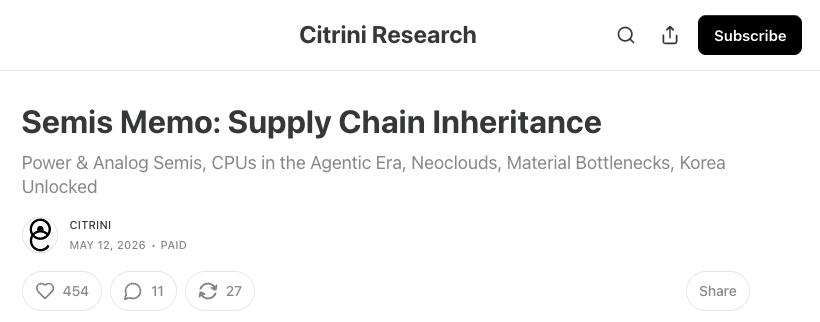
《Semiconductor Memo: Supply Chain Inheritance》, Citrini Research
The reason Citrini is bullish on Wolfspeed is that it is optimistic about the potential demand for silicon carbide in the power systems of AI data centers, and Wolfspeed is "the only game in town" in this field [1].
The day after the report was released, Wolfspeed's stock price soared by 20%. Along with this, related silicon carbide companies in the Hong Kong stock market also rallied. Tianyue Advanced Materials Co., Ltd. soared by more than 18%, hitting a new high since its listing, and Hantech Power Semiconductor Co., Ltd. also rose by more than 12%.
This lively scene almost makes people feel like they are back to the peak of silicon carbide a decade ago.
The Out - of - Favor Star
Wolfspeed can be considered one of the earliest "Musk concept stocks".
In 2016, the launch of the Model 3 brought Wolfspeed into the spotlight. The 48 silicon carbide MOSFET power chips on the inverter of the electric drive system made the capital market re - recognize this company that had been lingering on the edge of the semiconductor industry.
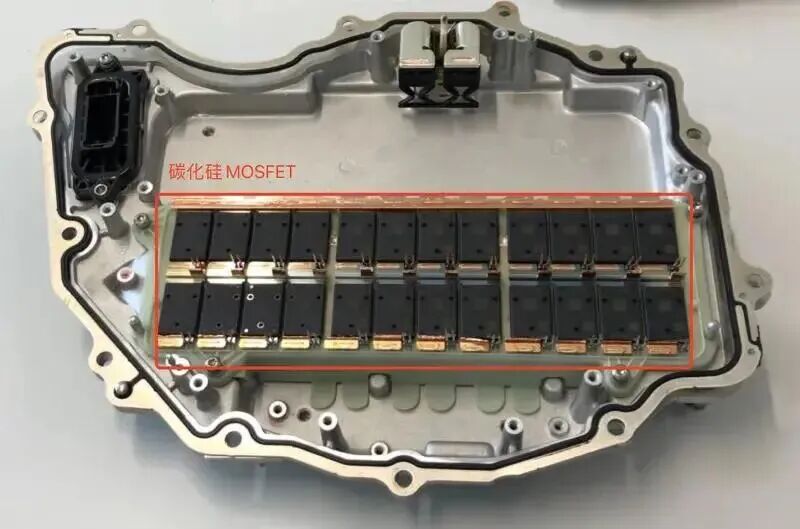
Silicon carbide MOSFETs in the Model 3 inverter
Originally, Wolfspeed used silicon carbide to manufacture blue - light LEDs, and its semiconductor business accounted for only 8% of its revenue (in fiscal year 2015). However, it was this 8% that brought great wealth to Wolfspeed.
The Model 3 dominated the market, and with the trend of electrification, in just a few years, silicon carbide became extremely popular in the industrial and capital circles. Industry giants flocked to it, and orders poured in.
In 2021, Wolfspeed sold its LED business and became what investment institutions called the "purest silicon carbide target". At that time, it was the only company in the US and one of only two in the world (the other being Rohm in Japan) that covered the entire silicon carbide supply chain from upstream substrates to downstream devices.
However, the expected huge profits did not follow.
From 2019 to 2024, the global silicon carbide production capacity construction was in full swing, and Chinese manufacturers built the most and with the highest efficiency.
Taking the 6 - inch silicon carbide substrate as an example, the global production capacity increased by five times within five years [2]. It is predicted that it will reach 4 million pieces in 2025 [3]. Among them, the actual effective production capacity of Chinese manufacturers reached 2.016 million pieces [4] (according to the production capacity of expansion projects as of November 2023, as counted by Jibei Consulting), accounting for more than half of the global production capacity.
The direct consequence of over - building production capacity was oversupply and a sharp drop in prices.
According to Frost & Sullivan, the price of silicon carbide substrates dropped from 4,400 - 6,400 yuan per piece in 2020 to an expected 2,400 - 4,400 yuan per piece in 2025. In 2025, the over - capacity of silicon carbide substrates will be as high as 1.5 million pieces [3].
In 2025, Tianyue Advanced Materials Co., Ltd.'s sales volume of silicon carbide substrates increased by nearly 80%, but its revenue decreased by 17.15%. The financial report frankly stated that it was due to "the decline in the average product price".
The overall capacity utilization rate of the industry declined significantly. The upstream utilization rate dropped to about 50%, and the downstream device utilization rate dropped to 70% [5].
This was tough for Wolfspeed. The 8 - inch silicon carbide substrate factory it invested heavily in has never reached full production since it opened in 2022, directly leading to a continuous increase in its "Under - utilization Charges".
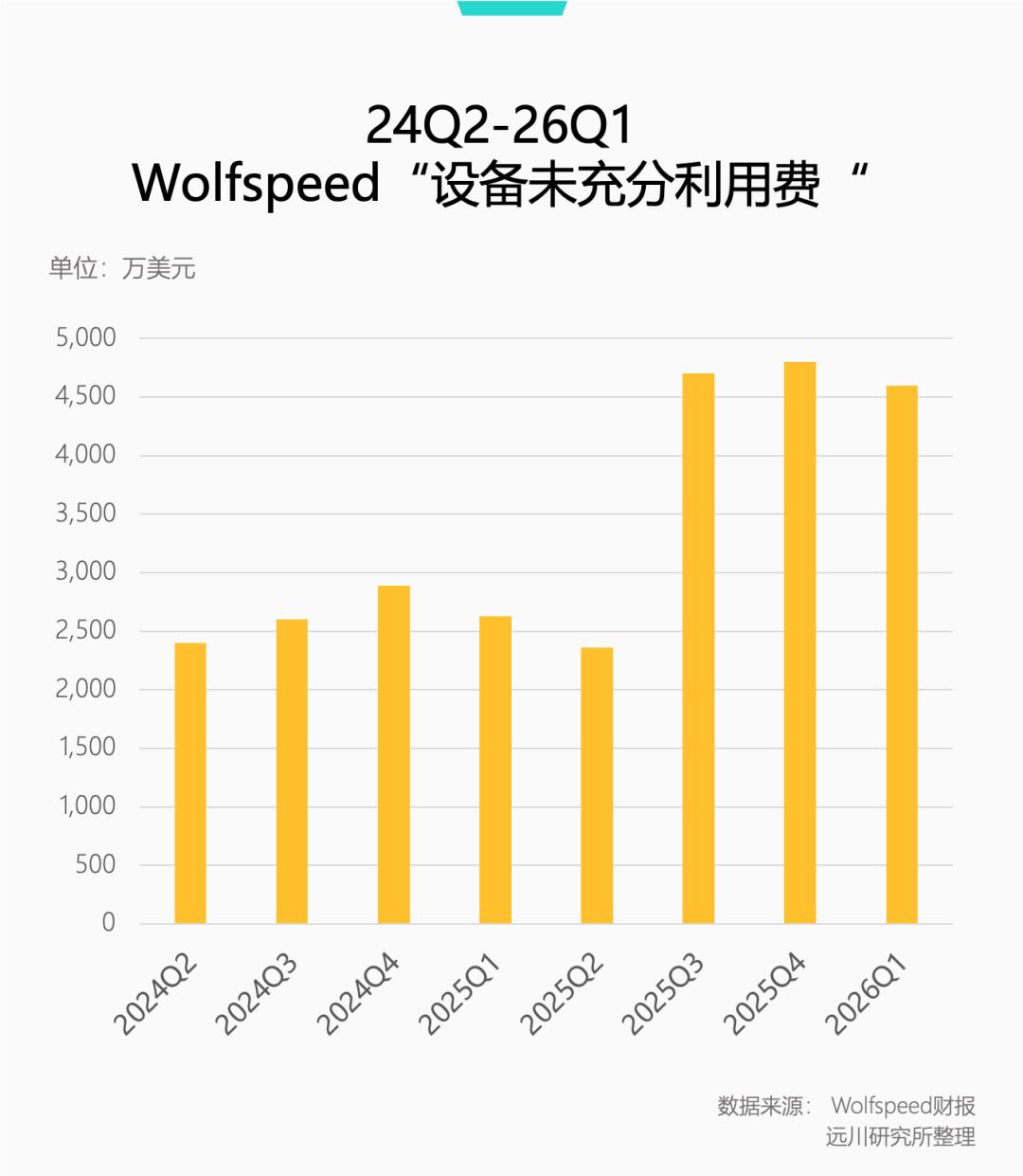
Rohm, its neighbor, "shared the same difficulties". In fiscal year 2025, it separately accrued an asset impairment loss of up to 193.6 billion yen (about $1.2 billion) for its silicon carbide - related production facilities.
In the first quarter of this year, Wolfspeed had a net loss of nearly $120 million, and Rohm recorded a loss of 173.246 billion yen (about nearly $1.1 billion), with its net profit margin plummeting to - 155.19%.
The core reason for the sharp decline after 2021 is that the silicon carbide market is not large enough, and too many players have crowded in within a short period.
Just as the once - beloved has become a thing of the past, AI has come to the rescue on a white horse.
The Black Knight Arrives
In March this year, Wolfspeed launched a 10,000V silicon carbide power MOSFET. We often hear about 800V/1000V in electric vehicle press conferences, but this "10,000V" is obviously not for electric vehicles.
In the past six months when Wolfspeed was on the verge of bankruptcy, the data center business has been the only bright spot in its performance. In the last two quarters, Wolfspeed's data center business increased by 50% and 30% quarter - on - quarter respectively.
The ultra - high - voltage 10,000V silicon carbide device is what Wolfspeed has prepared for AI data centers.
We know that the electricity from the power grid cannot be used directly. It needs to be transformed to an appropriate voltage through a transformer before it can be used by household appliances.
The same principle applies to AI data centers. From the alternating current of the power grid to the direct current actually used by GPUs, multiple voltage conversions are required. This is where silicon carbide devices come in handy - to improve conversion efficiency and reduce power waste.
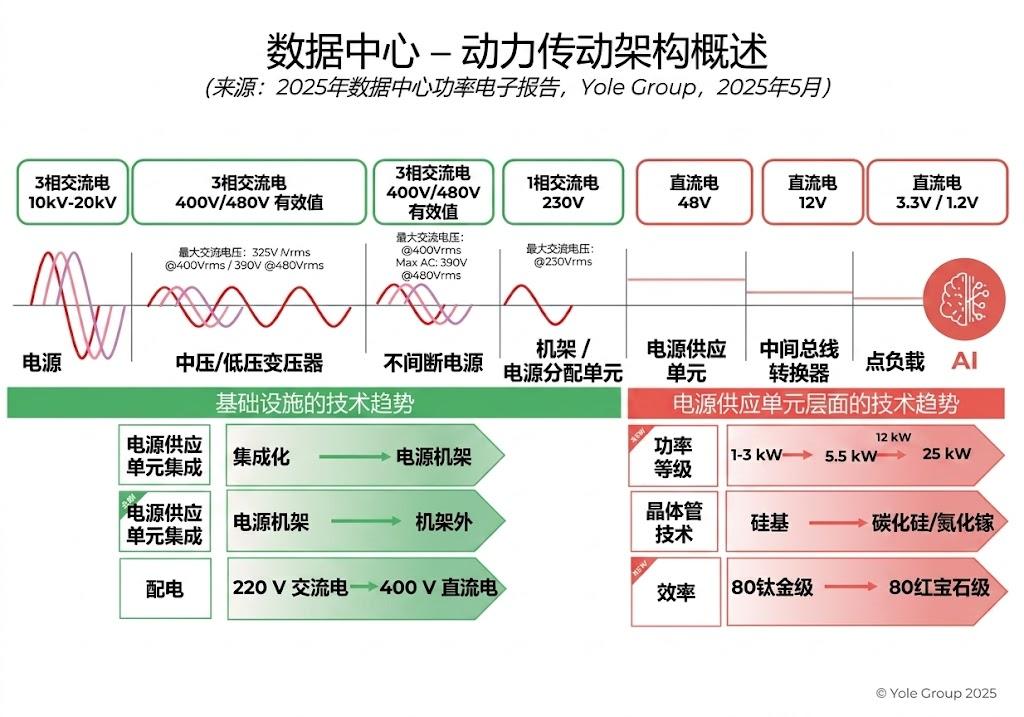
Multiple voltage conversions required from the alternating current of the power grid to the direct current used by GPUs
Currently, the capital market is mainly hyping around two aspects:
One is the power supply unit (PSU) in the server rack.
This is the scenario with the highest certainty at present. Leading manufacturers such as Infineon and Wolfspeed have already made actual shipments. Due to the "extremely strong" demand in this area, Infineon has significantly raised its revenue forecast for AI data centers.
The other is the "solid - state transformer" (SST), which Citrini believes is the next technological inflection point.
The core is to integrate the multiple voltage conversion processes between the power grid and the PSU (the green area in the figure) into one device in one step. This is also the target application of Wolfspeed's 10,000V device, but it is still in the early stage of innovation.
"800V" is a key node for the real large - scale implementation of these two applications.
"800V" refers to the DC 800V power architecture in data centers, which is considered an inevitable trend in the industry. NVIDIA set the goal of large - scale commercialization in 2027 last year.
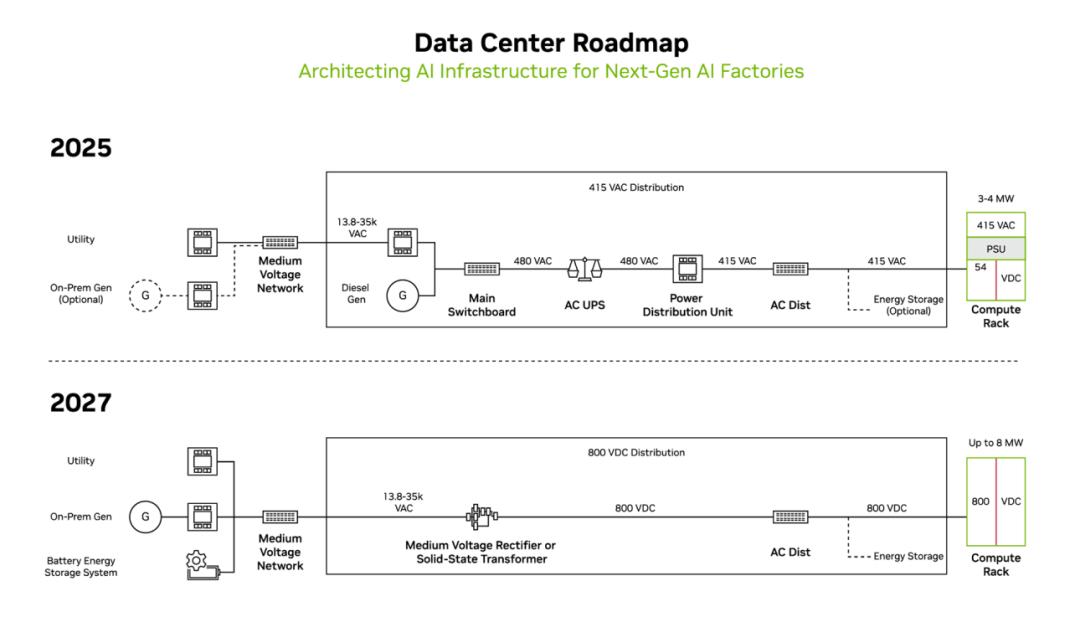
NVIDIA's data center power architecture roadmap
Once the DC 800V power architecture is adopted, with ultra - high power of over 100kW, silicon carbide will change from an optional to a mandatory component. Both silicon carbide PSUs and SSTs will face an unprecedented peak in demand.
Citrini believes that AI may bring a stronger second - wave of demand for silicon carbide, leading to a re - pricing of these key raw material suppliers.
So far, the rescue effect of AI has been initially reflected.
Infineon has urgently modified its idle production lines for automotive or industrial devices to produce AI power chips. It officially predicts that its AI business will contribute 1.5 billion euros in revenue in 2026.
ON Semiconductor has shaken off the gloom of several quarters. In the first quarter, its AI data center business increased by more than 30% quarter - on - quarter and doubled year - on - year. The CEO boldly predicted in the earnings conference that the annual revenue from the AI data center will double year - on - year.
In the financial reports of each company in the silicon carbide industry chain, the word "AI" appears very frequently.
However, can AI really be the life - saving straw for silicon carbide?
A Drop in the Bucket
The answer is no.
Firstly, silicon carbide is always a niche market, and the silicon carbide used in AI data centers is even more of a niche within a niche.
Silicon carbide devices are more expensive than traditional silicon devices. The industry generally believes that silicon carbide devices will only be used when the power supply exceeds 3000W, and there will be a rigid demand for them only when the power exceeds 5000W.
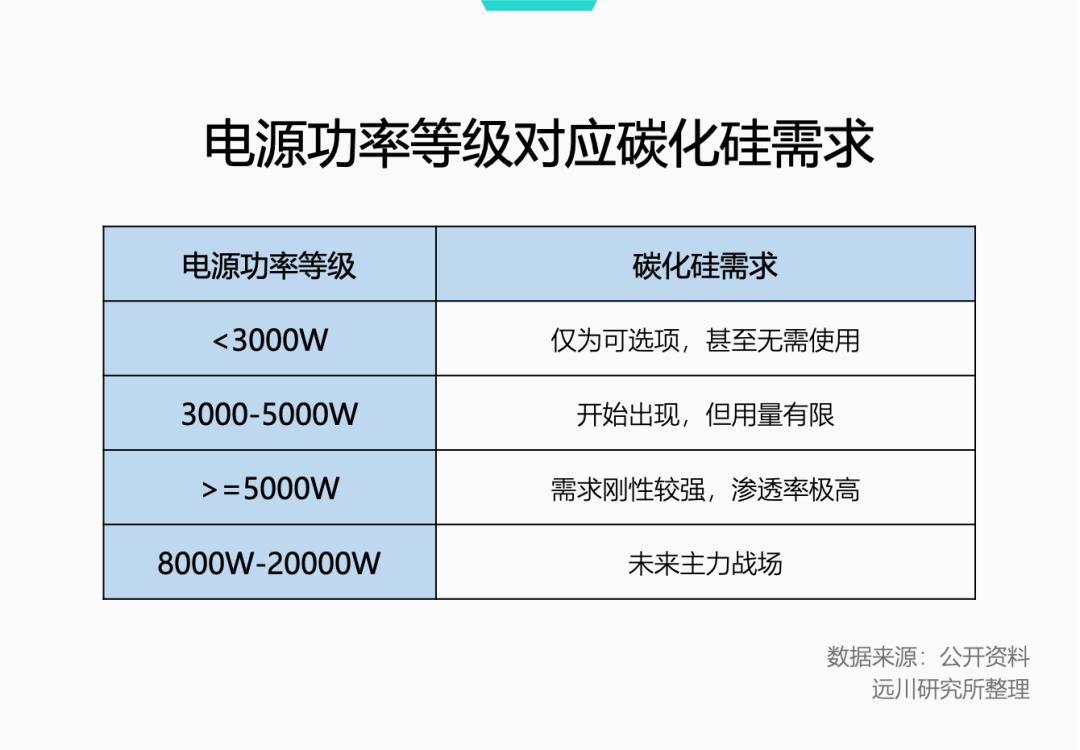
Currently, the mainstream power specification of domestic data centers is 3000W, and more than 90% of the power supplies below 5500W in global data centers still use silicon devices [7]. This means that in the short term, silicon carbide remains a "marginal player".
Yole predicts that it will not be until 2030 that the global revenue from silicon carbide devices will reach $10 billion [5]. In contrast, NVIDIA's data center revenue (mainly from AI GPUs) in the first quarter of this year has already exceeded $70 billion.
Secondly, the demand for this "niche within a niche" has almost been met by overseas leading manufacturers.
Compared with electric vehicles, silicon carbide devices used in AI data centers have more stringent requirements for efficiency, power density, and high - frequency performance, with a high technical threshold. Currently, Infineon almost dominates the market.
Infineon expects that its annual revenue from silicon carbide devices in the AI field will reach $250 million, while the industry estimates that the total annual revenue of silicon carbide devices in the AI field will not exceed $300 million [7].
The remaining $50 million is not enough for Wolfspeed to cover its $120 million loss.
For the eager - to - be - filled production lines of Chinese manufacturers, the orders from AI data centers are like water from a distant well that cannot quench the immediate thirst.
The advantage of Chinese manufacturers lies in the upstream segment. Whether they can get orders depends on the willingness of overseas device giants in the downstream.
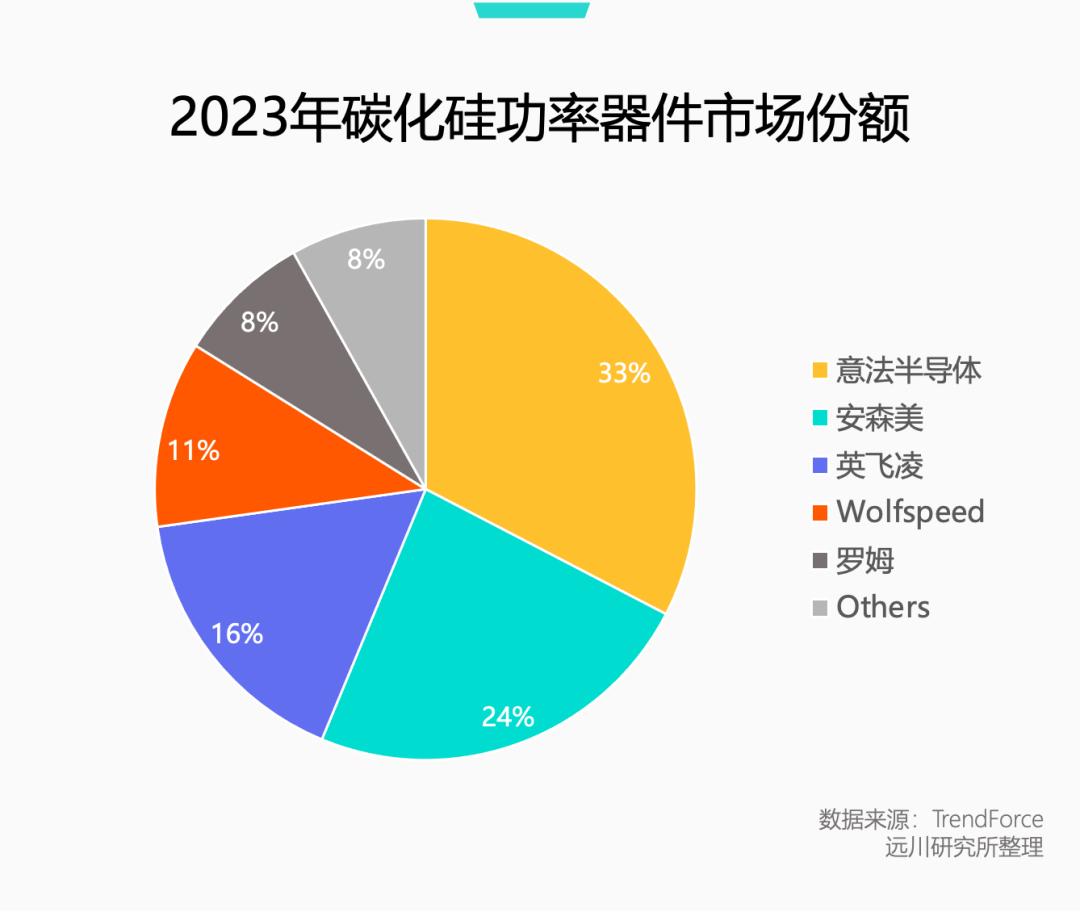
Chinese manufacturers have a low market share in silicon carbide power devices
On the one hand, Infineon has long - term cooperation with substrate suppliers such as Wolfspeed and Rohm and will not easily change suppliers.
On the other hand, in terms of technology, Chinese manufacturers are still in the stage of catching up. Take silicon carbide substrates as an example. There are 6 - inch, 8 - inch, and 12 - inch substrates. The larger the size, the more advanced the technology. Chinese manufacturers have just moved from 6 - inch to 8 - inch, while Wolfspeed's 12 - inch substrates were mass - produced at the beginning of the year.
Xinlian Integrated's financial report for the third quarter of last year revealed that its 8 - inch silicon carbide MOS devices have been sent for sampling to European and American AI companies. Tianyue Advanced Materials also stated in its financial report that it has closely cooperated with global leading power device manufacturers in the field of AI data centers.
However, research, development, and verification all take time. By the time the orders increase significantly, it will be too late.
In addition, another hype in the secondary market - the silicon carbide interposer - has no hope of being implemented in the short term.
In essence, it is to replace the silicon interposer that connects computing chips (such as GPUs) with other chiplets (such as HBM) with silicon carbide materials to improve heat dissipation. However, from the perspective of both material properties and cost, the general view in the industry is that "it's not necessary".