Just now, Jensen Huang raided the homes of Intel and AMD directly.
“There are too many things (in my pocket).” Huang Renxun (Jensen Huang) complained in Chinese.
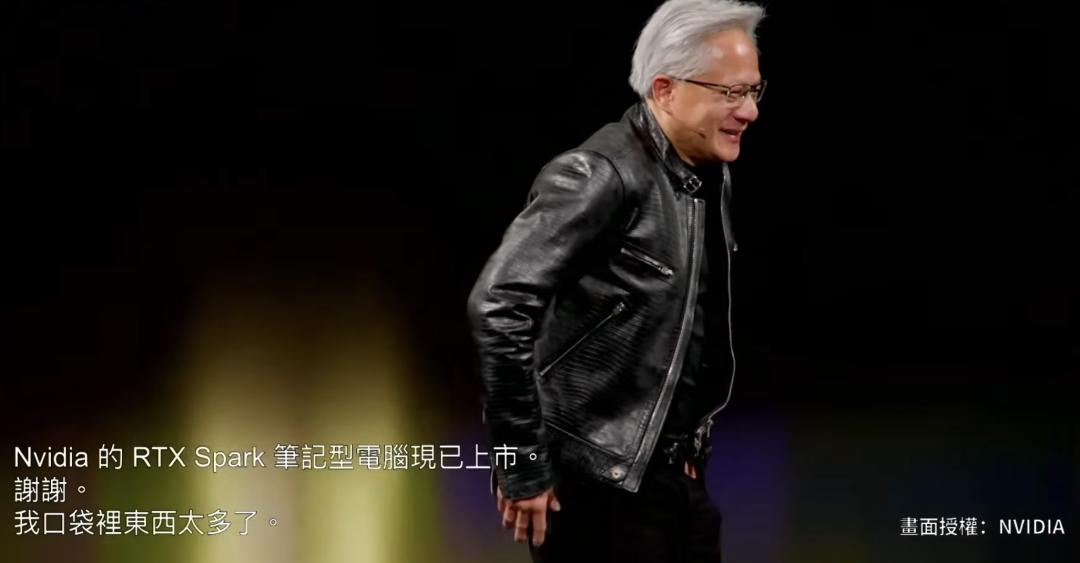
Image source: NVIDIA
On June 1st, on the eve of Computex Taipei, Jensen Huang, the founder of NVIDIA and the best product promoter in the history of GPUs, held a keynote speech at GTC Taipei 2026. He showcased NVIDIA's AI factory ecosystem and launched products such as the Vera CPU, Vera Rubin, Vera BlueField - 4 STX, DSX, and RTX Spark.
With so many names thrown at us, it's easy for ordinary people to only remember one thing: it's very powerful.
If we only look at the specifications, Huang's speech in Taipei is very much like a typical NVIDIA press conference. However, the real change worth noting is that NVIDIA is integrating CPUs, GPUs, networks, storage, cooling systems, Windows PCs, and even security permissions into the same narrative.
The name of this narrative is “Agent AI”. The two most important new players are the Vera CPU for data centers and the RTX Spark (previously rumored as N1X) for personal computers.
From GPUs to CPUs, and to “reinventing the personal computer”, NVIDIA doesn't just want to keep selling GPUs. It also wants to define what data centers and personal computers should look like in the AI era.
NVIDIA Vera: The Native CPU for the AI Era
Let's start with the most powerful part: the Vera CPU.
During the AI wave of the past few years, NVIDIA's core has always been the GPU. From the A100, H100 to Blackwell, the concerns in the AI industry have mainly revolved around GPUs - who can buy them, who can supply them, and who can stack up the server cabinets. But as large - scale models evolve from chatbots to agents, the situation becomes more complicated.
An AI agent doesn't just generate a piece of text. It needs to break down tasks, search for information, run code, call tools, verify results, and even maintain thousands of execution environments simultaneously.
At this point, the CPU is back in the spotlight. That's why we see NVIDIA's Vera CPU designed for the AI era.
NVIDIA's definition of Vera is straightforward. It's the first CPU built for the large - scale operation of AI agents. It has 88 self - developed Olympus cores, supports Spatial Multithreading, and has a maximum LPDDR5X memory bandwidth of 1.2TB/s. When integrated into the Vera Rubin system, it can be connected to the GPU via the second - generation NVLink - C2C with a maximum coherent bandwidth of 1.8TB/s.
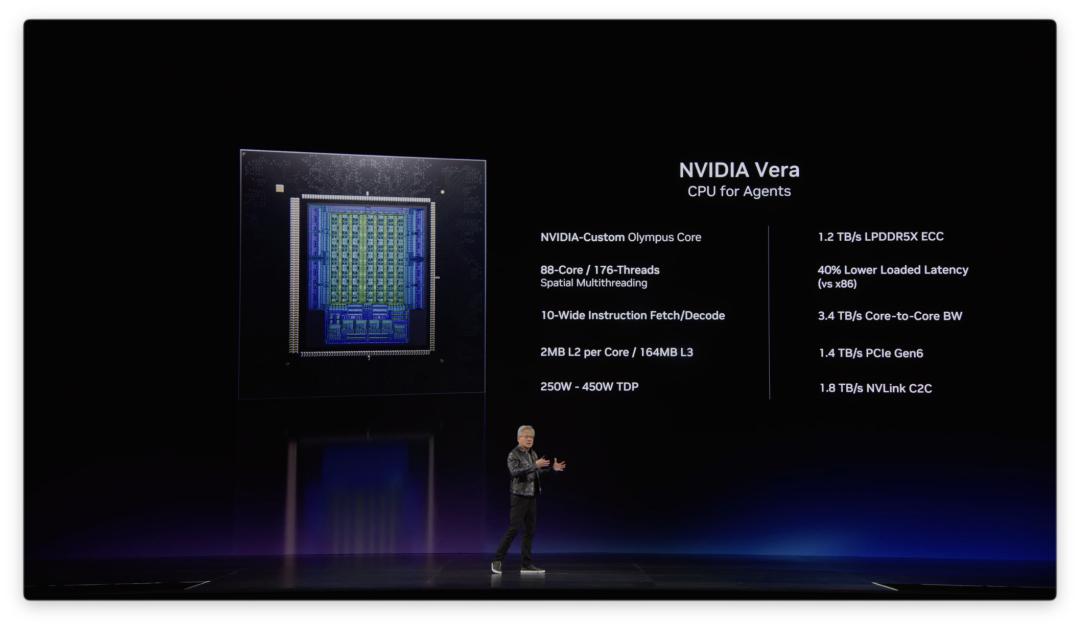
Image source: NVIDIA
Beyond the specifications, the CPU is no longer just a “manager” assisting the GPU. In the agent workflow, code execution, data processing, sandbox environments, and task orchestration have become key parts of the computing power factory. NVIDIA claims that Vera can complete tasks 1.8 times faster than x86 CPUs. They also previously emphasized a 2 - fold improvement in energy efficiency and a 50% performance boost.
The competition in the AI factory has shifted from “how much each card costs” to “how many tokens can be produced per watt of electricity”. Vera Rubin is an amplified version of this concept.
Jensen Huang also announced that Vera Rubin is entering full - scale mass production. The system consists of the Vera CPU, Rubin GPU, Groq 3 LPX, BlueField - 4 STX storage, and Spectrum - 6 network racks. According to the official statement, compared to the previous - generation Grace Blackwell, Vera Rubin can achieve a 10 - fold increase in large - scale agent throughput.
Since agents continuously read and write enterprise data, NVIDIA has also incorporated storage and security into the same narrative. The key of Vera BlueField - 4 STX is not just another DPU. It processes the agent's context memory, file access, and network isolation at the chip level.
According to NVIDIA's data, after introducing DOCA (NVIDIA's software framework), Vera BlueField - 4 STX can detect threats up to 1000 times faster than existing non - agent solutions during runtime and enforce network and file access policies at a rate of up to 800Gb/s.
RTX Spark Will Ignite Personal PC Agents
If Vera is the new foundation in the AI factory, RTX Spark is the product closest to ordinary people in this press conference.
NVIDIA and Microsoft have defined RTX Spark as a super - chip for Windows PCs for personal AI agents. It has 1 petaflop of AI performance, up to 128GB of unified memory, uses a Blackwell RTX GPU, 6144 CUDA cores, fifth - generation Tensor Cores, and FP4 precision, and is connected to a 20 - core Grace CPU via NVLink - C2C.
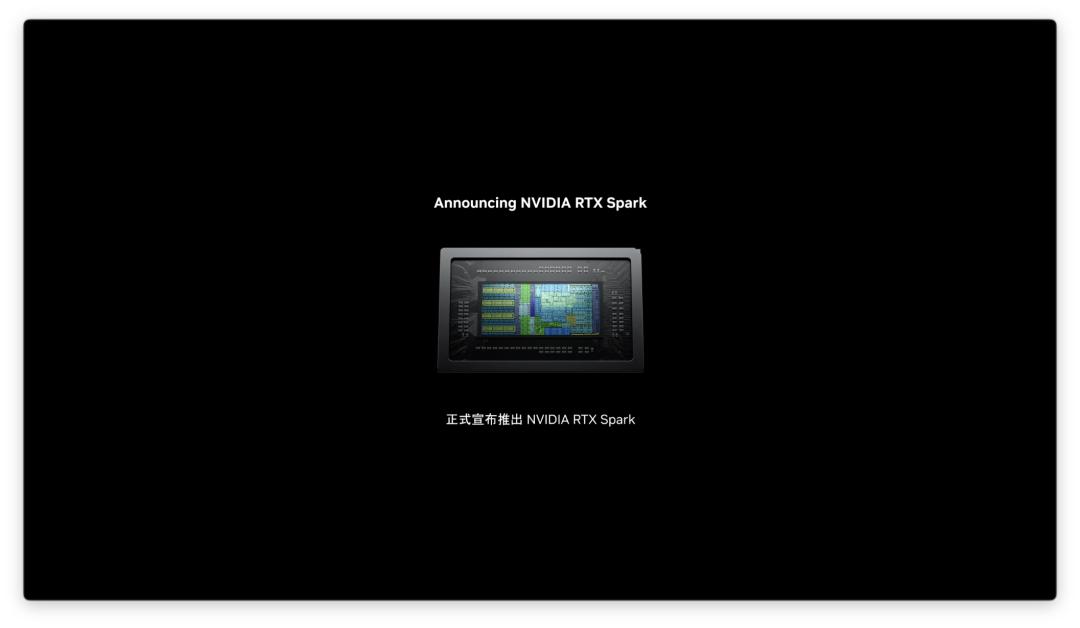
Image source: NVIDIA
By the way, the Grace CPU part of this SoC is custom - designed by NVIDIA in cooperation with MediaTek. The first laptop to be equipped with RTX Spark is Microsoft's Surface Laptop Ultra, which will be officially launched later this year. Laptops from Lenovo, Dell, HP, ASUS, and Acer equipped with RTX Spark are also on the way to the market.
The configuration of RTX Spark doesn't sound like a traditional laptop. It's more like a consumer - grade adaptation of DGX Spark. The usage scenarios provided by NVIDIA include:
- Run large models with 120 billion parameters and a maximum context of 1 million tokens locally;
- Render 3D scenes over 90GB;
- Edit 12K 4:2:2 videos;
- Generate 4K AI videos;
- Run AAA games at over 100 frames per second at 1440p.
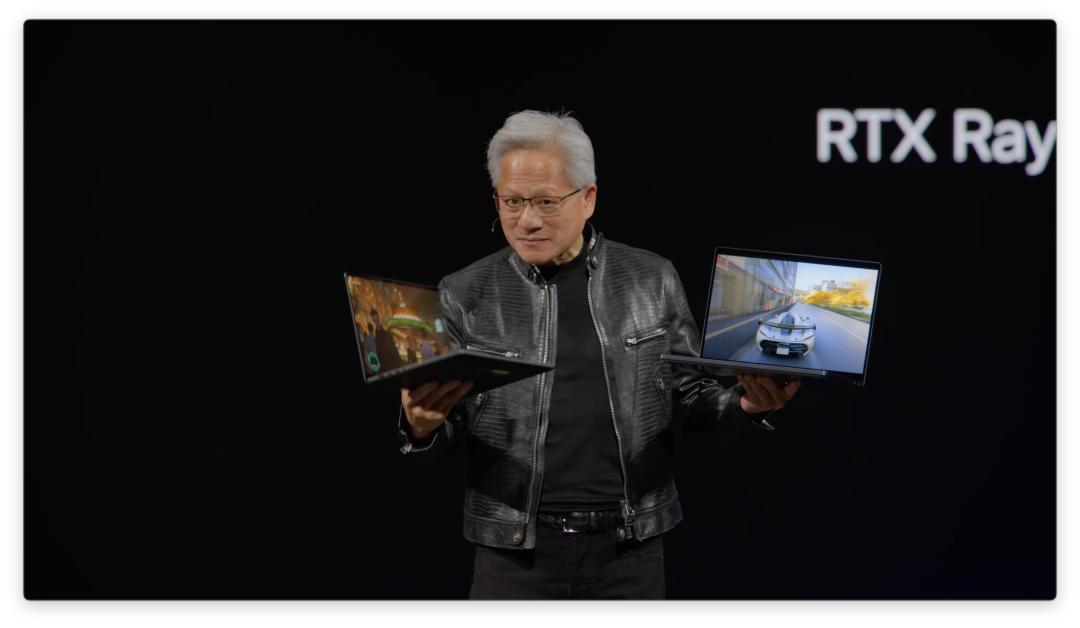
Surface Laptop Ultra equipped with RTX Spark. Image source: NVIDIA
In the past two years, the biggest embarrassment of AI PCs is that many products simply add an NPU to a traditional PC and tell users “this is an AI PC”. But what ordinary people really want to know is whether they can let AI do some practical work for them without queuing, paying token bills, or uploading private files to the cloud?
RTX Spark offers a more radical answer: to let agents directly enter the Windows workflow. NVIDIA and Microsoft will provide a new Windows security infrastructure and NVIDIA OpenShell to enable identity, isolation, policy, and permission control when agents run on the local machine. Adobe will also re - engineer Photoshop and Premiere for RTX Spark, claiming up to a 2 - fold increase in AI and graphics performance.
Of course, this doesn't mean that PCs will immediately transform from tools to colleagues. The real bottleneck lies in software. Whether agents can stably call applications, understand local files, who is responsible for errors, and whether users are willing to grant permissions to them are all issues that can't be solved by 1 petaflop alone.
Conclusion
During the speech, Jensen Huang showed a diagram of the AI factory ecosystem built around NVIDIA, which includes almost all the most powerful companies in the AI era. Among them, Lenovo, as the only company listed on the Hong Kong Stock Exchange, recently released its best - ever financial report.
Of course, this Taipei speech is not just about Vera and RTX Spark. NVIDIA has also advanced the blueprint of the “AI factory”. It launched the DSX platform and, for the desktop, introduced the DGX Station for Windows for enterprise users.
Another aspect is physical AI. NVIDIA not only released the Cosmos 3 open - world foundation model, open - source physical AI tools and skills, and the Isaac GR00T humanoid robot reference design but also expanded the DRIVE Hyperion robotaxi ecosystem.
As Jensen Huang said, (NVIDIA) has too many things in its “pocket”. From wafer fabs, AI factories, and enterprise desktops to hospitals, robots, and autonomous driving, NVIDIA is trying to make “agents” the default users of the next - generation computing platform. The more important “nodes” are data centers and personal PCs.
This article is from the WeChat official account “Lei Technology AGI”, written by Sanqi Eryishi, and is published by 36Kr with authorization.