Ranked ninth globally, this semiconductor giant from Hefei is heading to the Hong Kong stock market.
Amid the AI wave, Hefei, Anhui, with its forward - looking investment vision, has become one of the few inland cities in China that can compete with those in the Yangtze River Delta. From "saving the market by investing in display panels" to "betting on chips", it's no accident that Hefei is known as "China's most successful venture capital city".
As Changxin Technology is about to be listed on the Science and Technology Innovation Board, another semiconductor giant in Hefei has recently made progress in its IPO.
According to Gelonghui, Hefei Jinghe Integrated Circuit Co., Ltd. (hereinafter referred to as "Jinghe Integrated") has obtained the record - filing from the China Securities Regulatory Commission for its Hong Kong IPO on May 22, 2026. China International Capital Corporation Limited serves as the sponsor.
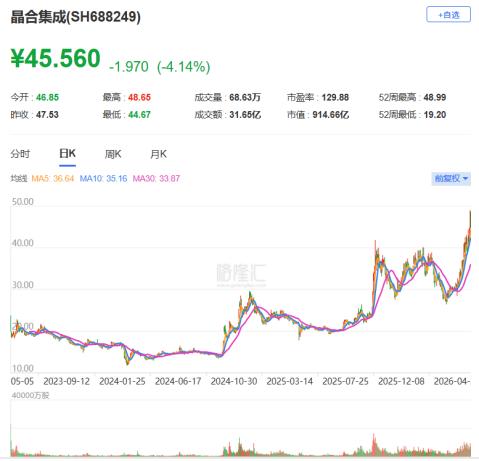
Jinghe Integrated was listed on the Science and Technology Innovation Board in May 2023, with the stock code 688249. As of May 29, the company's stock price was 45.56 yuan per share, and its market value was 91.47 billion yuan.
Focusing on 12 - inch wafer foundry, covering process nodes from 150nm to 28nm
The history of Jinghe Integrated can be traced back to May 2015. At that time, initiated by the Hefei Municipal Government, Hefei Construction Investment and Powerchip Venture Capital reached a technical cooperation and established the company. In November 2020, it was restructured into a joint - stock company, with its headquarters in Hefei, Anhui.
As of March 21, 2026, Hefei Construction Investment controls approximately 39.71% of the company's total issued share capital through direct and indirect means, and the actual controller behind it is the State - owned Assets Supervision and Administration Commission of Hefei.
After more than a decade of development, Jinghe Integrated has become a globally leading 12 - inch pure wafer foundry, providing wafer foundry services to global customers. Relying on its own technology and R & D capabilities, the company can cover process nodes from 150nm to 28nm.
According to Frost & Sullivan data, in 2024, Jinghe Integrated ranked ninth among global wafer foundries and third in mainland China in terms of revenue.
As a professional wafer foundry service provider, Jinghe Integrated relies on the upstream to provide necessary materials and technologies such as silicon wafers, photoresists, special chemicals, core equipment, EDA, and intellectual property licenses. It mass - produces high - quality processed wafers based on the integrated circuit design blueprints of fabless, asset - light wafer, and vertically integrated manufacturing (IDM) companies.
The company's process capabilities focus on key specific application integrated circuit categories, including display driver chips (DDIC) for display control, complementary metal - oxide - semiconductor image sensors (CIS) for image sensing, and power management integrated circuits (PMIC) for regulating and optimizing power usage.
In addition, the businesses of Logic IC (supporting data processing) and micro - control units (MCU) are also growing rapidly.
With the above product portfolio, Jinghe Integrated can support numerous applications such as consumer electronics, automotive electronics, industrial control, AI, the Internet of Things, and memory.
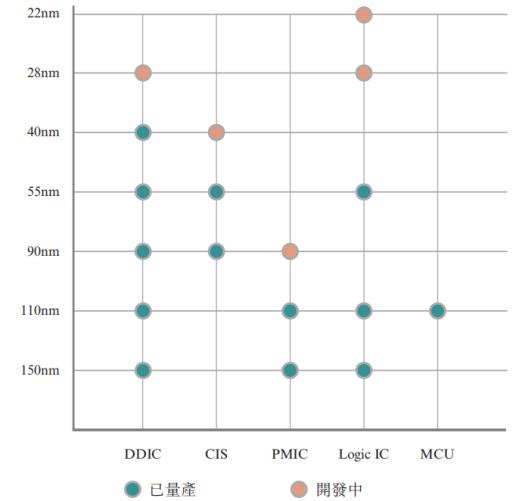
Development status of the company's main technology platforms, Source: Prospectus
In wafer foundry, the size of silicon wafers has developed from the initial 6 - inch and 8 - inch to the current mainstream 12 - inch. Although 8 - inch production lines still support traditional applications, the current incremental production capacity mainly comes from 12 - inch wafers, whose surface area is about 2.25 times that of 8 - inch wafers. When the yield rate is the same, more dies can be cut out, reducing the cost per wafer.
Jinghe Integrated operates a 12 - inch wafer foundry integrated production base in Hefei, with a total construction area of approximately 387,000 square meters.
In 2025, the company's total shipment of 12 - inch wafers was 1.6247 million pieces.
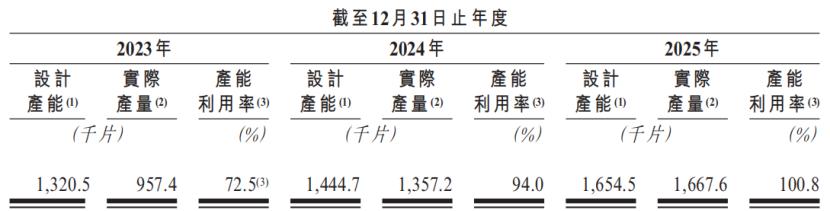
The company's annual production capacity, output, and capacity utilization rate, Source: Prospectus
The technological maturity of wafer foundry services is usually reflected in the process technology nodes.
Downstream applications such as industrial control, the Internet of Things, displays, and power devices have always had continuous and strict requirements for the long - term reliability and operational robustness of semiconductor products, which support the continuous and widespread popularity of mature nodes of 28nm and above.
For key components such as DDIC, CIS, PMIC, and MCU, mature nodes of 28nm and above are widely favored due to their mature and well - verified manufacturing processes.
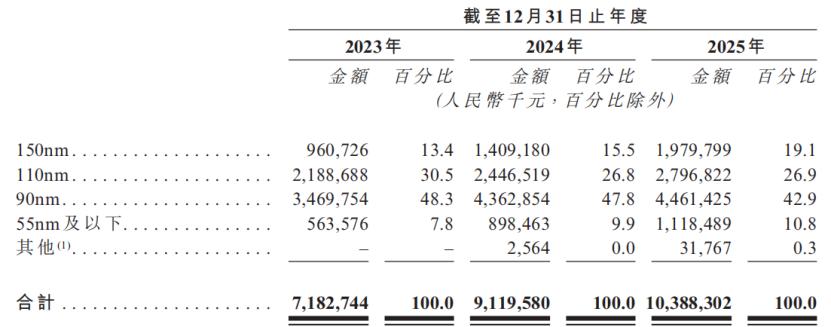
Income details of the company by technology node, Source: Prospectus
60% of the income comes from mainland China, and the customer concentration is relatively high
In recent years, despite the cyclical fluctuations in the semiconductor industry, Jinghe Integrated's income has been growing steadily.
In 2023, 2024, and 2025 (the reporting period), the company's total revenues were 7.183 billion yuan, 9.120 billion yuan, and 10.388 billion yuan respectively. In the same years, the gross profit margins were 20.3%, 25.2%, and 22.7%, and the net profits were 119 million yuan, 482 million yuan, and 467 million yuan respectively.
In recent years, the global wafer foundry industry has been growing steadily, with normal cyclical adjustments in between. After the pandemic, as the supply chain became tight, the demand for semiconductors soared in 2021 and 2022. Then, in 2023, the demand for consumer electronics weakened, and the industry entered the inventory reduction stage.
However, the overall global wafer foundry market is still expanding, growing from approximately $100.2 billion in 2021 to $174.7 billion in 2025, with an average annual growth rate of 14.9%.
Against this background, the company's income also grew from 2023 to 2025, mainly driven by the increase in market demand, the rich product portfolio, and the improvement of the economies of scale.
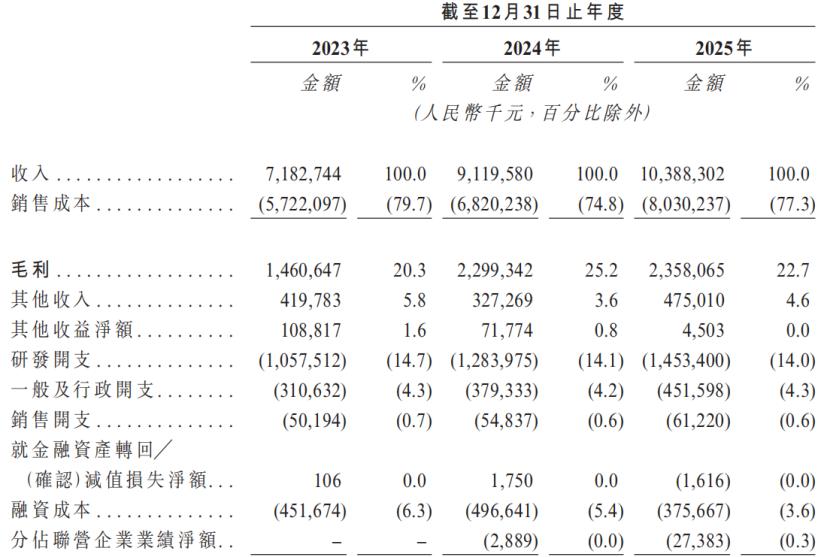
Key financial data, Source: Prospectus
Regionally, in 2025, 61.4% of Jinghe Integrated's income came from mainland China, and 30.5% came from Taiwan, China.
In terms of income composition, most of Jinghe Integrated's income comes from DDIC foundry, accounting for 84.8%, 67.5%, and 58.1% of the total income during the reporting period respectively, indicating a relatively concentrated business.
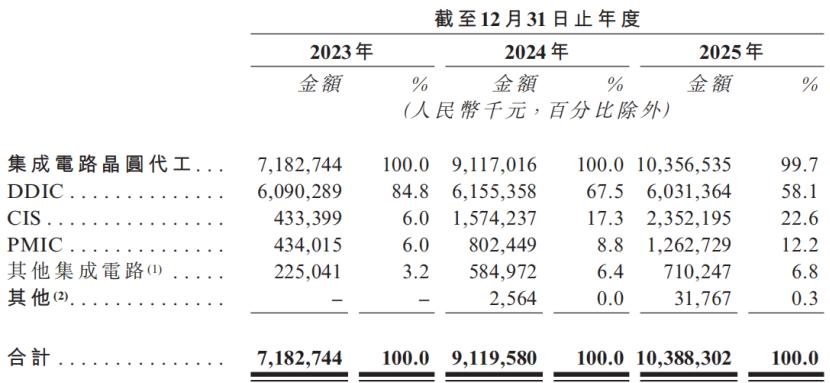
Income details by business line, Source: Prospectus
R & D ability is the cornerstone of technological progress and business growth. Currently, the company has established its R & D strength in the mainstream technology nodes from 150nm to 40nm and completed the development of the 28nm logic chip platform. In 2025, the company's R & D expenditure was approximately 1.453 billion yuan, accounting for 14% of the total income.
Jinghe Integrated mainly serves integrated circuit design companies such as fabless, asset - light wafer, and IDM companies. During the reporting period, the income from the top five customers accounted for 64.2%, 62.2%, and 57.9% respectively, indicating that the income is concentrated among a few large customers.
As of the end of each reporting period, the company's trade receivables were 857 million yuan, 993 million yuan, and 1.188 billion yuan respectively. The corresponding accounts receivable turnover days were 34.7 days, 37.1 days, and 38.3 days.
In 2023 and 2024, the company did not distribute cash dividends to shareholders. In 2025, it distributed 194 million yuan.
In 2023, Jinghe Integrated had a net cash outflow of 161 million yuan from operating activities. In 2024 and 2025, the operating activities turned into net cash inflows, which were 2.761 billion yuan and 3.843 billion yuan respectively.
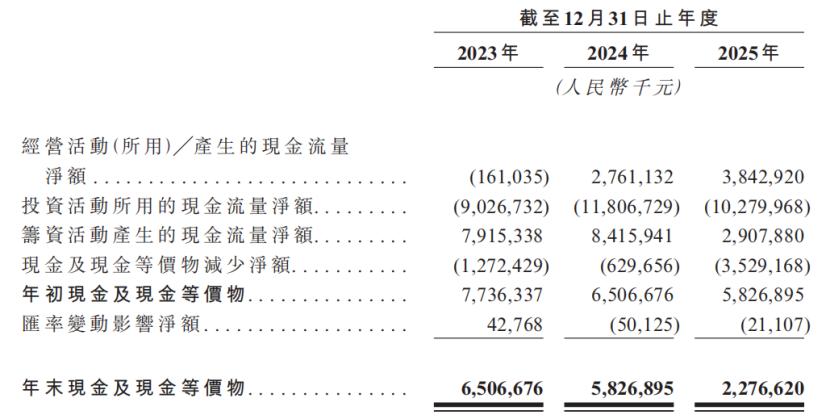
Summary of the cash flow statement, Source: Prospectus
Jinghe Integrated's market share in the global wafer foundry industry is approximately 0.9%
The integrated circuit industry chain includes links such as design, manufacturing, packaging, testing, and sales.
According to the different links that enterprises participate in, there are mainly three models: IDM (vertically integrated manufacturing), wafer foundry (Foundry, only engaged in manufacturing), and fabless model (Fabless, only engaged in design and sales).
In recent years, as technology has become more complex and costs have increased, the IDM model is gradually shifting to the "Fabless + Foundry" model due to its high operating costs and low flexibility, in order to reduce costs and improve efficiency.
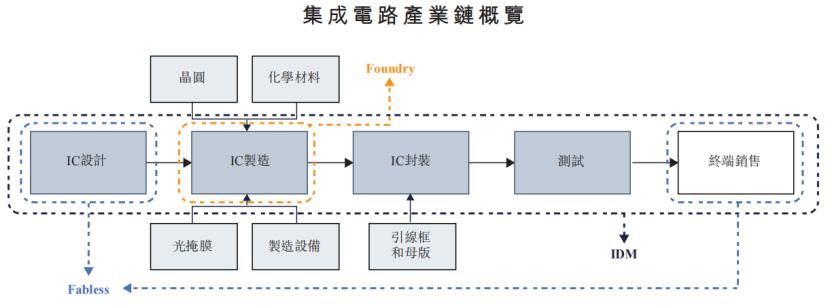
Overview of the integrated circuit industry chain, Source: Prospectus
The global integrated circuit market size increased from $463 billion in 2021 to $677.9 billion in 2025, with an average annual growth rate of 10.0%.
It is expected that from 2026 to 2030, the market will grow at an average annual rate of 11.2%, reaching $1115 billion by 2030.
Driven by domestic substitution and the rapid development of downstream new applications, the growth rate of the mainland China market has always been higher than the global average. It increased from $148.5 billion in 2021 to $246.4 billion in 2025, with an average annual growth rate of 13.5%. It is expected to reach $474.4 billion by 2030, with an average annual growth rate of approximately 14.0% from 2026 to 2030.
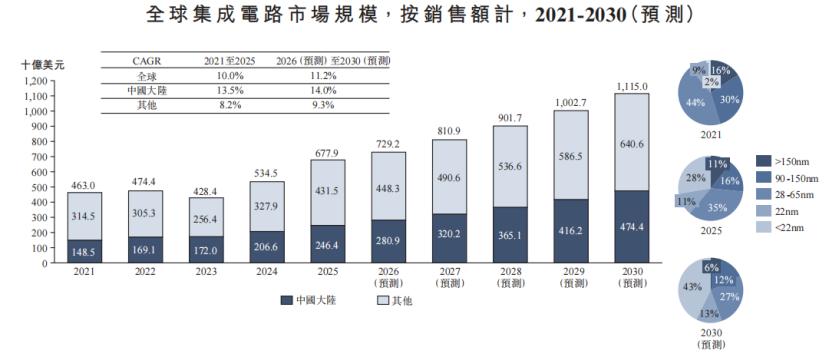
Global integrated circuit market size, Source: Prospectus
Specifically, the global wafer foundry market increased from $100.2 billion in 2021 to $174.7 billion in 2025, with an average annual growth rate of 14.9%. It is expected that by 2030, the market size will reach $295.5 billion, with an average annual growth rate of 10.7% from 2026 to 2030.
The wafer foundry market in mainland China increased from $9.4 billion in 2021 to $17.2 billion in 2025, with an average annual growth rate of 16.3%, and its share in the global market increased from 9.4% to 9.8%.
In the future, as the localization of the supply chain accelerates, it is expected that the average annual growth rate from 2026 to 2030 will rise to 15.1%, reaching $34.7 billion by 2030, and the share in the global market is expected to be 11.8%.
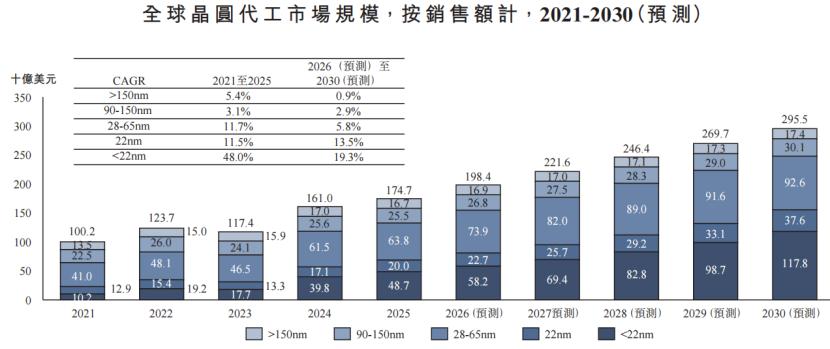
Global wafer foundry market size, Source: