The war among the Big Three in AI: Revolution, schism, and the empire's counterattack
01
This war didn't start with ChatGPT.
This statement might sound like an attempt to find a deeper origin in history. In fact, it's not. The real first shot was fired by the empire that was later forced to play catch - up: In 2017, a group of Google researchers published "Attention Is All You Need". The title was as light as an engineering judgment, but the consequences were as heavy as a pre - war mobilization order. It proposed the core architecture that later supported the era of large models - Transformer.
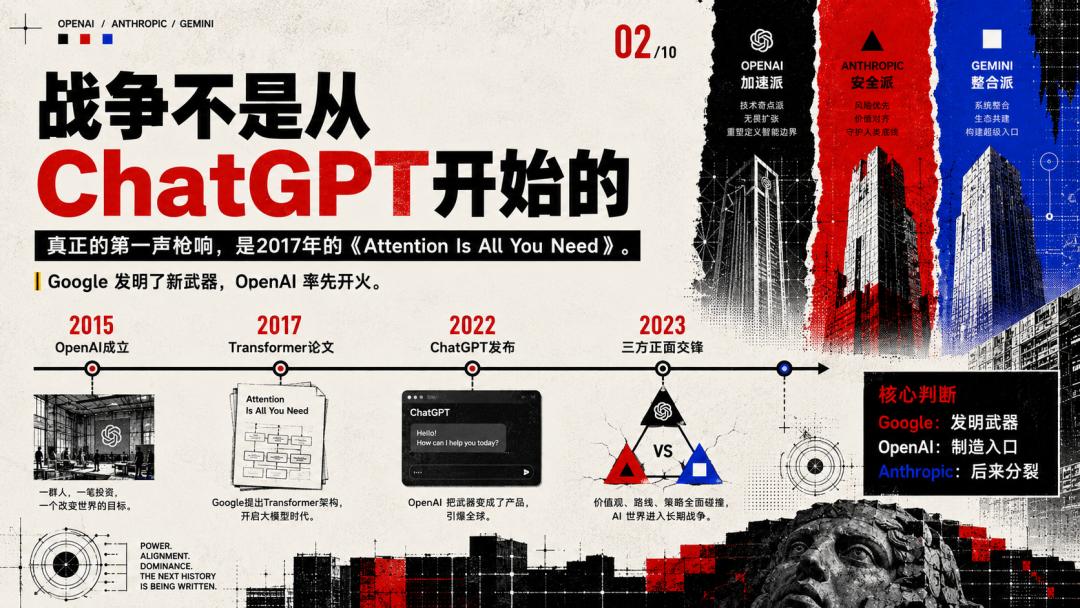
At that time, no one was pouring out their work anxieties into a chat box late at night. There were no corporate procurement departments arguing whether Claude was more suitable for writing code than GPT. And no investors were stuffing terms like "reasoning", "context window", and "agent" into valuation models. The revolution didn't have a name yet. It was just a method.
The old empire invented a new weapon. But it didn't fire first.
Google had papers, talents, computing power, search engines, browsers, email services, mobile operating systems, YouTube, DeepMind, and the world's most profitable information distribution machine. OpenAI had far fewer resources, not even its own cloud.
But history doesn't always reward those with the most resources. Sometimes, it rewards those who have few old assets to protect. Google needed to defend its search business, while OpenAI only needed to prove its existence.
This was the first crack.
02
Before ChatGPT, AI was a background capability. It was hidden in recommendation streams, advertising bidding, search rankings, photo album recognition, voice input, machine translation, and risk control systems. People were being changed by AI every day, but they rarely realized it. Technology worked in the background, and society pretended that everything remained the same on the surface. Then, a chat box appeared.
It didn't explain itself. It just answered.
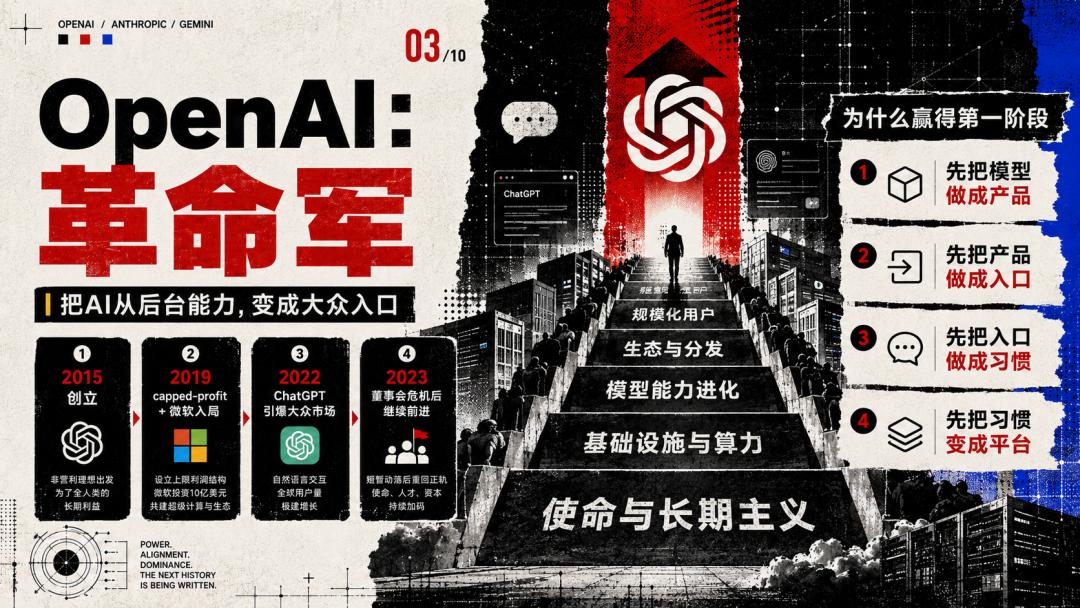
On November 30, 2022, OpenAI introduced ChatGPT to the public. The significance of that day didn't lie in its being accurate enough or smart enough. Instead, it was the first time that ordinary people felt that intelligence could be summoned. You didn't need to understand Transformer, pre - training, fine - tuning, or reinforcement learning. You didn't need to know about model parameters and computing clusters. All you had to do was ask a question, and it would give you an answer. It was like a search engine, but it didn't just provide links. It was like an assistant, but it didn't just set alarms. It was like a human, but it wasn't one.
This was a dangerous sense of intimacy.
OpenAI's first victory was a victory at the entry point. It transformed AI from infrastructure into an interface, from a research topic into a life experience, and from capital expenditure into a public topic.
Silicon Valley saw a new platform, Wall Street saw a new curve, students saw a shortcut for their homework, white - collar workers saw an outlet for overtime, entrepreneurs saw a narrative for financing, and the media saw traffic. Everyone saw what they lacked in it.
So it quickly became a myth.
But all myths come with a bill. OpenAI's bill was particularly expensive because from its very inception, it placed itself in an almost impossible position: It had to claim that it wasn't an ordinary company, yet it had to raise funds, recruit talent, purchase computing power, attract users, sell subscriptions, and sign corporate clients like the most aggressive companies. It had to say that AGI should benefit all of humanity, yet it had to explain to Microsoft, developers, enterprises, and the capital market why its path was worth continued investment. It needed moral language and business speed. It needed the face of a saint and the discipline of a mercenary.
This wasn't hypocrisy. It was a structure.
In 2015, when Sam Altman, Greg Brockman, Ilya Sutskever, Elon Musk, and a group of researchers, entrepreneurs, and investors founded OpenAI, it seemed more like a Silicon Valley - style anti - Silicon Valley manifesto: open, safe, and non - profit. General artificial intelligence shouldn't be monopolized by a few giants.
This stance had its power. It also had its naivete. Because AGI isn't just a paper or a public welfare project. It's a machine that needs to be fed by GPUs, electricity, data centers, engineers, and the patience of capital.
Idealism arrived first. The bill followed.
In 2019, OpenAI established a capped - profit structure. The term itself was like a compromise document: It wanted profit but also wanted to limit it; it wanted to attract capital but also wanted to preserve its mission; it wanted to tell the world that it wasn't an ordinary company, yet it had to admit that if it continued to operate like an ordinary non - profit organization, it wouldn't be able to purchase enough computing power or retain expensive talent.
In the same year, Microsoft came along. Satya Nadella didn't need to frame AGI as a debate about the fate of humanity like Altman did. He only needed to see a simpler fact: The next - generation software might need a new engine.
So, the revolutionary army got an arms dealer.
Without Azure, OpenAI would have been hard - pressed to become what it is today. Without OpenAI, Microsoft would have found it difficult to regain its aggressiveness in the old battles of cloud, office software, and search. The two companies needed each other, but they weren't the same.
OpenAI needed Microsoft's money, computing power, and corporate access. Microsoft needed OpenAI's speed, story, and sense of danger. One provided the mission, and the other provided the machine. Modern technological revolutions often start like this: First, there's a manifesto, then a bill, and finally, a data center.
Musk left, and Nadella entered. Fear receded, and deployment advanced.
This was OpenAI's earliest fate. It didn't commercialize after betraying its ideals. It commercialized because its ideals were too expensive. It said it wanted to make AGI benefit all of humanity, but all of humanity doesn't pay the GPU bills. Microsoft does. This detail is small but decisive. Many grand historical events are ultimately tied to such an invoice.
Then, the war became a public event.
At the beginning of 2023, Microsoft integrated OpenAI's capabilities into Bing, turning the search market, Google's most fertile ground, into a front - line battlefield. For two decades, Google had almost defined the public order of the Internet: People asked questions, and Google ranked the answers; websites produced content, and Google distributed traffic; advertisers paid, and users got free access to answers.
This order wasn't perfect, but it was stable enough that almost no one regarded it as an order anymore. Until ChatGPT resurfaced an old question: If answers can be directly generated, how much value do links have?
Google was forced to fight back.
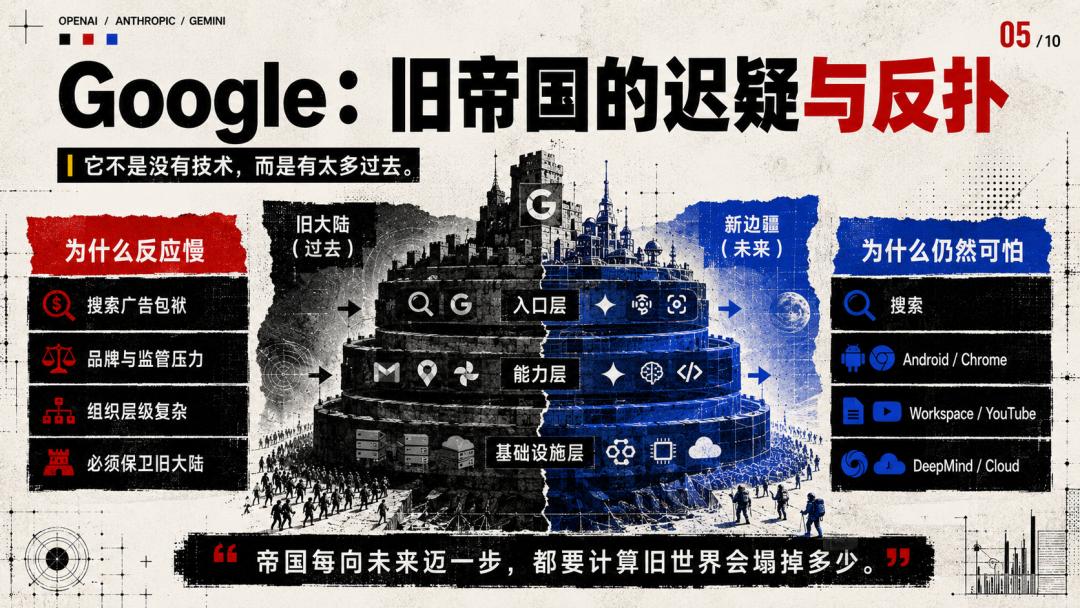
Google's initial counter - attack was ugly. Bard made a hasty debut, had a faulty demonstration, was punished by the market, and mocked by the public. The old empire suddenly seemed clumsy on its most familiar territory. It wasn't that it lacked technology. It had too much of a past. Search advertising, brand reputation, regulatory pressure, internal processes, product matrix, research culture, and business inertia all held it back.
Start - up companies can treat the future as their only asset, but empires can't. Every step an empire takes towards the future requires calculating how much of the old world will collapse.
This was Google's shame and also its rationality.
A Google without the burden of search advertising would surely be faster. But then it wouldn't be Google anymore. Its hesitation wasn't just simple bureaucratic slowness. It was the inevitable hesitation of an established interest group facing self - revolution. OpenAI could shout long live the new world because it had no old world to defend. Google couldn't. It was standing on the old world.
So, the first stage of the large - model war had a clear dramatic structure: OpenAI was like a revolutionary army, Microsoft was like an arms dealer and logistics officer, and Google was like an empire awakened by the gunfire. The revolutionary army won the support of the masses, the arms dealer won a strategic position, and the empire lost its composure.
But history won't let revolutionaries enjoy purity alone.
In November 2023, OpenAI's palace coup exposed the company's deepest contradictions to the public. The board of directors suddenly removed Sam Altman. Mira Murati took over briefly, Greg Brockman left soon after, and Ilya Sutskever's name was pushed to the center of the storm. Within a few days, employees threatened to leave en masse, Microsoft opened its arms to receive them, external investors applied pressure, Altman returned, and Bret Taylor and Larry Summers joined the new governance arrangement. That week, Silicon Valley saw clearly for the first time who really held the key to an organization that claimed to guard for all of humanity.
The answer wasn't pretty.
The board of directors could remove the CEO, but it couldn't remove the dependence on computing power. The non - profit structure could preserve the language of the mission, but it couldn't pay employees' option expectations. The security faction could issue warnings, but it was difficult to counter the established product inertia, capital commitments, and user expectations.
OpenAI's crisis wasn't a simple power struggle. It was more like a system blood test. The blood contained the mission, fear, corporate governance, Microsoft, employees' wealth, the future of humanity, and very ordinary job security.
In the end, the company survived.
This doesn't mean that the board of directors was necessarily right, nor that Altman was necessarily wrong. More importantly, this crisis brought an old - fashioned question back to the center of technology: Who has the right to decide how a technology that may change the social structure should progress? Is it the researchers, the board of directors, the CEO, the investors, the cloud platform, the employees, the users, or the "all of humanity" that is often mentioned but never really sits in the meeting room?
No one can give a satisfactory answer. So the company moves on.
03
This is the entrance to the second act: Anthropic.
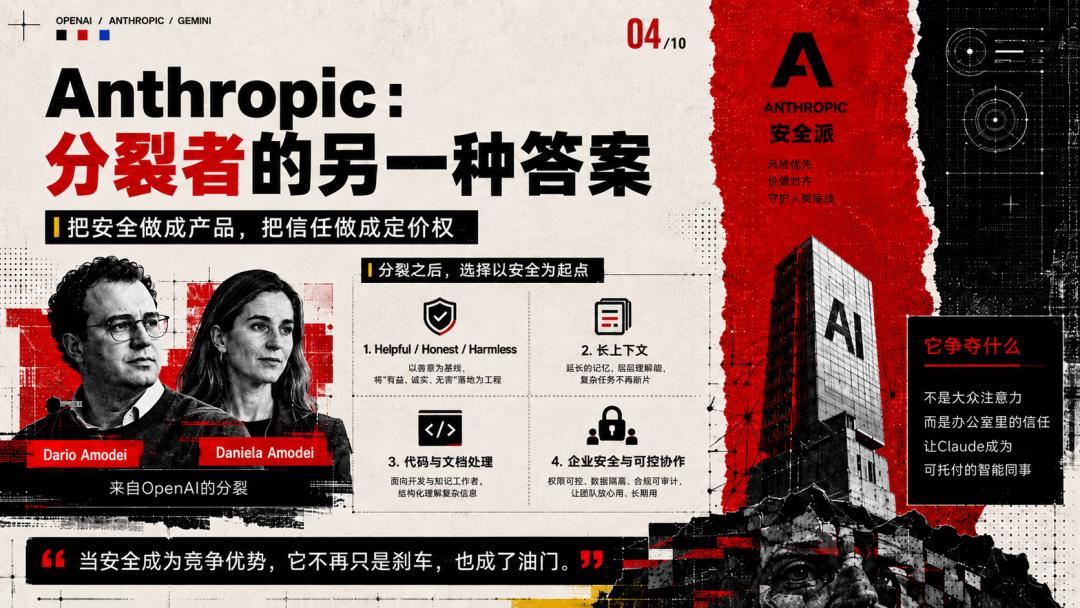
Anthropic isn't an ordinary competitor to OpenAI. It's more like OpenAI's shadow, another answer separated from the same conflict between idealism and accelerationism. Dario Amodei and Daniela Amodei aren't strangers who suddenly entered the large - model war from the outside.
They come from the same gene pool, are familiar with the same expansion laws, and know how the same organization accelerates its transformation between mission and business. The establishment of Anthropic isn't as simple as starting from scratch. It's more like a religious reform: not denying the original god, but saying that the original church has gotten too close to power.
Claude, therefore, has a sense of restraint from the very beginning.
OpenAI makes its model a comprehensive public entry point, while Anthropic makes Claude a professional assistant that knows its boundaries. "Helpful, honest, harmless." These three words have been repeatedly quoted and even seem like slogans, but their commercial meaning is very clear: We aren't the company that creates the most sensational effects. We're the company that you can trust to be part of your organizational process. It targets not the crowd in the square but managers, lawyers, engineers, and procurement committees in the office.
This is a quieter attack.
Claude's strength isn't just answering questions. It's "trustworthy". Long context, code - writing ability, document processing, corporate security, and a controllable style may not be as shocking as ChatGPT was when it first appeared, but they are closer to where the money really flows.
After the large - model war entered the corporate world, the question isn't whether a student can use it to write an essay. It's whether a consulting firm can use it to summarize client materials, whether a law firm can use it to process case files, whether a software company can let it access the codebase, and whether a financial institution can trust it not to make nonsense in critical situations. Ability alone no longer determines adoption. Trust starts to be priced.
Anthropic understands this.
So its moral language also has a dual purpose. On the one hand, security is indeed an unavoidable issue in the era of large models. On the other hand, security is also the most easily justifiable reason for corporate procurement within the organization. When Dario Amodei talks about risks, he isn't just philosophically anxious. He's also defending a commercial position. Claude doesn't need to be the most popular consumer entry point. It just needs to be the intelligent colleague that organizations can trust.
This is the paradox of Anthropic: The more successful it is, the harder it is for it to exist only as a warning voice.
Because when security becomes a competitive advantage, it's no longer just a brake. It also becomes an accelerator. Anthropic can say that it's more cautious than OpenAI, but it also needs to raise funds, purchase computing power, catch up on model capabilities, enter the core corporate processes, and prove that it's worth a higher valuation.
It split from the revolutionary army, criticized speed, but finally has to run. The modern technology industry is best at turning reflection into products, constraints into selling points, and moral anxiety into a commercial moat.
Even the apostates have to pay the military fees.
If OpenAI is the revolutionary army and Anthropic is the religious reformer, then Google is the old empire.
The old empire isn't stupid. On the contrary, it's too smart, too rich, too familiar with its own map, and too clear about what a real self - revolution means. Sundar Pichai surely knows the importance of generative AI, Demis Hassabis surely knows the upper limit of model capabilities, and Sergey Brin surely knows that Google can't give up the future. The problem has never been about knowing. The problem is that when a new answer threatens the old business, knowing alone doesn't lead to action.
Google's first public counter - attack was Bard.
It was an uncomposed debut. In February 2023, Bard gave wrong information during a demonstration, and Alphabet's market value evaporated by about $100 billion in one day. This figure has been repeatedly quoted, as if it were just a joke in the capital market. In fact, it's more like a political humiliation. A company with the mission of organizing the world's information made a mistake when answering a factual question. A company that had dominated search for two decades was questioned about its ability to answer in the "answer era". The market wasn't punishing a single mistake. It was punishing the empire's loss of composure.
Google finally realized that the old organization needed a new center.
In 2023, Google Brain and DeepMind merged, and Demis Hassabis was pushed to a more central position. The symbolic meaning of this move was greater than the organizational structure itself. Hassabis isn't just an AI executive. He represents the longer scientific tradition within Google: AlphaGo, reinforcement learning, neuroscience, and the imagination of general intelligence.
Pichai needs him not only for the technical route but also to show both internally and externally that Google's AI isn't a hasty make - up. It has a pedigree, papers, victories, and the empire's own ancestors.
But ancestors can't fight for their descendants.
The launch of Gemini is Google