Are the post-2010s and post-2020s saying, "I don't want to chat with real people anymore"?
The era of AI has arrived, dividing humanity into the "AI Generation" and the "Non-AI Generation."
Those who spend their childhood and adolescence in the third decade of the 21st century will become the first generation of "AI Natives." They are not just another generation but a different kind of people. In pre - modern times when society developed slowly, the childhoods of children in one century were hardly different from those in the previous century. By the second half of the 20th century, the pace of the era accelerated, and each decade brought a new world.
Entering the AI era, technology is evolving at a rate of one year or even half a year, and childhood has been thrown into a "collider," with an unknown qualitative change on the horizon. The code for future evolution lies in their childhood. In the past, childhood was filled with the noisy cicadas in summer, endless outdoor games, and regular - broadcast cartoons after school. Children had large chunks of time to wait for the unknown world.
Now, in childhood, the ubiquitous electronic screens emit blue light, and 24/7 connected electronic devices have become the biggest social and gaming arenas for children. AI tries to tell them all the answers. What kind of generation will the AI Natives be?
People start to compare, argue, imagine, and depict. Because the world belongs to you and us, but ultimately it will belong to the AI Natives. This time, AI seems to have got it right: they are the first explorers to resist technological nihilism with their physical bodies.
In the science - fiction novel Klara and the Sun, the writer Kazuo Ishiguro envisioned a highly intelligent future society: people can buy solar - powered artificial intelligence robots called "AF" (Artificial Friend) to accompany their children.
Klara is such a female AF. In fact, rather than being "perfect companions," AFs are more like artificial intelligence nannies - they call their young masters "my children." Children without AF companions are lonely, and the mission of AFs, as Klara said, is to be "as friendly and as useful as possible."
With the increasing popularity of AI technology, people have found that science - fiction novels are becoming reality at an unexpected speed: although human - shaped AFs like Klara that are understanding and empathetic cannot be mass - produced yet, it is feasible to let large AI models like Doubao, which support real - time voice conversations, act as "AI moms."
"Doubao, help me supervise my younger brother doing his homework, adjust his sitting posture, and stop him from fidgeting." "Okay, I'm keeping an eye on him! Brother, raise your head a bit more, don't always look down; keep a good sitting posture; focus on writing and don't get distracted!" Many parents have adopted this "unorthodox" way of raising children. Some people jokingly say that the first group of humans ruled by AI has emerged!
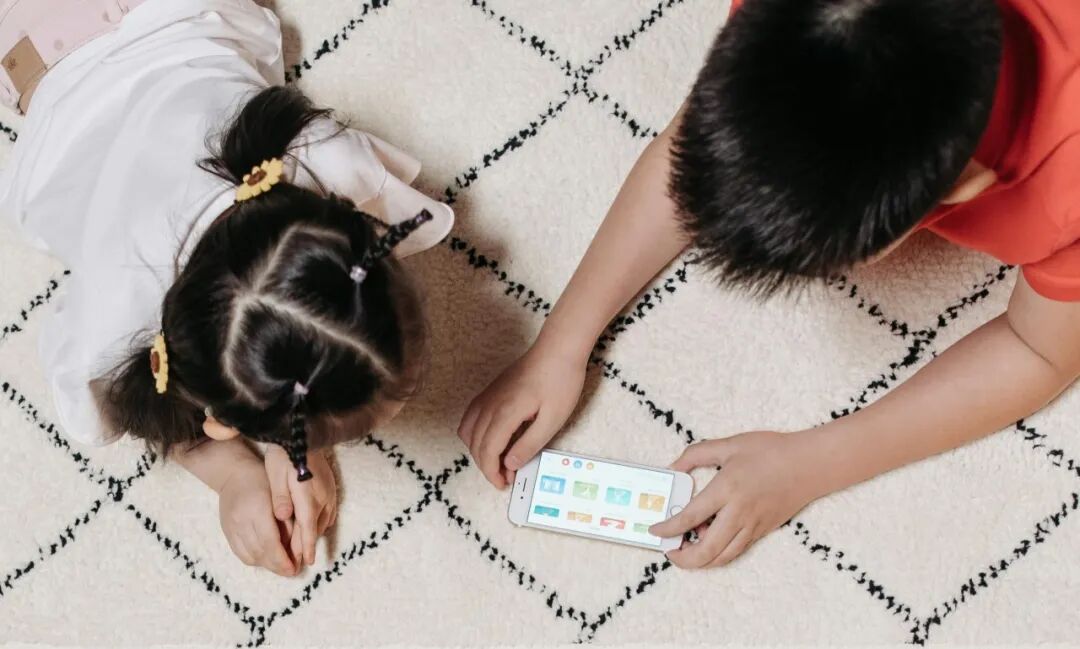
(Photo/pexels)
A questionnaire survey on the AI usage of primary and secondary school students conducted by the China Youth and Children Research Center in 2025 showed that over 60% (61.7%) of students have used AI, and the primary use is to assist in completing homework (71.0%). This generation of children has unhesitatingly embraced AI, so they are called the "AI Generation."
How AI reshapes childhood is becoming an important issue at present. This generation of children grows up with tablets and smartwatches, so they are "children in front of the screen." Moreover, since AI has partially replaced the functions of their parents - for example, parents who are bothered hand over the arduous task of tutoring homework to AI - they can even be called "children raised by AI nannies."
Consequently, what "growing up" means has become a question that we must rethink.
Today's children don't know how to play
Susan Linn, an American psychologist and a research associate at the Boston Children's Research Institute, found that today's children don't know how to "play." In her view, "play" in the traditional sense is an act of "actively exploring and perceiving the surrounding world and discovering and creating 'fun' things." Children who are exposed to digital devices such as tablets or electronic toys at an early age can gain pleasure just by pressing a button, which greatly weakens their desire to explore the real world.
In her book Childhood in Front of the Screen, Susan Linn wrote about a case: In Melbourne, Australia, a 5 - year - old boy named Noah patiently taught her how to use the "Lego City" racing app. In fact, Noah had a set of enviable physical Lego bricks just a few feet away. "This made me feel both sad and ridiculous: instead of building real cars, towers, etc. with bricks, we are buried in playing with tablets."
She found that children may be facing the screen anytime and anywhere. She cited data from "Common Sense Media" in her book: Before the COVID - 19 pandemic, American children aged 8 - 12 and teenagers aged 13 - 19 spent an average of 4 hours and 44 minutes and 7 hours and 22 minutes respectively on screens every day; after the pandemic, children and teenagers spent even more time on screens.
(Movie Ender's Game)
She once heard a marketer say: "I like the Lego apps because children can take them anywhere! If it's a pack of bricks, it can't be carried around." As she expected, the "Lego City" racing app doesn't allow players to fully unleash their creativity - the cars in the game are pre - assembled, the accessories are pre - made, and there is only one way to connect them. In addition, it encourages players to play more games, earn more points, and use points to buy virtual items, which ultimately leads to the same consumerist approach.
"Few people realize that continuous immersion in a commercialized and digitalized culture may also prevent young children from having the opportunity to develop the skills and qualities needed for growth - such as creativity, curiosity, and initiative." Susan Linn wrote in Children in Front of the Screen.
Regarding the currently popular AI that can truly respond to and accompany children, she said in an interview with the media that the business model of AI, like that of other technologies, requires more people to spend more time using it so that money can be made by placing advertisements to users.
"AI makes things too easy. I can give some prompts to AI, and then it will write my article for me. In my opinion, this is anti - creativity rather than supporting creativity. The best thing to do is not to use AI until we know the consequences. But currently, companies will say that we should use it until we know it's harmful. I just think it should be the opposite. We shouldn't use it until we know it's harmless."
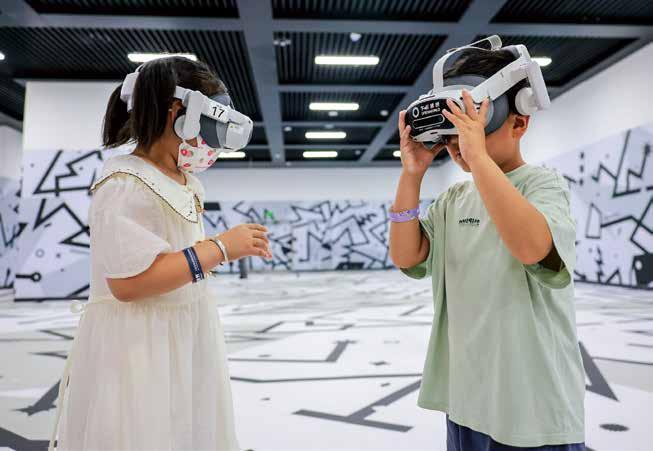
On July 9, 2025, in Hohhot, Inner Mongolia. A child is wearing VR equipment to explore and learn immersively in the Inner Mongolia Museum. (Photo/CFP)
"I only want to chat with AI, not with real people"
The survey on the AI usage of primary and secondary school students in 2025 by the China Youth and Children Research Center was completed by a team led by researcher Sun Hongyan. The results of 8,563 questionnaires made her worried - more than 20% of students said they "want to rely on AI for thinking and don't want to think on their own," and more than 10% of students completely believed the content provided by generative AI. What surprised her even more was that nearly half of the students chose to turn to AI rather than people around them when they had troubles, and more than 20% of students even "only want to chat with AI and don't want to chat with real people."
In an interview with The Paper, Sun Hongyan summarized the long - term impacts that the trend of teenagers preferring to chat with AI might bring.
One is self - identity. In Sun Hongyan's view, AI always "pampers children" and tends to cater to users. Even when there are some negative issues, it doesn't directly deny them. After long - term use of AI, children may go to the other extreme and think they are extremely "capable," and their self - identity becomes fixed.
The second is social skills. "In real - life interactions, relationships are not always harmonious. There will be conflicts and contradictions. If children live in virtual communication for a long time, their social skills will further deteriorate, and they will become more dependent on AI."
The third is emotional control. AI can indeed "reply instantly" and provide timely emotional comfort to children. However, AI's answers are standardized, which is different from face - to - face communication; AI also cannot understand the deep - seated needs of children. This is not helpful for children to learn to face and handle their emotions.
(Movie The Wandering Earth 2)
If people rely on AI from learning to daily life, they are actually "outsourcing" their brains to AI. A study pointed out that "social outsourcing" is becoming a common choice among young people globally. For example, a Yale University student named Patrick asked ChatGPT to help him organize a way to reject a girl. The girl initially thought the words were quite appropriate and that he was a nice person, but later she confirmed that "99% of it was written by AI." Patrick's behavior is a typical example of "social outsourcing."
Michael Robb, the research director of "Common Sense Media," said that young people use AI for socializing often because they don't know how to truly interact with others. On the other hand, it may also be because it has become more and more difficult to confide in others - out of consideration for "boundary - sense," contemporary young people try not to bother others. Thus, AI has become a reliable and indispensable emotional outlet.
However, in fact, this is a one - way emotional projection, an "artificial intimacy" without real responses. Experts generally believe that people should return to real life and establish specific connections. If parents are worried about their children's dependence on AI, the first thing they should do is not to leave their children in the care of AI and secretly rejoice that "the world has finally become quiet," but to immediately give time to their children.
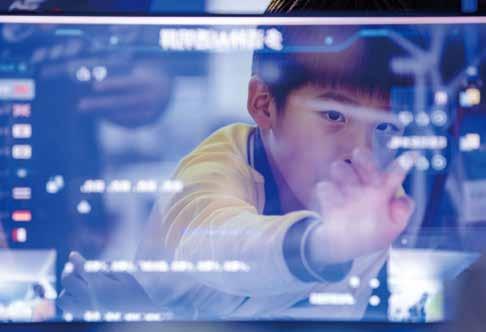
On October 25, 2025, in Wenzhou, Zhejiang. A child is experiencing a multilingual AI transparent screen in the experience area of the 2025 World Youth Scientists Summit. (Photo/CFP)
"I shape AI, and AI shapes me"
If a chimpanzee is raised like a human, can it shed its wild nature and develop abilities similar to those of humans?
This was a question raised by American psychologist Winthrop Niles Kellogg. To prove this, in 1931, he and his wife raised a 7 - month - old female chimpanzee named Gua together with their 10 - month - old son Donald. They treated Gua and Donald in the same way - they made them wear the same diapers and shoes, gave them the same company and emotional responses, and had the same daily schedules.
After 9 months, Gua made amazing progress. It could not only walk upright and eat with a fork but also read people's expressions and almost learned to use the toilet. However, Donald did the opposite. He started to learn the behaviors of the chimpanzee and imitate its calls. The Kellogg couple had to stop this experiment.
Todd Grindal, the president of the SRI Education Research Center, wrote in an article that this experiment nearly a century ago may provide clues to the potential risks behind the interaction between AI and young children. "We need to repeat that experiment on a larger scale - except that this time, the 'non - human' beside the child is not a chimpanzee but a machine."
(Movie Ready Player One)
Coexisting with companion - type AI is a process of "I shape AI, and AI shapes me." The risk is that as AI becomes more and more human - like after learning and optimization, young children who cannot maintain a cognitive distance from AI will instead be "AI - ized." The growth environment of children is constantly changing. In this AI era, the younger the child, the greater the possibility of the deviation of the "human nature" of being human.
From Neil Postman's The Disappearance of Childhood to David Buckingham's The Death of Childhood, people's continuous discussion of the proposition of "the death of childhood" is based on the idea of the enchantment of childhood, such as Rousseau's view that "childhood has independent value." Childhood is an exemption period before entering society, and people can preserve their natural instincts. At the same time, since it points to the future, it represents light and hope.
Ultimately, childhood will not die. The key lies in how we view it. Childhood will eventually end. Peter Pan, who never grows up, can only live in fairy tales. The key is what kind of attitude we will have when we step out of childhood and face the uncertain future. This is the meaning of growth.