Ideal: Wanting too much, leaving only "daydreams"?
Li Auto released its financial report for the first quarter of 2026 after the Hong Kong stock market closed and before the U.S. stock market opened on the evening of May 28th, Beijing time. Although Li Auto had relatively fully communicated the downward trend of the gross profit margin from car sales in the first quarter, even under the most pessimistic expectations, the performance in the first quarter itself was rather mediocre. And the guidance for the second quarter indicates that Li Auto has not yet reached the stage of "turning around from difficulties". Specifically:
① The revenue was slightly lower than expected, mainly due to a significant decline in the average selling price of cars: In the first quarter, Li Auto's automotive sales revenue was 21.5 billion yuan (the total revenue was about 23 billion yuan, a year-on-year decrease of 11.4%), which was lower than the market expectation. This was mainly because the average selling price of cars in this quarter continued to decline significantly by about 24,000 yuan to 226,000 yuan (lower than the market expectation of 234,000 yuan) compared with the previous quarter.
The core reasons for the significant decline in the average selling price are as follows: First, the vehicle model structure continued to shift significantly towards lower - priced models. The pure - electric vehicle model i6, which has a lower price, continued to be very popular, and its proportion increased significantly to about 60% compared with the previous quarter, while the proportion of the high - priced Mega model decreased to about 1.4%. Second, in the face of fierce competition, Li Auto continued to increase the discount on the core models of the L series in the first quarter (for example, there was a discount of about 36,000 yuan for the L6, about 45,000 yuan for the L7/L8, and about 50,000 yuan for the L9). The combination of these two factors pulled down the overall average selling price of cars.
② The gross profit margin from car sales dropped sharply, but it basically met the market's "low expectation" and Li Auto's previous guidance:
The actual automotive gross profit margin in the first quarter was 6.1%, a significant decrease of 10.7 percentage points compared with 16.8% in the previous quarter. Since the management had given a clear low - end guidance of about 5% in the previous quarter's earnings conference (mainly affected by the purchase tax subsidy, the increasing proportion of the low - priced i6, and the clearance of inventory of the old L series models), the market had long expected this (the consensus expectation was only about 5%). The final actual result was only about 1 percentage point higher than the market's "low expectation".
The gross profit margin from car sales was dragged down mainly due to the double impact of the decline in the average selling price and the increase in costs: In the first quarter, the cost per vehicle increased by 5,000 yuan to 213,000 yuan compared with the previous quarter. Although the proportion of the low - priced i6 increased, the scale effect weakened due to a 13% decrease in sales volume compared with the previous quarter, the prices of upstream storage chips and bulk raw materials increased (which had a negative impact of about 3 percentage points on the gross profit margin of the i6), and a purchase tax subsidy of about 15,000 yuan was provided for the i6. The combination of these three factors eroded the gross profit space, resulting in a gross profit of only 14,000 yuan per vehicle in the first quarter, indicating a huge real - world pressure on car sales.
③ The operating profit turned from profit to loss, and the ineffective sales leverage and the sharp decline in gross profit were the biggest drags:
In the first quarter, Li Auto's operating profit decreased significantly by nearly 2.55 billion yuan to - 3 billion yuan compared with the previous quarter, falling deeply into the quagmire of losses and becoming the biggest reason for the significant consumption of free cash flow in this quarter.
The core factors leading to the sharp decline in operating profit are as follows: On the one hand, the sales volume decreased by 13% compared with the previous quarter, resulting in the ineffective release of the sales leverage effect. On the other hand, the gross profit margin from car sales dropped sharply to 6.1%, seriously eroding the overall profit space.
Although the company exercised some restraint in the three major expenses, the R & D expenses (decreased by about 300 million yuan to 2.72 billion yuan compared with the previous quarter) and the sales and management expenses (decreased by about 600 million yuan to 2.05 billion yuan compared with the previous quarter) both decreased compared with the previous quarter due to seasonal factors, personnel streamlining, and the shift of the channel strategy from "expansion" to "intensive cultivation". However, they still could not offset the impact of the shrinking revenue and the "bleeding" of gross profit, ultimately leading to a significant turn to negative operating profit.
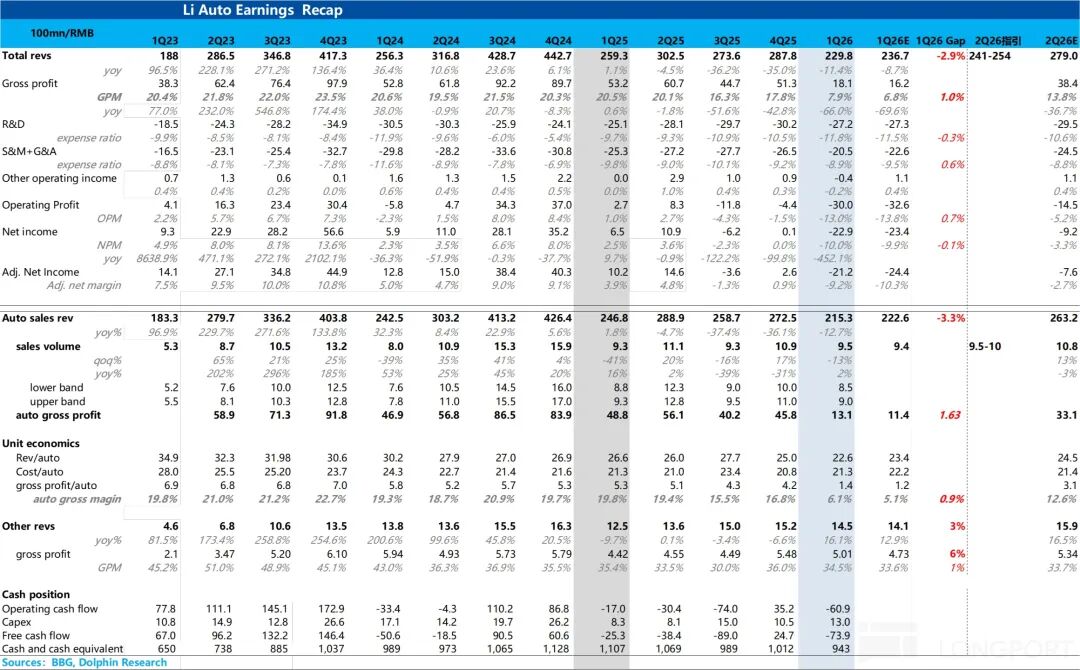
Overall, although Li Auto had fully communicated with the market in advance about this performance, giving the market a "pre - emptive shot", from the actual data, the sharp decline in the average selling price of cars and the gross profit margin from car sales directly led to a significant "bleeding" of operating profit and free cash flow, revealing that Li Auto still faced huge operating pressure under the "internal and external troubles".
Regarding the market's most concerned expectations:
① The sales volume guidance was lower than expected, and the order performance of the upgraded L9 was mediocre
Li Auto's sales volume guidance for the second quarter is 95,000 - 100,000 vehicles, which is not only lower than the market expectation of 108,000 vehicles but also a year - on - year decrease of 10% - 14.4%. Since 34,000 vehicles were delivered in April, this guidance implies that the average monthly sales volume in May and June is only 30,500 - 33,000 vehicles - showing a downward trend compared with April.
The biggest new product catalyst in the second quarter - the brand - new upgraded L9 was officially launched and started delivery on May 15th. The signal behind this lower - than - expected monthly sales volume guidance with a downward trend in May and June is that the current order performance of the upgraded L9 is rather mediocre and has not formed a strong incremental pull. It is also expected that the on - hand orders of the previously popular i6 are gradually being consumed. Overall, the boosting effect of the new car cycle on sales volume has not been effectively released.
② The revenue guidance was also "disappointing"
The automotive revenue guidance for the second quarter is only 24.1 - 25.4 billion yuan, also lower than the market expectation of 26.3 billion yuan, a year - on - year decrease of about 16% - 20%. This guidance implies that the average selling price of cars in the second quarter is about 238,000 yuan - an increase of about 12,000 yuan compared with the already low 226,000 yuan in the first quarter, but still lower than the market expectation of 245,000 yuan. This also reflects that the current order volume of the upgraded high - priced L9 may be relatively average and has not effectively pulled the overall average price back to a higher level.
However, on the positive side, Li Auto clearly stated that with the release and delivery of the new L9, it is expected that the automotive gross profit margin in the second quarter will recover from the low level of 6% in the first quarter to about 10%. But this is still significantly lower than the "healthy gross profit margin level of 20%" that Li Auto has maintained for a long time, and the degree of recovery is limited. The pressure on the profit side is still significant.
But looking beyond the operating bottom in the first quarter and considering Li Auto's performance in 2026 from an annual perspective:
① Li Auto is about to launch a series of comprehensively upgraded L - series models + a pure - electric flagship i9
Li Auto first launched a major facelift of the L - series models in the second quarter of 2026 - the new L9 (which was launched and delivered on May 15th). Next, the upgraded versions of the L8, L7, and L6 will also be released and start delivery from the end of the second quarter to the second half of the year. Among them:
L8 (five - seat flagship): It is expected to start delivery in Q3, with an enlarged body size, equipped with a 115kW range extender and a 72.7 - degree battery pack;
L7 (large six - seat high - end): Following the L8, it is positioned in the 300,000 - yuan price range;
L6 (large five - seat high - end): It is expected to be launched in Q4, with a new 51 - degree large - battery version;
i9 (pure - electric flagship SUV): It will be launched in the second half of the year as Li Auto's first full - size pure - electric flagship.
From the perspective of the currently released L9 series, Li Auto has achieved an increase in configuration and product strength:
a. The battery and range have been significantly upgraded: The whole series is standard - equipped with a 72.7kWh 5C ultra - fast charging battery, and the CLTC pure - electric range reaches 420km (a 50% increase compared with the old model);
b. The range - extender system has been upgraded: It is equipped with the third - generation self - developed range extender, and the WLTC fuel consumption under power - depleted conditions is as low as 6.3L/100km (7.6L for the old model);
c. The self - developed intelligent driving chip has been installed: The M100 "Mach" chip (5nm process) is installed for the first time, and the total computing power of the dual - core reaches 2560 TOPS;
d. The chassis technology has been comprehensively improved: The full - fledged wire - controlled active chassis is launched for the first time, including wire - controlled steering, rear - wheel steering, 800V active suspension, and EMB wire - controlled mechanical braking;
e. The body proportion has been optimized: The front overhang is shortened, the rear overhang is lengthened, the visual center of gravity is moved backward, and at the same time, 12 ultrasonic radars are replaced with UWB sensors to achieve a flawless surface for the whole vehicle.
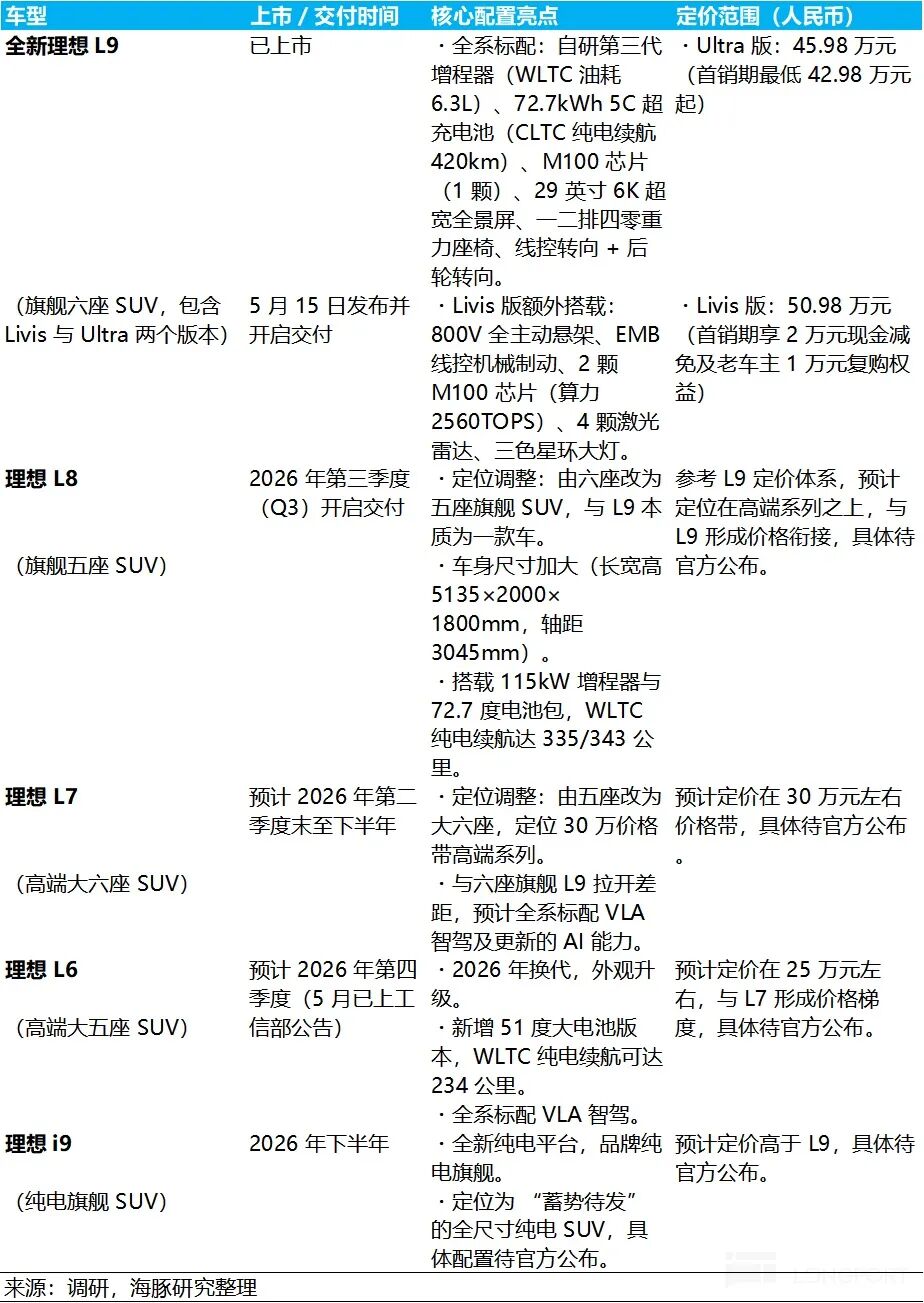
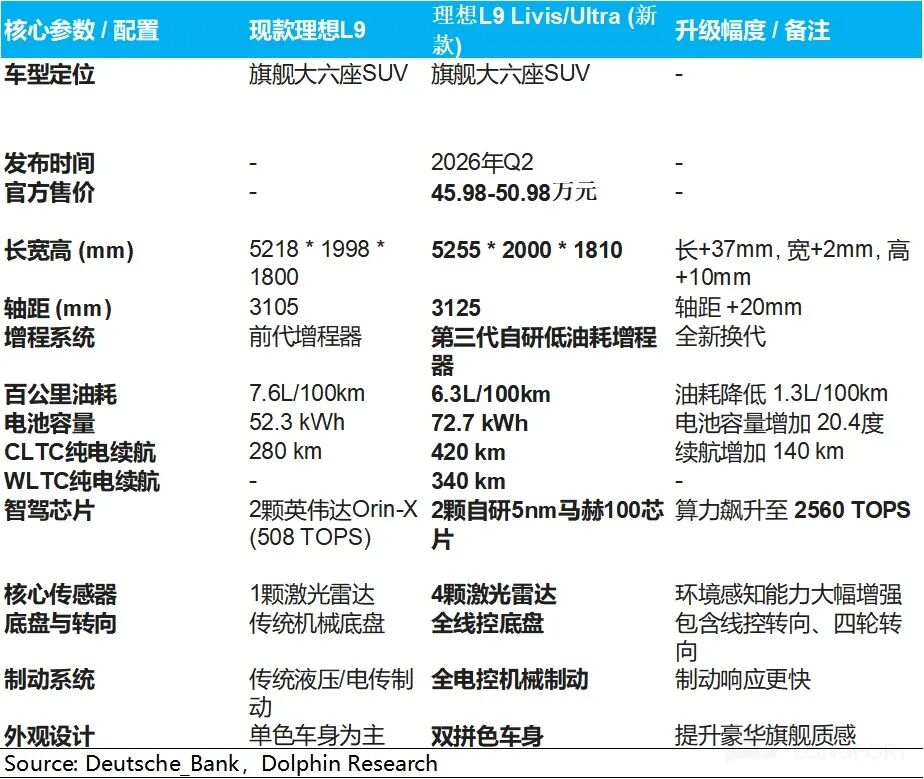
It can be seen that in 2026, Li Auto implemented a clear strategy of "increasing configuration while stabilizing prices + streamlining and focusing" in its vehicle model approach:
a) Implement a pricing strategy of "increasing configuration but with more realistic prices": Taking the new L9 as an example, the Ultra version is priced at 459,800 yuan (a 20,000 - yuan increase compared with the old model, but with a greater increase in configuration), and the Livis version is priced at 509,800 yuan (a 50,000 - yuan reduction compared with the pre - sale price). By product stratification (the standard version is responsible for volume growth, and the Livis version defines the brand height) as the core competitiveness, it achieves "fully - equipped from the entry - level";
b) Streamline SKUs and make the product line more focused: The product line has been streamlined from the previous four lines (9876) to two major lines: the flagship series (L9 six - seat + L8 five - seat) and the high - end series (L7 large six - seat + L6 large five - seat), solving the problems of too many SKUs, small differences between models, and difficulty in high - end configuration in the low - price range in the past.
This combination of "increasing configuration to boost sales volume and streamlining to improve efficiency" aims to cope with the impact of the market's full - scale shift to the large - range - extender/plug - in hybrid track in 2026, reverse the decline of the L - series core models, and rebuild the product moat relying on AI capabilities (self - developed chips + VLA large model).
② Li Auto's strategy of continuous investment in AI is expected to remain unchanged:
a. The self - developed computing power base is about to be launched: The self - developed "Mach 100 (M100)" chip using a 5nm process is about to be mass - produced. The effective computing power of its dual - core configuration per vehicle is as high as 2560 TOPS. This chip will be installed in the new - generation flagship L9 Livis model for the first time, and it is planned to promote the standard - installation of the VLA large model across the whole series in 2026.
b. Cross - border embodied intelligence: The R & D scope has been extended to "space robots", integrating the base model, self - developed chips, and robot operating systems. It is rumored that Li Auto's first embodied intelligent two - wheeled robot is expected to be officially unveiled in the first half of this year.
From the current stock price position of Li Auto:
The company still maintains the goal of a year - on - year sales volume increase of more than 20% in 2026, which is equivalent to about 480,000 vehicles. The incremental volume mainly comes from three major aspects: ① The comprehensive facelift of the L - series models; ② The full - year delivery cycle of the i6 (it was launched in the second half of 2025); ③ The incremental contribution of the new pure - electric flagship i9 (to be launched in the second half of the year).
However, considering:
a) Intensified market competition: Competitors have launched large - size range - extender SUVs targeting Li Auto's L - series models, forming a dense siege in the 250,000 - 350,000 - yuan price range;
b) Although the i6 is popular, it lowers the average price: As the main volume - driving model, its price is lower than that of the L - series, which structurally depresses the overall ASP;
c) The i9 is not a volume - driving model: The pure - electric flagship undertakes the function of brand - building and technology verification, and its sales volume ceiling is limited;
Therefore, under the neutral assumption, Dolphin Research expects Li Auto's annual sales volume in 2026 to be about 447,000 - 467,000 vehicles, a year - on - year increase of about 10% - 15%, lower than the company's official guidance of more than 20%.
In terms of revenue, with the increasing proportion of high - priced models (upgraded L9 and L8) and the stable volume of the i6, the average selling price of cars throughout the year is expected to be in the range of 230,000 - 245,000 yuan. Coupled with other business revenues (charging network, accessories, and services, etc.) of about 6.5 billion yuan, the corresponding annual total revenue is about 113.7 - 118.5 billion yuan.
Considering that Li Auto currently has abundant cash on hand (about 91.7 billion yuan), and the development of embodied intelligence (self - developed chip M100, VLA intelligent driving model, humanoid robot, etc.) is progressing simultaneously, and the automotive main business has the ability to