The leading large model company in Shanghai initiates its A-share IPO.
According to a report by Zhidx on May 30th, the official website of the China Securities Regulatory Commission shows that MiniMax, a leading Shanghai-based AI large model company, submitted a listing guidance filing report to the Shanghai Securities Regulatory Bureau on May 29th, kicking off its A-share listing process. CITIC Securities will serve as the guidance institution.
This also means that MiniMax will compete with Zhipu, which has already submitted an A-share listing guidance filing, for the title of the first large model company to be listed on the A-share market.
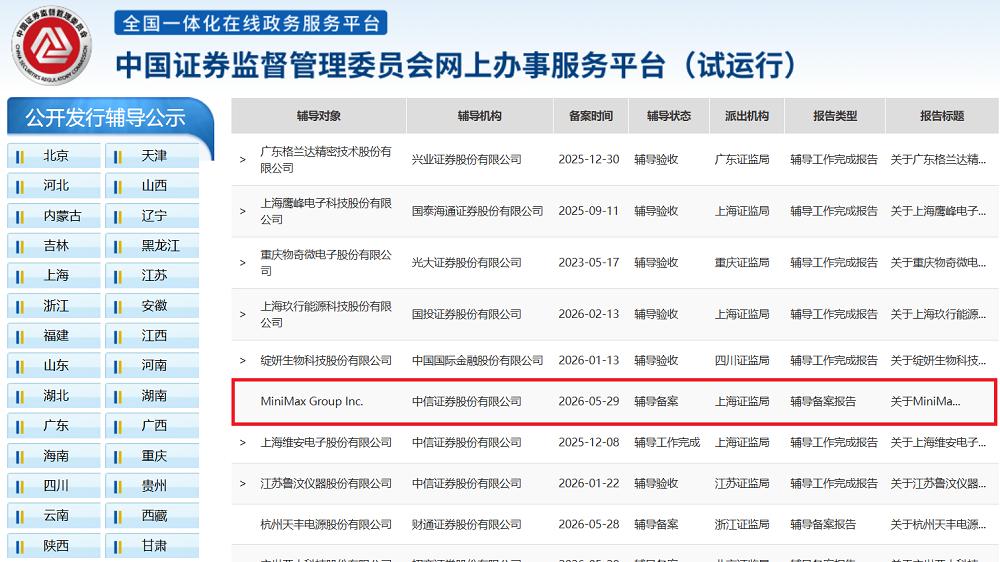
MiniMax was founded in January 2022 and completed its Hong Kong IPO in January this year. After the Hong Kong IPO, MiniMax's stock price soared. As of the close of the Hong Kong stock market on May 29th, its stock price was HK$840 (approximately RMB 725.24), a 409.09% increase compared to the issue price of HK$165 (approximately RMB 142.46), and its market value reached HK$263.454 billion (approximately RMB 227.545 billion). Since June 8th this year, MiniMax will also be included in the Hang Seng Tech Index.
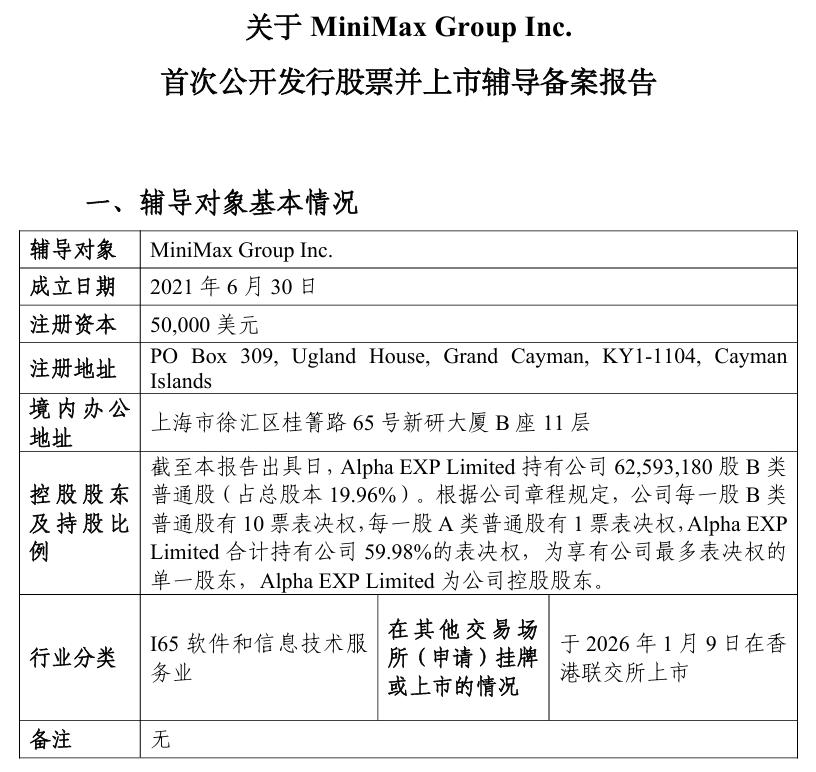
Behind the soaring stock price is the support of the company's fundamental performance.
On May 28th, MiniMax disclosed some business data. Over the past two months, MiniMax's ARR (Annual Recurring Revenue) has increased by more than 100%. The number of global enterprise and developer customers it serves has exceeded one million, a five-fold increase compared to six months ago; the global user base is approximately 300 million.
In March this year, MiniMax released its first annual report after listing. At the earnings conference call, founder and CEO Yanjunjie revealed that as of February 2026, the company's ARR had reached US$150 million.
That is to say, considering the more than 100% growth over the past two months, MiniMax's current ARR has exceeded US$300 million.
In the whole year of 2025, MiniMax achieved US$79.038 million (approximately RMB 535 million) in revenue, of which the revenue from AI-native products was US$53.075 million (approximately RMB 359 million), and the revenue from the open platform and other AI-based enterprise services was US$25.963 million (approximately RMB 177 million).
Its gross profit margin increased to 25.4%, and the adjusted net loss was US$250 million (approximately RMB 1.69 billion), with the loss rate narrowing significantly year-on-year.
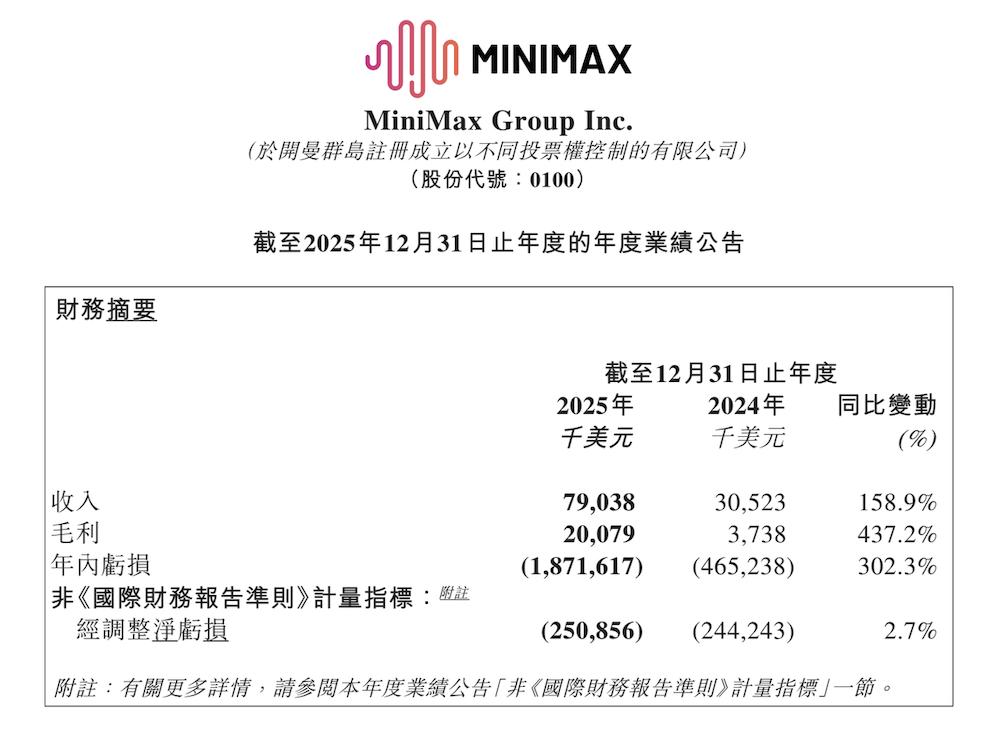
▲Some financial data of MiniMax in 2025
In terms of products, since the beginning of this year, MiniMax has successively launched three flagship large language models, MiniMax-M2.5, MiniMax-M2.6, and MiniMax-M2.7, and open-sourced the M2.5 and M2.7 models.
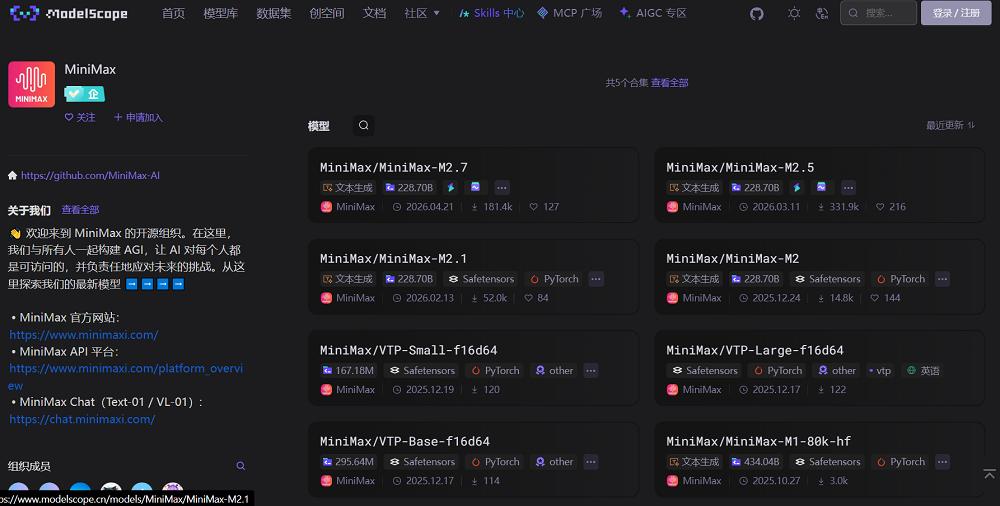
▲Some open-sourced models of MiniMax (Source: ModelScope)
With its high cost-performance ratio, MiniMax-M2.5 was well-received by many developers during the "Lobster Fever" (the open-source AI Agent framework OpenClaw) at the beginning of this year and was recommended in an article by "Father of Lobster" Peter Steinberger.
In mid-February this year, on the AI model aggregation routing platform OpenRouter, MiniMax once became the model vendor with the highest market share, accounting for 18.9% of the model call volume on OpenRouter. However, MiniMax has now dropped out of the top 10 on this list.
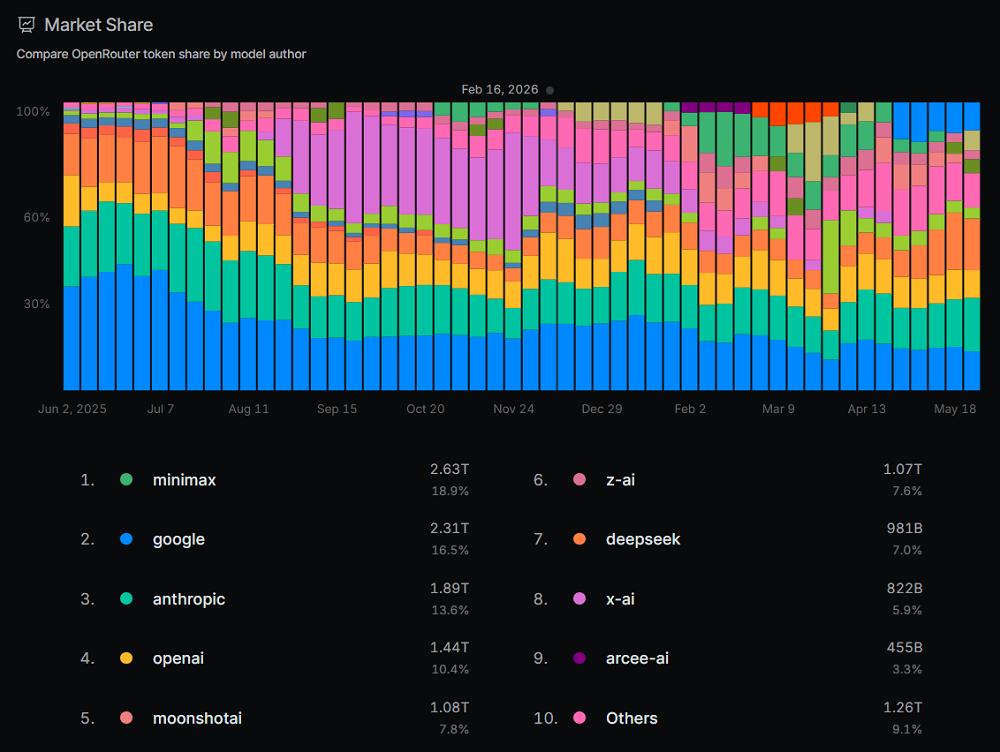
▲Ranking of OpenRouter model vendors in mid-February this year (Source: OpenRouter)
In addition, in May this year, MiniMax upgraded its Agent product and renamed it Mavis, providing a multi-Agent parallel working mode, which can be used to improve the completion rate of complex long-term tasks.
At the end of May, MiniMax's official account revealed that MiniMax-M3 is about to be released.
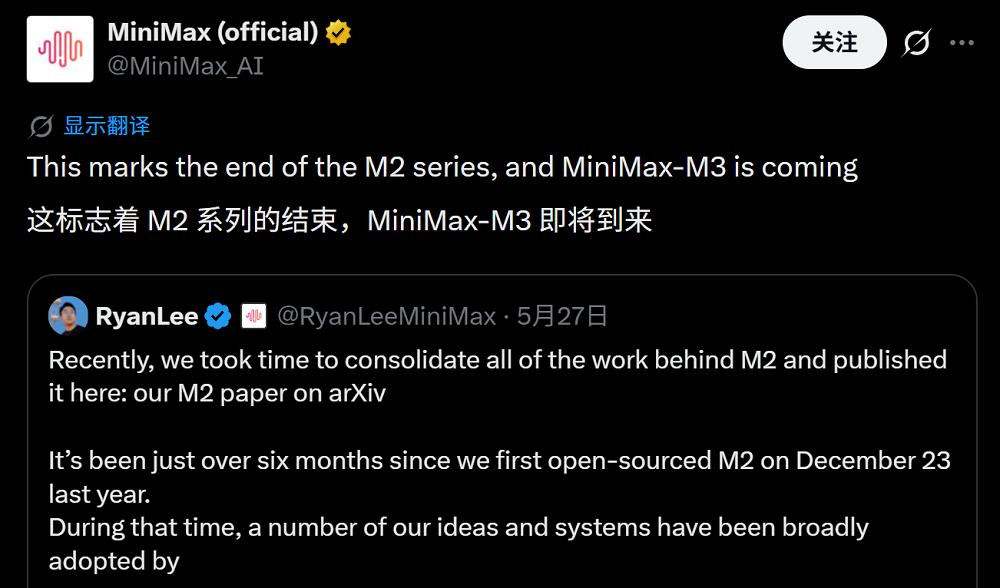
▲MiniMax's official account previewed the M3 model (Source: X platform @MiniMax_AI)
Skyler Miao, the engineering leader of MiniMax, revealed more technical details of MiniMax-M3. MiniMax-M3 uses the MiniMax Sparse Attention mechanism. Compared with MiniMax M2, in the Prefilling stage, the inference speed of MiniMax-M3 when processing one million tokens has increased to 9.7 times; in the Decoding stage, when the KV length reaches one million, the speed has increased to 15.6 times, and the attention latency has been effectively reduced.
The MiniMax Sparse Attention mechanism is based on the GQA (Grouped Query Attention) architecture. First, through the Index Branch, it uses the compressed Index Query (Idx Q) and Key (Idx KV) to calculate the block scores and perform max pooling to select the Top-k block indices most relevant to the current query. Then, it enters the Sparse Branch and performs sparse attention calculations only on these selected key blocks, thus significantly reducing the amount of computation.
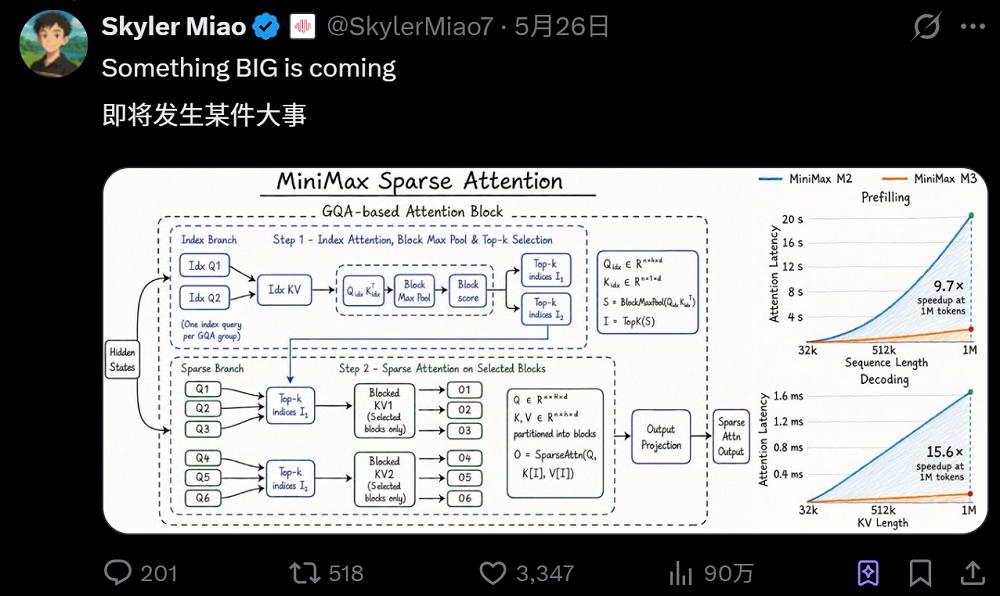
▲Technical details of MiniMax Sparse Attention (Source: X platform @SkylerMiao7)
Conclusion: Leading domestic large model players are rushing to go public
Since 2026, leading domestic large model companies have been accelerating their actions in the capital market. In addition to MiniMax, Zhipu submitted an A-share listing guidance filing in April 2025 but completed its Hong Kong IPO first. In February this year, Zhipu withdrew its previous A-share listing guidance filing and completed a new guidance filing registration, adding Guotai Haitong as the guidance institution.
In addition, there have also been reports that Dark Side of the Moon, Step Star, and Lingyi Wanwu are planning to go public in Hong Kong.
Facing high computing power investment and an incomplete commercialization path, leading large model players are opening up more diverse financing channels through listing.
This article is from the WeChat official account "Zhidx" (ID: zhidxcom), written by Chen Junda and published by 36Kr with authorization.