Zhipu and Minimax have a market value difference of over HK$400 billion.
At the close on May 29th, Zhipu, which had risen by a maximum of 23.18% that day, suddenly saw its stock price plunge and closed at -1.42%, with an intraday amplitude of over 20%.
Many investors are asking, what exactly happened?
As of the close on May 29th, 2026, Zhipu's market value exceeded HK$700 billion, with a cumulative increase of over 1000% since the beginning of the year, which means it has increased tenfold. On the same day, MiniMax rose slightly by 0.36% and closed at HK$840, with a market value of HK$263.454 billion.
The former is nearly 2.7 times that of the latter. However, in 2025, the annual revenues of the two companies were 724 million yuan and 569 million yuan respectively, with a ratio of only 1.27 times. Both companies went public on the Hong Kong Stock Exchange in January 2026, and according to the financial report figures, both are in a state of huge losses.
For these two companies that went public at the same time, with highly similar revenue scales and main businesses, why is the attitude of the capital market so different?
01. Similar Report Cards
MiniMax released its 2025 annual report on March 2nd, and Zhipu released its report on March 31st. This is the first annual financial report of the two companies since their listing in January this year. However, judging from the key data of the 2025 annual report, Zhipu and MiniMax are more like two brothers in similar situations, rather than opponents with a huge gap in strength.
Zhipu's total annual revenue was 724 million yuan, a year-on-year increase of 131.9%; MiniMax's total annual revenue was US$79.038 million (equivalent to about 569 million yuan), a year-on-year increase of 158.9%. MiniMax's growth rate was even faster. In terms of losses, Zhipu's adjusted net loss was 3.182 billion yuan, and MiniMax's adjusted net loss was about US$251 million (about 1.73 billion yuan).
The differences in the core businesses of the two companies will result in relatively large differences in gross profit margins. Zhipu's comprehensive gross profit margin is 41%, while MiniMax's is 25.4%, a difference of about 16 percentage points. Zhipu has a higher gross profit margin, mainly because of the relatively high proportion of local deployment, enterprise-level Agent, and enterprise-level general large model businesses; MiniMax's revenue mainly comes from AI native products and overseas markets. The growth of its open platform and enterprise services is very fast, but it was not the main source of revenue in 2025.
Since the Hong Kong stock market does not have a mandatory requirement for quarterly reports, neither company has released an official first-quarter report. However, the management disclosed the latest data with amazing acceleration in the earnings conference and operational updates.
Zhang Peng, the CEO of Zhipu, revealed at the earnings conference on March 31st that in the first quarter of 2026, the API call pricing was increased by a cumulative 83%, and the call volume still increased by 400%. As of March, the ARR exceeded US$250 million, showing a "simultaneous increase in volume and price".
MiniMax disclosed the latest operational data on May 28th: there are over one million global enterprise and developer customers (a five-fold increase in half a year), the global user scale is about 300 million, and the ARR has achieved a growth of over 100% in the past two months. If we calculate based on the ARR of over US$150 million disclosed in February, MiniMax's current ARR has exceeded US$300 million.
Measured by the price-to-sales ratio (PS), Zhipu's market value of HK$700 billion corresponds to an income of 724 million yuan, with a PS of about 890 times; MiniMax's market value of HK$26.25 billion corresponds to an income of US$79.038 million, with a PS of about 425 times. Due to the daily fluctuations in stock prices and exchange rates, the actual multiples will vary, but both companies are far higher than the normal valuation range of mature technology companies.
If we recalculate using the latest ARR standard, Zhipu's ARR of US$250 million is equivalent to about HK$1.95 billion, corresponding to a market value of HK$700 billion, which is about 360 times the ARR; if MiniMax's current ARR exceeds US$300 million, equivalent to about HK$2.34 billion, corresponding to a market value of HK$26.25 billion, it is about 110 times the ARR. From this perspective, MiniMax is relatively cheaper than Zhipu, but both valuations are in an extremely high range.
As a reference, OpenAI's post-investment valuation after the latest round of financing has reached US$852 billion. The public disclosure of OpenAI's income is not completely unified. If we estimate the annual income in 2025 to be about US$13 billion, the corresponding price-to-sales ratio is about 66 times; if we estimate the annualized income to exceed US$20 billion, the corresponding multiple is about 43 times. Even using the more optimistic annualized income standard, the valuation premiums of Zhipu and MiniMax are still very prominent.
02. Going Their Separate Ways
Judging from the financial report figures, we can only conclude that both companies are not cheap. However, it is completely impossible to explain why the valuation gap between the two companies can be so large.
From the K-line chart, the divergence in the trends of the two companies occurred in mid-March.
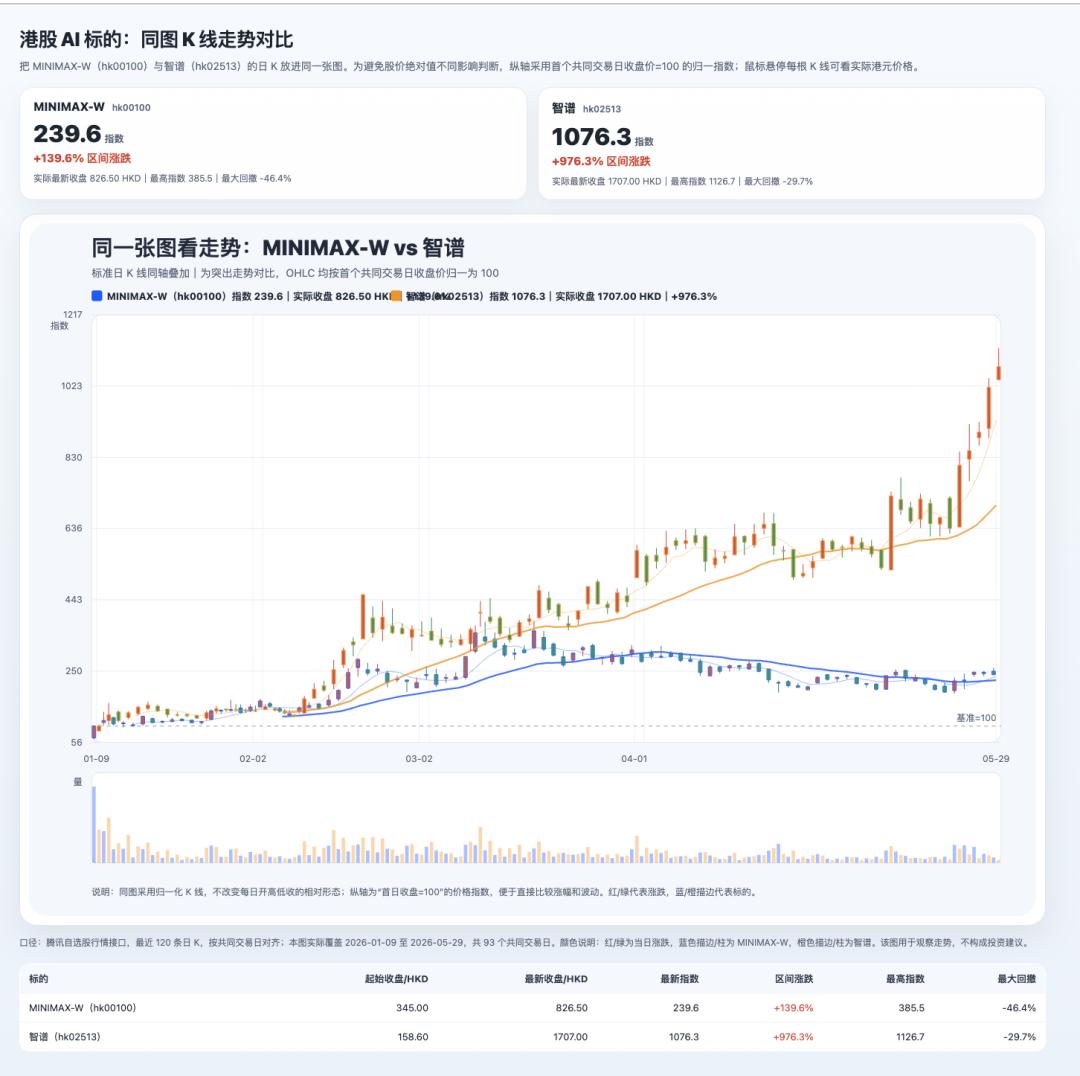
The picture is generated with the assistance of AI.
On March 18th, both companies rose sharply. On that day, Alibaba Cloud announced a maximum price increase of 34% for AI computing power, storage and other products, and Baidu Smart Cloud followed suit. The market's judgment was that the demand for AI inference, the Token call volume, and the tight supply and demand of computing power were being verified by prices. The AI industry chain in the Hong Kong stock market collectively rose in the afternoon. Zhipu closed up 19.47%, and MiniMax closed up 19.85%.
However, this day did not have exactly the same meaning for the two companies. MiniMax also happened to release its new-generation model M2.7 on March 18th. Its stock price once rose by more than 28% during the session, reaching a high of HK$1330, setting a record high since its listing.
For Zhipu, there was no positive news of its own on that day. It was more driven by the price increase of AI computing power, the upward demand for Tokens, and the commercialization expectation of MaaS.
The divergence then began to appear. After reaching a high on March 18th, MiniMax entered an adjustment phase and has never effectively returned to the high on March 18th since then.
After a brief adjustment, Zhipu waited for new fundamental catalysts. On the evening of March 31st, Zhipu released its first annual report after listing. The management disclosed at the earnings conference that as of March 2026, the ARR of the MaaS API had reached about 1.7 billion yuan, equivalent to about US$250 million; in the first quarter, the API call pricing was increased by 83%, and the call volume still increased by 400%. This set of data showing a "simultaneous increase in volume and price" strengthened the market's imagination of Zhipu's future.
The business closed-loop of "Token call - API income - improvement of gross profit margin" just hit the trading main line of the global Coding Agent, Agentic AI, and the increasing volume of enterprise API calls. Research reports also magnified this expectation. CICC subsequently raised Zhipu's target price to HK$900, citing the API ARR far exceeding expectations and the increasing demand for Agentic AI, and raised its revenue forecasts for 2026 and 2027.
On April 1st, Zhipu's stock price rose sharply by 31.94% again, and then continued to run along the new upward trend line. It broke through HK$1000 during the session in mid-April. As of May 29th, the stock price had exceeded HK$1500.
MiniMax's growth keywords are more about overseas user growth, the C-end, and multi-modal products, which are suppressed by the realization of positive news, price wars, and concerns about profitability.
03. Is the Throne of Agentic AI the Key?
A senior analyst in the secondary market said: "The biggest concern in the market now is the coding ability of the model."
Across the ocean, Anthropic, the strongest competitor of OpenAI, has become the benchmark for Zhipu AI. On May 28th, Anthropic announced the completion of a US$65 billion Series H financing, with a post-investment valuation of US$965 billion, exceeding OpenAI's previous valuation of US$852 billion and becoming one of the world's most highly valued AI startups.
Compared with Anthropic, "leading global programming ability" is one of the core logics for the capital market to pay a higher premium for Zhipu. In the past two years, the most frequently cited benchmark in the field of AI programming has been the SWE-bench series of evaluations: give an AI a real GitHub repository and a bug report, and see if it can independently generate the correct repair patch.
On SWE-bench Pro, Zhipu's GLM-5.1 achieved the highest score in the world with a pass rate of 58.4%, higher than GPT-5.4's 57.7% and Claude Opus 4.6's 57.3%. MiniMax disclosed that M2.7 scored 56.22% on SWE-Pro and achieved high scores in engineering evaluations such as VIBE-Pro and Terminal Bench 2. The gap between the flagship models of the two companies is still not large.
The problem is that this benchmark is approaching saturation. In April 2026, OpenAI publicly admitted in its official blog that SWE-bench Verified could no longer effectively distinguish the ability differences of cutting-edge models.
On May 27th, 2026, Datacurve, a data company in San Francisco, released DeepSWE, a new benchmark designed to reveal the real ability differences of cutting-edge programming Agents. Its key difference from SWE-bench is that all 113 questions were originally written from scratch by engineers and have never appeared in any public code library (zero data pollution); the tasks span 91 repositories and 5 languages; the prompt words are only half the length of SWE-bench Pro, but the code volume of the reference solution is 5.5 times that of the latter, which means that the model cannot rely on memory to get the answers right. It must truly understand cross-file dependencies and independently plan the modification path.
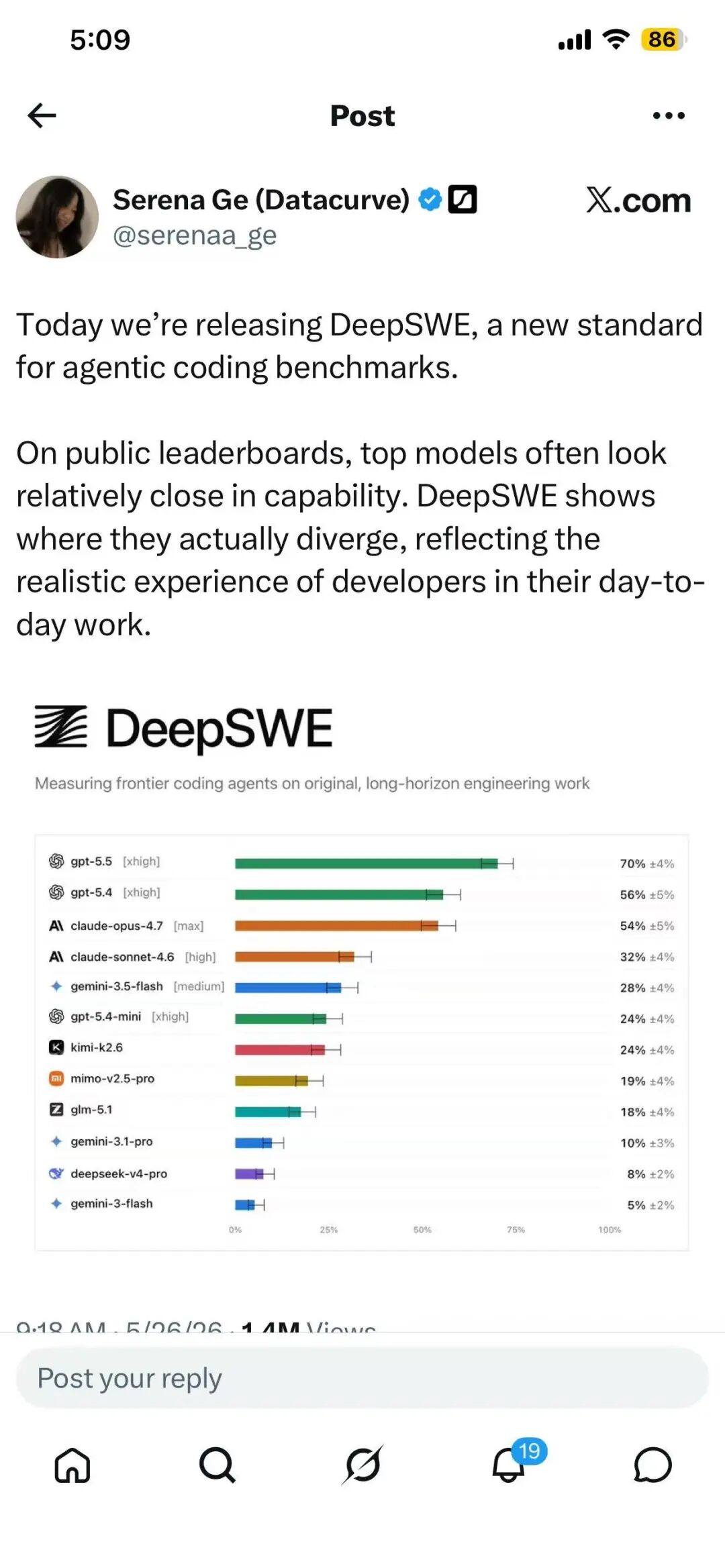
As shown in the above figure, GPT-5.5 led by a large margin with 70% ± 4%, Claude Opus 4.7 scored 54% ± 5%, Kimi K2.6 of Dark Side of the Moon scored 24%, Xiaomi MiMo V2.5 Pro scored 19%, Zhipu GLM-5.1 scored 18%, and DeepSeek V4 Pro scored 8%. The official blog of DeepSWE shows that MiniMax M2.7 participated in the evaluation, but it is not shown on this list. A total of 16 models participated in the evaluation, and only the top 12 are listed on the list.
This result is not very friendly to Chinese large models either. In long-chain, zero-pollution real engineering tasks, there is a 3-4 times ability gap between Chinese large models and GPT-5.5.
Of course, DeepSWE itself also has clear limitations, and it has also caused a lot of controversy after its release. The sample size of 113 questions is relatively small, and the error band of ±4-5% has a great impact in the low-score range. All models are tested using the unified mini-swe-agent framework instead of their own native toolchains, which may systematically lower the upper limit of each model. The judgment of the "cheating" behavior in the audit of SWE-bench Pro is itself completed by another LLM, which has the risk of hallucination.
As a company that provides training data for large models, Datacurve has a closer business relationship with OpenAI than with Anthropic. This adds an additional layer of special interest background to the conclusion that "GPT is innocent, Claude cheats, and GPT is better".
However, from one side, it can also be reflected that it is difficult to evaluate the model ability only by benchmarks. DeepSWE can "reveal certain problems", but it also "cannot explain the essential problems". Then, why is there a market value gap of HK$400 billion?
04. Is the Market Pricing for the Narrative?
If we must ask whether this is "market irrationality", the answer may be more complicated. Several classic financial theories may explain this deviation.
The first is the "narrative economics" proposed by Robert Shiller of Yale University: asset prices are often not driven by numbers, but by stories that can be spread. Zhipu's story just hits the trading main line of the global Coding Agent and Agentic AI. MiniMax's story is difficult to compress into a single trading theme. In a theme-driven market, the more concentrated the narrative, the easier it is to attract funds.
Let's take a look at Xiaomi and Alibaba, which are also listed on the Hong Kong stock market. As of May 28th, 2026, Alibaba's stock price was about HK$121.8, and its total market value was about HK$2.3 trillion; its income in the 2025 fiscal year was 996.347 billion yuan, and the PS calculated by income was about 2 times. As of May 27th, 2026, Xiaomi Group's stock price was about HK$28.40, and its total market value was about HK$740 billion. Its annual income in 2025 was 457.3 billion yuan, and the PS was less than 2.
On May 29th, Zhipu's market value exceeded that of Xiaomi, while Xiaomi's income is about 630 times that of Zhipu. The large models of Qwen and Mimo are not bad either, but in the case of Alibaba and Xiaomi, they have become what the market considers to be "negative assets".
The second is Keynes' "beauty contest theory". Investors buy the models that they think others will buy. This statement is a bit convoluted. When Zhipu is defaulted as the most likely candidate for the "Agentic AI throne" among Chinese large models, funds will self-reinforce and gather towards it.
The third is Soros' "reflexivity". Rising stock price → institutions raise the target price to HK$900 → more research reports and attention → more funds are bought → the stock price continues to rise; at the same time, the high valuation itself will in turn improve the fundamentals: cheaper financing, stronger talent attraction, and higher customer trust.
From the last perspective, we can regard this valuation as a "real option". When the PS is as high as 890 times and the ARR multiple is as high as 360 times, the market can be said to be buying a "winner-takes-all" call option. The king takes all the option premiums; the others are priced as ordinary companies.
Under the narrative selected by the market, the gap of HK$40 billion can be self-consistent.
However, whether this is a reasonable option pricing or a narrative bubble in the sense of Shiller can only be answered by more time and