Zhang Tao, the founder of Pudu Robotics, attended the opening ceremony of BEYOND Expo to jointly discuss the Physical AI path under the concept of "symbiosis of digital and physical worlds".
On May 27, 2026, the opening ceremony of BEYOND Expo 2026 was held at the Parisian Theatre in The Parisian Macao. The conference was themed "AI: The Symbiosis of Digital and Physical", focusing on the industrial process of artificial intelligence moving from digital systems to the physical world. In the subsequent fireside chat, Zhang Tao, the founder and CEO of Pudu Robotics, along with He Jiandong, the co - founder of BEYOND Expo, and other guests at the scene had in - depth exchanges around the theme of "Global Physical AI: Building a Billion - Dollar Robot Enterprise from Shenzhen".
This was Zhang Tao's first time sharing topics such as the globalization of Pudu Robotics and the implementation path of Physical AI at BEYOND Expo, as well as interpreting the business logic behind the "130,000 global robot shipments".
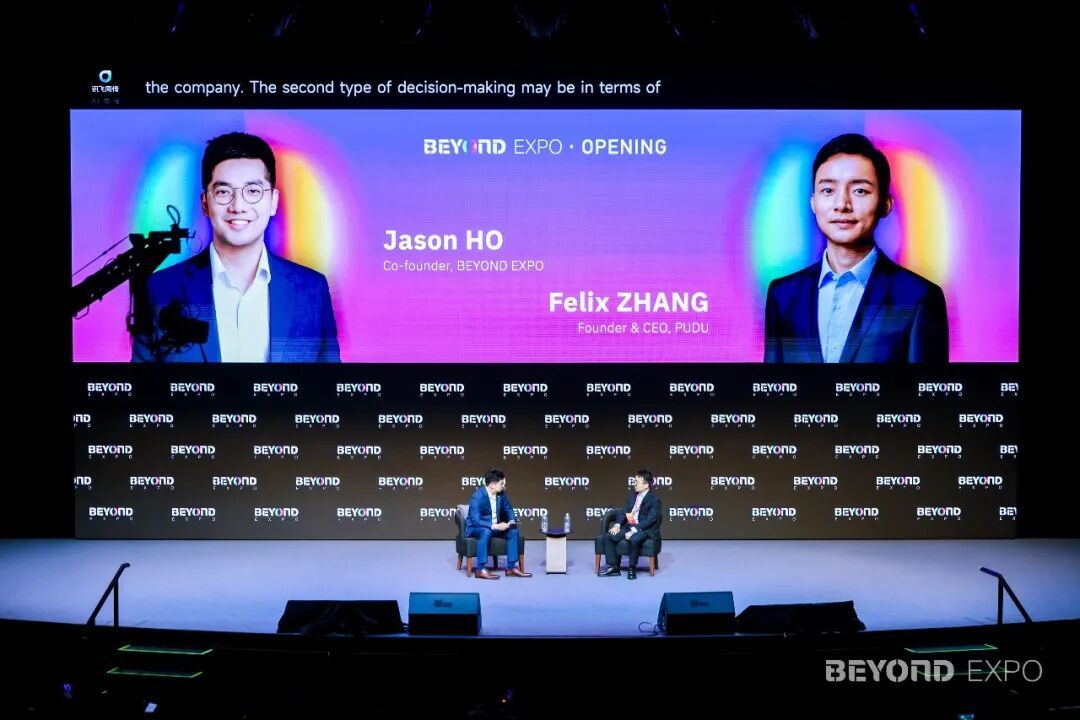
Zhang Tao, the founder and CEO of Pudu Robotics, attended the fireside chat at the opening ceremony.
I. B - side business is a "multi - round game", trading time for space
At the beginning of the fireside chat, Zhang Tao first shared the starting point of his entrepreneurship - dropping out of school to start a business, working on flying cars, running a technology media, and finally choosing to return to the robot track. The driving force behind it has always been "passion". "Entrepreneurship is a high - risk endeavor. Finding the direction you are most passionate about is the most important guarantee for long - term perseverance."
However, passion is just the starting point. After passion comes a more crucial choice: which track to pursue, which scenario to target, and whether to focus on the B - side or the C - side?
Zhang Tao pointed out in the conversation that the essential difference between the B - side and the C - side is not just the difference in unit price and usage scenarios, but two completely different business logics. The B - side business is like a multi - round game. Enterprises can continuously improve the matching degree between products and customer needs by long - term refinement of technology, products, organization, strategy, commercialization, and channel capabilities.
He said, "This means that what enterprises need on the B - side is not explosive power, but endurance - the B - side competition requires a 'hexagonal warrior' with capabilities in technology, products, commercialization, strategy, organization, etc."
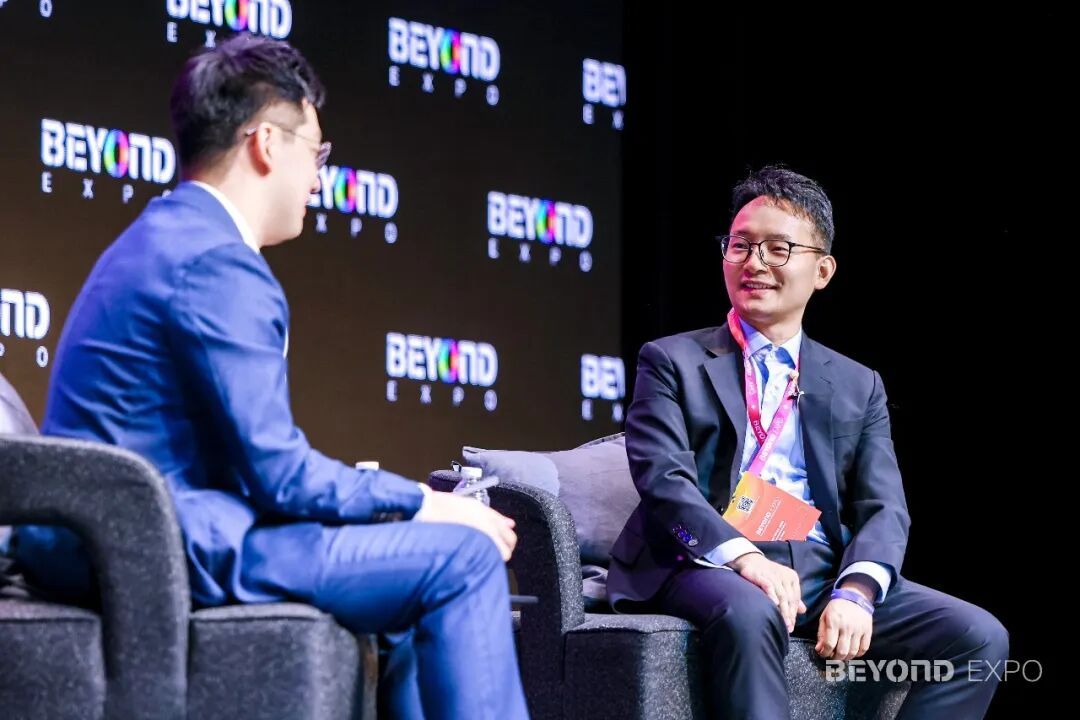
Zhang Tao, the founder and CEO of Pudu Robotics, attended the fireside chat at the opening ceremony.
Based on this logic, Pudu has expanded from commercial delivery robots to commercial cleaning robots, industrial delivery robots, and then to general embodied intelligent robots. With each category expansion, Pudu has been able to extend its reuse capabilities to a wider range of robot forms, achieving a leap from single - point breakthrough to platform - based layout, relying on the technology stack, scenario understanding, and channel resources accumulated in the "multi - round game".
II. Globalization strategy: The inevitable choice from "fearless ignorance" to localization
For most robot enterprises, going global is not a choice but a matter of survival - however, not many enterprises can really answer this question well. The overseas market means a more complex policy environment, a longer service chain, higher compliance thresholds, and the need to build channel trust from scratch. Pudu launched its overseas expansion plan just one year after its establishment. After ten years of exploration, it has gradually developed a globalization path from "testing the waters" to "in - depth cultivation".
In 2017, Pudu launched its overseas expansion plan just one year after its establishment. "At that time, we were fearless out of ignorance," Zhang Tao recalled.
In 2021, based on a review of sales data from various countries at that time, the team found that the labor efficiency and gross profit in the overseas market were significantly better than those in the domestic market. They then increased their investment and made a key decision: to implement more in - depth localization.
Currently, Pudu's business covers more than 80 countries and regions. The proportion of overseas revenue has exceeded 80% for many consecutive years, with the European market accounting for 30% and the US market showing a growth rate of up to 285%.
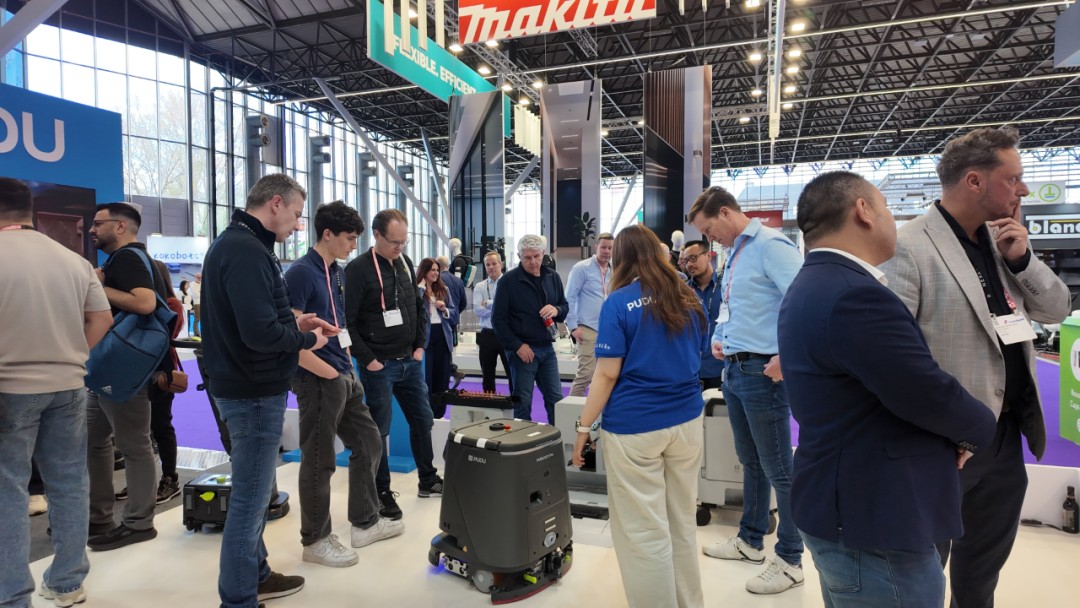
Pudu Robotics at the Interclean exhibition in the Netherlands
Zhang Tao summarized the global business into three levels:
1. Prioritize breadth, then depth
Going global is not about betting on a single point but about achieving a higher overall win - rate through a wider coverage. Pudu explores multiple markets simultaneously, increasing investment in countries with fast growth, high gross profit, and good customer feedback, and finding reasons for underperforming markets. Since the B - side sales chain is long and the single - point verification cycle is long, prioritizing breadth can improve the overall success rate.
2. The local team is the infrastructure
True localization is not just about placing a sales representative in the local area, but about allowing local people to have their own offices, teams, and decision - making power. Pudu has set up local offices and hired local employees in multiple core markets such as the United States, Japan, South Korea, and Germany. Zhang Tao said, "Only a localized team can do a good job in 'Glocal' - global localization."
3. Trust needs to be accumulated over time
Building trust with B - side customers is a process that requires continuous investment. Once interrupted, it takes several times as long to rebuild, and the rebuilt trust is often not as strong as before.
"Trust is the passport for robot globalization," Zhang Tao said. "But this passport is not valid forever once obtained. It needs to be renewed every year."
III. Opportunities and perseverance for service robot enterprises in the Physical AI era
BEYOND Expo 2026 set this year's theme as "The Symbiosis of Digital and Physical", which is based on the industrial judgment that AI is accelerating its penetration from the digital system to the physical world. In this macroscopic narrative, Pudu Robotics, as a leading enterprise in service robots, is both a practitioner and a verifier of Physical AI.
Regarding the current hot topic of embodied intelligence, Zhang Tao gave a calm industry judgment. He believes that the "GPT moment" of embodied intelligence requires two conditions to be met simultaneously: first, the generalization ability meets the requirements; second, there is a real blockbuster general - purpose robot product that allows customers to use it at low cost and with low thresholds. Currently, the industry is still in the data accumulation stage - the premise for the industry to reach the node of large - scale application is that general - purpose robot products can enter a wider range of customer scenarios at a lower cost.
Zhang Tao believes that robot enterprises in the AI era should achieve the integration of "ontology, model, agent, and commercialization", and none of them can be missing. The ontology determines whether the product can operate reliably in the physical world, the model determines the intelligence level, the agent determines the connection ability with the user scenario, and commercialization is the ultimate test of the technical value.
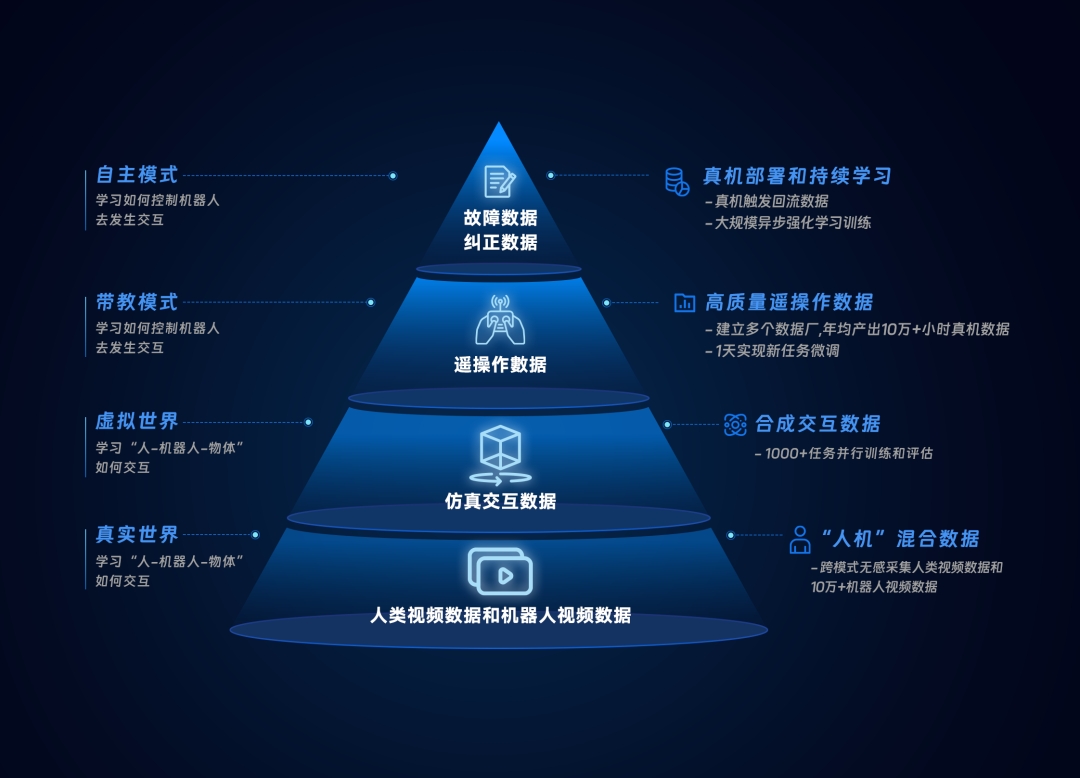
Pudu's layout in this direction is clear. In May, Pudu released the large - scale model of the embodied intelligence base, PuduFM 1.0, and the general embodied intelligent agent platform, PuduAgent. The former enables robots to understand the physical world, and the latter enables robots to work in an efficient and collaborative manner, closing the loop of "technology - product - business" in embodied intelligence. The one - brain - multiple - forms technical architecture, combined with the real - world data flywheel constructed by the deployment of over 130,000 real machines globally, is migrating its technical capabilities from "special - purpose robots" to "embodied general - purpose robots", realizing cross - product - line technical reuse of special - purpose, humanoid - like, and humanoid robots.
"Technology and business are like two legs. Without either one, you can't go far," Zhang Tao said.
IV. Building personal "AI Infra": Insights from the "data flywheel" for entrepreneurs
Finally, addressing the many entrepreneurs present, Zhang Tao borrowed the "data, algorithm, computing power" model in the AI field and gave a message about personal growth: "No one is omnipotent. For entrepreneurs, continuous growth and iteration are eternal. What really sets people apart is 'data' - that is, the books you've read, the roads you've traveled, and the people you've met. The more data you acquire, the faster your growth rate. Everyone should build their own 'AI Infra' and create their own data - driven growth flywheel."
About Pudu Robotics
Shenzhen Pudu Technology Co., Ltd., referred to as "Pudu Robotics", is a global leader in commercial service robots. It is committed to building a global intelligent robot infrastructure to serve 1 billion people. Based on the three embodied intelligent technology stacks of "embodied navigation, embodied operation, and embodied interaction", Pudu has achieved a one - brain - multiple - forms technical architecture and was the first in the industry to complete the full - form layout of special - purpose, humanoid - like, and humanoid robots. Pudu Robotics has built four product lines: delivery, cleaning, industrial, and general embodied intelligence. Its products are widely used in multiple industries such as retail, hotels, industry, warehousing and logistics, catering, property and real - estate cleaning, medical care, entertainment and sports, education, public transportation, and services. Its business covers more than 80 countries and regions globally, and the cumulative shipments have exceeded 130,000 units as of now.