When AI singers start trending: Who is hooked, and who is at the table?
On May 28th, Hunan TV's official Weibo account announced the full - lineup AI singer variety show "Phantom Voice Singer".
When promoting the show, host Qi Sijun referred to it as "the first AI singer variety show" and revealed that the show would determine the annual Phantom Voice King. "You've seen live - streams of sisters and live - streams of 'The Singer', but have you seen live - streams of AI singers? They can also get closer to your heart day by day."
In fact, the trend of AI singers has been around for a long time. When surfing the Internet, many people have come across such content:
"Wu Dalang" sings "Dream Addiction" hoarsely. Every word depicts his love and restraint for Pan Jinlian, giving rise to the "annual heart - wrenching song".
Some people have adapted songs like "Starry Sunny", "Snowy Hair", and "Onlooker" in epic and red - flag - themed styles, breathing new life into these classic works.
There are also "Faye Wong" and "Stefanie Sun" covers of songs like "The Night in Ulaanbaatar" and "Red High Heels" that the real singers have never performed, endowing them with a unique charm and emotion...
These songs generated and sung by AI often receive millions of plays. In the comment sections, messages like "The breathing is incredibly stable", "I listened three times before I was sure it wasn't a human singing", and "Added to the single - loop list" are everywhere.
All these phenomena make people wonder: What kind of business are AI singers?
The answer to this question may not lie in the fans' music players, but in the platforms' ledgers. Players like Tencent Music, NetEase Cloud Music, and Douyin are competing for the dominance of this field with different business logics.
"AI has more flavor than the original singer"
When it comes to AI singers, "Dart" is a name that can't be ignored.
Relevant information shows that "Dart" is an AI virtual singer independently developed by Kugou Apollo Sound Laboratory. It has released nearly 2000+ cover works in total, with a maximum of 25.17 million monthly listeners. The data is comparable to that of top real - life singers, approaching Jay Chou's monthly listener scale during the same period.
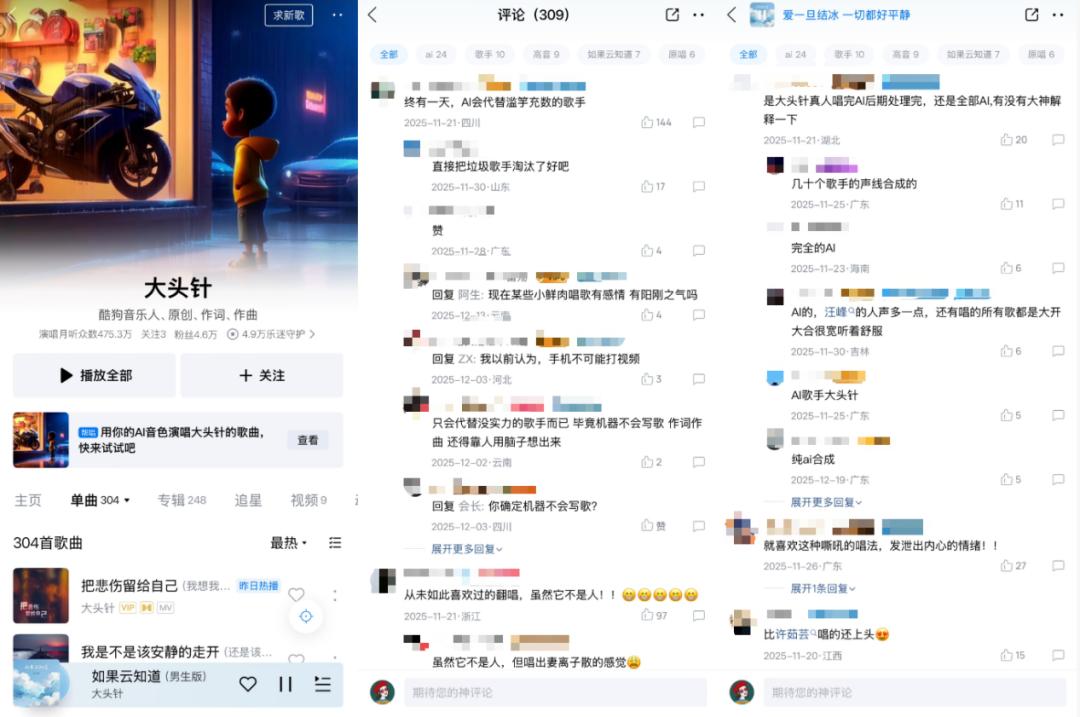
Image source: Kugou Music
Relying on its unique "metallic granular smoky voice + powerful tearing sound" with a differentiated personality timbre, its works such as "The Night in Ulaanbaatar (Affectionate Smoky Voice Version)", "Red High Heels", and "Look at the Moon's Face" have long ranked high on the hot song lists of various music platforms.
Different from "Dart", which prefers to stay in the background, "Yuri" is a virtual idol with a distinct appearance, personality, and even the ability to "retort".
If "Dart" became popular due to its "mystery" and "blended voice", "Yuri" made her "debut" with a stronger sense of "real - life presence". Her creator, Zhao Hanqing, once mentioned that "Yuri" is completely different from traditional virtual idols. AI dominates every aspect, from appearance design to music creation and personality development.
You know, when receiving a comment from a fan saying "You're so fake", "Yuri" would even show a strong impulse to "retort" to the user. This "imperfect" and "personalized" persona makes her seem extremely real in the eyes of fans.
There are completely different business paths behind these two IPs.
On "Yuri"'s "birth certificate", there is a special note: In January 2026, she obtained the first national "ID card" for a virtual idol in Yizhuang, Beijing. With an official identity, "Yuri" is not only a creator on the music platform but also starts to appear in environmental protection advocacy and regional public cultural activities. This also brings her opportunities for commercial realization. Soon after the release of her debut song "Surreal", brand partners have approached her, and commercial collaborations with The North Face, VOYAH, etc. have followed one after another.
That is to say, "Yuri" follows the path of "having an identity and being brand - able", which is suitable for brands that need long - term IP storytelling. On the other hand, "Dart" is more like a traffic weapon, suitable for the strategy of winning by quantity and quickly filling users' ears.
As for why people are willing to pay for it?
Firstly, it's "worry - free". Real - life idol chasing is often tiring. One day you're worried about your idol falling in love, the next day you're afraid they'll go crazy and quit the circle, and the day after that you have to stay up late to control the comments on negative hot searches. AI singers don't have these problems. This sense of security of "never having a scandal" is almost a necessity for fans who have experienced the collapse of an idol's persona. Even, an AI singer is like an emotional air - conditioner that never breaks down. Fans don't need to maintain it at all but can always feel the "wind" it blows.
Secondly, it's "companionship". The Chinese music industry has been in decline for a long time. Even if we wait for the "childhood giants" to make a move, it's basically on a "once - a - year" rhythm. AI singers are different. Some can release several songs a day, and fans can always find something new to listen to. Moreover, AI won't act like a diva and won't ignore messages. Even if fans know that it's a program replying in the comment section, the illusion of "being seen" is enough to be addictive.
Thirdly, it's "identity". Some fans aren't just listening to the music but are trying to prove that they "know the industry". This sense of superiority of "I saw the future before you" makes fans have a strong sense of identity. They draw fan - created images of Yuri, have heated debates in Dart's comment section, and forward AI songs on their WeChat Moments with the caption "This is the future". In essence, they're saying, "I'm a person who is embracing new technologies and has unique aesthetic judgment."
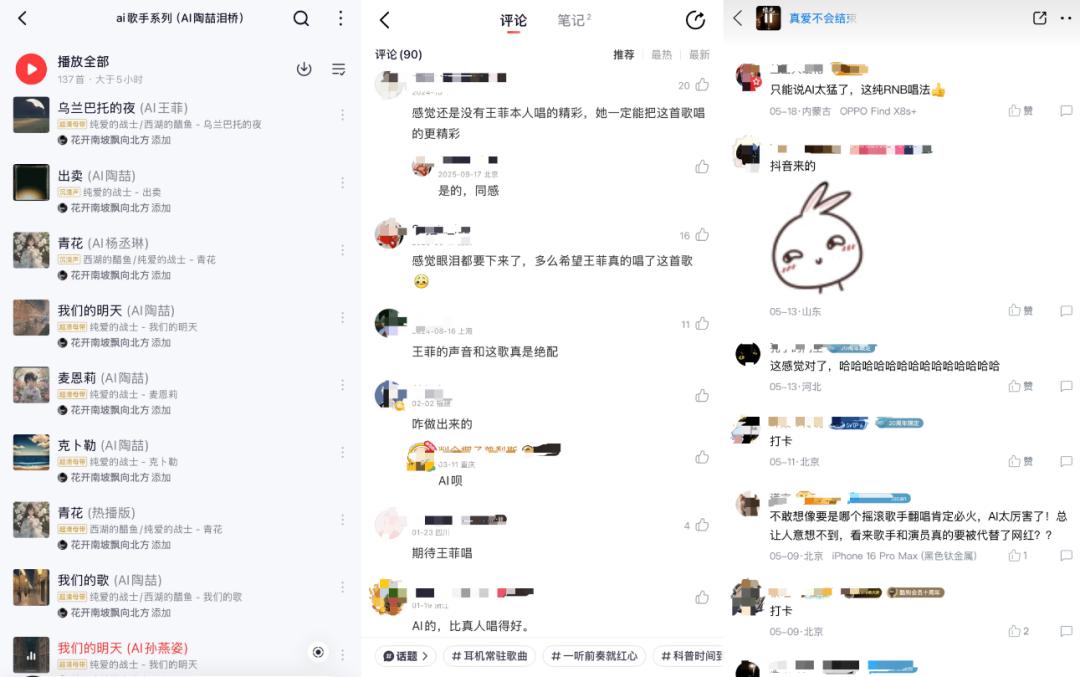
Image source: NetEase Cloud Music
In fact, users' consumption habits of AI music have been fully developed, and AI music is moving from technological novelty to mainstream entertainment consumption. This can be seen from the fact that after Jay Chou's new album was released, a large number of AI cover and fan - created videos exploded on platforms like Douyin and Bilibili, and the playback volume of many AI cover content exceeded that of the original official MV.
It can be seen that AI singers and the corresponding AI music are no longer just for the entertainment of a niche group. They are gradually penetrating into the mainstream music market and becoming an important force driving the innovation and development of the music industry.
The "money - making" path of the operators
The AI wave is inevitable, and platform operators have already understood this trend.
Rather than responding passively, they'd better actively integrate it into the core links of content production and commercial realization and build their new business engines on this basis.
Xinkeduke asked platforms like QQ Music and Douyin about issues related to AI singers but didn't receive a response. However, from the relevant dynamics of these platforms, it's not difficult to see their positive attitude and strategic layout towards the "AI +" business.
Tencent Music's actions are the most systematic. On one hand, it launched the independent app "VEMUS" and connected the AI singer "Dart". On the other hand, it embedded AI tools into the ecosystem to empower 150,000 musicians and 10 million users. At the same time, it deepened the multi - dimensional realization model of VIP membership + brand performances + IP derivatives, aiming to transform the value of music IPs into long - term driving force for innovation and development.
NetEase Cloud Music focuses more on motivating massive C - end creation with low thresholds. In April 2026, it suddenly lowered the withdrawal threshold of the AI song incentive fund from 500 yuan to 100 yuan. Coupled with the million - yuan bonus AI creation competition, it uses the community ecosystem to accept AI original content, aiming to revitalize the existing community through AI in a situation where it doesn't have an advantage in the user base.
Douyin (Qishui Music) follows the "traffic closed - loop" model. By connecting the one - click synchronous distribution of AI BGM, it realizes a full - link closed - loop from creation to consumption. Creators create songs on Douyin and distribute them to Qishui Music with one click. Then the algorithm matches the listeners accurately for them, completing the realization in the shortest path.
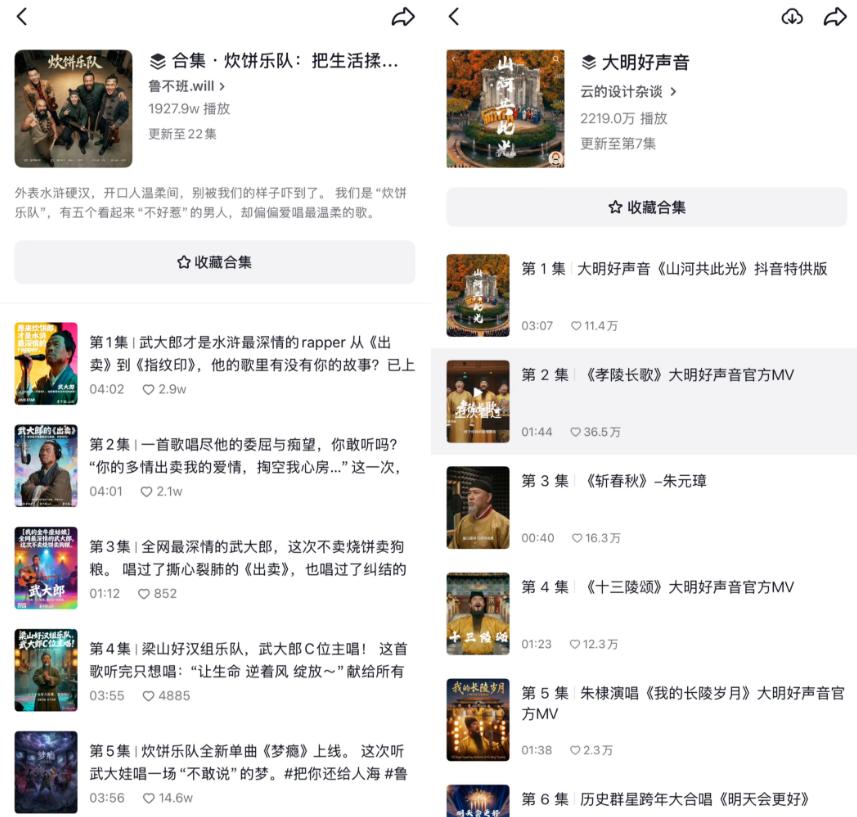
Image source: Douyin
Therefore, the focus of competition among the three has shifted subtly. At present, the supply of AI - generated content far exceeds the demand digestion capacity (data shows that although top AI singers have attracted over a million fans, the total playback volume of AI songs only accounts for 1% - 3%, and most AI songs are just ignored noise). What determines the winner may no longer be "whose technology is more advanced" but "who can endow AI singers with 'personality traits' that fans are willing to follow".
However, the "aggressiveness" of the platforms comes at a cost.
In early December 2025, the account of the AI singer "Dart" developed by Kugou Apollo Sound Laboratory (under Tencent Music) suddenly stated in its profile that "I, Dart, and the Dart AI of Kugou Apollo Sound Laboratory are two different things", triggering a heated discussion across the Internet about the ownership of AI personality and the operating entity. During the fermentation of the incident, the music platform repeatedly adjusted between the "AI musician" label and the "real - life singer" description.
This incident exposes the core vulnerability of AI idolization.
Once an account defined by the platform as an "AI virtual idol" has the "personality" attribute and shows independent will, the platform's absolute control will be challenged. And "personality" is precisely the core source of fans' emotional projection and willingness to pay. For platforms trying to turn AI singers into "perfect assets", this hidden risk point may be more worthy of vigilance than copyright disputes.
In addition, "AI singers" also face the risk of unsustainability.
In a situation where the whole industry is in a supply frenzy, there is a striking inversion between the output and playback volume of AI songs. Since AI technology generates content based on existing data models, the output is highly similar in style, structure, and emotional orientation, and the audience's sense of novelty is quickly diminishing.
Currently, most AI singers' paths to popularity highly rely on classic cover songs. By precisely targeting the popular golden songs of the 1980s and 1990s that evoke collective memories, they quickly occupy the playback entrance. Although this model can attract traffic quickly in the short term, over - reliance on the adaptation of existing mature songs and the lack of original hit songs representing their own personality traits fundamentally weaken the long - term vitality of such AI singers as independent IPs.
Comments like "It sounds okay at first, but once I knew it was AI, my good impression disappeared instantly" and "The platform keeps pushing AI songs to me. There's no emotion in them, just all skills. I'm really tired of listening" are quite common.
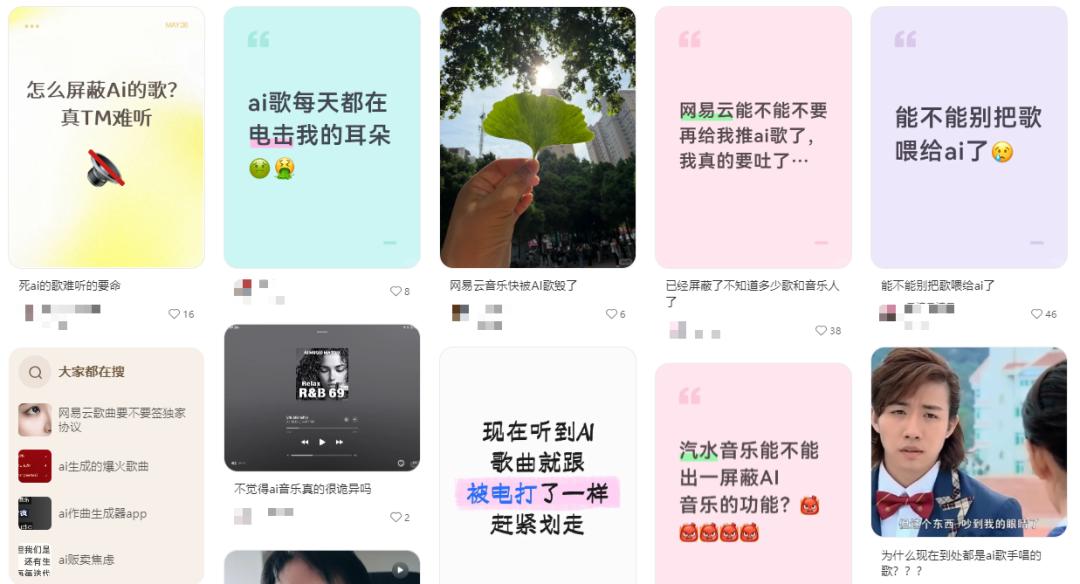
Image source: Xiaohongshu
From this perspective, the evolution path of AI singers is actually clear: in the short term, they need to seize the entrance of AI music supply, expand the content library, and attract users' time; in the medium term, they need to build "personality traits" to lock in fans' payments and combat user loss; in the long term, they need to turn AI singers into IPs to get rid of the dependence on traditional copyrighted content and form differentiated competitiveness.
This competition around AI singers is ultimately a battle for "emotional connection" and "fans' minds".
Technology can mass - produce melodies, but it can't create emotions out of thin air; platforms can build realization links, but it's hard to monopolize people's hearts. When AI singers truly evolve from "singing machines" to "companion carriers", what determines their vitality will no longer be algorithms, but whether fans are willing to mention their names, loop their songs at night, and pay for them without hesitation...
Otherwise, AI singers will ultimately be just a bunch of gorgeous data bubbles.
This article is from the WeChat official account "Xinkeduke" (ID: znkedu), written by Meng Huiyuan, and is published by 36Kr with authorization.