Duan Yongping has a large stake in Pop Mart. Should ordinary investors follow suit?
The largest increase in holdings of Pop Mart, with the shareholding ratio reaching 5.69%, officially making it the second - largest shareholder. After this news came out, the market became lively again.
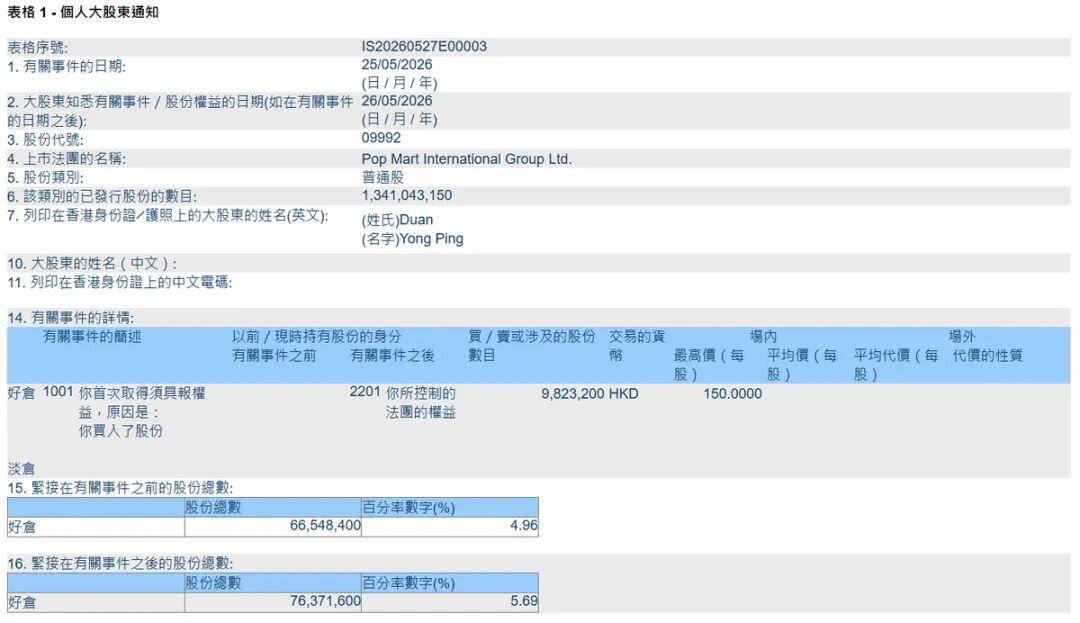
Many people, upon seeing the "Chinese Warren Buffett" make a move, immediately think about following suit and buying.
But I think this decision is not that simple.
The most common mistake in investment is to directly apply others' logic to oneself.
Duane Wong's purchase of Pop Mart doesn't mean this stock is suitable for everyone, nor does it mean that following him will definitely result in profits. Instead of focusing on what he bought, it's better to figure out what he really values about Pop Mart.
Now, when people mention Pop Mart, the first thing that comes to mind is definitely Labubu. This IP has been extremely popular in the past year, directly pushing the company's performance to a new height. So, many people simply equate buying Pop Mart with buying Labubu.
However, judging from Duane Wong's investment style over the past two decades, he probably doesn't think this way. When he invested in companies like Apple, Tencent, and NetEase in the past, he never focused on a single product but rather valued the management, corporate culture, and long - term self - sufficiency ability.
So, I think what he is really betting on with this heavy investment is whether the founder Wang Ning and the team can continuously incubate new super IPs in the future.
There are indeed risks associated with Labubu. The popularity fades quickly, and its overseas stickiness is average. These are significant issues. But if we look at a longer time frame of five to ten years, whether a single IP will become obsolete is not the most core issue.
Disney doesn't rely on Mickey Mouse for a lifetime, and Nintendo doesn't survive on a single game. What really matters is their ability to continuously create new things. Pop Mart faces the same challenge.
To be honest, I also have some doubts about Pop Mart.
This doubt doesn't entirely come from the financial reports but from some very subjective observations.
There is a Pop Mart store near my home. Two or three years ago, when it was at its peak, I often saw many young people visiting the store on weekends. There would even be queues when new popular products were launched. In the past year, although there are still people in the store, the customer flow is obviously not as exaggerated as before.
There is also a very intuitive feeling. A few years ago, I often saw people in my WeChat Moments showing off their Pop Mart purchases, such as blind boxes, hidden items, and newly bought Labubu toys. At that time, it seemed that there were suddenly many people around me collecting trendy toys. But now, such content has decreased significantly.
Of course, these are just personal observations and don't represent the real market situation. It's even possible that because Pop Mart has entered the mass market from a niche circle, it no longer has the "show - off attribute" it once had. But this change at least makes me wonder:
Is Pop Mart currently in the middle of its growth phase, or is it approaching a certain popularity ceiling?
Many people are currently entangled about operational issues such as single - IP dependence and the slowdown in overseas growth. But personally, I think the more crucial question is: How big is the trendy toy market?
The current valuation of Pop Mart in the capital market is not based on that of an ordinary toy company. Instead, it's a bet on whether it can grow into a global consumer IP platform. To put it bluntly, it's a bet on whether young people will continue to pay for emotional value and identity in the next few decades.
If the bet is right, Pop Mart's future competitors may be companies like Disney, Lego, and Sanrio. What they sell is not just products but cultural symbols and emotional connections.
Many traditional investors don't understand this. When they see a doll that costs a few dozen yuan being sold for hundreds of yuan, they think it's unreliable. But what consumers are actually buying is not the plastic but the happiness, topics, and the feeling of "I'm special because I have this." This is similar to the underlying logic of limited - edition sneakers, luxury goods, and game skins, all of which satisfy emotional needs, and emotional needs often generate higher premiums.
This is where the problem lies.
Optimistic people believe that this represents a new consumption trend. As material wealth becomes more abundant, young people will be more willing to pay for their interests and emotional value. If so, the market space for Pop Mart may be much larger than that of the traditional toy industry.
But pessimistic people think that trendy toys are essentially a form of fashion consumption. The biggest characteristic of fashion consumption is its rapid change. People may like Labubu today, another character tomorrow, and a new hot item the day after. No one really knows whether it can build a cultural influence like Disney over several decades.
To be honest, I don't have an answer myself.
I used to think that the trendy toy market was a relatively niche consumption area, and it was difficult for a true global giant to emerge. But the explosion of Labubu in the past two years has made me wonder if I underestimated the consumption habits of the younger generation.
So, I think what the market is really arguing about is never how long Labubu will remain popular.
The real difference lies in: Is Pop Mart growing into the next global cultural consumption platform, or is it just a very good but limited - scale trendy toy company?
If it's the former, the current valuation may not be expensive. If it's the latter, once the future growth slows down, the valuation may face compression.
But even if you agree with Duane Wong's judgment and think that Pop Mart does have the opportunity to go far in the future, there is still a problem that must be considered.
You and Duane Wong are actually playing different games.
For Duane Wong, investing is more like buying the cash flow for the next ten years. He has enough time and a thick enough safety cushion. A 30%, 40% drop, or even a halving of the stock price may just be fluctuations to him.
But for many retail investors, the situation is completely different.
For many people, their investment funds are used for purposes such as buying a house, education, retirement, or even daily life. A 20% book loss doesn't just feel like a change in numbers but real pressure.
Many people think they are long - term investors, but after experiencing several months of continuous decline, they find that they are not as patient as they thought.
Almost all the companies that were later proven to be very successful in history have experienced significant fluctuations. Apple, Tencent, Amazon, and Meta have all gone through this.
The people who ultimately make a lot of money are not necessarily the smartest but often those who can hold on for a long time.
There is a very interesting phenomenon in the history of investment: Many people bought great companies but didn't earn great returns. The reason is not that the companies are not excellent but that they got off the train early on the road to success.
So, Duane Wong's heavy investment in Pop Mart is definitely worth paying attention to, but I won't rush to draw a conclusion based on this news.
So far, I'm neither particularly optimistic nor particularly pessimistic about this company. I prefer to think of it as a story that is still in the verification stage.
What really needs to be verified in the next few years may not be how many Labubu toys can be sold but whether Pop Mart can prove that it has the ability to cross the boundaries of trendy toys and grow into a larger cultural consumption platform.
If it can do so, the current controversies may all become noise.
If it can't, then much of the imagination space the market has given it will have to be re - priced.
This article is from the WeChat official account “DifferentFin”, author: Yechaxuebai. It is published by 36Kr with authorization.