Analysis of Q1 Earnings Reports: The Cloud Computing Battle Among Alibaba, Baidu, and Tencent Intensifies, with ByteDance Making the Outcome Harder to Predict
The revenue growth in Q1's financial report is impressive, but it's getting increasingly difficult for "selling computing power" to support the profit story.
In Q1 of 2026, Alibaba Cloud's revenue increased by 38% year - on - year, Baidu Smart Cloud by 79%, and Tencent's enterprise services by 20%. Three representative cloud providers have all delivered good financial reports. This is an expected result in the incremental market, but the competition among these platforms is intense.
Since last year, the cost of the computing power layer has been rising continuously, while the price of the model API layer has been dropping rapidly, and the gap is widening. For cloud providers in the middle, their pricing power and profit margins depend on which end their revenue focus is closer to and whether they have the ability to build a real moat between the two ends.
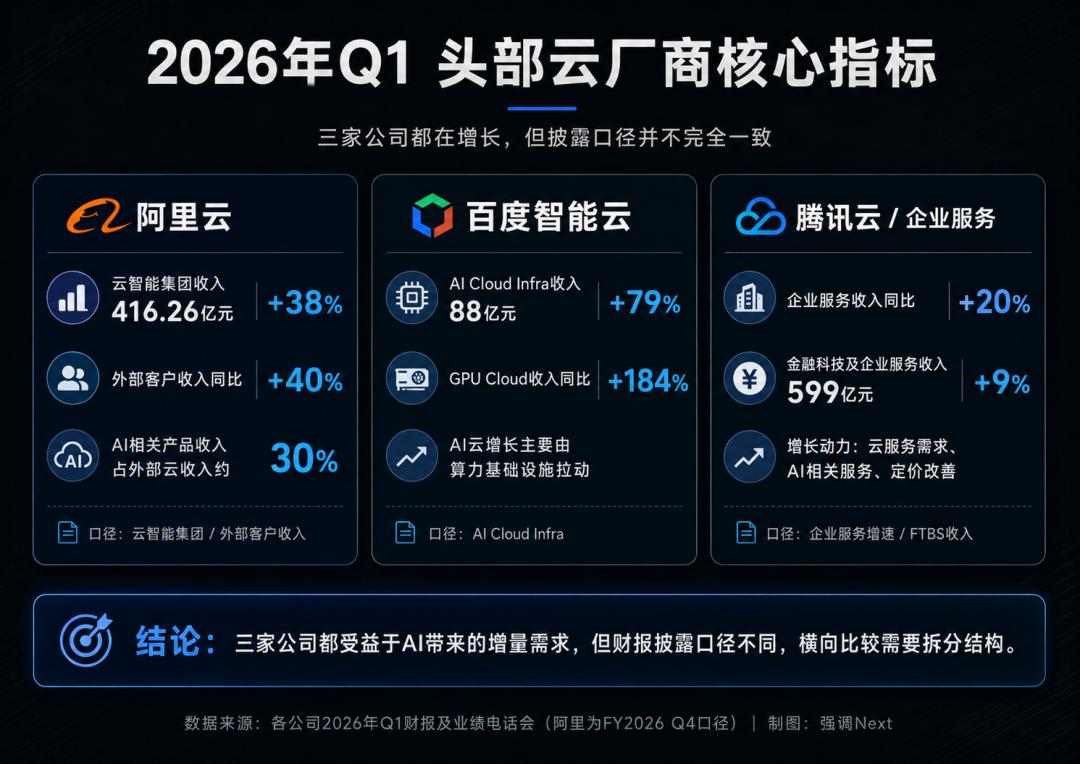
From the financial reports, it can be seen that the three companies are betting on different areas and facing different pressures. The figures this quarter are starting to outline the boundaries of each company's bets.
1 · Alibaba Cloud: The Real Logic of Full - Stack Betting
In the first quarter, Alibaba Cloud's external revenue reached 41.6 billion, a year - on - year increase of 38%. The revenue from AI - related products was 8.9 billion, with three - digit growth for 11 consecutive fiscal quarters. The proportion of AI revenue in external cloud revenue has exceeded 30%.
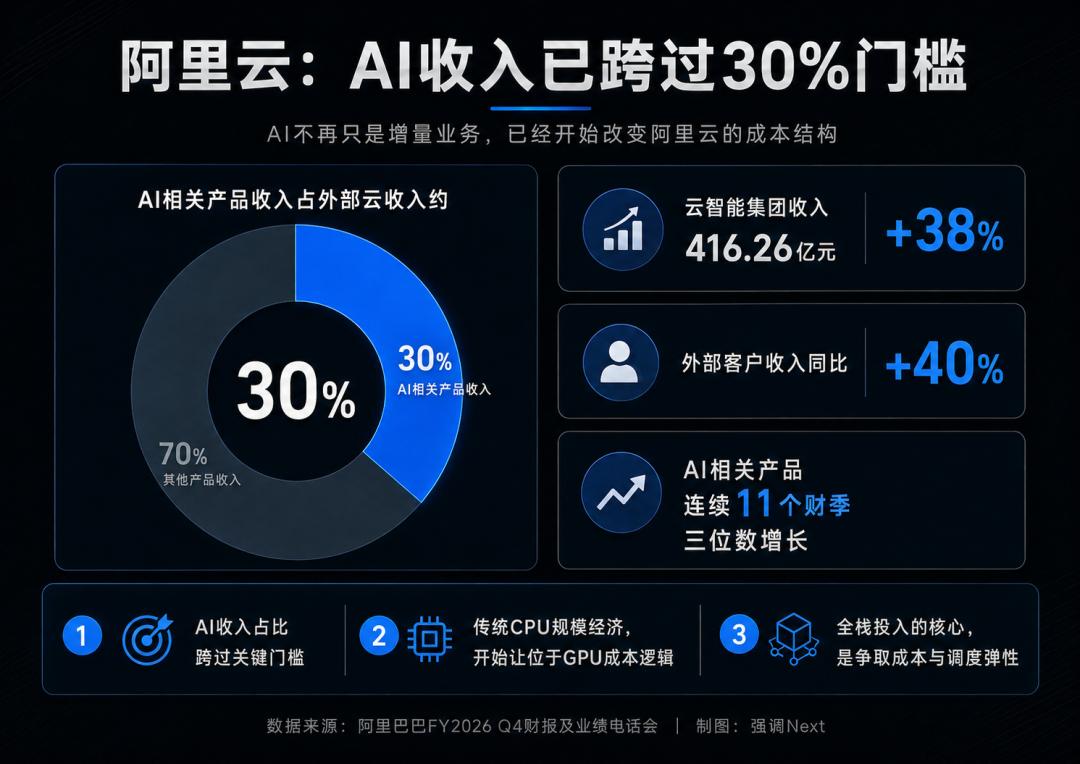
This proportion is a threshold. The cost logic of traditional cloud services is the economies of scale of CPUs. The larger the volume, the lower the unit cost, and price cuts and expansion can be carried out simultaneously. Once the AI - related revenue exceeds 30%, the cost characteristics of GPUs start to dominate the accounts. The costs of H - series chips, HBM memory, and supporting power and cooling only increase. It's difficult for the profits from traditional workloads to dilute these costs sufficiently. Alibaba Cloud's external commercial revenue growth rate of 40%, the fastest in the past nine quarters, indicates that the migration of this cost structure is accelerating.
In this context, Alibaba's full - stack strategy (T-head Semiconductor → Tongyi Qianwen → Cloud platform → Industry applications) is not just a matter of technological integrity; it's a cost logic. The goal of T - head Semiconductor is not to match NVIDIA in performance but to provide Alibaba with a cost leverage other than NVIDIA in specific training and inference scenarios.
If it succeeds, it means that Alibaba has more flexibility in GPU procurement negotiation and mixed scheduling of self - developed computing power than pure cloud providers. The group's promised 380 billion yuan investment in AI infrastructure over three years will be concentrated this year. This is a prerequisite for the realization of the full - stack logic, not just a signal of large - scale investment.
However, 53% of China's top 500 companies use Alibaba Cloud's AI services. This is market penetration, not the depth of lock - in. Large enterprises usually maintain a multi - cloud strategy to avoid being locked in by a single provider. Whether full - stack binding can transform from "use" to "dependence" depends on the irreplaceability of Tongyi Qianwen and industry models in specific business scenarios. The current financial report figures prove the scale but not the depth.
2 · Baidu Smart Cloud: The First - Mover Advantage with an "Expiration Date"
Baidu's figures this quarter are the most visually impactful among the companies: the revenue from GPU cloud increased by 184% year - on - year, and the overall AI cloud revenue was 8.8 billion, with a growth rate of 79%.
The high growth rate of the GPU cloud reflects, to a large extent, the realization period of a first - mover advantage: Baidu was the first domestic company to build a large - scale GPU cloud. The Kunlun Core P800 has completed the verification of a 30,000 - card cluster. The years of accumulated computing power operation experience have created a premium space during the period of tight supply. This is a competitive barrier, but it is a depreciating asset, not a continuously appreciating moat. As the computing power infrastructure of other providers is gradually in place, the premium brought by the first - mover advantage will decrease.
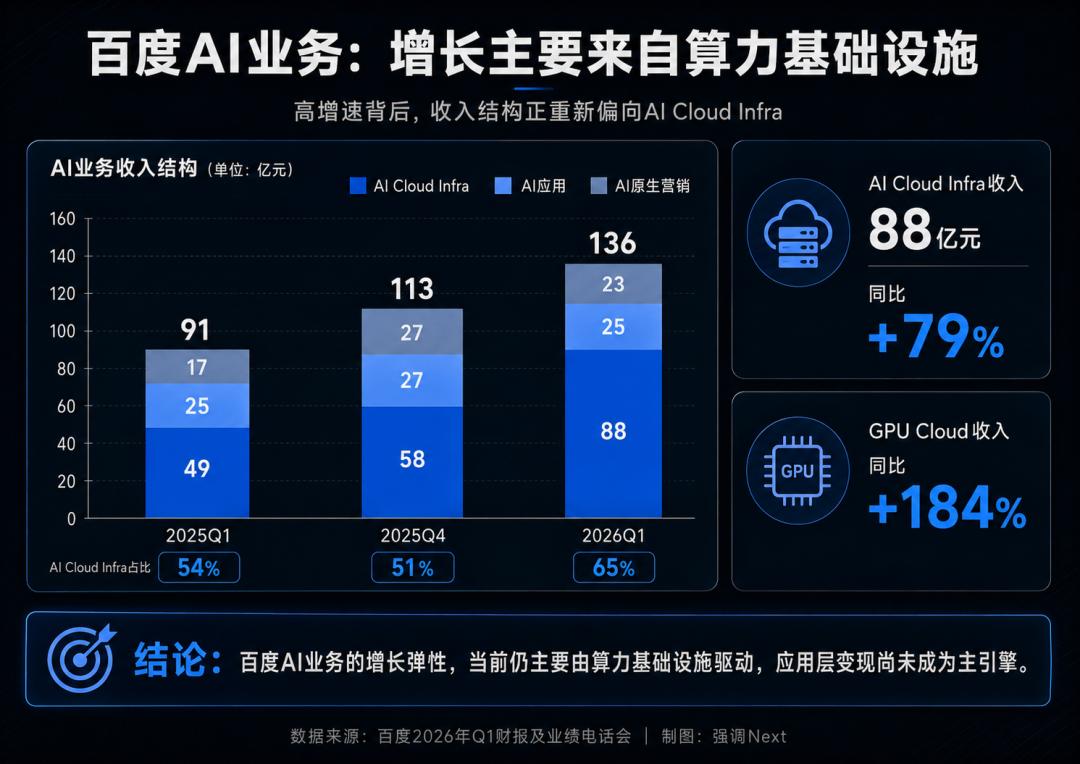
More importantly, in terms of revenue structure, 65% of Baidu's AI cloud revenue comes from computing power infrastructure, and the combined revenue from AI applications and native marketing is less than half. The end - game described by Robin Li at the earnings conference, which is billed based on "AI agents completing tasks", requires a completely different business model. It must establish deep enough scenario binding at the application layer to make customers willing to pay for the results rather than for the computing power. There is no sign in Baidu's current revenue structure that this transformation has started.
This problem is further exacerbated in the context of the accelerating commodification of models. Every price cut of DeepSeek's API accelerates the model layer becoming a pure cost item rather than a source of differentiation.
The specific impact on Baidu is that the space for the Wenxin series of models as a charging differentiator is getting narrower, and this is precisely the core support for Baidu to establish bargaining power at the application layer. Computing power is being sold, models are depreciating, and the commercialization path at the application layer is not clear yet, and the flywheel has not been formed.
3 · Tencent Cloud: Where Are the Boundaries of Pricing Power After Profitability?
Tencent's enterprise services increased by 20% year - on - year, the lowest growth rate among the companies, but Tencent Cloud has the cleanest balance sheet.
After achieving large - scale profitability in 2025, Tencent Cloud continued this momentum in Q1. While its peers are generally in a stage of heavy investment and under profit pressure, Tencent Cloud has passed the break - even point.
Tencent Cloud raised prices twice this quarter, but for different layers. In March, it first raised the retail price of large - model Tokens, and in April, it adjusted the IaaS base (AI computing power, container services, and EMR all increased). This order is not accidental. Customers at the Token retail layer are more substitutable, and their reaction to price changes is more predictable. Testing the market acceptance at this layer first and then passing on the price increase to the IaaS layer with higher migration costs is a systematic exploration of the boundaries of pricing power. The premise for such an operation is a clear understanding of its customer structure and the financial safety margin provided by actual profits.
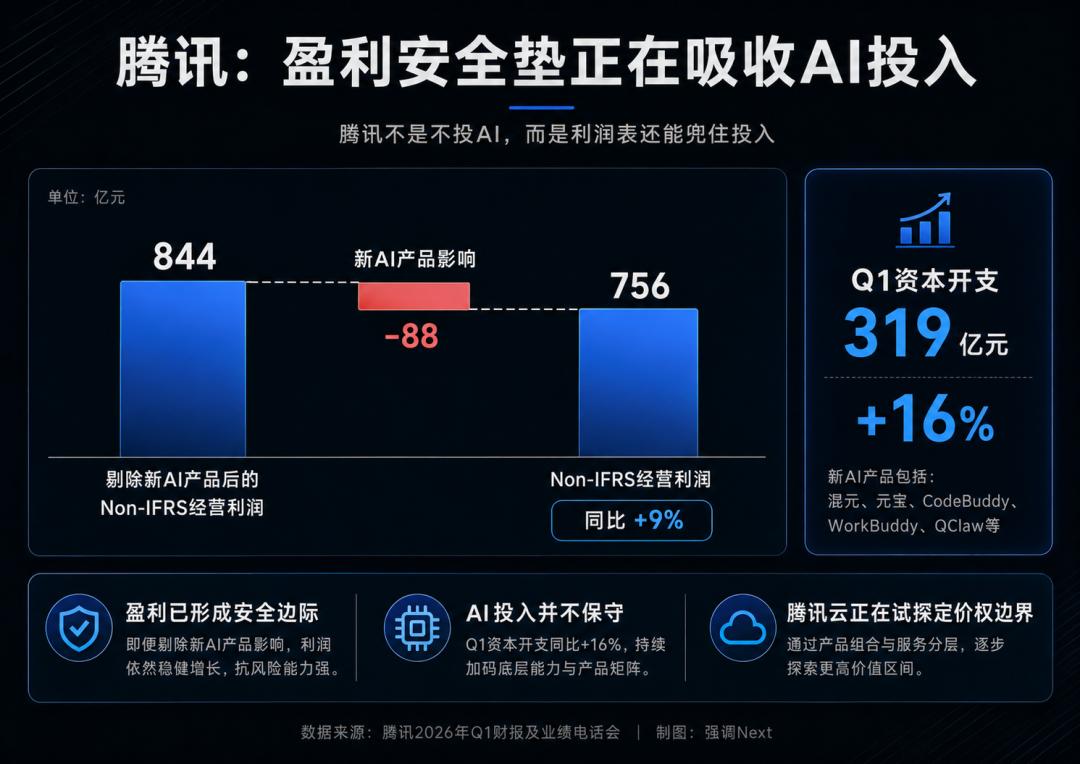
Tencent's AI investment scale can be quantified from a side in the financial report.
This quarter, Tencent's non - IFRS operating profit increased by 17% year - on - year, and the difference of about 8.8 billion between this and the announced 9% is Tencent's actual net investment in new AI products such as Hunyuan and Yuanbao this quarter. WorkBuddy is already the most widely used enterprise AI agent in China, and Hunyuan 3 has topped the international developer platform's call volume for three consecutive weeks. Tencent's investment in AI is not conservative, but its information disclosure is more restrained.
The core risk of Tencent's path does not lie in the present but in the upper limit of its enterprise services. The 20% growth rate is stable, but whether it can achieve the same level of scenario depth as Alibaba's full - stack in mid - and small - sized enterprise customers lacks sufficient data support. Maintaining profitability is a moat, but the width of the moat remains to be tested.
4 · ByteDance and Huawei: Two Variables Without Visible Financial Reports
ByteDance is not listed, but there are several figures to estimate the scale of Volcengine: in the first half of 2025, the revenue from GPU cloud was about 3.5 billion, with a growth rate of over 200%; according to IDC, the proportion of MaaS Token calls was 46.4%; ByteDance's estimated capital expenditure in 2026 is about 200 billion yuan, higher than the annual CapEx of any listed cloud provider.
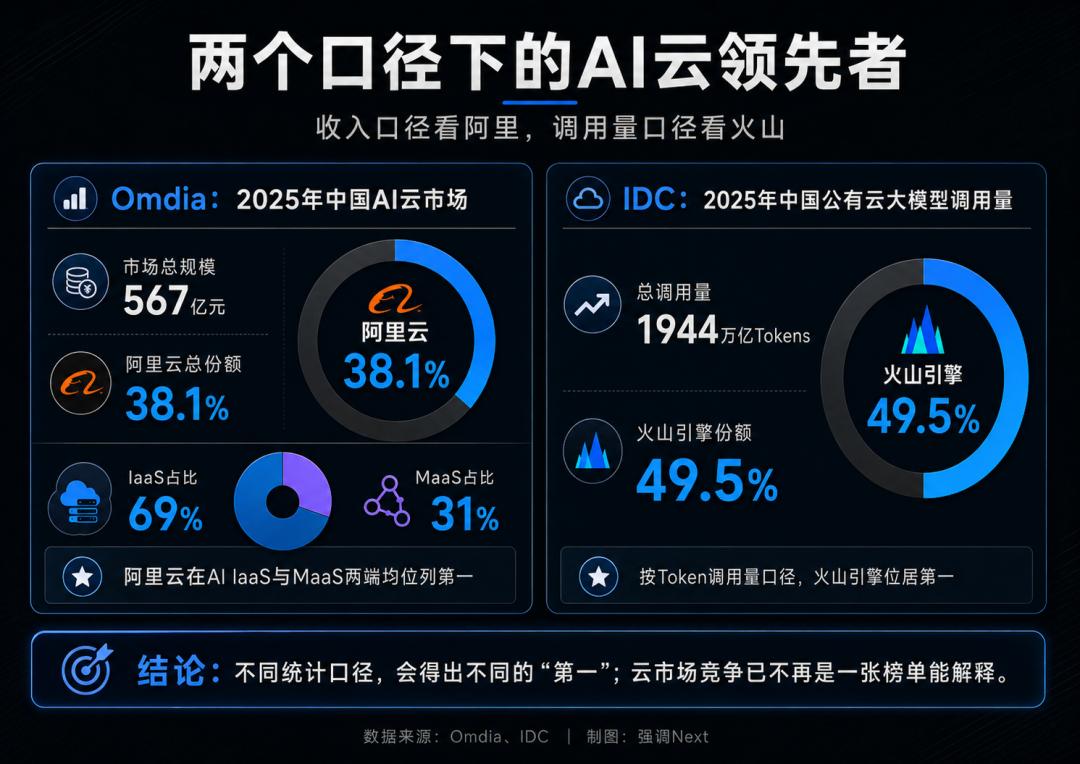
In this wave of price increases, Volcengine chose not to follow, and this is its trump card: it doesn't need to explain profits to shareholders.
The cloud businesses of Alibaba, Baidu, and Tencent must justify their pricing logic in their own income statements. ByteDance's advertising business can continuously inject funds into Volcengine, allowing it to fight a non - profitable war in the cloud market. This is not just a competitive strategy but a difference in financial structure that cannot be compensated by operations in the short term. The flow of price - sensitive customers after the price increases of leading providers is logically quite clear.
Huawei Cloud is on a different track. In 2025, its annual cloud revenue was about 38.5 billion, with a growth rate of 8.5%, the lowest in the horizontal comparison. However, this figure is distorted in the horizontal comparison because Huawei's core customer group (central enterprises, state - owned enterprises, governments, and operators) is not buying elastic computing power but data sovereignty, self - controllability, and on - site delivery capabilities. This is a track that others cannot enter, and there is no doubt about its moat.
The real risk for Huawei Cloud is not competition but the accelerating trend of government and enterprise customers building their own computing power centers. When large central enterprises directly purchase computing power and build their own private clusters, it is, in a sense, an affirmation of Huawei's delivery capabilities, but it will be reflected in Huawei's books as stagnant cloud service revenue. If this trend spreads, the problem of "the lowest growth rate" for Huawei Cloud may not be a problem of competitiveness but a change in the form of the market it is in.
5 · Conclusion
This quarter, the financial report growth rates of cloud providers are impressive, and the incremental growth brought by AI is obvious. However, the incremental growth is being distributed according to a new logic.
With the rising cost of the computing power layer and the accelerating commodification of the model layer, under the pressure from both ends, only those who can establish deep enough scenario binding at the application layer can obtain profit margins that do not rely on scale accumulation.
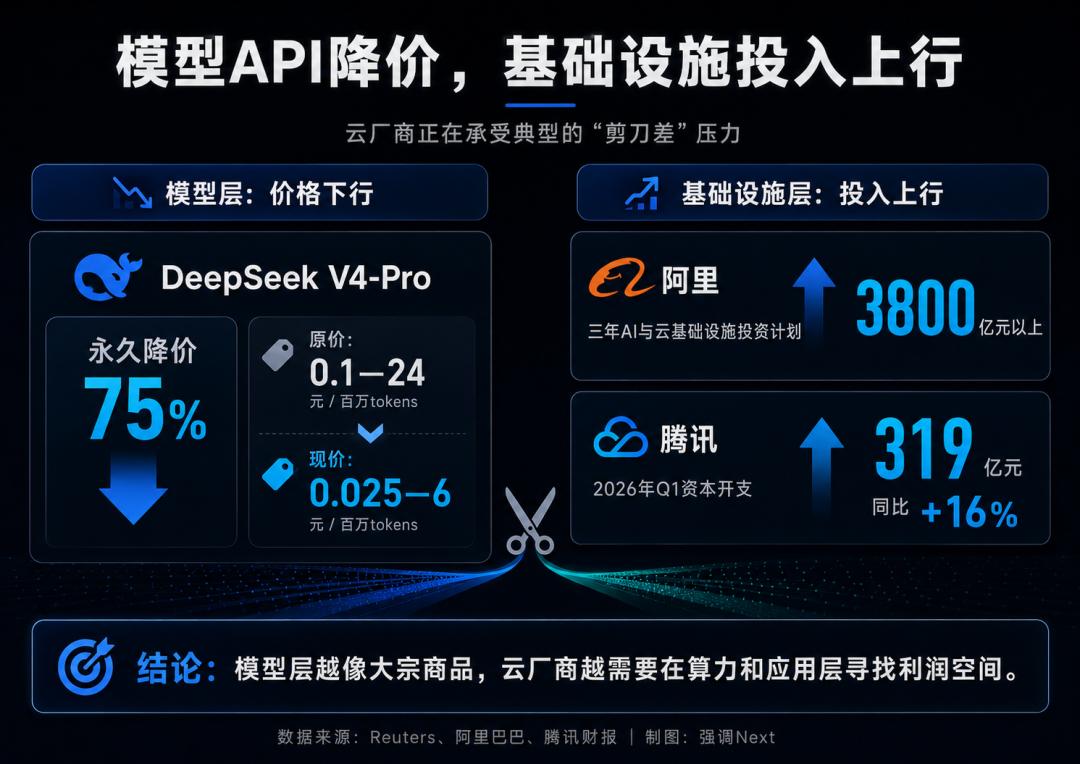
Alibaba is betting on this position with full - stack investment, but the depth of lock - in has not been verified. Baidu's first - mover advantage in computing power is being realized, but the transition at the application layer has not started. Tencent has maintained profitability and is systematically exploring the boundaries of pricing power. ByteDance is waging a price war with an unequal financial structure, and its progress is in a black box. Huawei is on a different track, with its own upper limit and non - erodible stock.
None of these five companies can say for sure today that they have completed the transition from "selling computing power" to "selling irreplaceability".
· Data and some information sources:
The Q1 2026 financial reports and earnings conference calls of each company. Some Alibaba data are for FY2026 Q4 (as of March 31, 2026). Data related to Volcengine are from industry media reports and institutional estimates. Market share data are cited from Omdia (comprehensive revenue caliber) and IDC (MaaS Token call volume caliber) respectively.
This article is from the WeChat official account "Emphasize Next" (ID: leo89203898), author: Yixiu, editor: Xiaobai, published by 36Kr with authorization.