Insta360: Revenue Up, Profit Down. Why Is "Doing Everything" the Biggest Strategic Pitfall?
Insta360 (688775) presented a "contradictory" performance report in 2025.
Its annual revenue reached 9.741 billion yuan, a year - on - year increase of 74.76%, almost doubling. The R & D investment was 1.53 billion yuan, nearly doubling year - on - year, and the scale exceeded the sum of the previous three years. However, the net profit attributable to the parent company dropped to 929 million yuan, a year - on - year decline of 6.62%. In the first quarter of 2026, this contradiction further intensified: the revenue was 2.481 billion yuan, a year - on - year increase of 83.11%, but the net profit attributable to the parent company was only 84.62 million yuan, a year - on - year plunge of 52.02%; the non - recurring profit after deduction decreased by 61.27%.
The revenue growth rate far outpaced the profit growth rate, and the trend of "selling more but earning less" has been established.
This performance report points to a core question: when a company's revenue is growing at a doubling rate while its profit is shrinking rapidly, how much "value" is left in the growth? The answer lies in Insta360's continuous category expansion strategy in recent years.
Starting from panoramic cameras, but the ceiling is within reach
Insta360's story starts with a classic niche market.
It follows the script of a market definer. Founded in 2015, it rose with panoramic cameras and once became a synonym for this category.
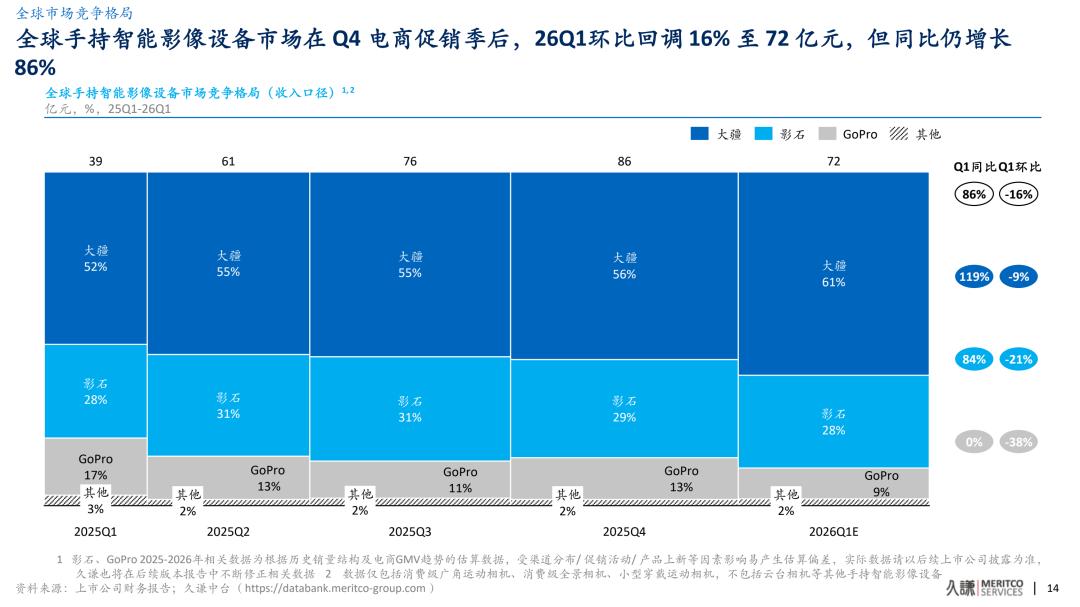
However, the scale of the panoramic camera market itself sets a natural limit to growth. Data shows that the global market for handheld intelligent imaging devices was about 36.5 billion yuan in 2023. Compared with trillion - level tracks such as smartphones, the expansion space is limited. More importantly, according to a research report on the industry released by Jiuqian in May 2026, in the overall market of handheld intelligent imaging devices, the leading brands have occupied 61% of the market share, and Insta360 ranks second. The continuous increase in industry concentration means that the space for latecomers is narrowing.
The desire for a larger market has driven Insta360 onto the path of continuous category expansion for many years. Since the launch of sports cameras in 2019, Insta360's product line has been expanding year by year: thumb cameras (officially launched in 2023), gimbal cameras, wireless lapel microphones, and the ongoing R & D of drones and AI hardware cooperation. The vision of "photography robots" put forward by founder Liu Jingkang in the shareholder letter has pushed this expansion logic to a higher - level narrative.
Here is a key strategic proposition: category expansion itself is not a problem. The problem lies in whether the direction, rhythm, and resource allocation of the expansion match its own capabilities and endowments.
The first cost of multi - front operations: the income statement speaks
The most direct signal comes from the structural dispersion of R & D investment.
In 2025, Insta360's R & D investment was 1.53 billion yuan, a year - on - year increase of 96.95%. In the first quarter of 2026, it invested another 465 million yuan, a year - on - year increase of 101%. Looking at the total amount alone, this is a company willing to spend money on technology. However, if these investments are spread across at least seven or eight directions such as panoramic cameras, sports cameras, thumb cameras, gimbal cameras, drones, lapel microphones, AI chips, and photography robots, the actual R & D intensity of each category needs to be re - examined.
Make a simple estimate: the total R & D budget of 1.53 billion yuan is dispersed across seven or eight product lines, and the average investment per line is less than 200 million yuan. For reference, GoPro's R & D expenses in 2025 were about 85 million US dollars (about 600 million yuan), all concentrated in the sports camera category. In terms of single - track R & D density, Insta360's investment in each line is far less than that of focused competitors. More notably, a significant proportion of Insta360's R & D investment has flowed into frontier directions such as AI chips and embodied intelligence, which are still in the investment stage and have no clear commercialization path. These "future investments" continuously consume current - period profits, and the annual report does not give a timeline for when they will be converted into revenue.
There is a concept of "critical mass" in R & D investment: in a technical direction, if the investment is below a certain threshold, it is difficult to form breakthrough outputs; only when it is above the threshold can a qualitative change occur. The total R & D budget of 1.53 billion yuan is divided among seven or eight lines, with an average of less than 200 million yuan per line. In fields such as imaging chips and AI algorithms that require continuous high - intensity investment, whether this level of dispersed investment can support the technical reserves for long - term competition with single - track deep - ploughing companies is a problem that investors need to face up to. From the perspective of the patent structure, Insta360's 2025 annual report shows a total of 1,120 patents, of which only 261 are invention patents, and the total number of utility models and design patents is 859, accounting for about 76.7%. The technical barriers of utility model and design patents are much lower than those of invention patents. The gap between "a large number of patents" and "strong core technology" is precisely indirect evidence of the dilution of R & D resources under multi - front operations.
The deterioration of the income statement is more intuitive. In 2025, Insta360's overall gross profit margin dropped to 45.7%, a year - on - year decrease of 6.5 percentage points. Among them, the gross profit margin of consumer - grade intelligent imaging devices was only 45%, a year - on - year decrease of 7 percentage points. The annual report attributes the decline in the gross profit margin to the price increase of storage components and intensified market competition. Correspondingly, in the face of price competition, Insta360 lowered the price of its main product, the X5, by several hundred yuan. Increasing revenue by sacrificing price has further eroded the profit margin.
Increasing revenue by sacrificing price itself is not a problem - many technology companies have taken this path during the expansion period. The problem is that Insta360 has a too long front in its product line, and the loss of pricing power is not a problem of a single category but a systematic one. Panoramic cameras need to reduce prices to maintain market share, sports cameras need low prices to open up the market, and thumb cameras need cost - effectiveness to compete with mobile phone imaging. The trend of "selling more but having thinner profits" occurs not only in a single product but also in three main product lines simultaneously. This means that Insta360 hardly has a product line with the ability to "raise prices against the trend", which is a signal worthy of attention among consumer goods companies.
The scissors gap of more than 80 percentage points between the revenue growth rate (75%) and the profit growth rate (- 6.6%) reveals a simple logic: when growth more depends on price cuts and category expansion rather than product premium and efficiency improvement, the profit quality declines while the scale expands.
The second cost: the identity transformation from "pioneer" to "latecomer"
Category expansion has made Insta360 play completely different competitive roles under the same brand.
In the panoramic camera track, Insta360 is a pioneer. However, in new tracks such as sports cameras and thumb cameras, Insta360's role has changed to that of a latecomer. The core dilemma of latecomers is that they need higher R & D and marketing costs to pry open market share in the existing pattern, but the returns may not be proportional.
How "expensive" is this dilemma? In 2025, Insta360's sales expenses reached 1.679 billion yuan, a year - on - year increase of 103.31%. The sales expense ratio increased from about 14.8% in 2024 to 17.23%. These 1.679 billion yuan in sales expenses were not spent on the panoramic camera, a "conservative" category - the panoramic camera is already a synonym for the category and does not require large - scale market education. Instead, they were spent on convincing consumers that "sports cameras don't have to be GoPro" and "thumb cameras are more suitable for Vlogs than mobile phones". The customer acquisition cost of latecomers is naturally higher. New categories have no user mind - set accumulation, and every market share is "bought" with marketing investment. When the growth rate of sales expenses (103.31%) far exceeds the growth rate of gross profit, the marginal revenue of selling one more product may be negative. This is not growth but burning money to expand the scale.
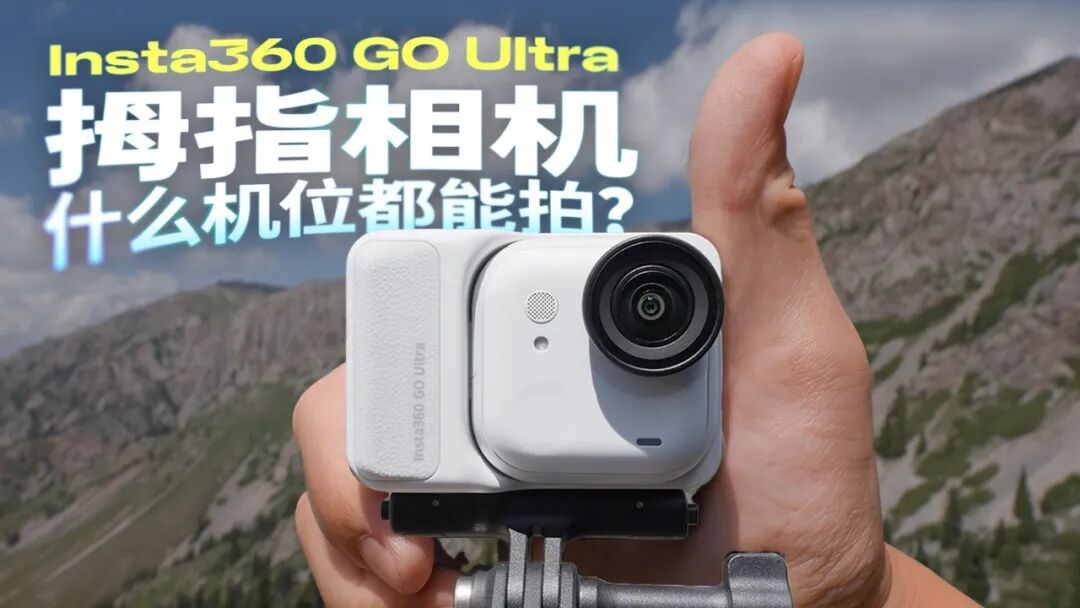
There is not a competitive relationship but a coverage relationship between thumb cameras and smartphone cameras. In the past five years, the imaging systems of flagship mobile phones have achieved a qualitative leap: multi - camera systems, computational photography, and AI algorithms have pushed the image quality and convenience of daily shooting to a very high level. When mobile phones can already shoot portrait modes with a cinematic feel and 4K HDR videos, why do consumers need to spend an extra few hundred or thousands of yuan on a thumb camera with more single - function and not necessarily better image quality?
In contrast, sports cameras have a use value that is difficult to replace by mobile phones due to their rigid requirements such as extreme waterproofing, anti - shake, and drop resistance. The positioning of thumb cameras as "portable recording" exactly coincides with the core usage scenarios of mobile phone photography. The GO Ultra launched by Insta360 in 2025 is equipped with a 5nm AI chip and supports 4K lossless zoom, trying to build differentiation in image quality and AI functions. However, AI imaging is precisely the area where mobile phone manufacturers invest the most intensively. The iteration speed of AI photography algorithms of Apple, Huawei, and Samsung is not comparable to that of a camera company.
When the core selling point of a category is "a little more portable than a mobile phone", its moat is surely not very deep. If category expansion points to a battlefield that is being covered by mainstream technological trends, no matter how good the product design is, it is difficult to change the fate of being replaced.
The third cost: the continuous dilution of brand recognition
Another hidden cost brought about by category expansion is the blurring of brand recognition. This cost will not be directly reflected in the financial statements in the short term, but its long - term impact may be the most profound. The essence of a brand is to "reduce consumers' choice costs". You don't need to compare parameters because you know that buying GoPro means buying a sports camera and buying Sony means buying a mirrorless camera. When Insta360 expands its product line to seven or eight directions, each new product launch dilutes the answer to the question of "what does Insta360 equal". This is not brand extension. The premise of brand extension is that the core category is already stable. Insta360 has not established an equally unshakable cognitive barrier in a second category outside of panoramic cameras. At this time, each additional product line is not "expanding the brand boundary" but "scattering brand assets".
What does Insta360 represent in consumers' minds? For early users, it is a synonym for "panoramic cameras". However, now it is also a brand of sports cameras, thumb cameras, gimbal cameras, and will soon become a brand of drones and microphones. There is a classic warning in positioning theory: when a brand tries to do everything, it may represent nothing.

In contrast, although GoPro's revenue has shrunk to about 652 million US dollars in recent years and its camera shipments have dropped to about 2 million units, the mental anchor of "sports camera = GoPro" is still clear. The consequence of this strong association with a single category is that even during the period of scale shrinkage, GoPro's gross profit margin in 2025 still remained above 33%. Although it is lower than Insta360's consumer - grade product gross profit margin (45%), considering that GoPro's revenue scale is only a small part of Insta360's consumer - grade business, the brand premium of its unit products has not collapsed due to the scale shrinkage. And what about Insta360? "A fun panoramic camera"? "A small thing that can be attached to the body to shoot Vlogs"? "A cost - effective alternative"? The dispersion of user recognition directly leads to the brand no longer having pricing power. When consumers can't clearly say what your brand represents, their purchase decisions will degenerate into pure parameter comparison and price comparison. And in the matter of parameter involution, there is never a shortage of latercomers who are cheaper than you.
A greater risk: all - around attacks trigger all - around competition
Another consequence of category expansion is that the more fields Insta360 reaches into, the more diverse and powerful the competitors it faces.
This is not a simple problem of "intensified competition". The key is that the tracks Insta360 enters are exactly the strategic high - ground areas regarded by mobile phone manufacturers. Gimbal cameras, AI imaging, and portable shooting - these categories are highly homologous to mobile phone imaging technology. Mobile phone manufacturers do not need to start from scratch when deploying these categories. The imaging algorithms can be directly transferred from the mobile phone product line, the supply chain can use the bargaining power of the mobile phone system, and the channels can reuse tens of thousands of offline stores and self - owned e - commerce platforms. Insta360 is not just facing "a few more competitors", but a group of competitors with structural advantages in technology reserves, supply chain efficiency, and channel coverage. Moreover, the marginal cost of these competitors entering new tracks is much lower than that of Insta360.
The entry path of mobile phone manufacturers is worthy of vigilance. According to industry media reports, OPPO, vivo, and Honor have successively launched gimbal camera products and entered the tracks laid out by Insta360. However, what really needs to be paid attention to is not these products themselves - the current volume of mobile phone manufacturers' gimbal cameras is still small - but the underlying logic: mobile phone brands are upgrading their imaging capabilities from "mobile phone auxiliary functions" to "independent hardware categories". Huawei and Xiaomi have long deployed sports cameras and smart cameras, and Apple's Vision Pro and spatial video strategy are also redefining the boundaries of "shooting". When mobile phone manufacturers operate imaging hardware as an independent category, the ecological barriers formed by their hundreds of millions of user bases - account systems, cloud storage, and device interconnection - are difficult for single - category companies to compete with. Insta360 not only has to compare products with mobile phone manufacturers but also compare the stickiness of their ecosystems.
The greater risk is that competitors are not only competing in Insta360's new battlefields but also putting pressure on its core base. According to a research report on the industry released by Jiuqian in May 2026, in the overall market of handheld intelligent imaging devices, the leading brands have occupied 61% of the market share, and Insta360 ranks second. Panoramic cameras - the category where Insta360 started and the ace with a 67.2% global market share - are facing unprecedented competition intensity. History provides a clear reference: GoPro's global market share of sports cameras once exceeded 80% in 2014, but when competitors entered the market with the same performance and lower prices, GoPro's market share dropped rapidly within five years. Although Insta360's 67.2% share of panoramic cameras seems stable, if "defending the"