The fifth trillion-yuan city in central China is coming.
As of 2025, the list of Chinese cities with a GDP of over one trillion yuan has been fixed at 29. Looking back at the past five years, the expansion speed of trillion - yuan cities has significantly slowed down, and there have been no new additions in the central and western regions.
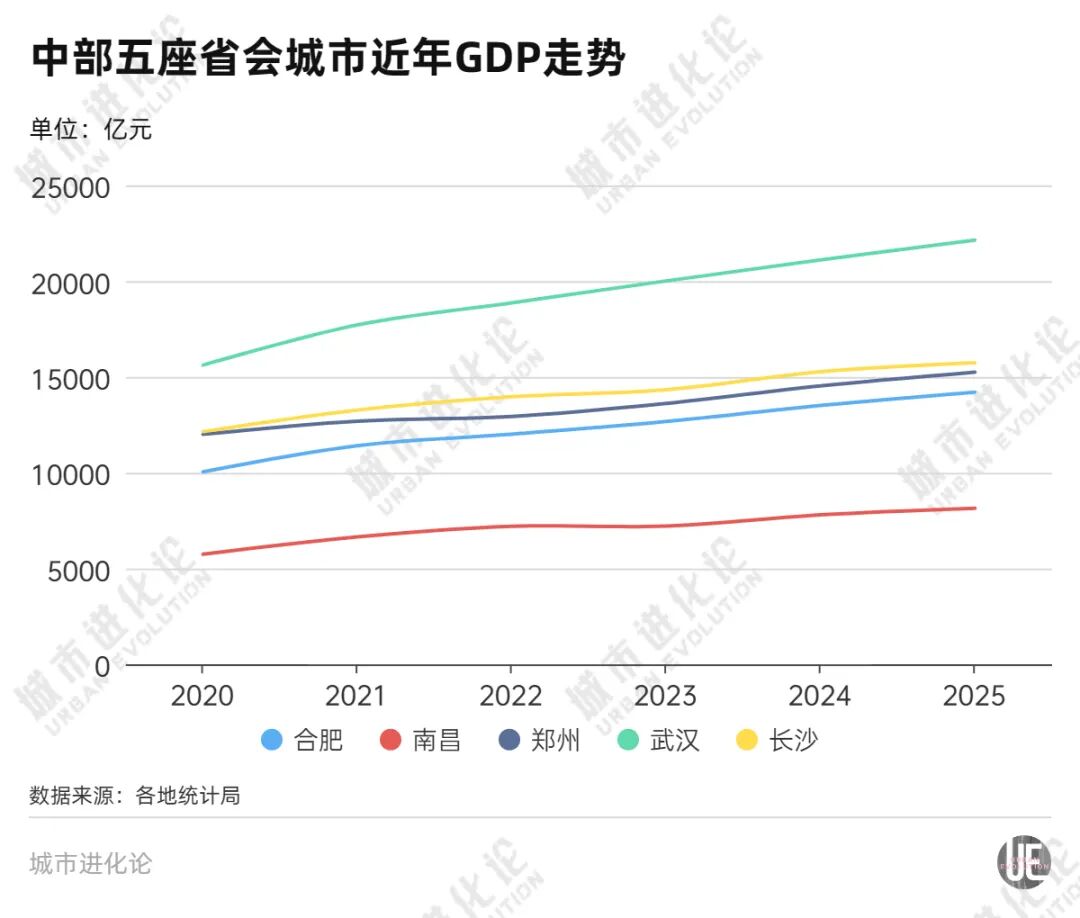
Focusing on the central region, since Hefei joined the trillion - yuan club in 2020, four provincial capitals - Wuhan, Changsha, Zhengzhou, and Hefei - have formed a "four - pillar" pattern. After that, there has been an obvious gap, and no new cities have been promoted. Under the goal of "accelerating development" in the urban agglomeration in the middle reaches of the Yangtze River, more "mid - tier cities" are urgently needed to fill the gap.
As the city in the central region closest to the one - trillion - yuan threshold, Nanchang has recently frequently set the goal of reaching one trillion yuan in GDP.
On May 27th, the theoretical learning center group of the Nanchang Municipal Party Committee and the Ganjiang New Area Party Working Committee held a centralized learning seminar. At the meeting, it was emphasized again that the period of the 15th Five - Year Plan is a crucial period for Nanchang to comprehensively enhance its urban core competitiveness and influence. It is necessary to continuously improve Nanchang's comprehensive strength and development level and accelerate the construction of a high - energy - level city with a GDP of one trillion yuan.
Nanchang is not the only city aiming for the one - trillion - yuan goal. Recently, two major sub - central cities in Hubei - Xiangyang and Yichang - have successively released their 15th Five - Year Plan outlines, both proposing to accelerate the development towards a city scale of one trillion yuan during the 15th Five - Year Plan period.
Which city will be the first to cross the one - trillion - yuan threshold and become the fifth trillion - yuan city in the central region?
01
Breaking through the One - Trillion - Yuan Barrier
During the 14th Five - Year Plan period, Nanchang's GDP crossed three 100 - billion - yuan steps, reaching 814.169 billion yuan in 2025. Looking forward to the 15th Five - Year Plan, Nanchang has put forward the goal of "building a high - energy - level city with a GDP of one trillion yuan".
Comparing horizontally with the provincial capitals in the central region with a GDP of over one trillion yuan, Nanchang's economic development during the 14th Five - Year Plan was not slow. The cumulative growth of its GDP scale was 41.7%, which is comparable to that of Wuhan and Hefei and much higher than that of Changsha and Zhengzhou.
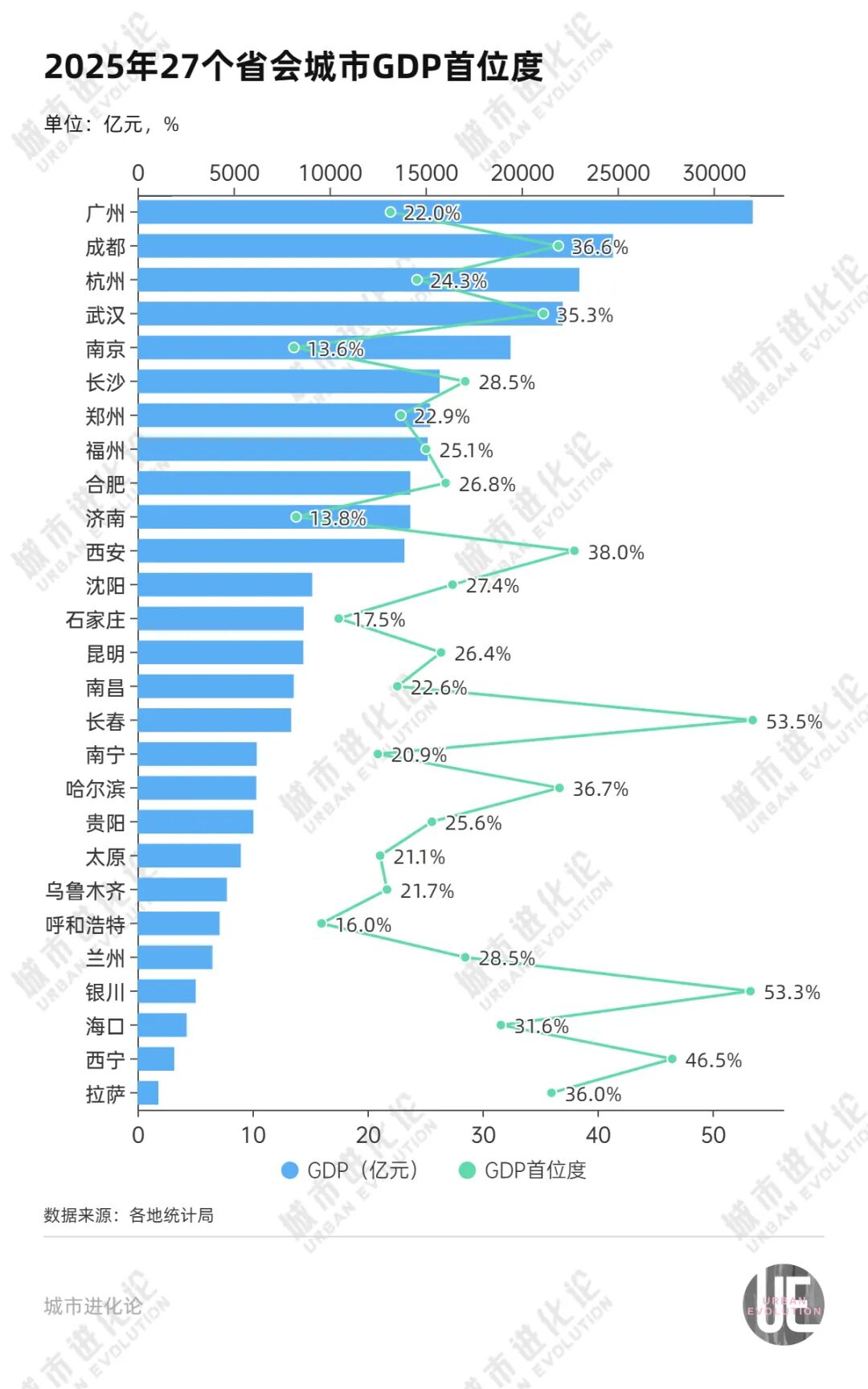
Compared with the growth rate, Nanchang's shortcoming lies in its relatively small economic scale. In 2025, Nanchang's economic primacy was 22.60%, ranking relatively low among the 27 provincial capitals in the country and only higher than that of Taiyuan among the provincial capitals in the central region. In recent years, reversing the situation of a "weak provincial capital" has always been the focus of efforts for Nanchang and even Jiangxi.
Qin Zunwen, the vice - president of the China Association of Urban Economics and the secretary - general of the Yangtze River Economic Belt Think - Tank Alliance, told Urban Evolution that against the background of the accelerated development of the urban agglomeration in the middle reaches of the Yangtze River, Nanchang needs to quickly promote its GDP to exceed one trillion yuan, so as to become an important supporting force for the construction of the urban agglomeration in the middle reaches of the Yangtze River together with Wuhan and Changsha.
Economic development cannot be separated from industrial support. A high proportion of industry is a major feature of Nanchang's economic structure.
Last year, the added value of Nanchang's manufacturing industry accounted for the highest proportion among the provincial capitals in the central region, and its growth rate ranked among the top in provincial capitals across the country. Looking back over the past decade, the proportion of the added value of Nanchang's secondary industry in GDP has always remained above 40%, more than 4 percentage points higher than that of provincial capitals in the central region with a GDP of over one trillion yuan, such as Wuhan, Changsha, Zhengzhou, and Hefei.
Qin Zunwen believes that the high proportion of manufacturing is Nanchang's differentiated economic structural advantage. At present, Nanchang should adhere to the strategy of building the city on manufacturing, give full play to its characteristic endowments such as the primary electronic information industry, the only aviation manufacturing base in the central region, and the world's VR capital, to support its GDP to exceed one trillion yuan as soon as possible. Judging from Nanchang's growth rate in recent years, it is expected to "cross the finish line" ahead of schedule during the 15th Five - Year Plan period.
The economic data for the first quarter of 2026 confirm the stable growth trend supported by Nanchang's industry: the added value of the secondary industry increased by 5.6%, further improving compared with the whole of last year and nearly one percentage point higher than the growth rate of the tertiary industry. Driven by industry, Nanchang's GDP increased by 5% year - on - year in the first quarter, 0.3 percentage points higher than the whole of last year, matching the provincial economic growth rate.
However, Qin Zunwen reminded that in the long run, compared with other provincial capitals with a GDP of over one trillion yuan, Nanchang also needs to improve its "soft power" and gradually reduce the proportion of manufacturing in the economic structure. In the long - term stage of the next five to ten years, it should stably develop advanced manufacturing while making up for the shortcoming of modern service industries.
In fact, relevant layouts have been made in Nanchang's medium - and long - term planning.
The 15th Five - Year Plan outline of Nanchang clearly states that it is necessary to continue to make efforts in accelerating the construction of a modern industrial system and adhere to focusing on the real economy in economic development.
Zhao Jie, a member of the Standing Committee of the Nanchang Municipal Party Committee and the executive vice - mayor, previously publicly stated that in the next five years, Nanchang will strive to maintain a reasonable proportion of manufacturing and build a modern industrial system with advanced manufacturing as the backbone. Taking Nanchang's primary electronic information industry as an example, it will consolidate and enhance its position as an important national manufacturing center for intelligent terminal equipment, LED, and new displays, and build a "world display capital".
At the same time, more attention should be paid to promoting the extension of producer services towards specialization and the high - end of the value chain, promoting the high - quality, diversified, and convenient development of consumer services, and continuously improving the level of integrated development of modern service industries and advanced manufacturing.
02
New Growth Pole
In fact, during the entire 14th Five - Year Plan period, no new provincial capitals joined the trillion - yuan club. From Dongguan, Yantai, and Changzhou to Tangshan, Wenzhou, and Dalian, all the newly promoted trillion - yuan cities are non - provincial capitals, becoming the main force for the expansion of the trillion - yuan camp.
Consequently, the number of trillion - yuan cities has become a new dimension for measuring the comprehensive economic strength of a province. For example, Jiangsu, which has five trillion - yuan cities, is regarded as the "ceiling" of balanced development among provinces in China.
Focusing on the central region, Hubei is expected to achieve a new breakthrough in the number of trillion - yuan cities outside the provincial capital. Recently, Yichang and Xiangyang in Hubei have both clearly stated in their local 15th Five - Year Plan outlines that they aim to reach an economic scale of one trillion yuan.
In the view of local media, if the two cities succeed in their sprint, the "one main and two sub - centers" pattern of Hubei's economic development will become more balanced, and Hubei will also become the province with the most trillion - yuan cities in the central region, forming a leading advantage.