Die fünfte Stadt mit einem Bruttoinlandsprodukt von einer Billion Yuan im zentralen China ist bald da.
By 2025, the list of Chinese cities with a GDP of over one trillion yuan has been set at 29 cities. Looking at the past five years, the expansion of cities with a trillion - GDP has significantly slowed down, and there were even no new additions in central and western China.
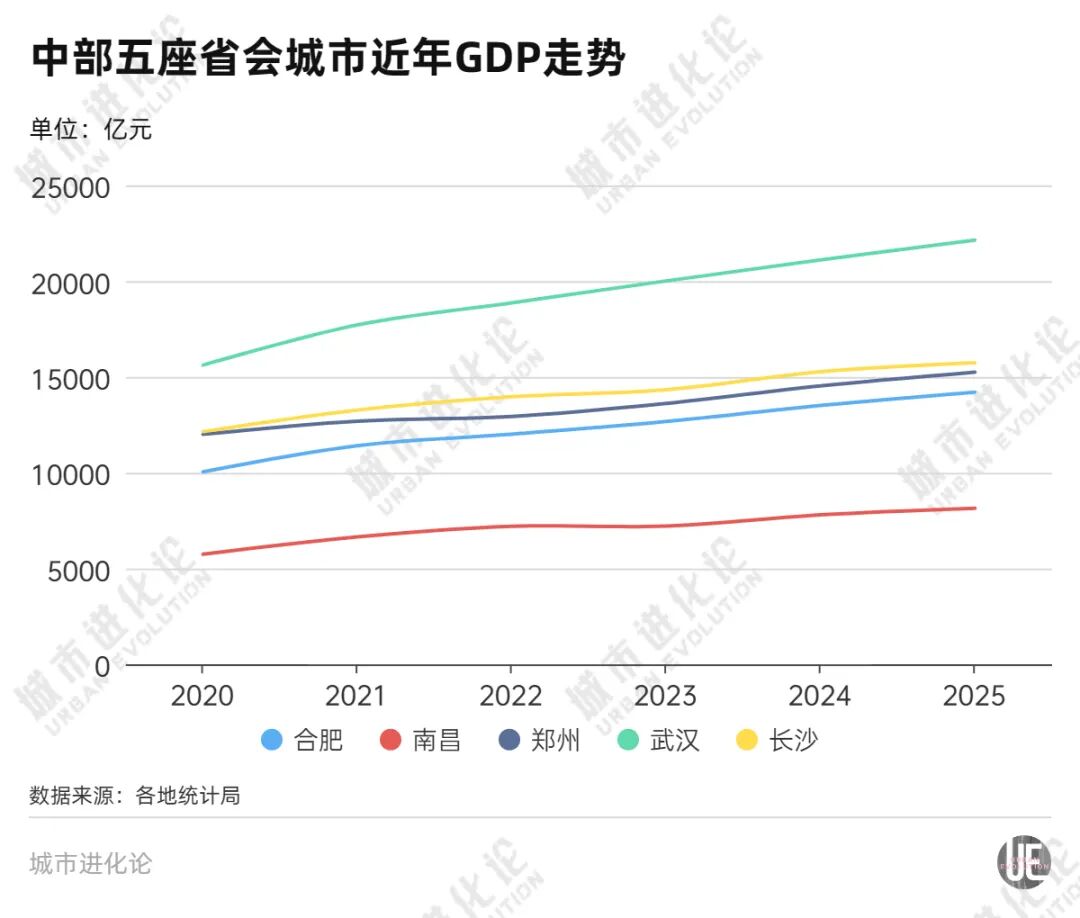
If we focus on the central region, after Hefei entered the trillion - club in 2020, a balance was formed among the four provincial capitals Wuhan, Changsha, Zhengzhou, and Hefei. However, since then, there has been a clear gap, and there have been no new cities rising into the trillion - club. Under the goal of the "Accelerated Development" of the urban agglomeration in the middle reaches of the Yangtze River, there is an urgent need for more "medium - sized cities" to fill the gap.
As the city in the central region closest to the trillion - threshold, Nanchang has repeatedly announced the goal of a trillion - GDP recently.
On May 27th, a joint learning and discussion session of the theoretical learning center group of the Nanchang Municipal Party Committee and the Party Working Committee of the Ganjiang New Area was held. At the meeting, it was emphasized again that the period of the "15th Five - Year Plan" is a critical phase for Nanchang to improve the city's overall core competitiveness and influence. The overall strength and development potential of Nanchang should be continuously improved to make the city a high - performance city with a trillion - GDP.
Nanchang is not the only city aiming for a trillion - GDP. Recently, the two most important secondary cities in Hubei - Xiangyang and Yichang - have successively released their "15th Five - Year Plan" plans and both stated that they want to work towards the scale of a trillion - GDP within the "15th Five - Year Plan".
Which city will be the fifth city in the central region to cross the trillion - threshold and become a city with a trillion - GDP?
01
Breaking out of the Trillion Corner
During the "14th Five - Year Plan", Nanchang increased its GDP by 30 billion yuan and reached 814.169 billion yuan in 2025. Looking at the "15th Five - Year Plan", Nanchang has set the goal of "creating a high - performance city with a trillion - GDP".
Compared with other provincial capitals in the central region with a trillion - GDP, Nanchang was not slow in economic development during the "14th Five - Year Plan". The cumulative increase in GDP was 41.7%, which is comparable to Wuhan and Hefei and much higher than in Changsha and Zhengzhou.
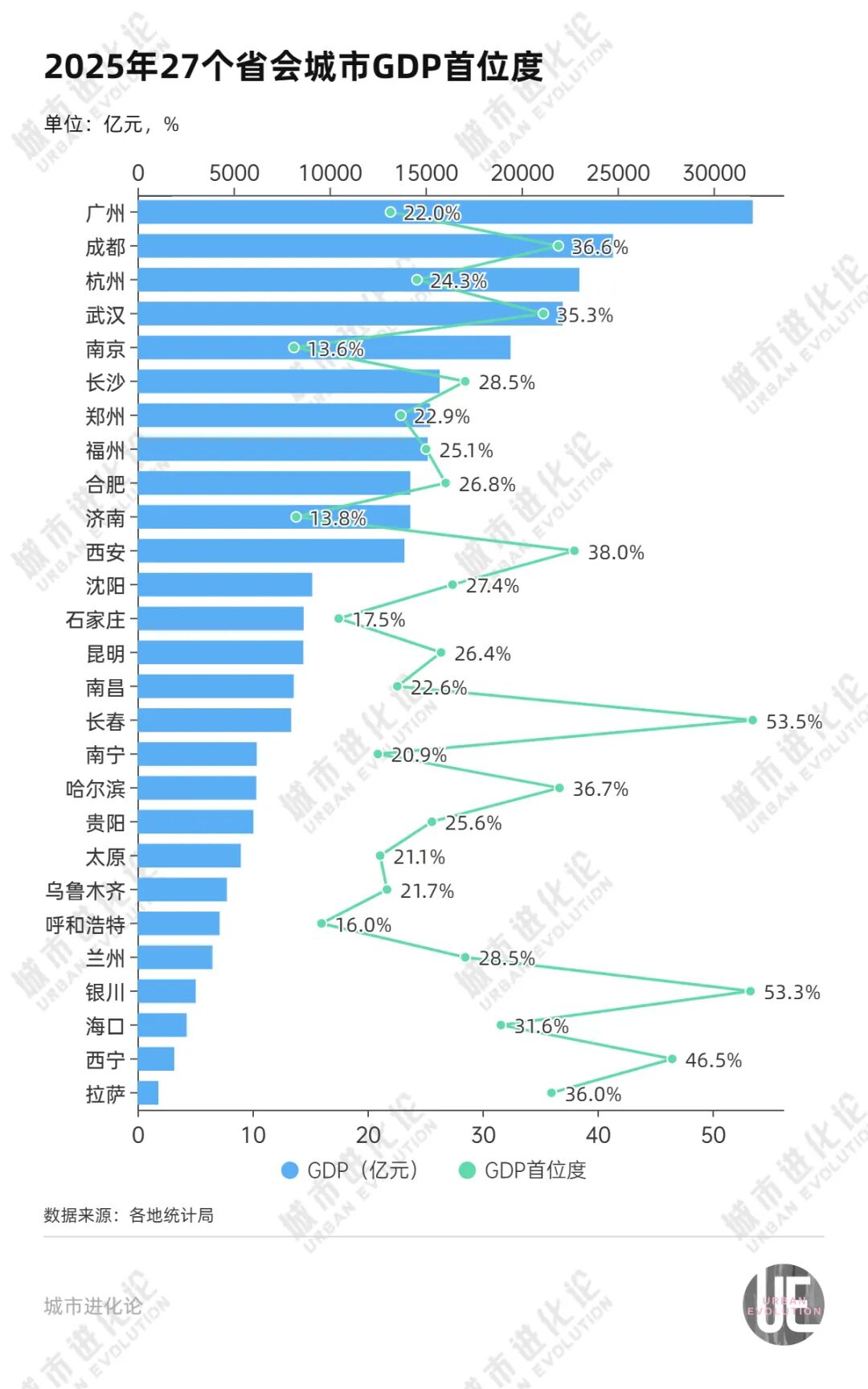
Compared with the growth rate, Nanchang's weakness lies in its relatively small economic scale. In 2025, the proportion of Nanchang's GDP in the total provincial GDP was 22.60%, which is relatively low compared with the 27 provincial capitals across the country and is only higher than that in Taiyuan in the central region. In recent years, it has always been the goal of Nanchang and Jiangxi to improve the situation of the "weak provincial capital".
Qin Zunwen, the vice - president of the Chinese Society for Urban Economics and the general secretary of the think - tank alliance for the Yangtze River Economic Belt, said in an interview with "City Evolution Theory" that in the context of the accelerated development of the urban agglomeration in the middle reaches of the Yangtze River, Nanchang must increase its GDP to over one trillion yuan as soon as possible to become an important support for the development of the urban agglomeration in the middle reaches of the Yangtze River together with Wuhan and Changsha.
Economic development depends on industrial support. A high proportion of industry is a characteristic of Nanchang's economic structure.
Last year, the proportion of the added value of the manufacturing industry in Nanchang's GDP ranked first among the provincial capitals in the central region, and the growth rate was at the top among provincial capitals across the country. Looking at the past ten years, the proportion of the added value of the secondary industry in Nanchang's GDP has always been over 40%, which is more than four percentage points higher than in Wuhan, Changsha, Zhengzhou, and Hefei, the provincial capitals in the central region with a trillion - GDP.
Qin Zunwen believes that the high proportion of the manufacturing industry is a differential advantage of Nanchang's economic structure. In the current phase, Nanchang should strengthen the manufacturing industry as the foundation of the city's development and use specific advantages such as the electronics and information technology industry, the only aviation manufacturing base in the central region, and the "World Capital of VR" to increase the GDP to over one trillion yuan as soon as possible. If we extrapolate Nanchang's growth rate in recent years, there is a possibility that Nanchang can achieve the goal earlier in the "15th Five - Year Plan".
The economic statistics for the first quarter of 2026 confirm the stable growth trend of Nanchang's industry: the added value of the secondary industry increased by 5.6%, which is a further increase compared with the whole of last year and is nearly one percentage point higher than the growth rate of the tertiary industry. Driven by the industry, Nanchang's GDP in the first quarter increased by 5% compared with the previous year, which is 0.3 percentage points higher than the whole of last year and is in line with the provincial economic growth rate.
However, Qin Zunwen warns that in the long run, compared with other provincial capitals with a trillion - GDP, Nanchang must improve its "soft power" and gradually reduce the proportion of the manufacturing industry in the economic structure. In the next five to ten years, Nanchang should stably develop the advanced manufacturing industry and at the same time fill the gap in the modern service industry.
Actually, there are already corresponding plans in Nanchang's medium - and long - term plans.
The "15th Five - Year Plan" planning program of Nanchang clearly stipulates that it must adhere to accelerating the construction of a modern industrial system and focus the economic development on the real economy.
Zhao Jie, a member of the Political Bureau of the Nanchang Municipal Party Committee and the deputy mayor, has previously publicly stated that in the next five years, Nanchang will strive to maintain an appropriate proportion of the manufacturing industry and establish a modern industrial system with the advanced manufacturing industry as the core. Taking the electronics and information technology industry, Nanchang's most important industry, as an example: Nanchang will consolidate and improve its position as an important manufacturing center for intelligent end - devices, LEDs, and new display technologies at the national level and create the "World Capital of Display Technology".
At the same time, the promotion of the productive service industry should be strengthened in the direction of specialization and a higher value chain, the service industry close to people's lives should be developed in a high - quality, diverse, and convenient way, and the level of the integrated development of the modern service industry and the advanced manufacturing industry should be continuously improved.
02
New Growth Poles
Actually, during the whole "14th Five - Year Plan", there were no new cities with a trillion - GDP among the provincial capitals across the country. From Dongguan, Yantai, Changzhou to Tangshan, Wenzhou, and Dalian, all the new cities with a trillion - GDP are non - provincial capitals and will become the main force for the expansion of the trillion - club.
It follows that the number of cities with a trillion - GDP has already become a new dimension for measuring the overall economic strength of a province. For example, Jiangsu, which has five cities with a trillion - GDP, is regarded as the "top" province in terms of balanced development in the inland.
If we focus on the central region, there is a possibility that Hubei outside the provincial capital will first achieve a new breakthrough in the number of cities with a trillion - GDP. Recently, Yichang and Xiangyang in Hubei have clearly stated in their local "15th Five - Year Plan" planning programs that they want to work towards the scale of a trillion - GDP.
In the view of local media, if the two cities are successful, the "one main center and two sub - centers" model of economic development in Hubei will become more balanced, and Hubei will become the province with the most cities with a trillion - GDP in the central region and gain an advantage.
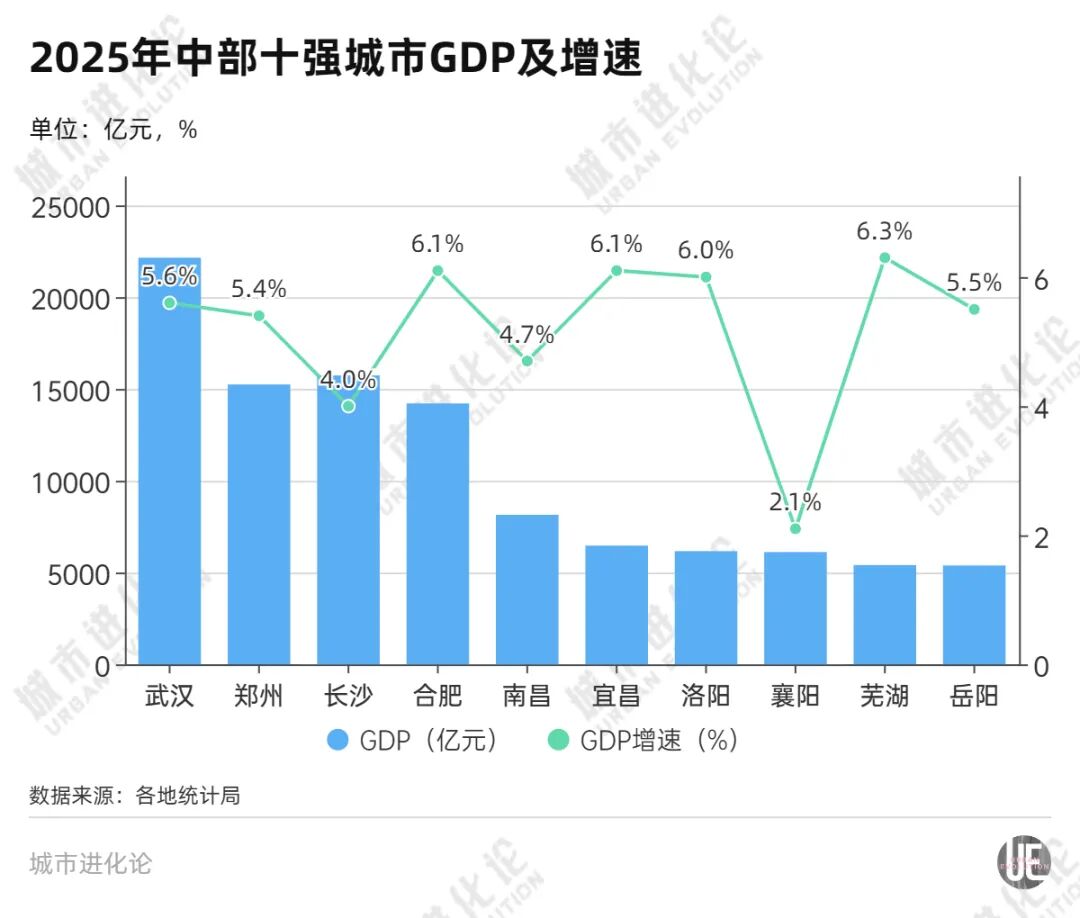
The economic growth rate is the support for the expectation of the increase in city size.
Taking Yichang as an example: In the past five years, Yichang has achieved an average economic growth of 7.2%. In the first quarter of this year, with an economic growth rate of 7.5%, it led the top ten cities in the central region and was 2.5 percentage points above the national average.
The core of the growth lies in the industry, especially in the new energy and new materials industry. In 2025, the gross value of the new energy and new materials industry in Yichang increased by 90.4% compared with the previous year. From January to April this year, on the basis of a high level, it continued to achieve rapid growth of about 50%, which is much higher than the average growth rate of the whole industry in the city.
Qin Zunwen analyzes that after the full completion of the "closure, conversion, relocation, and transformation" of chemical enterprises along the river, Yichang has undergone an adjustment and upgrading of the industrial structure. In the future, the high - tech industry could enter an explosion phase and have a rapid growth rate. But estimating from the current GDP of 600 billion yuan, it will be difficult for Yichang to achieve the goal of one trillion yuan in the next five years, and it has to "jump to pick the fruits".
In comparison, the challenge for Xiangyang to cross the trillion - threshold is even greater.
In 2025, the economy in Xiangyang showed slow growth, especially the secondary industry, whose growth rate was only 0.2%. In the first quarter of this year, the economy in Xiangyang continued to be under pressure and only achieved a growth of 2.2%.
Qin Zunwen said that the slowdown of the economy in Xiangyang is highly affected by the cycle of the automobile industry, the main industry in the city. It must accelerate the transformation of the automobile industry towards electrification and intelligence.
In view of the weaknesses in industrial development, Xiangyang has already determined the direction of transformation. The government work report of Xiangyang in 2026 shows that Xiangyang will change the industrial structure from "one dominant sector" to "multiple support points". Among them, the new energy industry is one of the important support points.
As a prominent project in the new energy industry in Xiangyang, the production base project for new energy and intelligent off - road vehicles of Dongfeng is expected to be able to produce vehicles by the end of May. By using the resources of leading enterprises in the industry, Xiangyang tries to integrate local suppliers into the supply system for new energy and intelligent connected vehicles.
At the same time, in the new energy and new materials industry, the lithium - battery production base of Chueneng New Energy in Xiangyang will be put into operation this year. The annual turnover will exceed 20 billion yuan. After cooperation with local enterprises in the industry, there is a possibility that the new energy industry in Xiangyang will rise to a billion - level cluster.
03
Reserve Candidates
In the economic pattern of the central region, the competition among cities with a GDP of over 500 billion yuan is much more intense than the fixed ranking of the top cities.
The most watched is the multi - year competition among Luoyang, Yichang, and Xiangyang for the position of the "largest non - provincial capital" in the central region.
As early as 2021, Luoyang set the goal of reaching an economic scale of over one trillion yuan by the end of the "14th Five - Year Plan". But according to the actual development results, Luoyang's GDP at the end of 2025 was only 616.4 billion yuan, far from the trillion - threshold, and it was caught up by Yichang and Xiangyang, which had a faster economic growth rate.

In Qin Zunwen's view, Luoyang has a good foundation in industry, technology, culture, and population, but the potential advantages have not been fully utilized.
Actually, Luoyang's determination to reshape the industrial structure has already been shown.
Since last year, with the goal of establishing a modern industrial system, Luoyang has built 12 advantageous industrial chains such as agricultural machinery equipment, storage, and aviation equipment. Thanks to the precise industrial...