The three major telecom operators have found a new story, but tokens are not that easy to sell.
Telecom operators have started doing business with Tokens. However, Tokens are not the same as traffic and are not that easy to sell.
Recently, China's three major telecom operators have successively launched Token packages. China Telecom, China Mobile, and China Unicom have successively introduced Token packages and related AI services, selling large - model call volumes to users such as individuals, families, developers, and small and medium - sized enterprises.
Although the relevant packages are still in the early promotion stage, they have quickly become a new narrative that the capital market pays attention to.
On May 18th, the stock prices of the three major operators all rose. Among them, China Telecom led the increase, once hitting the daily limit and closing up 7.74%.
The three major operators have intensively launched Token - related products. Behind this is that the operators are completing an identity switch, and the Token package is just the tip of the iceberg of this transformation on the user side.
In the past few decades, every change in the operators' business has often been accompanied by a change in the billing unit. The way ordinary people understand communication services in daily life has undergone several quiet unit switches and role superpositions.
First, it was paying by the minute. When users made a phone call, they knew exactly how much it would cost.
Later, it was paying by traffic. When watching videos, browsing web pages, or sending WeChat messages, what was consumed was measured in GB. The operators' business has also long revolved around voice, SMS, and traffic.
Now, a new billing unit has begun to be included in the operators' package lists: Token (also known as "word token").
Every change in the billing unit often corresponds to a change in the role of the infrastructure. In the era of minute - based billing, operators were providers of communication networks; in the era of traffic - based billing, operators were carriers of the mobile Internet entrance.
When Tokens start to be included in the package lists, the role that operators are trying to play is further changing from a "connection service provider" to an "AI computing power entrance". Just as the power grid used to deliver electricity from power plants to thousands of households, operators are trying to turn the computing power in the intelligent computing centers into a public resource that can be purchased monthly and consumed according to the amount, just like water and electricity, through the package and billing system.
However, to understand this round of operators selling Tokens, in addition to looking at the package price itself, we also need to pay attention to the underlying infrastructure logic and whether it can be truly understood and accepted by the market.
The picture is generated by an AI tool.
01. The real challenges begin after the Token packages are launched
The Token packages currently launched by operators do not have the complex pricing of model manufacturers' APIs that distinguish between input, output, and cache hits. They are packaged as a monthly quota as a whole, with simple and clear classifications: how much per month, how many Tokens are included, and which models can be used.
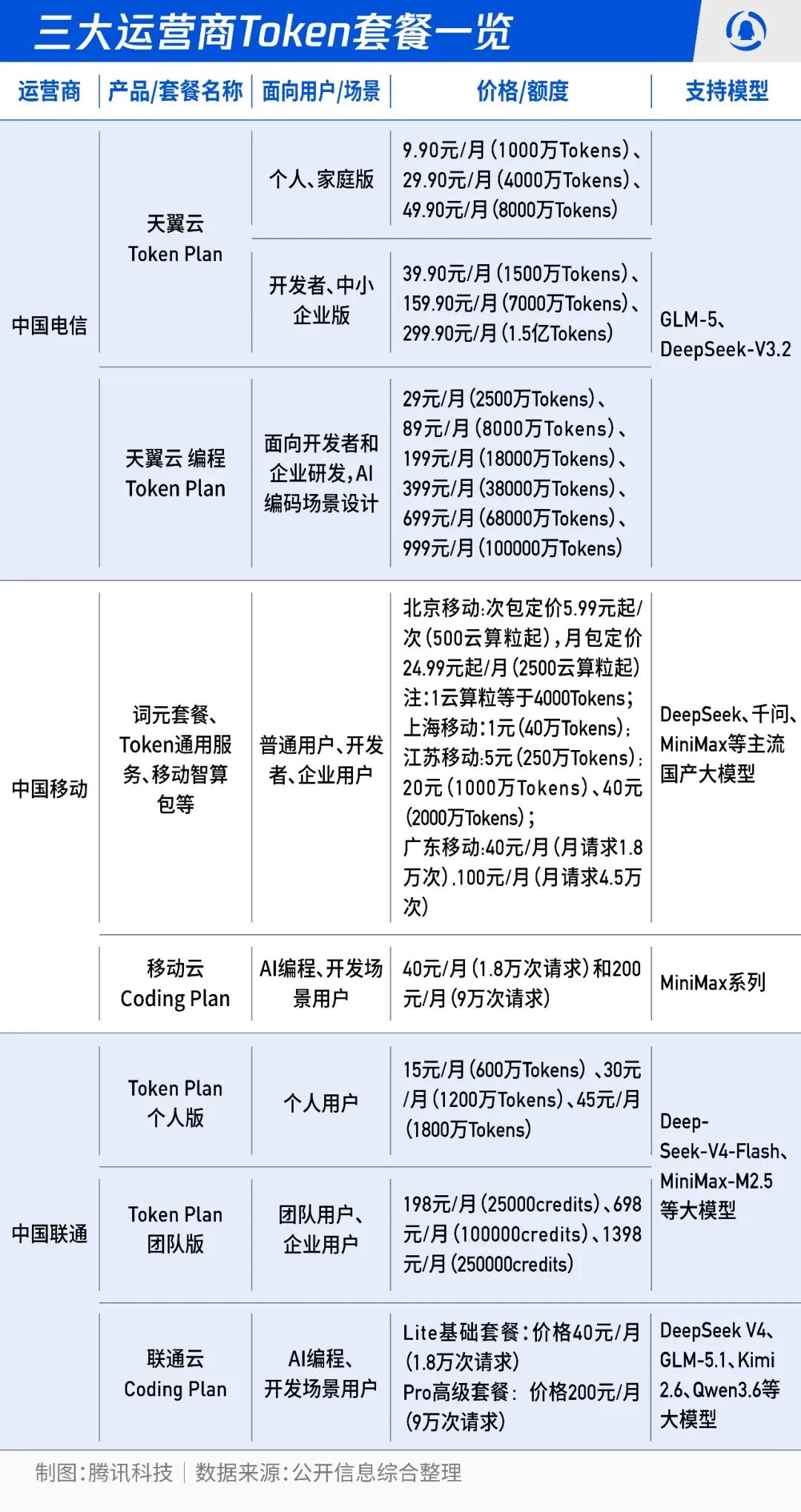
When computing power truly changes from a back - end resource to a front - end product, all major operators face a common problem: Can users really understand Token packages as well as they understand traffic? There are quite a few thresholds.
"The current Token packages seem dazzling, but I actually have no concept of how to use Tokens," said a user.
Tokens are not as relatively unified as GB of traffic. For the same 10 million Tokens, the consumption speed is different when used for short Q&A and long - document analysis; the sense of value is also different when used for ordinary chatting and code generation; if different models are accessed, the model price, inference speed, context length, and output quality may all be different.
This is also one of the difficulties that operators need to pay attention to when selling Tokens at present: They cannot simply put a technical unit in the package list but also need to translate it into rights and interests that ordinary users can understand.
In addition, the package rights and interests are not transparent enough. Many operator packages only state the total Token quota or the number of requests, but do not clearly split the input, output, cache hits, and deduction rules for different models like the model manufacturers' APIs. There are also some other measurement units such as cloud computing grains.
This also makes it difficult to judge whether the packages are expensive or not. If only making a rough conversion, the nominal unit price of some operator packages does not seem high. However, the API prices of model manufacturers usually distinguish between input and output, and the output is often more expensive, while the input for cache hits may be very cheap.
There is also the issue of the frequency of scenario use. Ordinary users may use it more for daily Q&A, writing copy, making summaries, and personal agents; developers may write code and debug programs frequently; enterprise users may connect to customer service, office systems, knowledge bases, or intelligent agent processes. The usage frequencies of different users vary greatly. Whether the package can be renewed depends on whether AI has truly entered high - frequency and essential scenarios.
Individual users care about whether they can use it, whether it is easy to use, and whether it is expensive; enterprise users also care about stability, concurrency capabilities, data security, permission management, service guarantees, and bill controllability.
An entrepreneur said, "I am more concerned about which suitable large models can be connected to my business system, whether the calls are stable, whether they can be connected to the office system, customer service system, code development process, or internal knowledge base, and how the security is. If the usage exceeds the package, will it be automatically disabled, throttled, or continue to be billed according to the amount?"
If enterprises want to connect the operators' Token packages to customer service systems, office systems, R & D processes, or internal knowledge bases, they need more explicit SLAs, clearer data boundaries, and more stable interface capabilities. Otherwise, it will be difficult for it to transform from a trial product into a basic service that enterprises purchase in the long term.
Therefore, whether Token packages can be as popular as data packages depends on whether operators can overcome several thresholds: users can understand them, the rights and interests can be clearly stated, the scenarios are high - frequency enough, the costs can be covered, and the enterprise connection is stable and reliable.
02. The Token layouts of the three operators have different focuses
Some users are confused about how to use Tokens. "After I buy a Token package, where exactly can these Tokens be consumed? Can they be consumed in commonly used AI products, or can they only be used in the operators' own products?"
Behind a string of abstract Token numbers, what users are actually buying is a large - model call quota. As for where to use it, it depends on which entrances the operators have packaged it into.
Currently, the Token packages of operators mainly have several types of usage scenarios:
One is to use them in the operators' designated AI products, such as cloud computers, AI assistants, office tools, and programming tools. After users purchase the package, they can call the models within these products and consume the corresponding Token quota.
Another is for developers and enterprises to use as APIs. After enterprises or developers buy the Token package, they can obtain the interface capabilities and connect large models to their own applications, websites, office systems, or development processes.
There is also a way to connect with ecological products such as third - party AI applications, cloud mobile phones, and cloud computers. Users do not necessarily need to enter the operators' software products to chat. They can also use AI capabilities in specific cooperative products through the accounts, quotas, payment, and model channels provided by the operators. For example, China Mobile Shanghai Company has jointly launched a co - branded WorkBuddy intelligent agent workbench with Tencent. For 1 yuan, users can purchase 400,000 Tokens, which support mobile phone bill payment and are compatible with multiple models.
It is worth noting that although all three operators are selling Tokens, their strategic focuses are different, which reflects their different judgments about their future roles.
Currently, China Telecom's strategy is the most "distinct". At the 2025 performance press conference, Chairman Ke Ruiwen said that the company would "reshape its business with Token operations". General Manager Liu Guiqing further explained that China Telecom would take Token services as the main line of operation and was committed to "strengthening its own Tokens, expanding ecological Tokens, and exploring international Tokens".
In addition, the centralized procurement project of the "Token Factory" generation capacity service of China Telecom Ningxia Branch in 2026 has an overall estimated scale of 16.451 billion yuan. This is the first billion - level procurement project named "Token Factory" among the three major operators. The "Token Factory" also sounds like a strategic declaration: It is not just selling Tokens but also aiming to become a factory for producing Tokens.
China Mobile focuses more on the path of prioritizing infrastructure. It places the construction of computing power infrastructure at the core, simultaneously promotes the construction of a national integrated computing power network, provides computing power services that can be used immediately and are accessible to all, and turns Tokens into a "universal currency" that connects computing power, models, applications, and users.
Currently, China Mobile has invested a total of 2.4 billion yuan in Qingyang, Gansu, and completed the construction of 4 data centers, lighting up the first domestic domestic - made computing power cluster with ten thousand graphics processing units. It is accelerating the construction of a domestic - made intelligent computing industrial park with one hundred thousand graphics processing units and upgrading to the Token economy.
China Unicom regards Tokens as a key boost for the development of Agent and AI cloud services and incorporates Tokens into Unicom Cloud, Yuanjing MaaS, UniClaw office assistant, and government - enterprise service systems.
The three operators have slightly different focuses in their paths, but they have the same direction: They are all shifting from building computing power to selling computing power and are trying to complete such identity conversions and leaps and achieve actual implementation.
However, the most familiar product form at present still follows the familiar "package" form: packaging complex resources, setting prices, putting them into the billing system, and then selling them through apps, business halls, cloud platforms, and customer managers.
03. After the growth stalls, the three major operators "seek change"
Looking deeper, the collective launch of Token packages by the three major operators is also a business change under real - world pressure.
In late March 2026, the three major operators successively disclosed their annual performance for 2025. The financial reports showed that the revenues of the three companies still maintained growth, but the growth rate was less than 1%.
Among them, China Mobile achieved revenues of 1.0502 trillion yuan, a year - on - year increase of 0.9%; the revenues of China Telecom and China Unicom were 523.9 billion yuan and 392.22 billion yuan respectively, with year - on - year increases of 0.1% and 0.7% respectively.
In terms of net profit, China Mobile achieved a net profit attributable to the parent company of 137.1 billion yuan, a year - on - year decrease of 0.9%, becoming the only company among the three major operators with a declining net profit growth rate.
The net profits attributable to the parent company of China Telecom and China Unicom were 33.2 billion yuan and 9.127 billion yuan respectively, with year - on - year growth rates of 0.5% and 1.1% respectively.
Overall, the revenue and net profit attributable to the parent company of the three major operators continue to remain at a high level, but all show signs of weak growth.
The fundamental reason for this situation is that the growth space of traditional businesses is approaching its limit. In 2025, the mobile Internet traffic increased by 17.3%, but the revenue from mobile data traffic services decreased by 3.1%. As users use more, operators sell at lower prices, and the logic of the traffic business is failing - the traffic is still increasing, but the money that can be earned per GB of traffic is getting less and less.
Moreover, the peak of 5G investment has passed, the space for new users is limited, and it is difficult for the profit space of traditional connection services to see a larger growth market.
At the beginning of 2026, the three major communication giants sent out clear signals of business adjustment and strategic focus, all conveying a clear signal of "fully embracing AI". All three have clearly defined the boundaries of their core businesses and concentrated resources on advantageous tracks, including computing power, AI applications, government - enterprise and industry markets, and channel and terminal ecosystems.
Zhou Guijun, a communication industry analyst, said that the investment in 5G network construction continues to decline, the profit space of traditional connection services is basically saturated, and AI is rapidly impacting traditional industries, so operators must seek change. Yang Guang, a telecom strategy analyst at Omdia, also believes that all three have elevated "AI +", "computing power network", and "industry market" to an unprecedented level and are transforming from simple traffic pipeline - type enterprises in the past to composite enterprises of "traffic + computing power + software + services".
When operators sell Tokens, in addition to keeping up with and embracing the wave of the AI era, they are also facing the real - world pressure of the slowdown in the growth of traditional connection services after the "increase in volume and decrease in price" of the traffic business and urgently need to find new growth stories.
04. From building computing power to selling computing power, operators have entered a new stage
In a broader context, the launch of Token packages by the three major operators is actually a natural result after the national - level computing power network has advanced to a certain stage.
In the past few years, China has been promoting the construction of infrastructure such as the "East - West Computing" project, the national integrated computing power network, and computing power interconnection. What needs to be solved at the national level is that data centers, intelligent computing centers, and cloud resources in various regions should not be isolated "computing power islands" but should be connected, scheduled, and traded like the power grid and communication network.
In terms of resource scale, the total computing power in China reached 280 EFLOPS in 2024, of which the eight national hub nodes accounted for 175 EFLOPS. Computing power has changed from the resource of a single enterprise or a single park to a new type of infrastructure that needs to be coordinated and scheduled nationwide.
In this computing power network, the three major operators play a key role. They were most proficient in building and operating communication networks in the past, and now they are extending this ability to the field of computing power: on the one hand, building intelligent computing centers, AIDCs, AI accelerator cards, and computing power scheduling platforms; on the other hand, transforming these back - end resources into products that can be purchased and used by the market.
This change has been reflected in the financial reports. In 2026, the total capital expenditures of the three major operators are all decreasing, but the proportion of computing - power - related investment continues to increase: China Mobile's capital expenditure plan for 2026 is 136.6 billion yuan, a year - on - year decrease of 9.5%, but the investment in computing power networks and intelligent networks increased by 62.4% and 19.8% respectively; China Telecom's estimated capital expenditure for 2026 is 73 billion yuan, of which the investment in computing power infrastructure is 25.5 billion yuan, a year - on - year increase of 26%; China Unicom's capital expenditure in 2026 decreased to about 50 billion yuan, of which the proportion of computing power investment exceeded 35%.
The statements of the management also point in the same direction. Ke Ruiwen, the chairman of China Telecom, proposed that in the face of the adjustment of the VAT rate, the company would take this as an opportunity to increase the layout of businesses such as AIDC, intelligent computing, and quantum, accelerate Token operations, and use AI to improve the efficiency of existing assets. Li Yuzhuo, the chief financial officer of China Unicom, also said that the company would accelerate the optimization of the business structure and promote the transformation from a "basic pipeline provider" to a "digital comprehensive service provider".
Therefore, the computing power resources invested by operators in the past