Die drei großen Telekommunikationsanbieter haben neue Geschichten gefunden, aber Tokens sind nicht so einfach zu verkaufen.
Telecommunications operators are now engaged in the token business. However, tokens are not data volumes and are not as easy to sell.
Recently, the three major Chinese telecommunications operators have successively launched token packages. China Telecom, China Mobile, and China Unicom have introduced token packages and corresponding AI services, which are sold to individuals, households, developers, small and medium - sized enterprises, and other users to enable access to large models.
Although these packages are still in the early stage of market launch, they have already become a new narrative in the capital markets.
On May 18th, the stock prices of the three telecommunications operators rose together. China Telecom led the increase and almost reached the daily limit, closing with a 7.74% increase.
The three telecommunications operators have brought a large number of token products to the market. Behind this approach lies an identity transformation of the telecommunications operators, and the token packages are only the part of this transformation that is visible to users.
In the past few decades, with each business change of telecommunications operators, the billing unit has usually also changed. The way people understand telecommunications services has undergone several silent unit conversions and role overlaps.
First, billing was based on minutes. Users knew exactly how much they had to pay for a call.
Later, the billing method changed to data traffic. When watching videos, surfing the Internet, and sending WeChat messages, data traffic in gigabytes is consumed. For a long time, the business of telecommunications operators has revolved around voice, SMS, and data traffic services.
Now, a new billing unit has entered the package lists of telecommunications operators: Tokens (also called "word tokens").
Each change in the billing unit usually corresponds to a change in the role of the infrastructure. During the minute - billing era, telecommunications operators were providers of communication networks. During the data - traffic billing era, they were carriers of mobile Internet access.
If tokens are included in the package lists, telecommunications operators are trying to transform from "connection service providers" to "AI computing power entry points". Just as the power grid used to transport electricity from power plants to households, telecommunications operators are trying to transform the computing power of data centers into a public resource through packages and billing systems, which can be purchased monthly like water or electricity and consumed as needed.
To understand the token sales business of telecommunications operators, one not only needs to consider the package prices but also pay attention to the underlying infrastructure logic and market acceptance.
This picture was generated with an AI tool.
01. The real problems start after the token packages are launched into the market
The token packages offered by telecommunications operators do not have as complicated pricing models as the APIs of model manufacturers, which distinguish between input, output, and cache hits. Instead, the tokens are aggregated into a monthly quota and simply categorized: How much does the package cost per month, how many tokens are included, and which models can be used.
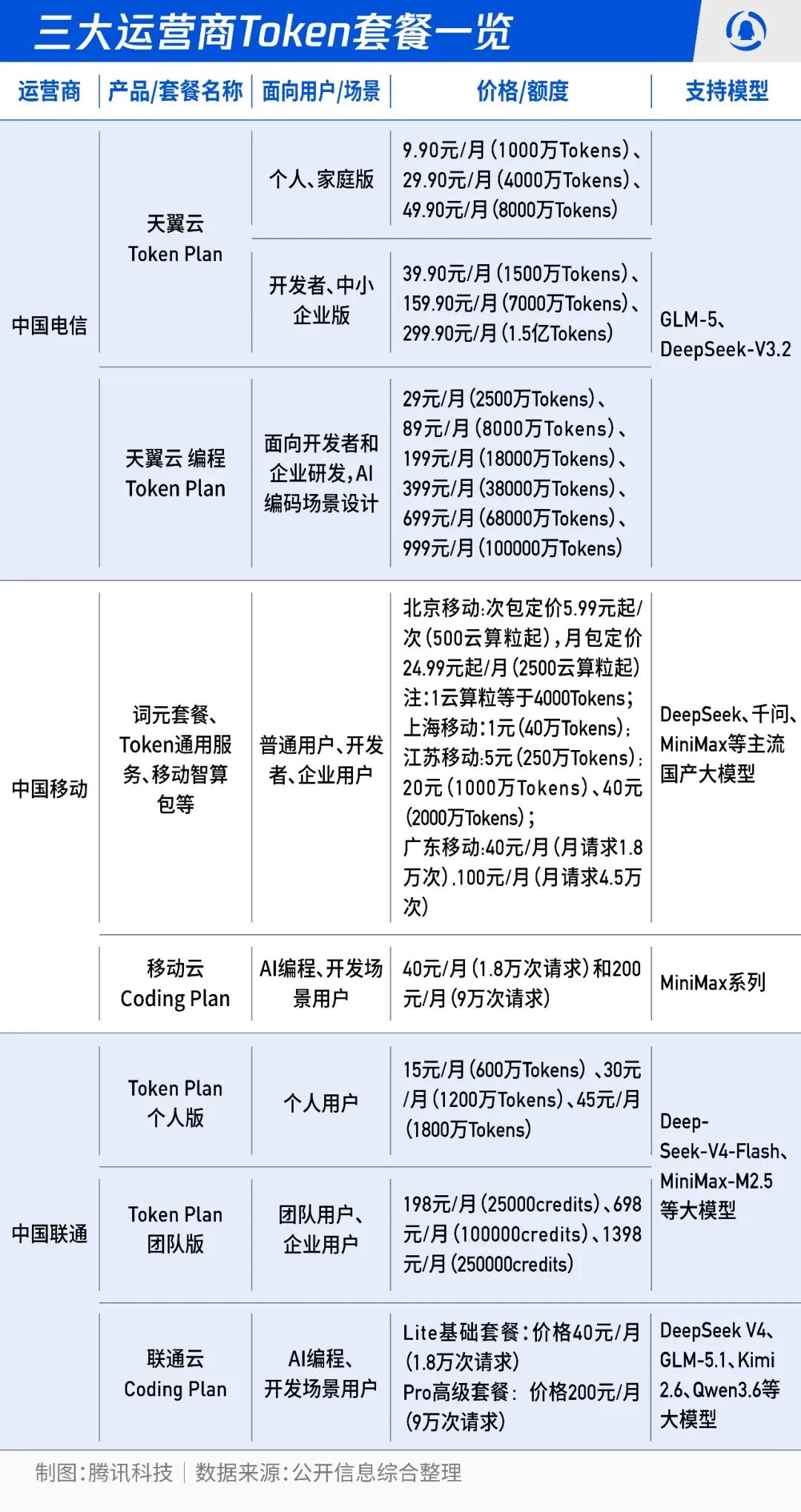
When computing power actually becomes a foreground product from a background resource, all telecommunications operators have to answer the same question: Can users understand token packages as well as data traffic? There are some hurdles here.
"The token packages seem very confusing now, and I have no idea how to use tokens." said a user.
Tokens are not as uniform as GB data traffic. The same 10 million tokens are consumed at different speeds for short questions and long document analyses. They also have different values in ordinary chat conversations and code generation. When using different models, the model prices, inference speed, context length, and output quality can vary.
This is one of the problems that telecommunications operators need to pay attention to when selling tokens: They cannot simply include a technical unit in the package list but must convert it into rights that ordinary users can understand.
In addition, the package rights are not transparent enough. Many packages of telecommunications operators only indicate the total token quota or the number of requests, but they do not break down the input, output, cache hits, and billing rules for different models as clearly as the APIs of model manufacturers. There are also other units of measurement such as cloud computing units.
This makes it difficult to judge whether the packages are expensive or not. A rough calculation shows that the prices of some packages of telecommunications operators do not seem high. However, the API prices of model manufacturers usually distinguish between input and output, where the output is often more expensive and the input may be very cheap in case of cache hits.
There is also the problem of usage frequency in different scenarios. Ordinary users use AI more for daily questions, text writing, information summarization, and personal agents. Developers write code and test programs more frequently. Enterprises can integrate AI into customer service, office systems, knowledge management, or the agent process. The usage frequencies of different user groups vary greatly. Whether the packages can be renewed depends on whether AI is actually used in high - frequency and urgent scenarios.
Individuals are interested in whether AI can be used, how well it works, and how much it costs. Enterprises are also interested in the stability, parallel processing ability, data security, access control, service guarantee, and controllability of bills.
A businessman said: "I am mainly interested in which large models are suitable for my business system, whether the access is stable, whether I can integrate the model into the office system, customer service, code development process, or internal knowledge management, and how secure it is. If I exceed the package quota, will the access be automatically disabled, the speed reduced, or will I still be billed according to consumption?"
If enterprises want to integrate the token packages of telecommunications operators into customer service, office systems, development processes, or internal knowledge management, they need clearer service - level agreements (SLA), clearer data boundaries, and more stable interface capabilities. Otherwise, it is difficult for the product to transform from an experimental product into a basic service for long - term procurement by enterprises.
Therefore, the spread of token packages, like that of data - traffic packages, depends on whether telecommunications operators can overcome some hurdles: Users must be able to understand the packages, the rights must be clearly explained, the scenarios must be high - frequency, the costs must be covered, and enterprise integration must be stable and reliable.
02. The token strategies of the three telecommunications operators have different focuses
Some users are unsure how to use tokens: "After I bought a token package, where can I actually consume these tokens? Can I use them in common AI products or only in the products of telecommunications operators?"
Behind the abstract token numbers, users are actually buying a quota for access to large models. Where to use the tokens depends on which accesses the telecommunications operators have integrated them into.
Currently, there are mainly three types of usage scenarios for the token packages of telecommunications operators:
One possibility is to use them in the AI products determined by the telecommunications operators, such as cloud computers, AI assistants, office tools, and programming tools. After users buy a package, they can call the models in these products and consume the corresponding token quota.
Another possibility is to use them as an API for developers and enterprises. After enterprises or developers buy a token package, they can obtain access to the interfaces and integrate the large models into their applications, websites, office systems, or development processes.
Another possibility is to integrate them with third - party AI applications, cloud smartphones, cloud computers, and other ecosystem products. Users do not necessarily have to enter the software products of telecommunications operators to chat. They can also use the AI functions in certain cooperation products through the accounts, quotas, payment methods, and model channels provided by telecommunications operators. For example, the Shanghai branch of China Mobile has jointly launched a WorkBuddy intelligent agent workplace product with Tencent, where one can buy 400,000 tokens for 1 yuan, and it is compatible with mobile billing and multiple models.
It is noteworthy that the three telecommunications operators have different strategic focuses in token sales, which indicates their different ideas about their future roles.
So far, China Telecom has the "clearest" strategy. At the 2025 earnings press conference, the chairman of the board of directors, Ke Ruiwen, said that the company would "reshuffle its business through token management". The CEO, Liu Guiqing, further explained that China Telecom regards token services as the main line of its business and will strive to "strengthen its own tokens, expand ecosystem tokens, and explore international tokens".
In addition, the Ningxia branch of China Telecom launched a central procurement project for the generation capacity of the "Token Factory" in 2026, with an estimated total volume of 16.451 billion yuan. This is the first procurement project in the billion - yuan range among the three major telecommunications operators named after the "Token Factory". The "Token Factory" also sounds like a strategic statement: It is not only about selling tokens but also about becoming a token factory.
China Mobile places more emphasis on infrastructure. It focuses on building computing - power infrastructure and simultaneously promotes the construction of a national integrated computing - power network. It provides computing - power services that are immediately available and cost - effective and makes tokens a "universal currency" that connects computing power, models, applications, and users.
So far, China Mobile has invested a total of 2.4 billion yuan in Qingyang, Gansu, and built four data centers. It has built the first national computing - power cluster with 10,000 cards in China and is accelerating the construction of a national computing - power cluster with 100,000 cards to develop into the token economy.
China Unicom sees tokens as an important driver for the development of agent and AI cloud services and integrates them into China Unicom Cloud, Yuanjing MaaS, the UniClaw office assistant, and the enterprise service system.
Although the three telecommunications operators have different focuses, they have the same goal: They are transforming from computing - power builders to computing - power sellers and trying to implement this identity transformation and leap into practice.
Currently, the most well - known product format is still offered in the familiar "package" form: Complex resources are aggregated, priced, included in the billing system, and sold through apps, branches, cloud platforms, and customer service representatives.
03. After the growth stops, the three telecommunications operators are looking for changes
In terms of the deeper reasons, the joint launch of token packages by the three telecommunications operators is also a business adjustment under real pressure.
At the end of March 2026, the three telecommunications operators successively released their annual reports for 2025. The balance sheets show that the revenues of the three companies continue to grow, but the growth rate is below 1%.
China Mobile achieved a revenue of 1,050.2 billion yuan, a 0.9% increase compared to the previous year. China Telecom and China Unicom achieved revenues of 523.9 billion yuan and 392.22 billion yuan respectively, a 0.1% and 0.7% increase compared to the previous year.
In terms of net profits, China Mobile achieved a consolidated net profit of 137.1 billion yuan, a 0.9% decrease compared to the previous year. It is the only company among the three telecommunications operators with a declining net - profit growth rate.
China Telecom and China Unicom achieved consolidated net profits of 33.2 billion yuan and 9.127 billion yuan respectively, a 0.5% and 1.1% increase compared to the previous year.
Overall, the revenue and consolidated net - profit indicators of the three telecommunications operators remain at a high level, but there are signs of weak growth.
The fundamental reason for this situation is that the growth potential of traditional businesses is almost exhausted. In 2025, mobile Internet traffic increased by 17.3%, but the revenues from the mobile data - traffic business decreased by 3.1%. Users are consuming more, but telecommunications operators are selling at lower prices. The logic of the data - traffic business no longer works - although the traffic continues to increase, the price per GB of data traffic is getting lower and lower.
In addition, the peak of 5G investment is over, and the potential for new users is limited. It is difficult for the profit potential of traditional connection businesses to reach larger growth markets.