"Selling properties to switch to battery cells", the stock price soars 340% "ahead of time". Are real estate companies also chasing the "light"?
"Selling properties to acquire chips", a well - known developer is about to make a complete transformation. "Stand in the light, don't just stand there." It seems that Jingtou Development (600683.SH) has grasped the meaning of this sentence and is ready to step out of the real - estate business and stand in the light.
Two months ago, Jingtou Development announced the complete divestiture of its real - estate business. Recently, it officially announced that it will acquire the equity of an optical chip company from its major shareholder, making a complete transformation from the real - estate industry to the "optical module" field.
It is worth noting that during the short period between the announcements of "selling properties" and "acquiring chips", Jingtou Development's stock price soared by 340%. Moreover, the stock price took off before the release of these two major announcements. This precise "foresight" has attracted wide attention.
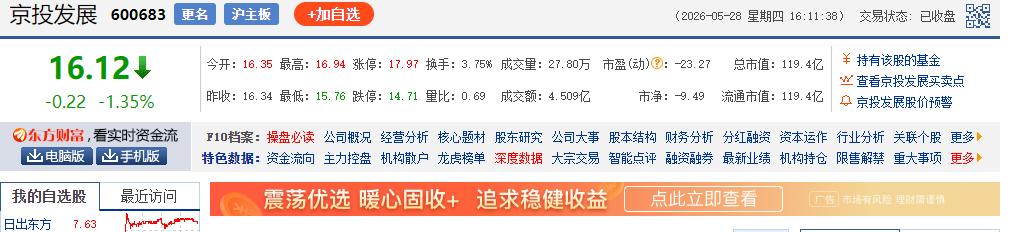
However, soon after, as the Shanghai Stock Exchange issued an inquiry letter, Jingtou Development's stock price began to decline, falling for seven consecutive trading days from May 13th to May 21st. As of the close on May 28th, the company's stock price was 16.12 yuan per share, a decline of more than 26% compared with the peak of 21.83 yuan per share after the official acquisition announcement.
The optical chip company that Jingtou Development intends to acquire, Xi'an Qixin Optoelectronics, has been in the red for more than a year. Its revenue last year was only 124 million yuan, and its business scale is limited.
The valuation of Qixin Optoelectronics in previous capital increase rounds shows that as of July 2022, the company was valued at 2.571 billion yuan.
As of March 31, 2026, Jingtou Development's total assets were 56.464 billion yuan, with a cash balance of 3.294 billion yuan on the books. The balance of interest - bearing debt (including perpetual financing) was 44.108 billion yuan, and the estimated annual interest expense in 2026 was about 1 billion yuan.
Jingtou Development believes that Qixin Optoelectronics is relatively small in scale. If the acquisition is successfully implemented, Jingtou Development has the ability to ensure the company's financial stability by reasonably arranging its own or self - raised funds.
Transforming from the traditional real - estate industry to the current hot "optical module" field is, of course, a good move in terms of direction. However, the problem lies in the fact that the cross - border transition from real estate to "optical modules" is as difficult as "switching from operating an excavator to making chips".
What's more worth pondering is that the "optical module" field is in a period of strong demand due to the increasing demand for AI computing power. However, the major market share is in the hands of industry giants, and the capital required for technology R & D is also substantial. Moreover, companies such as Yuanjie Technology, Guangxun Technology, Changguang Huaxin, and Source Photonics are in the forefront in terms of technological breakthroughs and market share. Some leading optical chip companies have seen significant increases in revenue and profits in the past year and the first quarter of this year, while Qixin Optoelectronics is still in the red.
Can Jingtou Development catch up with the pace of industry upgrading in this chip - acquisition move?
01 Cross - border chip acquisition and the stock price "leading the way" with a sharp rise
Jingtou Development's "cross - border chip acquisition" was not directly initiated by the listed company. Instead, the controlling shareholder first acquired the relevant shares and then transferred them to Jingtou Development, completing the asset injection into the listed company.
In December 2025, Jingtou Development's controlling shareholder, Beijing Infrastructure Investment Co., Ltd. (referred to as "Jingtou Company"), first acquired the equity of Qixin Optoelectronics through its Beijing New Infrastructure Industry First - phase Equity Investment Center (Limited Partnership) (referred to as "New Infrastructure Fund"), with an acquisition share of about 3.99%.
In December 2025, March 2026, and April 2026, the New Infrastructure Fund successively acquired the shares of Qixin Optoelectronics from 13 shareholders. Currently, it holds a total of 20.9052% of Qixin Optoelectronics' shares.
The next step after the New Infrastructure Fund's acquisition of Qixin Optoelectronics' equity is to inject the relevant assets into the listed company, Jingtou Development. The whole process from the planning of the transfer to the release of the acquisition announcement by Jingtou Development took only more than 20 days.
On April 20, 2026, Jingtou Company first discussed the matter of injecting assets into the listed company (Jingtou Development) through oral communication. Subsequently, on April 23rd and May 7th, it further discussed the asset injection matter through oral communication, telephone communication, and written documents.
On May 11th, senior executives of Jingtou Company, including the chairman, general manager, and secretary of the board, discussed and communicated with all the directors, the president, and the secretary of the board of Jingtou Development about Jingtou Development's purchase of assets and related - party transactions, and released relevant announcements.
The key point is that during these more than 20 days, Jingtou Development's stock price rose significantly. Especially during the five trading days from April 29th to May 8th before the disclosure of the acquisition matter, Jingtou Development's stock achieved "five consecutive daily increases", with the stock price rising from 13.59 yuan per share to 17.23 yuan per share.
Jingtou Development's "five consecutive daily increases" in the stock price can be said to be a quite accurate "foresight".
After the announcement of the acquisition of Qixin Optoelectronics, on May 11th and 12th, Jingtou Development's stock hit two daily limit up boards, and the closing price on May 12th reached 20.85 yuan per share.
From the start of the rise on April 29th to the close on May 12th, Jingtou Development's stock price rose by more than 53.42% before and after the announcement of the cross - border chip acquisition.
From the beginning of this year to the disclosure of the acquisition matter on May 11th, Jingtou Development's stock price had risen by 343.79% in total.
Judging from the stock price trend chart, the stock price took off in early February. More than a month later, on March 15th, Jingtou Development announced that the company planned to divest its real - estate business, intending to transfer the assets and liabilities related to the real - estate development business it held to its controlling shareholder, Jingtou Company, and pay in cash.
Jingtou Development also said that after the transfer was completed, the company would no longer engage in real - estate development business. However, at that time, Jingtou Development did not explain its next - step business direction, nor did it disclose the information about its controlling shareholder's acquisition of Qixin Optoelectronics, which was not made public until May 11th.
Due to the significant fluctuations in the company's stock price before and after the announcement of the acquisition matter, Jingtou Development received an inquiry letter from the Shanghai Stock Exchange on the day of announcing the acquisition of Qixin Optoelectronics' equity.
In response to the information disclosure and insider information management issues related to the stock price that the regulatory authorities were concerned about, Jingtou Development replied, "After self - inspection, there was no early leakage of insider information in this acquisition planning by the company. The company also did not find any insiders trading the company's stocks during the self - inspection period."
02 Can the still - loss - making "chip" company make it into the main lineup?
The inquiry letter mentioned that Jingtou Development is mainly engaged in real - estate development and operation. It has been in the red from 2023 to 2025, with net profits attributable to the parent company of - 659 million yuan, - 1.055 billion yuan, and - 1.216 billion yuan respectively, and the loss amount has been increasing. The Qixin Optoelectronics that Jingtou Development intends to acquire is mainly engaged in related businesses such as optoelectronic device manufacturing. Not only is it quite different from Jingtou Development's original business, but it was also in the red in 2025 and the first quarter of 2026.
Can a continuously loss - making real - estate enterprise acquire another loss - making chip company and achieve a "two negatives make a positive" effect?
On May 18th, one week later, Jingtou Development made public the content of its response after the above - mentioned inquiry.
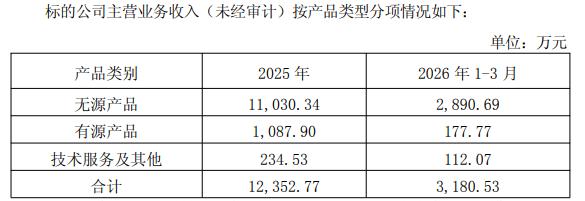
Xi'an Qixin Optoelectronics is mainly engaged in the R & D, production, and sales of silicon - based modified photonic integrated materials, photonic integrated chips, optical devices, optical components, optical modules, and subsystems. In 2025, Qixin Optoelectronics' revenue was about 124 million yuan, with a loss of 61.1046 million yuan. In the first quarter of 2026, its revenue was about 31.8053 million yuan, with a loss of 21.794 million yuan.
Qixin Optoelectronics' main products are optical communication chips and component products, which can be further divided into passive products and active products. Among them, passive products are applied to 100G, 200G, 400G, 800G, and 1.6T high - speed optical modules and are one of the core components of high - speed data center optical modules.
The data for 2025 and the first quarter of 2026 show that Qixin Optoelectronics' main customer types are optical module and optical communication manufacturers, and its main revenue comes from passive products. As of March 31, 2026, Qixin Optoelectronics had outstanding orders (contract amount) of about 68.3391 million yuan.
Source: Company announcement
In response to the reasons for Qixin Optoelectronics' losses, Jingtou Development disclosed in the response letter that it was mainly due to the typical characteristics of the technology industry, which is "high investment and long cycle". On the one hand, as a technology - driven enterprise, Qixin Optoelectronics has continuously maintained high - intensity R & D expenditures. Coupled with the huge capital expenditure for self - building wafer and packaging and testing production lines, the pre - stage rigid costs have been pushed up. On the other hand, although the market demand is strong, the company's production capacity is still in the construction and new product ramping - up period, and the scale effect has not been fully released, resulting in the current operating revenue being unable to fully cover the comprehensive costs formed by the heavy - asset layout and high R & D investment.
After reading Jingtou Development's introduction to the basic situation of Qixin Optoelectronics, it can only be said that it is indeed very basic, and several key issues are still quite vague. The first is the industry status and technical level of Qixin Optoelectronics in the "domestic substitution" of optical chips, and no clear description is given.
For example, regarding the main optical communication chip products, it only says that "passive products... are applied to 100G, 200G, 400G, 800G, and 1.6T high - speed optical modules and are one of the core components of high - speed data center optical modules", without directly stating whether the company has the ability to develop optical chips suitable for 1.6T high - speed optical modules.
In addition, Jingtou Development also said that in terms of product applications, Qixin Optoelectronics' core product, the high - speed wavelength - division multiplexing chip, has entered the supply chain system of major optical module manufacturers and achieved mass supply. However, it did not specify at which rate the chip products are supplied in mass and whether it has the ability to supply high - speed optical modules such as 800G and 1.6T in mass.
In contrast, Yuanjie Technology, a leading company in the optical chip field, has expressed it very clearly in its financial report. Let's compare. Yuanjie Technology said:
"In the high - speed data center market, 800G, 1.6T, and higher - speed optical modules represent the most advanced technology in the industry. The direct - modulation rate of the laser chips required for them reaches 100G and above, which has become the limit for the design and production of direct - modulation laser chips. Silicon photonics integration technology has become the solution for 400G, 800G, 1.6T, and higher - speed optical modules. However, it requires the laser chip emission light source to be coupled into the waveguide of silicon - based materials, but there are problems of low coupling efficiency of light sources between different materials and large optical transmission losses."
Next, Yuanjie Technology specifically explained the progress of the company's technology R & D on laser chips:
Yuanjie Technology "completed the development of the following difficulties in the high - power laser chip technology: ① Structural design and theoretical simulation; ② Wafer epitaxial process and optical waveguide design; ③ Grating design and manufacturing; ④ High - power chip testing and reliability evaluation system. With this technology, the company solves the problem of light power saturation at high temperatures while ensuring product reliability and successfully develops 50mW/70mW/100mW high - power laser chips."
It should be noted that in terms of speed, 1.6T optical modules were shipped in mass in 2025 and entered the commercial explosion period in 2026. While other major optical chip manufacturers have reaped the industry dividends, Qixin Optoelectronics is still in the red, and its revenue scale is only at the level of 100 million yuan.
In contrast, Yuanjie Technology's revenue in 2025 was 600 million yuan, a year - on - year increase of 138.5%. More than 60% of its revenue came from the data center business, reaching 393 million yuan, a year - on - year increase of 719.06%. The annual net profit also turned from loss to profit, reaching 191 million yuan.
In addition, Yuanjie Technology's revenue in the first quarter of 2026 increased by 320.94% to 355 million yuan, and the net profit was 179 million yuan, almost catching up with the profit level of last year.
Looking at Changguang Huaxin again, in 2025, it achieved a revenue of 477 million yuan, a year - on - year increase of 75.09%. The net profit attributable to shareholders of the listed company was 21.7641 million yuan, turning from loss to profit. At the same time, Changguang Huaxin's 100G EML has been mass - produced, the 200G EML is in the customer verification stage, and chips such as 100G VCSEL and 100mW CW DFB have reached the level of mass production and shipment.
In addition, Changguang Huaxin's layout of the next - generation high - speed optical communication technology route of silicon photonics integration through its subsidiary will achieve process line - up by the end of 2026 and start production in 2027.
After comparison, it is clear that Jingtou Development's disclosure of information such as Qixin Optoelectronics' products and technologies is relatively vague. It is difficult for investors to make accurate judgments on the chip type, technology R & D progress, etc.
The competitive pressure that Qixin Optoelectronics faces also comes from industry technology upgrading.
Currently, the demand for AI is growing exponentially, driving the rapid increase in the global demand for inference computing power. This trend has prompted Internet cloud providers to continuously increase their investment and accelerate the construction of intelligent computing centers, and has also driven the evolution of