In - depth analysis: Meta starts charging subscription fees. Is the "free lunch" on social platforms disappearing?
Meta's recent introduction of subscriptions for Instagram, Facebook, and WhatsApp may seem, on the surface, like an attempt by the established social platforms to increase revenue. However, what's more noteworthy is that social platforms are now separating the free web, paid identities, paid reach, and paid AI computing power into different tiers. It's crucial to note that Meta isn't selling "ad-free social software"; instead, it's selling value-added rights within social relationships.
According to public reports, Meta is rolling out Instagram Plus, Facebook Plus, and WhatsApp Plus for general users globally. The monthly prices for Instagram Plus and Facebook Plus in the US are $3.99, while WhatsApp Plus costs $2.99 per month. The disclosed features include Story data, more audience lists, personalized icons, fonts, stickers, themes, and more pinned chats.
Meanwhile, Meta will conduct more subscription tests under the Meta One brand. Meta One Plus and Meta One Premium for Meta AI users are priced at $7.99 and $19.99 per month respectively. The main differences lie in higher computing power for queries, deeper reasoning, and greater image and video generation capabilities. Additionally, the Essential and Advanced plans for creators and businesses are also under testing, priced at $14.99 and $49.99 per month respectively. The features will cover verification, impersonation protection, data analysis, link pages, search ranking, and Reels follow buttons.
The key change: Meta isn't just adding a few membership packages; it's starting to integrate social networking, creator management, business accounts, and AI computing power into a unified subscription system.
The "free tier of social platforms is thinning"
This change indicates one thing: the "free" aspect of social platforms hasn't disappeared, but the free tier is becoming thinner.
Previously, free social networking was essentially an advertising platform. Users produced content, built relationships, and contributed their attention for free, while the platform monetized through advertising and commercial tools. The current issue is that the platform is being squeezed by advertising growth, user growth, and AI costs simultaneously. As a result, the platform is introducing a second layer of charging: basic social networking remains free, but enhanced expression, more detailed audience management, higher visibility, deeper data insights, and greater AI usage can all be charged for.
This isn't a replacement for advertising; it's adding a membership control layer to the advertising platform.
Paid social networking may not start from "users hating ads" but rather from "users wanting to improve their efficiency and status in the social network."
Ordinary users pay for personalization, identity display, and social details; creators pay for reach, analysis, and link conversion; businesses pay for customer acquisition, management, and higher certainty; and heavy AI users pay for computing power and complex tasks. Different groups are buying different things, but at the core, they're all buying a right: having more capabilities than free users within the same social network.
A practical reference for domestic social software
Many people's first reaction might be to ask: Will WeChat start charging a monthly fee in the future? I believe it's highly unlikely to be a "message-sending fee" model. Charging for the core communication layer would damage the network effect and also impact the larger ecological benefits of payments, mini-programs, video accounts, advertising, and local services.
However, this doesn't mean that Chinese social software won't move towards a paid model.
In fact, there has long been social payment in the Chinese Internet, but it's usually not called "social subscription." Tencent's 2025 performance announcement shows that the combined monthly active accounts of WeChat and WeChat International reached 1.418 billion, the monthly active users of QQ on mobile were 508 million, and the number of paid value-added service subscriptions was 267 million. In the same year, the revenue from Social Networks was 127.7 billion yuan, a year-on-year increase of 5%, with the growth coming from video account live streaming, music subscriptions, and virtual items in App games.
This set of data shows that there is payment in Chinese social networking, but it has long occurred in content, entertainment, identity, virtual items, and ecological services, rather than on the basic chat button.
Therefore, what's more likely to happen in the future isn't "charging for WeChat's basic functions" but rather the continuous thickening of these value-added tiers:
Management tools for creators and businesses, such as enhanced data analysis, lead management, content distribution, private domain conversion, and customer service automation.
Identity and trust tools, such as verification, brand protection, impersonation prevention, and homepage asset management.
AI assistants and content production tools, such as helping businesses write materials, handle customer service, generate videos, understand comments, organize group chats, and make product recommendations.
Efficiency benefits for high-frequency users, such as larger storage, better search, stronger group management, and more detailed privacy control.
In other words, the monetization of Chinese social software is likely to start from "charging tool fees to users with high intent, high value, and high consumption" rather than "charging an entry fee to everyone."
Differences in AI tool pricing between China and the US
This can also explain the differences in the commercial paths of AI tools between China and the US.
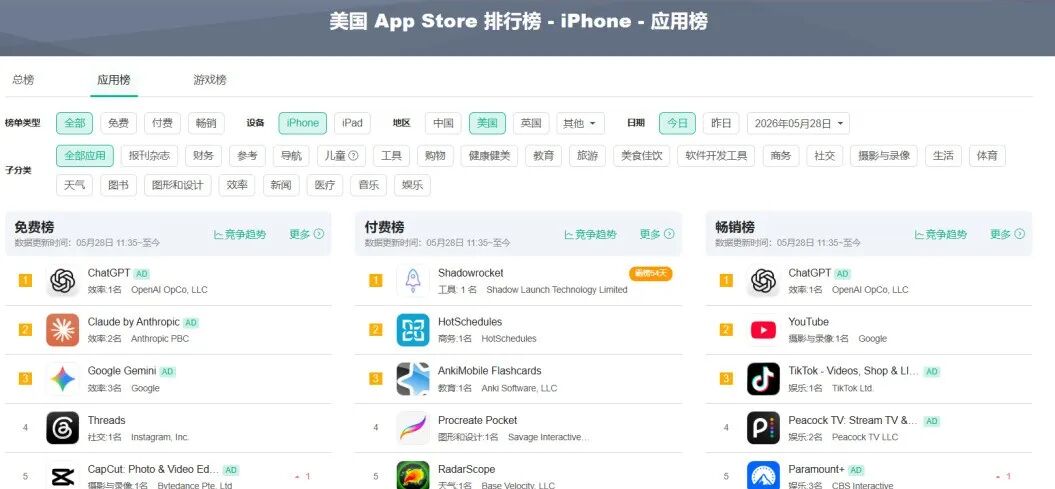
In the US market, the paid path for ChatGPT is very straightforward. According to data monitored by Qimai on May 28th, ChatGPT ranked first on both the free and best-selling lists of iPhone apps in the US. Its in-app purchase options include ChatGPT Plus for $19.99, ChatGPT Go for $8, and Pro-related items in the $100 and $200 ranges. Meta One's AI subscription follows a similar logic: light users can use it for free, while heavy users pay for higher computing power, deeper reasoning, and more generation quotas.
In the Chinese market, Doubao has also introduced a clear subscription tier. Qimai data shows that on May 28th, Doubao ranked fourth on the free list of iPhone apps in China, with an estimated 194,270 downloads the previous day. Its app description lists the basic version as free, the standard version at 68 yuan per month, the enhanced version at 200 yuan per month, and the professional version at 500 yuan per month. However, Doubao didn't rank high on the best-selling list, so we can't conclude that it has reached the same stage as ChatGPT, which has both a high free ranking and a high best-selling ranking.
The key difference in AI pricing between China and the US is that top US AI tools are more like "directly selling model capabilities and computing power quotas," while top Chinese AI tools are more like "first seizing the entry point and then charging for high-level models, image and video generation, office productivity, and ecological scenarios in different tiers."
This isn't a matter of which is more advanced; it's due to different market paths.
US users are already accustomed to paying directly for software subscriptions, and enterprise and personal productivity tools are more likely to form the mindset of "paying a monthly fee for efficiency." Chinese users are more sensitive to subscriptions for general tools, but there is already a very mature payment environment for super apps, content platforms, games, live streaming, memberships, virtual items, business tools, and local services.
Final judgment
Therefore, I believe that the real signal Meta is sending this time isn't "all social apps will start charging," but rather "social platforms are becoming paid operating systems in the AI era."
Whoever controls the relationship chain, content flow, identity system, and business accounts can integrate AI into real scenarios. A single AI app can sell computing power, but social platforms can sell "computing power + relationships + reach + conversion."
Of course, the risks are also obvious. First, if the subscription features are just minor embellishments, users may not pay in the long term. Second, if paid reach affects content fairness, creators and ordinary users will be dissatisfied. Third, after AI is integrated into social relationships, privacy, data usage, and the protection of minors will become more sensitive. Fourth, even if the Chinese market moves towards a paid model, it's difficult to copy Meta's US dollar subscription prices and product structure.
But the overall direction is clear: In the future, social software may not charge everyone, but it will increasingly charge those who "want to manage themselves better, gain more reach, use AI more, and improve efficiency."
The real dividing line in the future won't be between free and paid, but rather between free basic networks and paid value-added capabilities.
*This article is reprinted from Arthur Wu. It only represents the author's personal views, and the copyright of the article belongs to the original author. The content is for communication and reference only and does not constitute professional advice.
This article is from the WeChat official account "Qimai Research Institute." Author: Arthur Wu. Republished by 36Kr with permission.