The Era of Extreme Flattening: The Disappearing Middle Managers
God Translation Bureau is a compilation team under 36Kr, focusing on fields such as technology, business, workplace, and life, and mainly introducing new technologies, new ideas, and new trends from abroad.
The capital that once supported the employee scale is now flowing into the GPU field. The organizational structure chart is being reshaped, and the titles printed on business cards may be the last relics to disappear.
Number of layoffs in the technology industry in the first quarter of 2026: 81,747
The AI capital expenditure of the four major hyperscale cloud service providers in 2026 increased by 77% year-on-year: $725 billion
Number of AI-related job openings in the United States: 275,000
Proportion of layoffs in the first quarter attributed to AI and automation: approximately 50%
Quick Overview of Key Points
In the first quarter of 2026, approximately 81,700 people were laid off in the technology industry, setting the highest single-quarter record in two years. Meanwhile, the four major hyperscale cloud service providers invested $725 billion in AI infrastructure, a 77% year-on-year increase. The capital that supported engineer recruitment in 2021 has now become GPU clusters.
This is a structural change, not a cyclical adjustment: The CEO of Salesforce told investors that he needs fewer employees; Meta characterized its layoffs as reallocating the compensation budget to AI; Oracle laid off 30,000 traditional positions to fund data center construction. The context has shifted from "financial discipline" to "technological replacement."
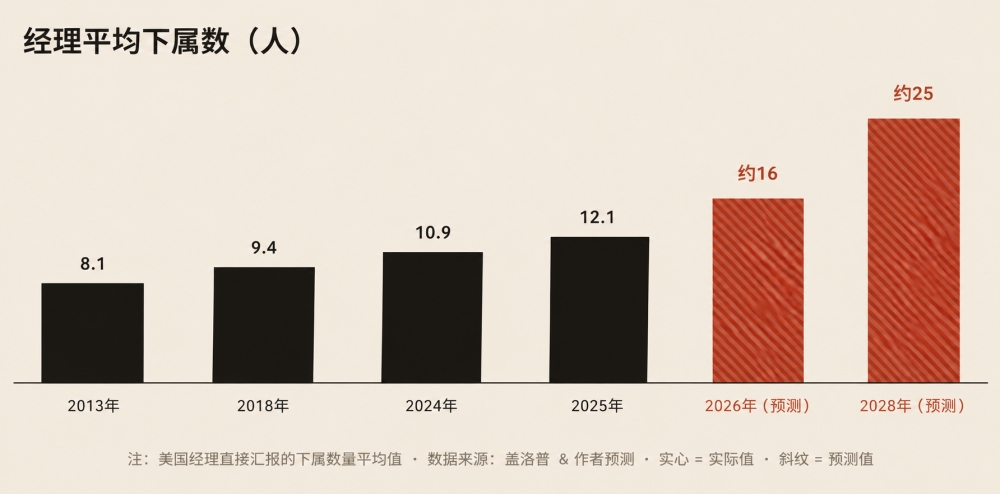
The pyramid is turning into a plain. The hierarchy of "director → manager → individual contributor" is collapsing and evolving into a model where a supervisor leads 25 members and is equipped with a resident AI agent. The span of management has jumped from 8.1 in 2013 to 12.1 in 2025 and is expected to reach approximately 25 in 2028.
Five major areas have borne the brunt of the layoffs: customer support (92%), quality assurance/auditing (84%), middle management (78%), recruitment/human resources operations (72%), and junior engineering positions (68%). Senior individual contributors in the fields of AI, infrastructure, and security are enjoying a salary premium of over 56%.
The "2028 Crisis": Companies streamlined middle management in 2026, effectively dismantling the mechanism for cultivating senior leaders in 2028 - only 6% of Generation Z aspire to be executives, and 37% of employees in flat organizations say they feel lost.
In the first quarter of 2026, approximately 80,000 technology professionals lost their jobs, the highest quarterly total in the industry in at least two years. In the same quarter, the four major hyperscale cloud service providers promised to invest a total of $725 billion in AI infrastructure, a 77% year-on-year increase. These numbers are not a coincidence. The capital that was used to hire engineers in 2021 became GPU clusters in 2026, and the executives signing the checks are no longer beating around the bush or using euphemisms.
This is not a repeat of the industry's correction in 2022. That round of layoffs was to correct over - hiring during the pandemic in a rising - interest - rate environment. This round is structural. The CEO of Salesforce clearly told investors that he doesn't need so many people. Meta described its 10% layoffs as reallocating the compensation budget to AI research. Oracle laid off up to 30,000 traditional positions to support data center expansion. The workplace discourse system has shifted from "cost - cutting" to "job replacement."
Under the headlines, the organizational structure chart is being redrawn. The traditional pyramid structure - with the CEO at the top, passing through three to four layers of management to reach an engineer team of six to eight people - is being compressed at both ends. Middle managers are the most obvious victims, but the resulting chain reaction of titles, responsibilities, and career paths is far more interesting than just the headcount.
01 Roles at the Epicenter
The risks are not the same for everyone. Five major camps have borne the brunt of the layoffs, and which camp you belong to is far more important than which company you work for.
Customer Support and Customer Experience (92%)
Salesforce laid off 4,000 people. The default first - level conversations are now handled by large language models (LLMs), and humans are only responsible for handling complex escalated issues.
Quality Assurance (QA) and Content Review (84%)
It is transitioning to AI evaluation engineering, but the role has been significantly compressed.
Middle Management (78%)
Gartner predicts that one - fifth of companies will lay off more than half of their middle managers by the end of the year.
Recruitment and Human Resources Operations (72%)
Meta cut 35% - 40% of these functional departments.
Junior Engineers and General IT Positions (68%)
Research from Stanford University shows that junior programming positions have been affected. IBM is one of the few exceptions, with its number of junior employees tripling.
Traditional Infrastructure (On - premise Database Administrators, System Administrators) (65%)
Oracle laid off up to 30,000 such positions and redirected the funds to data centers.
Senior Individual Contributors in AI/ML, Infrastructure, and Security Fields (+56%)
Salary premium for high - demand AI positions; the number of relevant job postings increased by 92% year - on - year.
This last category of occupations is crucial. According to Bloomberg's estimate, approximately half of the positions cut due to AI will be re - recruited within 12 months through offshoring or at a lower level. Some actions that seem like "AI replacement" are actually geographical migration and salary repricing in the guise of AI. For the unemployed, the end result is the same, but it changes our prediction of whether the position itself will disappear.
02 The Past and Present of Organizational Structure
As shown in the following two diagrams. The left shows the form of most large - scale technology organizations in 2022: a five - layer pyramid, where a director manages three managers, and each manager manages seven engineers. The right shows the form that Amazon, Meta, and Intel are clearly building: a compressed three - layer structure, where a technical supervisor is responsible for managing 15 to 50 contributors assisted by AI agents.
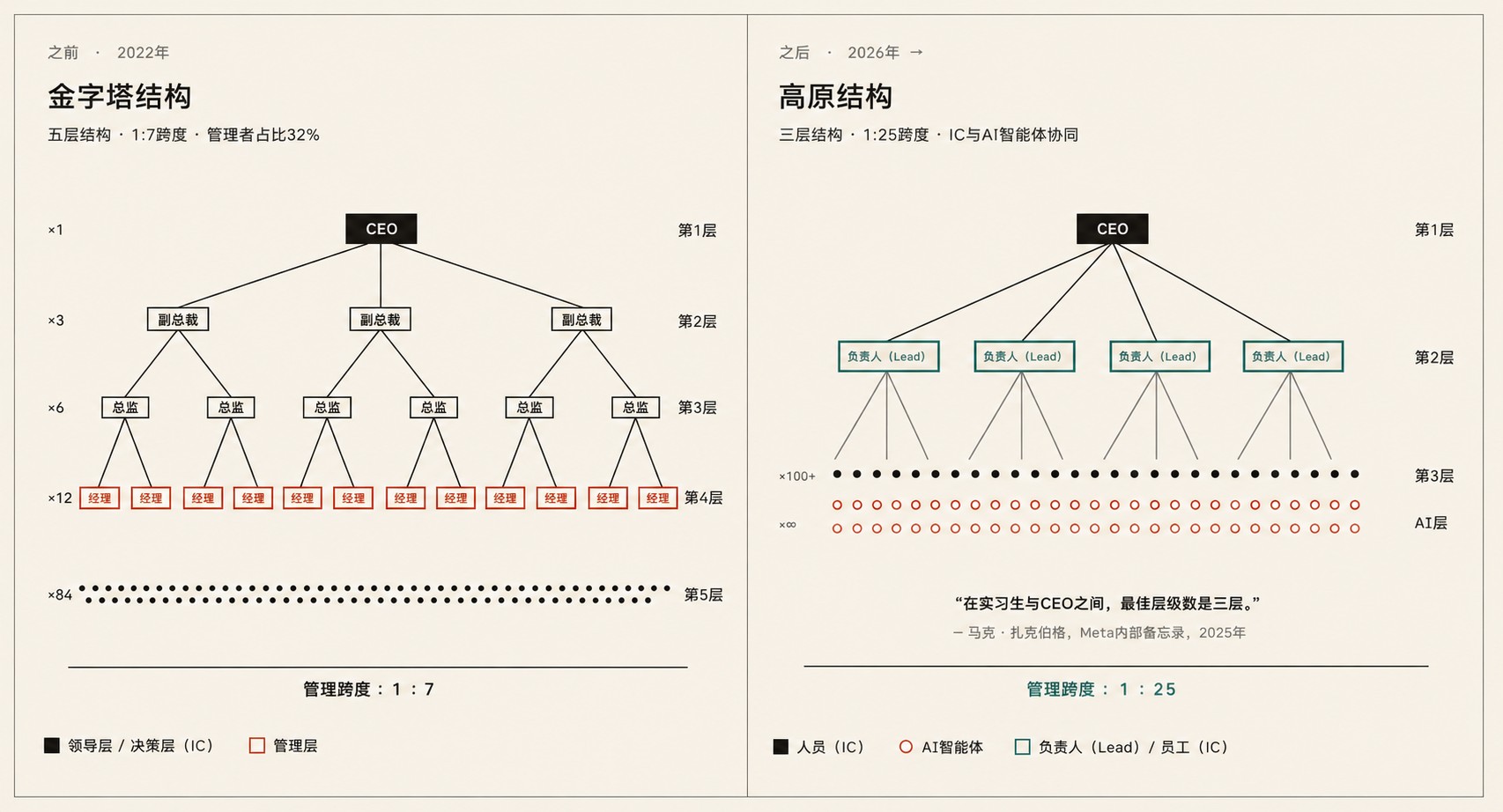
This structural change is very drastic. Two complete management layers - the directors who manage managers and many traditional engineering managers - are compressed into a "Lead" role. This role is both a technical contributor, a coordinator, and a talent buffer. Under the supervisor, the individual contributor (IC) level is expanding and is paired with resident AI agents, which handle code generation, ticket sorting, scheduling, progress reporting, and an increasing number of autonomous tasks.
This form will bring three consequences. First, decision - making speed is accelerated due to fewer reporting steps. Second, the coordination overhead falls on the supervisor, who now manages 25 people instead of 7. Finally, the rungs of the career ladder are missing - the traditional path of "individual contributor → senior individual contributor → manager → director → vice - president" has lost its middle links.
03 Span of Management: The Hidden Metric
The clearest quantitative signal of flattening is the number of people directly led by each manager. Gallup has been tracking this data annually since 2013. Its trajectory shows a one - way and accelerating upward trend.
"The era of managers managing managers who manage managers is over. Either contribute directly to the output or step aside."
- New dogma, translated from internal communications at Meta and Amazon.
04 Titles Change Faster Than Job Content
The least - reported part of this story is about the titles themselves. Jobs haven't disappeared - most of them have been reallocated and renamed. The following table maps the roles that were abundant in 2022 to their evolved forms in 2026.
Engineering Manager (managing 8 people) → Technical Supervisor / Player - Coach (managing 15+ people)
Spend 30% - 50% of the time writing code. The coaching method has changed from synchronous one - on - one interviews to asynchronous code reviews. Career development conversations have changed from once a week to once a quarter.
Senior Director → Functional Supervisor / General Manager
Two layers of subordinates are merged into one. The role is more strategic and less focused on personnel management - more like the owner of a small business unit.
Senior Recruiter → Talent Partner / Channel Engineer
Search, screening, and scheduling are driven by AI. The human role is narrowed to securing senior employees and managing AI prompts and strategies.
Customer Support Representative → Customer Experience Upgrade Specialist
The first - level support has disappeared. The remaining humans only handle the escalated issues submitted by robots - which means each call is more difficult and the cognitive load of each ticket is higher.
QA Engineer → AI Evaluation Engineer
Less hand - written testing, more building and maintaining evaluation pipelines to detect regressions, hallucinations, and policy violations in AI output.
Junior Developer → Apprentice / Usually Laid Off
The industry is dividing. Most companies are cutting entry - level positions. A very small number of companies (most notably IBM) are tripling their efforts to reserve them as future leadership talent.
Project Manager → Project Supervisor / Agent Orchestrator
Coordinate humans and AI agents in a hybrid workflow. Less focus on status tracking, more focus on the design of the team's "operating system."
Data Analyst → Insight Engineer
Kanban and regular reports are automated. The remaining work is hypothesis design, root - cause investigation, and setting new questions for AI to answer.
Database Administrator/System Administrator (On - premise) → Platform/Reliability Engineer
Traditional technology stack positions are being laid off in large numbers. The way out is to migrate to the managed cloud and adopt AI - driven incident response.
05 The 2028 Crisis
Every company pursuing flattening is making the same trade - off - sacrificing long - term capabilities for short - term profits. The cost savings are immediate and measurable, but most boards have not inquired about the due date of the price.
A 2025 study by Korn Ferry found that 37% of employees in flat organizations said they felt lost. Deloitte found that only 6% of Generation Z aspire to be executives. Companies that laid off middle managers in 2026 also dismantled the mechanism for cultivating senior leaders in 2028. The talent pool is thinning in both directions: those who should have grown into those positions have left, and those who could have taken over think the positions are not worth pursuing.
The most radical flattening implementers are betting that they can recruit talent from the outside when they need talent depth again. This bet is based on the assumption that the labor market can still spontaneously produce senior leaders without a cultivation system. This is not the case. The market situation of senior technology leaders in 2028 will be an empirical test of these current decisions.
What will replace the lost cultivation system is an open question in this cycle. Some companies are trying to establish a structured senior individual contributor (Staff - IC) path to absorb the leadership cultivation function without the need for formal management positions. Others rely on rotation programs and external coaching. Many companies do nothing - they believe that AI tools will continue to rapidly compress the workload, so that the talent reserve problem will never really break out.
This is the most powerful version of the argument in support of flattening: that AI tools will continue to absorb a large amount of coordination, prioritization, and communication translation work, so that the currently crisis - ridden leadership functions will no longer exist in their current form. And the least tenable version, which is what most companies are privately betting on: is to leave the problem to future generations.
Translator: boxi.