On the eve of Yunjing's listing, ZHANG Junbin talks about his fears for the first time: The loneliness of being the top leader is beyond anyone's understanding.
"We don't mind benchmarking against anyone, but we reject false growth."
In 2026, the floor-cleaning robot industry is experiencing a severe structural upheaval. According to data from Aowei Cloud Network, from January to April this year, the cumulative online sales volume of domestic floor-cleaning robots was only 952,800 units, a significant year-on-year decline of 21.18%. However, the average price increased by 3.58% year-on-year to 3,412 yuan, presenting a deep adjustment pattern of "declining volume and rising price".
Meanwhile, five Chinese brands, including Roborock, Ecovacs, Dreame, Xiaomi, and Yunjing, have monopolized the top five positions in global shipments, forming a "Chinese Legion" monopoly. However, as the industry concentration continues to tilt towards the top players, the competition has not cooled down at all, with DJI and other strong players entering the market.
Yunjing is standing at the crossroads of this changing situation.
Ten years ago, founder Zhang Junbin started as a "lone soldier" in a 20-square-meter office. Ten years later, the company has entered the global top five with an annual shipment volume of 1.7 million units, with a valuation exceeding 10 billion yuan. In April 2025, it completed a $100 million Pre-IPO financing led jointly by Tencent and the Beijing Robot Industry Fund, and is now making all-out efforts to list on the Hong Kong Stock Exchange.
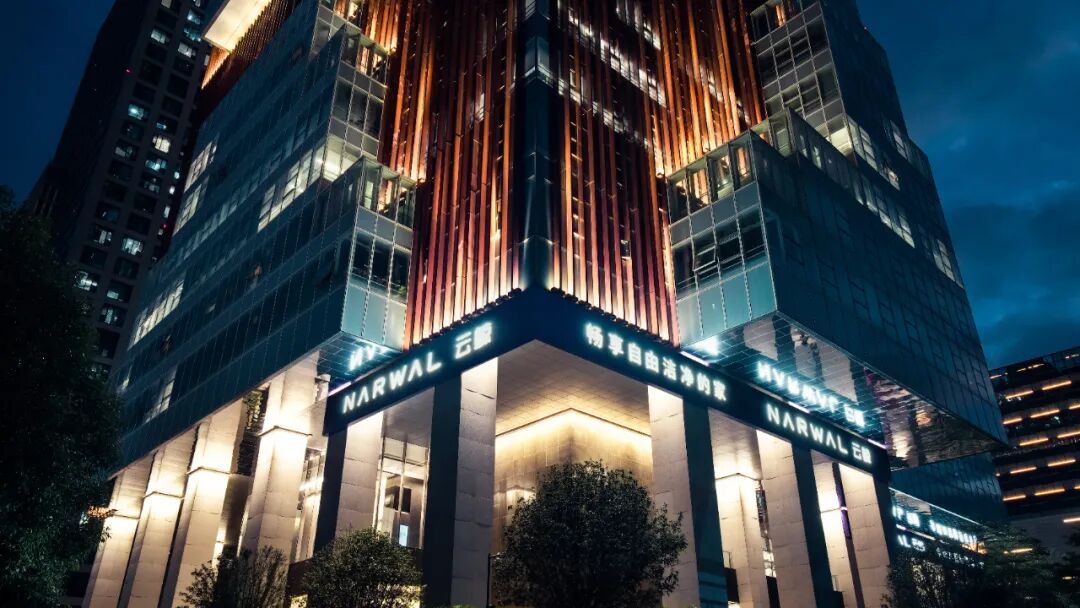
Picture | Yunjing's office building
However, beneath the spotlight, Yunjing also faces hidden challenges: In Q1 2026, its online sales market share of floor-cleaning robots declined, and core executives left the startup on the eve of the IPO. There have been continuous doubts from the outside world about "slow innovation" and "a single product line".
In the highly competitive floor-cleaning robot industry, Zhang Junbin has always been a hard-to-classify figure. He and his company have been labeled as "long-distance runners" - steady, focused, not chasing after trends, and even a bit stubborn.
Zhang Junbin's growth path has led the outside world to frequently compare Yunjing with DJI. As outstanding disciples of Li Zexiang, Wang Tao defined the global drone category with DJI, while Zhang Junbin carved out a niche in the competitive cleaning market with a floor-cleaning robot that can wash its own mop. However, Zhang Junbin said that the essence of both is the same: "We are both providing the best products for different industries." He said bluntly that entrepreneurs from Teacher Li's ecosystem all share the same characteristic - "not just a pure business machine".
This "slow" brand in the eyes of the outside world is now at a crucial juncture - its tenth anniversary and an imminent IPO. At a time when the industry is generally anxious about growth, Zhang Junbin insists: "We don't want to keep providing industrial waste to the market." In his view, growing the business at the expense of losses and boosting sales with short-term stimulants are things that Yunjing "will never do". He is even vigilant about the growth rate of some competitors: "What is real growth? If the results are not even necessarily accurate, then analyzing the reasons is not a question worth discussing."
In this in-depth conversation, Zhang Junbin rarely shed his "nice" facade. He admitted that during a system crash crisis, "customer service staff queued up to cry in the toilet". When talking about the sense of fragmentation during the executive adjustment and his position as the founder, he said bluntly that "loneliness is something that no one else can understand". However, in the face of that 1% of happiness, 99% of the pain is worth it. He said, "The core of a person is to be self-consistent", and Yunjing's way of self-consistency is to always return to the product itself.
From a geeky teenager to an end-to-end operator, Zhang Junbin describes himself as just an "entrepreneur" and is still learning to become a "qualified entrepreneur". The following is a conversation between Phoenix Tech's "Wave" and Zhang Junbin, edited without changing the original meaning:
01
On entrepreneurial growth: "The founder is naturally lonely"
Phoenix Tech: This year happens to be Yunjing's tenth anniversary. Ten years ago, you were making a prototype in a 20-square-meter office. Ten years later, the company has entered the global top five. What was the biggest surprise for you in these ten years?
Zhang Junbin: The biggest surprise was being able to grow the company to its current scale.
Looking back ten years ago, I had just graduated, and my idea was very simple: I just wanted to polish a world-class product.
I never imagined that the company would reach its current size. At that time, Teacher Li Zexiang joked that I was a "lone soldier" because I was the only one. Now, looking back, the company has one or two thousand employees.
Moreover, in the past, I only considered domestic users, but now I have to face the global market, which was never a problem I would think about ten years ago. This also applies to management. In the past, I didn't have many people to manage, but now I have to oversee everything from R & D, product development, supply chain, marketing, to logistics and services. I didn't have these concepts at that time.
Phoenix Tech: In 2016, you decided to make a floor-cleaning robot that can wash its own mop. What did the first prototype you made by hand prove? What was the moment that made you sure this could work?
Zhang Junbin: The definition of any product can be divided into two stages.
In the first stage, when communicating the product definition with users, not just one or two, but perhaps ten users are very excited, which means you have chosen the right direction.
In the second stage, when the prototype is made and handed to ordinary users for testing, and they really like it.
When you get both of these right, the product will most likely be successful.
Phoenix Tech: The product once experienced a large-scale system crash. You said your heart rate soared to 200 at that time. Can you describe that moment?
Zhang Junbin: It was a very tense and stressful process. In 2020, a software bug caused many machines to crash. Almost the entire team didn't rest much that week and was constantly fixing the bug. Some problems could be solved through an upgrade, but some machines had to be sent back to the factory. We set up seven repair production lines in one week to repair the remaining machines and send them back. This was an extremely urgent and complex task, and you weren't sure if you could completely solve the problem. However, when we faced the users sincerely and solved the complex problems one by one, it was very rewarding.
Phoenix Tech: From solving technical problems to considering the survival of the company, what was the core of this fear?
Zhang Junbin: The core of the fear came from the pressure from users. At that time, my phone was the last line for customer service. The phone was constantly ringing, and when I picked it up, people were scolding. Of course, when you make a product, you hope people will be happier. But at that moment, because of a bug, many people couldn't use the product, and the core spirit of the product was being undermined. It was the pressure from hundreds of thousands of people. At that time, our customer service staff basically queued up to cry in the toilet because of the huge pressure.
Phoenix Tech: After that crisis, the company expanded from 200 to nearly 1,000 people and implemented a division system, which means you delegated your power. What was the most difficult part of this process for you personally?
Zhang Junbin: The most difficult part in growing from 200 to 1,000 people was management. When there were 200 people, you could stand up and see everyone at a glance, and you could call most people by their names. Later, so many new faces joined, along with various executives, and everyone had different work concepts and values.
You have to hand over decision - making power to people you don't fully understand. Trust is much more difficult than management itself.
Phoenix Tech: From being fully committed to product creation to being an end-to-end operator, which moment made you feel the most lonely and misunderstood?
Zhang Junbin: In any company, the loneliness of the founder is something that no one else can truly understand.
You have to bear a lot of pressure that executives can't see. This is something that comes with the position and is unavoidable. You can't expect those around you to empathize with you, and it's not their responsibility either.
It's difficult for an excellent CEO to make everyone happy. You have to balance fairness and promote the development of the company, so your choices are bound to not meet everyone's demands. This is where the sense of loneliness essentially comes from.
Phoenix Tech: What was the most "ruthless" decision you made in these ten years?
Zhang Junbin: It might be that while many companies were expanding their product categories, we chose to focus on polishing our products.
This decision was "ruthless" because it goes against human nature. While everyone else is moving forward, you're staying put and focusing on the details. But it was also a very conflicting process.
Phoenix Tech: Have you ever cried alone after making a decision?
Zhang Junbin: (Silence) Yes.
When it's difficult to make everyone happy, it means you might have to sacrifice some people's interests to protect the interests of more people. At the moment of making that decision, my heart was very complicated. It was something I didn't want to do at the core, but I had to do it.
Phoenix Tech: In these ten years, have you ever missed out on a promising trend because of sticking to your principles and felt regretful?
Zhang Junbin: There is regret. There were fluctuations in my mind when we insisted on making only one ultimate product.
But looking back now, as long as a company adheres to its product concept and values, it can go a long way. This means that sometimes you have to make choices. In the past, there were few people and limited resources, so we had to focus. But as the organization's capabilities and talent density have improved, we have more choices. Now we have four major product categories, and our R & D capabilities are sufficient. We need to balance both speed and scale. Yunjing is already on this path.
Phoenix Tech: If you could say one thing to Zhang Junbin, who was in a 20-square-meter office with a monthly salary of just over 1,000 yuan in 2016, what would you say?
Zhang Junbin: I would tell him to go to a place with a high concentration of talents to grow quickly and never work in isolation. When you're surrounded by excellent people, your growth rate will be extremely fast. I think those years were too slow, and it should have been compressed by half.
Phoenix Tech: What expectations or promises do you have for yourself ten years from now?
Zhang Junbin: I hope to truly transform from an entrepreneur into a qualified businessperson. I'm just an entrepreneur now. After seeing many excellent businesspeople, I realize there is still a big gap between us. I should accelerate my learning from them in the next ten years.
Phoenix Tech: You once said that the core of entrepreneurship is altruistic creation. After experiencing the system crash crisis, organizational changes, and the IPO sprint, can that initial belief that helping others brings happiness still support you under today's pressure?
Zhang Junbin: Yes. If a founder doesn't have a spiritual core beyond just pursuing profit, they will probably give up during difficult times. All companies develop in a fluctuating manner. I've observed many excellent founders, and essentially, it's about passion - perhaps 99% of the time is spent making painful choices, but that 1% of the time spent doing what you love makes up for the unhappiness caused by the 99%. Without that drive, it's very difficult to get through the tough times.
02
On product strategy: "In the future, a family only needs three robots, and Yunjing will only be the cleaner"
Phoenix Tech: The sales volume of Flow 2 (also known as Xiaoyao 003 in China) increased by nearly 305% within 24 hours of its overseas debut. The term "comprehensive integration" was mentioned. What does it specifically refer to?
Zhang Junbin: It mainly refers to the comprehensive integration from product definition, project development, supply chain management, delivery node control, logistics speed selection, to marketing and market operations. In the past, things were a bit fragmented. Only by achieving comprehensive integration can we truly create products that users need and ensure stable delivery at key nodes.
Phoenix Tech: In the past ten years, you have insisted on developing products in the price range of over 5,000 yuan. If the low - end market continues to expand, will Yunjing be labeled as a "small and beautiful" brand?
Zhang Junbin: Our products in the price range of 5,000 - 6,000 yuan still have a relatively good sales volume. High - end users demand new technologies and new experiences. Yunjing's product innovation and user experience are at the forefront of the industry, so it's a natural choice to develop products that meet the needs of high - end users. However, this doesn't mean we won't develop products for the mid - and low - end markets. The demands in each price range vary greatly, and we will provide products with good experiences that are suitable for each price range based on their core demands.
Phoenix Tech: You said you don't pursue ineffective scale. From March to April this year, without any subsidies, your revenue and gross profit reached a record high. What are the difficult, labor - intensive, and dirty jobs that outsiders can't see?
Zhang Junbin: There are too many.
First of all, we have to be extremely strict with product costs. In fact, our investment in the cost of many functions is higher than the industry average, with higher standards for materials, technology, etc. In theory, products with better functions should be sold at a higher price, but this isn't always obvious.
Secondly, we need to be efficient in marketing. We need to find accurate users outside the platform and optimize the in - platform advertising system step by step.
Thirdly, we have to tackle the difficult task of expanding sales channels. In the past, we mainly focused on online sales. Now we attach great importance to distribution and