The new product war on Pinduoduo
01 Stop Comparing Prices
New products are always in the spotlight in the traditional retail industry.
Costco replaces about 30% of its products every year to ensure that the 4,000 SKUs in its stores always remain fresh. 7-Eleven updates about 70% of its SKUs annually, and the lifecycle of fresh food products is usually only 2 - 4 weeks. Before each new product launch of Xiaomi cars, Lei Jun becomes the most enthusiastic salesman. For players in the automotive industry, the success or failure of new products directly affects the survival of the brand. The setback of the MEGA series once pushed Li Auto into a trough.
However, in the e-commerce field, the "status" of new products has long been subordinate to price. Low price is the most prominent label of e-commerce platforms and the most direct reason for many consumers to choose them. This has made many merchants actively or passively join the price war and then fall into endless homogeneous competition.
An counter - intuitive phenomenon is happening: more and more small and medium - sized merchants are using new product R & D to fight against the price war.
Clothing merchants are promoting new products on various platforms as vigorously as promoting a movie. From fabrics and craftsmanship to sample displays, they spare no effort to show that the new products are "worth it". More and more new products are emerging on Pinduoduo. Since around 2025, the trend has become more obvious: Mengniu launched a co - branded pure milk with "Ne Zha", and 100,000 pieces were sold out as soon as they were launched; Dabao launched an A - alcohol skin - rejuvenating lotion targeting young people, and the sales reached tens of thousands of bottles soon after its launch.
The reason is that e - commerce competition is entering a new paradigm. GMV is no longer the only criterion for judging success or failure, and the industry has entered a long - term narrative. Both merchants and platforms are trying to stay away from the price war because it will lead to homogeneous competition, which in turn causes redundancy and low quality on the supply side.
New products are like a ladder to escape. They are naturally more likely to attract attention, and users also have higher price expectations for them. Therefore, in the competition around new products, price is not the most important factor. Factors such as material, taste, design, and freshness are the keys to appealing to people.
A sufficiently successful new product can bring a new narrative for the enterprise. When Steve Jobs took out the iPhone in January 2007, the market was not optimistic. Nokia engineers laughed at its touch - screen design, and the co - CEO of BlackBerry thought it would not have any real impact, "except perhaps some media effects".

In the face of innovators, the past experience of the industry is often an obstacle to be discarded. In an era when the mainstream mobile phones were priced at $99, the iPhone, priced at $500, sold more than 1.4 million units within half a year of its launch, exceeding most people's expectations. The following story is well - known to everyone.
However, the other side of new products is risk.
Samsung once positioned the Note 7 as a direct challenger to the iPhone 7 and invested huge resources in breakthroughs in functions such as the screen, S Pen, and waterproofing, piling up a large number of radical features. As a result, due to a battery design defect, 35 explosion accidents occurred globally. Eventually, the product was recalled and production was stopped, resulting in a direct loss of more than $10 billion. Under the competitive pressure of Pepsi, Coca - Cola launched New Coke with an innovative flavor in 1985, which received numerous complaints and was even criticized as "betraying the American spirit". Eventually, it was forced to be discontinued, wasting $40 million in R & D and millions of dollars in marketing expenses.
The fear of risk is an important reason why many small and medium - sized merchants are reluctant to easily develop new products. Large companies can bear the consequences of multiple new product failures because the rewards of a successful new product are enough to cover all losses and even bring extremely imaginative profit margins and future prospects. However, small and medium - sized merchants are vulnerable, and a single new product failure may wipe out everything.
Therefore, many people prefer to copy popular products, offering lower - configuration products at lower prices to boost sales. However, although this choice seems to have higher certainty, it is doomed to be unsustainable. Low - price and low - quality products are difficult to generate effective repurchases, let alone user stickiness.
The value of new products is thus being re - examined.
02 New Products Equal Demand
The late founder of Japan's 7 - Eleven, Toshifumi Suzuki, had a classic assertion: Our competitors are not our peers, but the ever - changing customer needs.
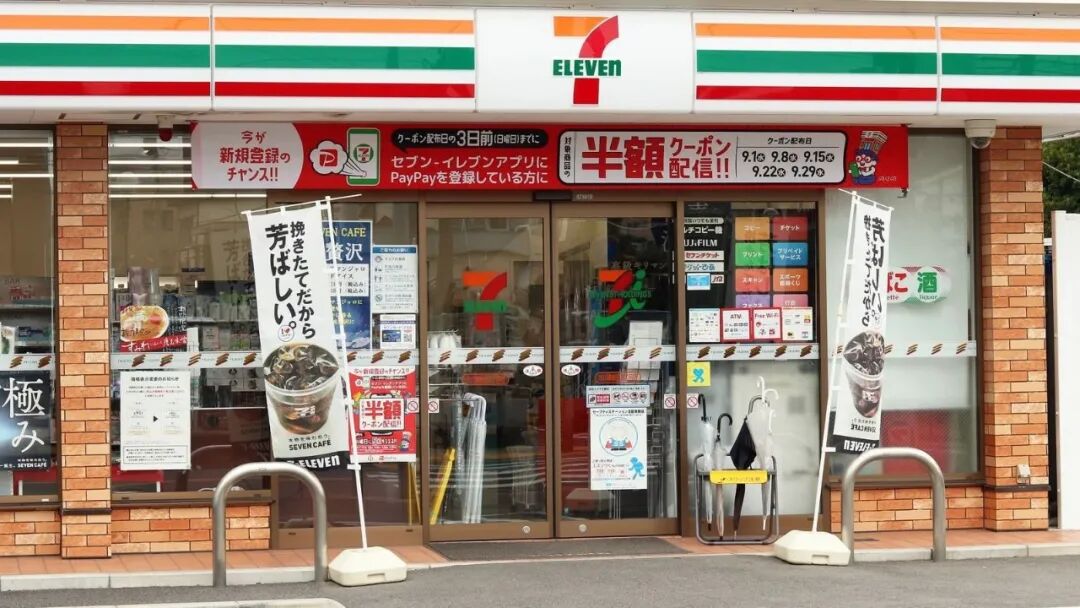
Globally, successful consumer brands are extremely good at capturing changes in consumer demand. Pop Mart has grasped the anchor point of emotional consumption, and Luckin has understood the real coffee - drinking habits of Chinese consumers. When Lululemon was founded in 1998, yoga was still a niche activity and was not valued by traditional sports brands such as Nike and Adidas. However, the founder found that middle - and upper - class women needed a product that could not only be used for fitness but also showcase a lifestyle. Subsequently, he firmly associated his brand with labels such as self - discipline, health, and the middle class, making it popular around the world.
The same is true for the popular new products on Pinduoduo. When young consumers began to pay attention to anti - aging, Chando launched the Purple Bottle Essence; when young people fell in love with Hanfu, a children's clothing factory in Foshan put children's Hanfu on the shelves. Their efforts have all received tangible performance rewards.
A certain business is the most important consideration for merchants when choosing a new - product platform. This choice is as simple as a child choosing between candy and pills.
Of course, the specific factors to be considered also include the input - output ratio, profit, etc. All e - commerce platforms are actively embracing new products, but the costs that merchants need to pay on different platforms vary. For example, some platforms require merchants to buy advertising space first, optimize keywords, and invest in direct - access vehicles, spending money before making money. Some platforms require good content for promotion to guide conversions - not all merchants are good at taking beautiful pictures.
At present, a group of merchants have achieved certain sales of new products on Pinduoduo.
For example, there are many new product SKUs in the "10,000 - person Group Purchase". For merchants, this is like a ticket to certainty: participate in the 10,000 - person group purchase to boost sales - meet the threshold for the 10 - billion subsidy - enter the 10 - billion subsidy to get more traffic - achieve a positive cycle. In the past three years, many products of Supor have become popular on Pinduoduo in this way.
The key to certainty lies in Pinduoduo's platform logic, which is to collect and batch different demands.
In short, it is "from the crowd and back to the crowd". The scattered personalized demands of the crowd are collected by Pinduoduo, produced by merchants, and finally returned to each specific person in the form of packages. Merchants get business, and users have their demands met.
Take the "10,000 - person Group Purchase" as an example. During the group - buying process, merchants can obtain rich data, including but not limited to: user preference, main target groups, geographical distribution, etc. This greatly reduces the uncertainty in the production and sales process.
New products born based on big - data methods are themselves the products of market consumer demand, so the probability of "missing the mark" is lower.
03 The Way of Differentiated Survival
All successful new products need to have a strong enough difference - whether compared with the brand's past products or similar products of other brands. So Apple got rid of the mobile phone keyboard, and there are always products you've never seen on the shelves of membership - based stores like Costco and Sam's Club.
In a market with sufficient supply, the importance of difference is even higher. Psychologist Herbert Simon mentioned in the "Bounded Rationality Theory" that in an information - overloaded environment, consumers do not look for the optimal solution but for options that are good enough and easy to identify. Only a strong enough difference can trigger human curiosity and create a connection.
This is one of the current dilemmas in the e - commerce industry.
As the industry has developed to date, almost no product cannot be purchased online. When the e - commerce supply is sufficient, "differentiation" will become the focus of competition in the new stage.
However, this is a topic that is easier said than done. The ultimate dilemma in business competition is that any successful innovation will be quickly imitated. The developed supply chain formed in China in the past few decades has further lowered the technical threshold for imitation. For example, in the clothing industry, within three days after a popular product comes out, there may be imitations all over the Internet. This means that merchants not only need to launch new products with strong enough differences to directly attract consumers but also build deeper moats around new products.
A well - proven path is to build consumer perception.
When Steve Jobs returned to Apple in 1997 to save the company on the verge of bankruptcy, he did an important thing: he produced and released the famous "Think Different" advertisement, spreading the concept of differentiation before the differentiated products were launched.
Pepsi has been competing with Coca - Cola for many years but has never been able to shake the latter's position as the "authentic" brand. It had to change the track, emphasizing that it is the choice of young people and opening up a new market through distinct differentiation. The root cause is that Coca - Cola has become a label of American culture.
Of course, most small and medium - sized merchants do not have the ambition and strength of Coca - Cola. Fortunately, the stratification of consumption is bringing more obvious benefits. From new Chinese - style products, trendy toys to the otaku economy, more and more niche demands have become independent businesses, giving many small and medium - sized merchants the opportunity to take root in vertical tracks and build consumer perception on a small scale. In essence, this is a re - discovery of "human needs".
Sharp - eyed merchants have adjusted their strategies. "Ordinary products can only compete on price. It's boring and has no future," a jade seller told us. He chose the Hetian jade track. At first, he made everything from bracelets and pendants to necklaces. Now, he is gradually focusing on delicate bracelets popular among young women, with the price range set between $1000 - $2000. Each bracelet is hand - strung by a designer with an art background, emphasizing color - matching art, and each combination can find a corresponding element in traditional Chinese paintings, highlighting the beauty of Chinese style.
Continuously creating new products and strengthening consumer perception is bound to be a slow process. However, the moat formed in this way can also help more merchants survive through the cycles.
The e - commerce industry is accelerating its reshuffle.
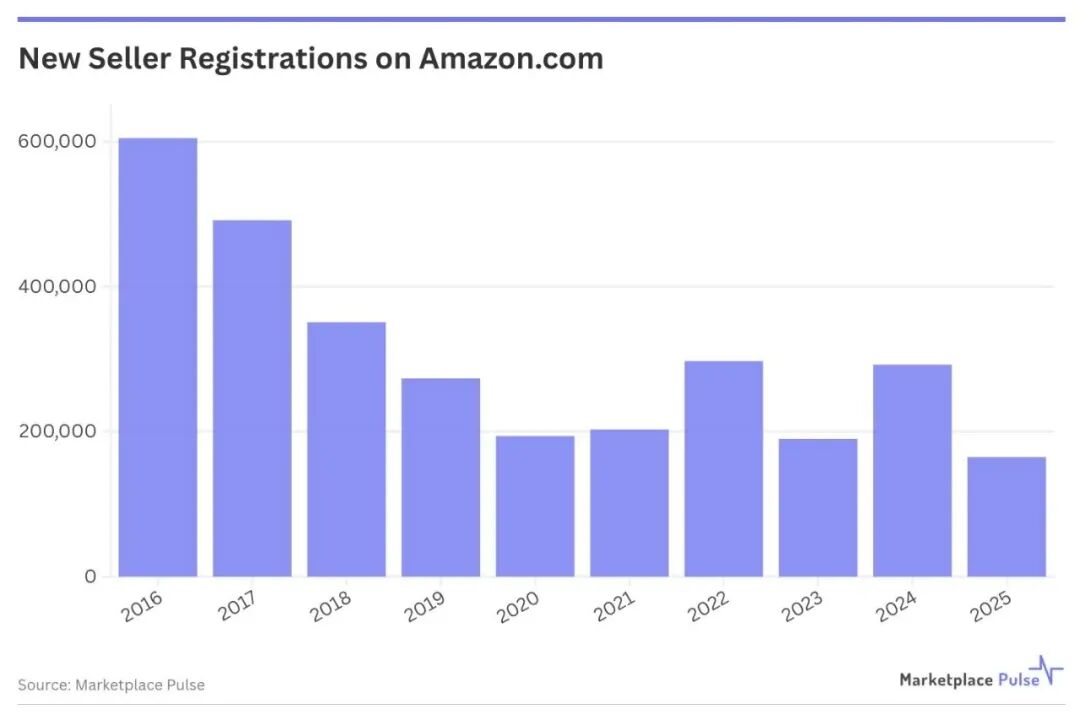
Data from the cross - border e - commerce research institution Marketplace Pulse shows that in 2025, only about 165,000 new sellers registered on Amazon globally, a 44% decrease from 2024, hitting the lowest level in nearly a decade since statistics began in 2015. At the same time, the number of sellers with an annual platform revenue of over $1 million exceeded 100,000, nearly doubling compared with about 60,000 in 2021. That is to say, the high - difficulty mode of e - commerce business is discouraging more ordinary people. However, the excellent players remaining in the market are getting more generous profits.
The competition in the domestic market is also fierce. Financial report data shows that the number of active merchants on Pinduoduo has increased from 1 million in 2017 to 16.8 million in 2025, an 17 - fold increase in 8 years. However, Pinduoduo is also supporting innovative merchants. Programs such as the support for high - quality new merchants, 10 - billion reduction, and 100 - billion support launched in recent years have revealed its desired direction of evolution.
This seems to be something that Pinduoduo has to do. It has gathered a rich enough supply and demand. When homogeneity is broken and more new demands are met, the supply side will also complete a silent upgrade - and Pinduoduo's own evolution should also follow.
This article is from the WeChat official account "Shannong Xiashan", author: Yuan Wen, published by 36Kr with authorization.