Understand Meta's 2026 Annual General Meeting at a Glance: Zuckerberg Bets Big on Four AI Directions, All Ten Shareholder Proposals Rejected
On May 27, local time in the United States, Meta's 2026 annual general meeting of shareholders was held online. More than 92% of shareholders with voting rights either attended the meeting in person or sent representatives to participate. At the meeting, shareholders voted on two board proposals and ten shareholder proposals.
The preliminary voting results showed that all 12 directors nominated by the board were re - elected, and the appointment of Ernst & Young for auditing received more than 99% support. All 10 shareholder proposals were rejected, with the highest support rate for one proposal being only 27%.
Subsequently, Mark Zuckerberg spent most of the time explaining his AI strategy. He divided the opportunities into four directions: using AI to improve core applications and advertising, creating personal AI agents, creating business agents, and developing AI hardware. The capital expenditure in 2026 is between $115 billion and $135 billion, almost twice that of last year. He said this was "the most exciting moment in 20 years."
The following are the core contents of this annual general meeting of shareholders:
01 Board Proposals: 12 Re - elected, Audit Appointment Almost Unanimously Approved
Proposal 1: Election of 12 Directors
All 12 director candidates were re - elected, with each receiving more than 82% support. This means that Zuckerberg, Chief Independent Director Robert Kimmitt, and other board members will continue to serve until the 2027 annual general meeting of shareholders.
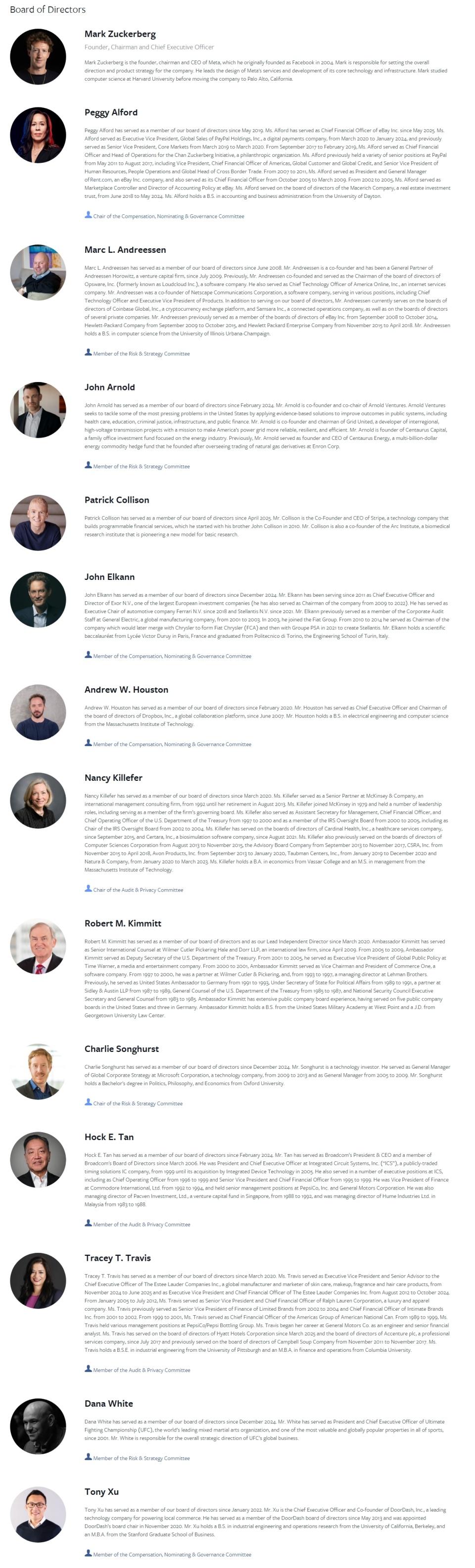
Meanwhile, two long - time board members left the board. Hock Tan and Tracey Travis officially retired after this meeting.
Proposal 2: Approval of Ernst & Young as the Independent Audit Firm
This proposal received more than 99% support, with less than 1% of votes against. The Audit and Risk Oversight Committee recommended Ernst & Young LLP as the independent registered public accounting firm for the 2026 fiscal year, and shareholders had few objections.
02 All 10 Shareholder Proposals Rejected, Highest Support Rate 27%
Proposal 3: Report on Risks of AI Data Use
Proposer Paul Chesser spoke on behalf of the National Legal and Policy Center. He asked Meta to issue an annual report clarifying whether the management is aware of the following risks: how Meta obtains external data, how it uses this data to train AI, and what legal, financial, regulatory, and public welfare issues are involved.
Chesser presented several sets of figures. Meta's capital expenditure plan for 2026 is between $115 billion and $135 billion, almost twice that of last year, with most of it going towards AI infrastructure. He said Meta has revised its privacy policy, allowing users' pictures, videos, and text to be used for AI training without their explicit consent. He quoted Meta's own statement: "When a user or someone else in a chat chooses to share these messages," private chat content can also be used for AI training. Chesser believes this is a structural loophole - as long as one person in a chat clicks to share, the information of others will also be collected by Meta, and those people have not given separate consent.
He also mentioned two cases in March this year. A jury in New Mexico awarded $375 million against Meta. A jury in California found that Meta and Google were negligent in their product design, which was harmful to minors. Additionally, Meta was fined 1.2 billion euros for illegally transferring user data out of Europe, and the settlement for the Cambridge Analytica lawsuit was $725 million.
The board opposed this proposal, stating that Meta's existing privacy protection practices, information disclosure, and committee oversight are sufficient.
Voting result: Approximately 10% in favor, 90% against. The proposal did not pass.
Proposal 4: Annual Vote on Executive Compensation
Proposer John Chevedden asked Meta to hold an annual "say - on - pay" vote to determine whether executive compensation is reasonable.
Currently, Meta's next shareholder vote on executive compensation will not take place until 2028. This means that from now until 2028, shareholders have no say in this area during these years. Chevedden said, "Without an annual vote, Meta can pay excessive compensation to executives in years when shareholders have no say."
The board opposed this proposal but did not elaborate on the reasons at the meeting.
Voting result: Approximately 27% in favor, 73% against. This was the proposal with the highest support rate among the 10 shareholder proposals today.
Proposal 5: Abolish the Dual - Class Share Structure
Proposer Tammy Rodriguez spoke on behalf of NorthStar Asset Management. Her daughter, Selena Rodriguez, died at the age of 11, and her death was related to Instagram addiction.
Rodriguez mentioned that in March 2026, juries in Los Angeles and New Mexico found that Meta knowingly took advantage of children's vulnerabilities. Internal documents presented in court showed that Meta researchers wrote, "Instagram is a drug. We're basically drug dealers."
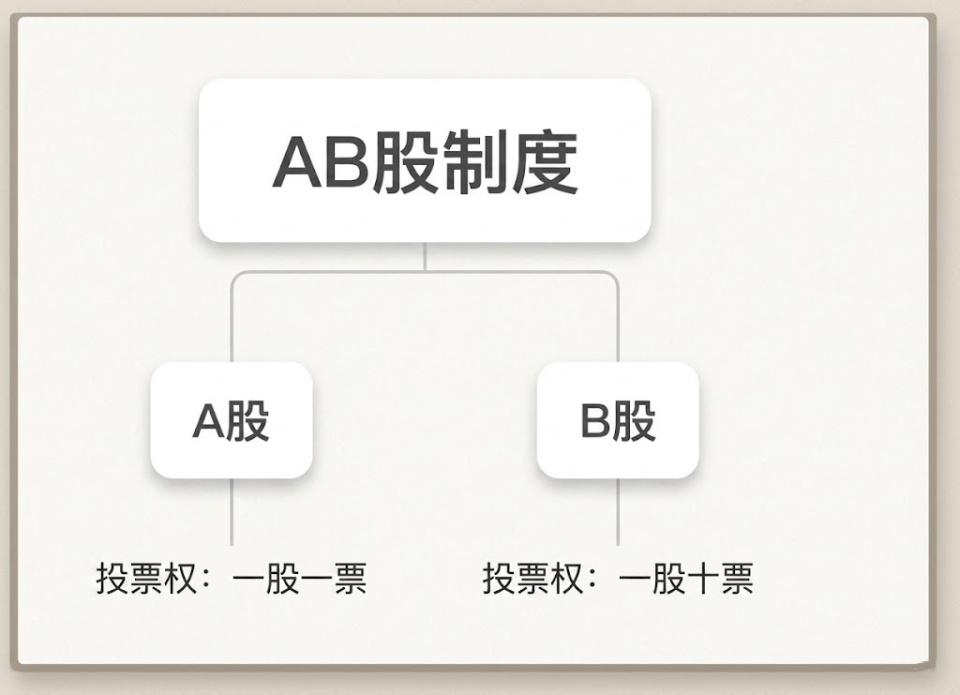
Meta's current share structure is as follows: Class A shares have one vote per share, while Class B shares have ten votes per share. According to the 2025 proxy statement, Zuckerberg owns approximately 99.8% of the issued Class B shares and controls approximately 61% of the total voting rights, although he only represents approximately 14% of the economic ownership.
The board opposed this proposal but did not elaborate on the reasons.
Voting result: Approximately 26% in favor, 74% against. The proposal did not pass.
Proposal 6: Disclose Voting Results by Share Class
Proposer Marissa Martinez spoke on behalf of the Illinois State Treasurer's Office. She asked Meta to disclose voting results separately for Class A and Class B shares. Her reason is that currently, Class A shares have one vote per share, while Class B shares have ten votes per share. Based on an analysis of the 2024 and 2025 votes, many shareholder proposals received majority support among Class A shareholders, including disclosing voting results by class, eliminating the dual - class share structure, issuing a report on the impact of child safety, and issuing a report on the risk of misinformation in generative AI. However, they failed overall due to the concentrated voting power of Class B shares.
The board opposed this.
Voting result: Approximately 20% in favor, 80% against. The proposal did not pass.
Proposal 7: Report on Human Rights Due Diligence in Conflict Areas
Proposer Fatine Al - Rwan is a Palestinian journalist. She said her content was deleted, her live broadcasts were cut off, and her account was suspended because she recorded the actual situation in Palestine. She mentioned that there are problems with Meta's content moderation in Myanmar, Tigray, and Gaza. She asked Meta to issue an independent public report to evaluate the company's human rights due diligence in conflict areas.
The board opposed it.
Voting result: Approximately 4% in favor, 96% against. The proposal did not pass.
Proposal 8: Report on Anti - Semitism and Hate Issues
Proposer Dani Nurik spoke on behalf of JLens. JLens is a Jewish investor network and an affiliate of the Anti - Defamation League. She asked Meta to issue a report to evaluate the effectiveness of its policies and practices in addressing anti - Semitism and other forms of hate. She pointed out that a similar proposal last year received more than 46% support in the votes of independent shareholders.
She mentioned that Meta decided to withdraw its third - party fact - checking program in 2025. As of April 15, 2026, there were 105 accounts on Instagram related to the white supremacist Groyper network, with a total of more than 1.4 million followers, regularly posting content denying the Holocaust, anti - Semitic conspiracy theories, and pro - Hitler content. Accounts listed as foreign terrorist organizations (including ISIS and Al - Qaeda) still had more than 340,000 followers. When this content was reported, Instagram only deleted 7% of it.
The board opposed it.
Voting result: Approximately 7% in favor, 93% against. The proposal did not pass.
Proposal 9: Report on Climate Change Commitment
Proposer Katie Carter spoke on behalf of the Presbyterian Church (U.S.A.) and As You Sow. She asked Meta to issue a report explaining how it will fulfill its climate commitments regarding greenhouse gas emissions in the context of the increasing energy demand of AI and data centers.
She presented several sets of figures: Since 2019, Meta's direct emissions from data center energy use have increased by 223%. American utility companies are responding to Meta's electricity demand by reneging on climate commitments, expanding fossil fuel infrastructure, and delaying the closure of coal - fired power plants. Meta is also building its own on - site methane gas plant. She believes that Meta's data center energy consumption exceeds its efforts to increase renewable energy, which may endanger the achievement of the net - zero goal by 2030.
The board opposed it.
Voting result: Approximately 7% in favor, 93% against. The proposal did not pass.
Proposal 10: Incorporate Child Safety into Executive Compensation
Proposer Kelly Stonelake served as a director at Meta for nearly 15 years. She asked Meta to issue a report evaluating the feasibility of incorporating child safety improvements into Meta's executive compensation plan.
Stonelake listed several recent lawsuits and fines, including a $375 million judgment in New Mexico, a potential maximum fine of $12 billion in the EU, and the advancement of social media restrictions for minors in at least 15 countries. She also mentioned that independent tests found that only 8 out of 47 adolescent safety features worked as described.
The board opposed it.
Voting result: Approximately 3% in favor, 97% against. The proposal did not pass.
Proposal 11: Data Protection Impact Assessment of Generative AI
Proposer Lydia Kuykendal spoke on behalf of Mercy Investment Services. She asked the board to oversee a data protection impact assessment.
She pointed out that on October 1, 2025, Meta announced that it would "start using Meta AI to improve recommendations on our apps" starting from December 16. This means that the company will collect data from users' daily conversations with AI chatbots, including private details of personal life, relationships, health, and beliefs. Users cannot completely opt out of this monitoring.
She cited data: 97% of Meta's $36.5 billion in revenue in the first quarter of 2024 came from advertising. She said that in March, a jury for the first time found that social media apps should be considered defective products because they were designed to take advantage of the developing brains of teenagers. She also mentioned that Meta recently announced that it would use tools to track employees' work activities, such as recording keystrokes, mouse movements, and screen content, to train AI, and employees cannot opt out.
The board opposed it.
Voting result: Approximately 7% in favor, 93% against. The proposal did not pass.
Proposal 12: Report on the Risk of H - 1B Visa Abuse
Proposer Steven Milloy spoke on behalf of the National Center for Public Policy Research. He asked Meta to issue a report explaining the risk of "anti - American discrimination" caused by the abuse of the H - 1B visa program. He believes that the H - 1B visa is not used to fill real skill gaps but is a mechanism for employers to obtain cheap labor.
He presented figures: In 2023, the average salary of new H - 1B workers in the technology industry was approximately $99,000, 25% lower than the median salary of $132,000. He believes this has led to a slowdown in the wage growth of American workers and forced experienced American engineers to leave the industry.
The board opposed it.
Voting result: Less than 1% in favor, 99% against. The proposal did not pass.
03 Zuckerberg Explains AI Strategy: Four Directions
Zuckerberg divided the AI strategy into four directions at the meeting.
First, improve core applications and advertising. He said AI has already made sorting, recommendation, and content understanding better. "In Meta's history, for the first time, we will be able to not only observe statistical patterns but also build a principled understanding of what you care about and the actual content of each piece of content to show you more useful things." In terms of advertising, AI has improved targeting and creative generation capabilities. "The trends in the past few years seem to indicate that we are seeing increasing returns."
Second, personal AI agents. Zuckerberg said his view is different from that of many in the industry. "I've heard many people say that AI will replace humans, but I think AI will actually amplify people's ability to do what they want to do, such as helping to improve health, learning, relationships, and achieve personal and professional goals. In the future, people will become more important, not less important." He envisioned that in the future, everyone will have an AI agent. There will be a free version supported by business and advertising revenue, as well as a paid - subscription premium version with more computing power and more functions.
Third, business agents. As of April this year, the number of weekly conversations with Meta's business AI has increased tenfold since the beginning of the year. Currently, this service is free for most businesses, but Zuckerberg said the company will find a way to turn it into a long - term business.
Fourth, AI hardware. Zuckerberg specifically mentioned AI glasses. The number of daily users has tripled year - on - year, and he called it "one of the fastest - growing consumer electronics categories in history." The Ray - Ban Meta Optics launched this year is designed for all - day wear, and there will be new partners later. He believes that the 1.5 to 2 billion people around the world who wear glasses will eventually switch to AI glasses, and subscription services and premium features will be future sources of revenue.
Regarding the Profit Model
A shareholder asked: Besides advertising, how does Meta make money when others use your AI?
Zuckerberg's answer: Personal agents may have subscriptions, and business agents can take a cut from each sale; AI hardware can be sold, and there are also related subscription services.
Regarding cloud services, Zuckerberg said that almost every week, companies approach Meta, either asking Meta to provide API services or directly buying computing power. He admitted that these demands exist, but currently, Meta needs this computing power for its own AI construction, so it has not sold it externally. However, he also left the option open: if there is excess computing power in the future, selling it to others is an option.
Regarding Costs and Returns
A shareholder asked: When will the infrastructure and operating costs stop growing faster than revenue and return to the previous high operating leverage?
Zuckerberg responded that Meta does not manage its business based on a specific profit - margin target but focuses on long - term profit growth. He admitted that the revenue from AI "has not fully come in," but AI is already improving the core business. He said that Meta's model is to first create products that users like, confirm the retention rate, then distribute them on a large scale, and finally monetize them. Currently, the company is still in the stage of heavy investment in infrastructure and model building.
Regarding Muse Spark and Meta AI
