New Aauto users don't want to see each other every day.
On May 27th, Kuaishou released its financial report for the first quarter of 2026.
On the surface, it was slightly better than expected: the revenue reached 33.7 billion yuan, exceeding analysts' expectations by 0.9%; the adjusted net profit was 3.374 billion yuan, surpassing expectations by 11.3%; the monthly active users reached 772 million, hitting a new historical high.
However, what really deserves attention is not these few "better - than - expected" figures, but the DAU/MAU ratio. In the first quarter, Kuaishou's DAU/MAU was 53.5%, 3.7 percentage points lower than the market expectation, and it was the single - item indicator with the largest miss in the entire report.
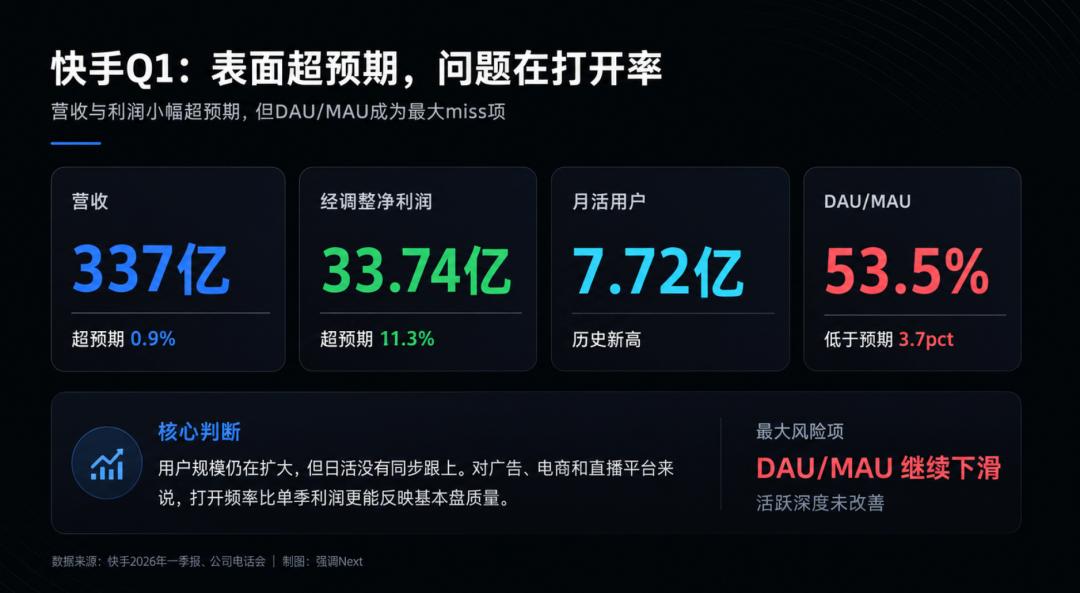
This means that although Kuaishou's user scale is still growing, the frequency of user opening and the depth of user activity have not improved synchronously. For a content platform that relies on advertising, e - commerce, and live - streaming for monetization, this is a bigger problem than a decline in single - quarter profit.
1
The decline of live - streaming and the continuous ebb of the "Laotie" economy
Live - streaming was Kuaishou's earliest commercial pillar and an important label that distinguished it from Douyin.
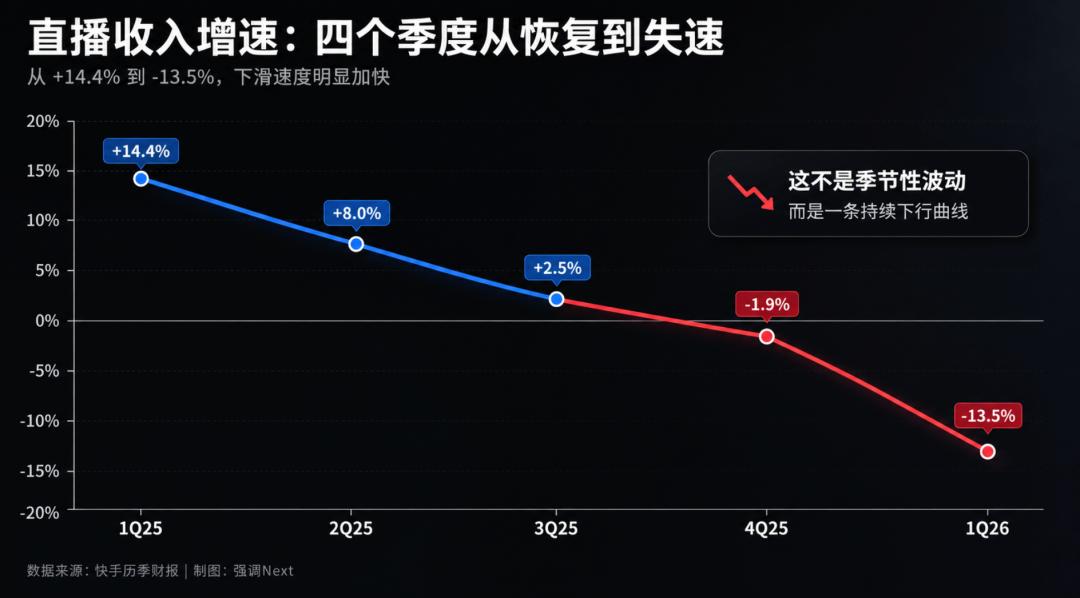
A year ago, Kuaishou still emphasized in a conference call that its live - streaming revenue increased by 14.4% year - on - year, calling it a signal of "restoring the positive growth trend". However, after four quarters, this figure has dropped to - 13.5%.
The growth rate trajectory of live - streaming revenue is very clear: it was + 14.4% in Q1 2025, + 8.0% in Q2 2025, + 2.5% in Q3 2025, - 1.9% in Q4 2025, and - 13.5% in Q1 2026. This is not a seasonal fluctuation but a continuous downward curve, and the decline speed is accelerating.
In its early days, Kuaishou established a commercial closed - loop relying on the "Laotie" economy, the guild ecosystem, and reward sharing. This model supported the platform's early growth and also formed a differentiating point in users' minds. However, now, this basic market is shrinking.
In a broader context, live - streaming rewards are no longer the growth center of content platforms. Douyin shifted its business focus to e - commerce and advertising early on, and the revenue share of live - streaming in the ByteDance ecosystem has been continuously diluted. Kuaishou adhered to the live - streaming narrative for a longer time and is now under more obvious pressure.
When the industry as a whole migrates towards the e - commerce and advertising internal circulation, platforms that still rely on the reward model will inevitably reach their growth ceilings earlier.
2
772 million monthly active users: the quality depends on retention
In the first quarter, Kuaishou's monthly active users reached 772 million, with a net increase of 31 million in a single quarter, hitting a new historical high. The management's explanation mainly pointed to the Spring Festival: in the first quarter, a series of intensive content and activity plans were carried out around the Spring Festival, which boosted the user scale in the short term.
This explanation is reasonable, but it also brings another problem: users attracted by festivals often have weaker retention. Whether the newly - added monthly active users can be converted into stable daily active users determines the quality of this round of growth.
In the first quarter, Kuaishou's daily active users were 413 million, with only an increase of about 5 million compared to the previous quarter, a growth rate of 1.2%, significantly lower than the growth rate of monthly active users. The DAU/MAU dropped from 55.0% in Q4 2025 to 53.5%, indicating that a considerable number of monthly active users only open the app occasionally and have not formed a high - frequency usage habit.
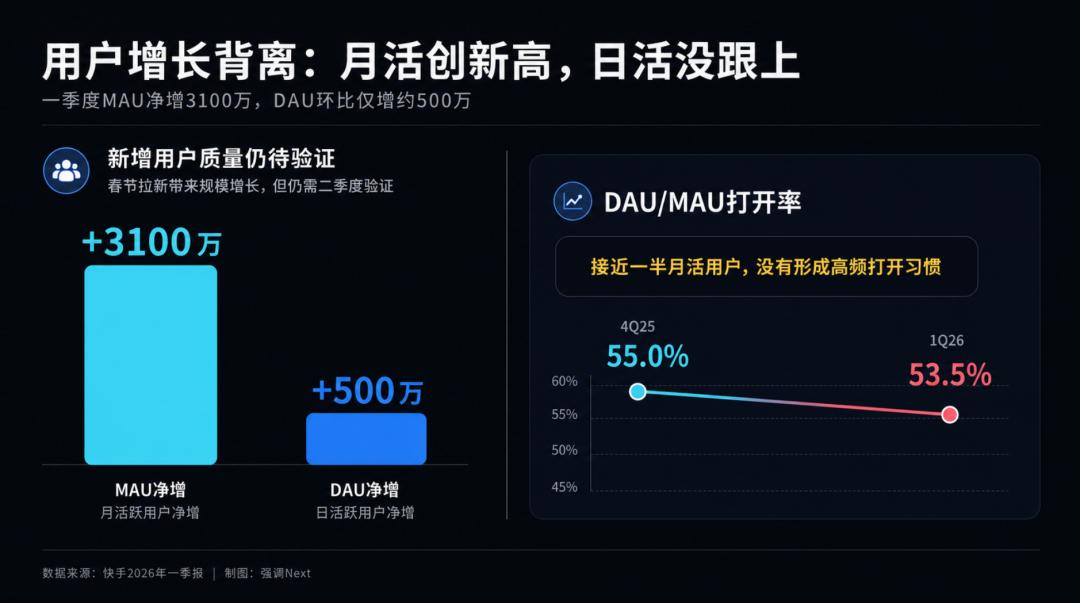
For advertisers, this is crucial. The user scale is just an entry point, and the frequency of opening and the depth of stay determine the advertising value.
Bilibili is a comparable example. In Q1 2026, Bilibili's DAU was 115.2 million, a year - on - year increase of 8%; its MAU was 376 million, a year - on - year increase of 2.2%; the average daily usage time of users reached 119 minutes, an increase of 11 minutes year - on - year. Bilibili's DAU/MAU is about 30.6%, seemingly lower than Kuaishou's. However, Bilibili is a mid - video community, and users don't need to open it every day. More importantly, Bilibili's DAU, usage time, and advertising revenue are all growing.
In contrast, Kuaishou has an increasing MAU, stagnant DAU, and a declining opening rate.
This is also reflected in the commercialization results. Kuaishou's advertising revenue increased by 9.3% year - on - year in the first quarter, while Bilibili's advertising revenue increased by 30% year - on - year and has maintained high - speed growth for 13 consecutive quarters. The difference in user activity depth will ultimately be reflected in advertising revenue.
The comparison with Xiaohongshu is more straightforward. Xiaohongshu has about 350 million monthly active users, less than half of Kuaishou's. However, its advertising revenue in 2025 was about 32 billion yuan, and the advertising value per monthly active user was about 91 yuan, nearly twice that of Kuaishou. The reason is simple: Xiaohongshu users come with search and purchase intentions, and the attention in active scenarios is more valuable.
Scale is not the only variable for advertising value. What users want to do when they open the platform is a more crucial variable.
3
The e - commerce GMV is no longer disclosed, but the slowdown persists
Kuaishou's e - commerce was once the most important second growth curve of the platform.
In 2021, Kuaishou's e - commerce GMV increased by 78% year - on - year; it dropped to 33% in 2022, 31% in 2023, 17% in 2024, and further dropped to 12.9% in the fourth quarter of 2025. In five years, it has dropped from 78% to 13%.
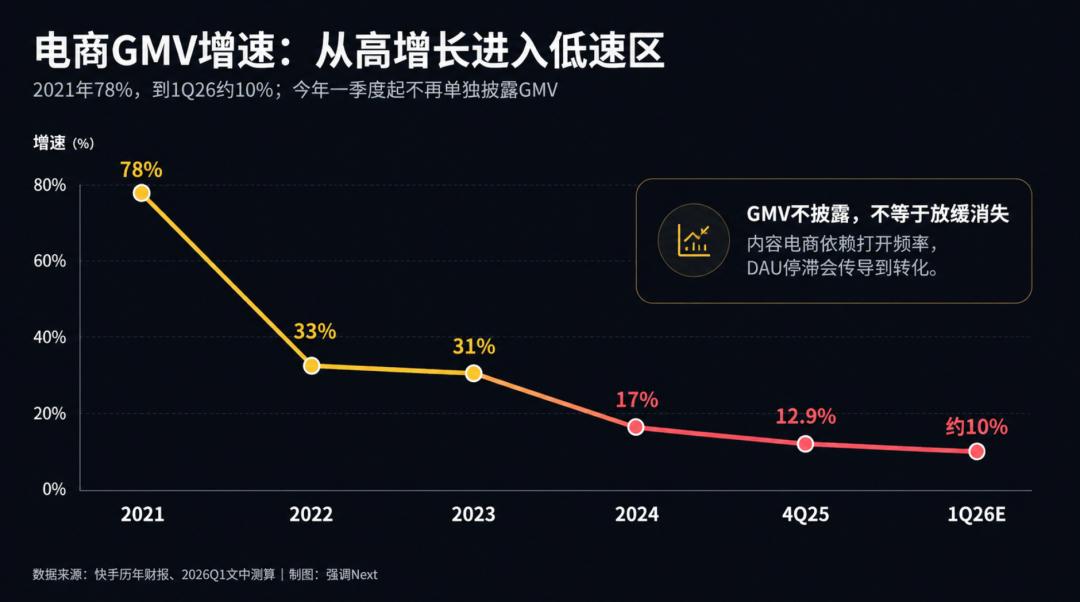
Since the first quarter of this year, Kuaishou has stopped disclosing its GMV separately. The company explained that this is to be in line with the industry, as Alibaba and Pinduoduo have also stopped disclosing relevant figures. This reason is valid, but most of these companies stopped disclosing GMV after the growth rate entered a low level.
Based on the revenue growth rate of "other services", the change in the commission rate, and market expectations, Kuaishou's e - commerce GMV growth rate in Q1 2026 is approximately close to 10%, continuing to slow down compared to last year.
In the industry, this growth rate is not easy. Douyin's e - commerce GMV exceeded 4 trillion yuan in 2025, and its growth rate is still over 20%. Kuaishou's scale is about one - third of Douyin's, but its growth rate has significantly lagged behind.
The foundation of content e - commerce is the traffic funnel. The longer the user's usage time and the more frequently they open the app, the thicker the conversion foundation. It is not surprising that Kuaishou's e - commerce growth rate has slowed down due to the stagnant DAU and the declining opening rate. The decline in advertising growth rate is also related to this. When e - commerce merchants' ROI expectations tighten, their internal - circulation advertising investment will shrink accordingly.
When a platform's GMV growth rate approaches 10%, there will be fewer reasons for merchants to significantly increase their budgets.
4
The gross profit margin drops, and both AI and short dramas are squeezing profits
In the first quarter, Kuaishou's gross profit margin was 51.2%, a decrease of about 4 percentage points compared to the previous quarter and significantly lower than 54.6% in the same period last year.
The pressure mainly comes from two aspects.
First is the investment in AI computing power. Kuaishou's annual capital expenditure budget for 2026 is 26 billion yuan, an increase of about 11 billion yuan compared to 2025. The core investment is in the computing power related to the Keling large - model. Based on a 5 - year depreciation period, this will put a pressure of about 1 to 2 percentage points on the annual gross profit margin, and as the fixed assets accumulate, the cost - side pressure will continue to be released.
Second is IAA short dramas, that is, free short dramas monetized through advertising. The platform needs to share profits with content providers. This part of the business is growing rapidly, but its gross profit margin is lower than that of brand advertising and performance advertising. The change in the content structure is pushing down the overall gross profit margin.
For the same AI investment, the effects of different companies are not the same.
Bilibili's AI - related capital expenditure is expected to increase by about 1 billion yuan this year, with an impact of about 500 million yuan on the income statement. However, AI has begun to be reflected in the growth of DAU, usage time, and advertising, indicating that the AI investment is improving the distribution and monetization efficiency of the main site.
Kuaishou's 26 billion yuan is mainly invested in Keling. Keling itself is growing rapidly, but the synergy between it and the main - site advertising and e - commerce is not clear. In other words, Kuaishou is building an independent AI product line rather than simply using AI to improve the efficiency of the main site.
This path is not wrong, but the return period is longer, and the short - term pressure is greater.
5
How long can cost - cutting last?
In the first quarter, Kuaishou's sales expenses increased by 4% year - on - year. However, looking into the details, the promotion investment increased, while the employee cost on the sales side decreased by 8%. The management expenses decreased by 7.5% year - on - year, and the R & D expenses increased by 10%. The increase mainly came from bandwidth and server costs rather than personnel expansion.
This shows that Kuaishou is using traffic investment to replace human - powered sales and continuing to compress management and middle - platform costs.
In the short term, this supports the better - than - expected profit. However, the cost - cutting space on the expense side is limited. For a content platform, once the revenue growth rate continues to slow down, it is difficult to support the profit in the long term by simply cutting expenses.
Baidu in the first quarter is a reference. Its traditional online marketing revenue decreased by 22% year - on - year, and its net profit attributable to shareholders decreased by 55% year - on - year. Cost - cutting is still ongoing, but it is difficult to fully offset the pressure on the revenue side.
Kuaishou still has some room for maneuver at present. However, if the revenue growth rate cannot improve in the next two or three quarters, the marginal effect of cost compression will become weaker and weaker.
6
Keling finally has a real scale
In previous financial reports, Keling has always been highlighted by Kuaishou, but its revenue scale was too small to really affect the valuation judgment. Since Q1 2026, the situation has changed.
In the first quarter, Keling's revenue was 650 million yuan. As of March, its ARR had reached 500 million US dollars, and the growth continued in April and May. Some media reported that according to the current growth curve, Keling's ARR is expected to reach 1.3 billion US dollars in the first quarter of 2027.
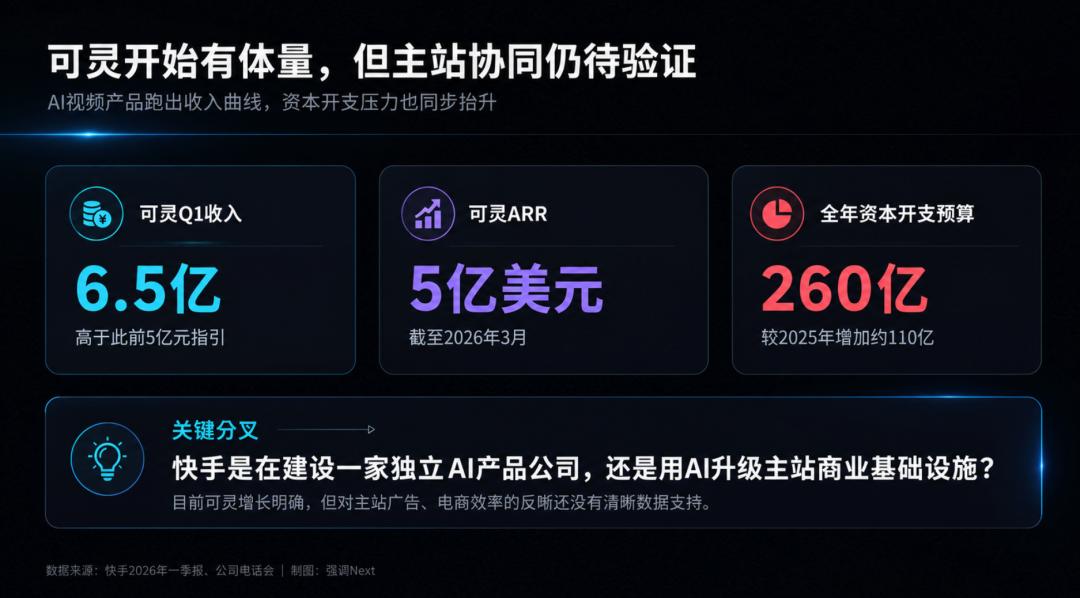
This is no longer just a decorative figure but an independent revenue growth curve. In the global AI video - generation track, Keling is one of the few products that have achieved substantial commercial revenue.
However, the problem lies here: a considerable part of Keling's revenue comes from overseas subscriptions and API services, and it is not integrated with Kuaishou's main - site advertising and e - commerce ecosystem. It is penetrating more deeply into professional scenarios such as film and television, advertising, and short dramas, but it has not significantly improved the advertising efficiency of Kuaishou's main site or significantly increased e - commerce conversion.
Therefore, Kuaishou's AI investment faces a crucial fork: is it building an independent AI product company or using AI to upgrade the main - site commercial infrastructure?
If it is the former, Keling needs to establish an independent valuation logic; if it is the latter, the synergy effect of the main - site AI transformation has far from been realized.
This is also the reason why the progress of Keling's spin - off listing has attracted market attention. When the AI assets are not fully reflected in the main - site valuation, independent financing and listing are direct ways to obtain re - pricing. Baidu's promotion of the "A + H" spin - off listing of Kunlun Chip follows a similar logic.
For Kuaishou, whether Keling can support the 26 - billion - yuan AI investment cost after independence is one of the most important variables in the current valuation story.
7
Next, see if the main site can stabilize
In Q1 2026, the three most notable figures for Kuaishou are: a year - on - year decline of 13.5% in live - streaming revenue, a DAU/MAU of 53.5%, and a gross profit margin of 51.2%.
These three figures will continue to be tested in the second quarter.
The decline of live - streaming is a trend - based problem, and there