With an annual income of 1.77 billion, the uncle who sells used mobile phones is going to IPO.
Flashback Technology, a company specializing in recycling second - hand mobile phones, is gearing up for an IPO on the Hong Kong Stock Exchange.
In this market, there are already companies like Aihuishou and Zhuanzhuan (collectively accounting for 16% of the market share). However, Flashback Technology has a unique way of establishing itself: it recycles old mobile phones in the offline stores of brands such as Huawei, Xiaomi, vivo, and Honor.
In 2025, it recycled over 4.3 million mobile phones through this method, generating a revenue of 1.771 billion yuan.
Xiaomi is not only a shareholder of Flashback Technology but also its largest source of recycled phones. In 2024, it once contributed over 40% of the recycled phone supply.
However, the profit margin in the second - hand mobile phone recycling business is thin. How can it break through?
01
How does the old mobile phone recycling business make money?
Liu Jianyi, the founder of Flashback Technology, is 55 years old this year and has worked in the communication industry for 18 years. Before starting his business, he served as the director of the operator department at Tianyin Holdings, a leading mobile phone distributor, for 9 years. After leaving, he entered the second - hand digital product industry.
In 2016, Liu Jianyi founded Flashback Technology. Most of the core team members come from traditional communication channels and have mature offline resources. However, they did not follow the conventional path in the industry.
At that time, many peers were doing the same thing: spending on advertising and offering subsidies to compete for C - end users. Flashback Technology does not target C - end users but focuses on B - end users. Instead of opening its own stores, it does business by leveraging other stores and captures the natural traffic brought by the trade - in programs of brand owners and operators.
This business approach can be summarized as "To B asset - light".
Upstream, Flashback Technology recycles old mobile phones through the offline stores of Xiaomi, Huawei, Samsung, vivo, Honor, and the three major operators. Downstream, it sells the recycled phones in bulk to small and medium - sized digital merchants across the country, making a profit from the price difference.
It has a different business model from Aihuishou and Zhuanzhuan. Aihuishou, backed by JD.com, operates C - end self - operated stores, while Zhuanzhuan focuses on the online platform model. Flashback Technology is more like a "behind - the - scenes player" - it does not directly face consumers but specializes in being a service provider behind the stores.
The success of this model relies on two barriers.
The first is the channel barrier.
As of now, Flashback Technology has partnered with over 77,000 offline stores, covering 31 provinces across the country. In 2025, the procurement volume through the trade - in channel accounted for 86.4% of the company's total procurement volume.
More importantly, its relationship with brand owners is more than just a partnership.
Xiaomi is not only a partner but also a shareholder of Flashback Technology. Through Jinmi Investment and Shunwei Capital, the Xiaomi ecosystem holds shares in Flashback Technology. In 2024, Xiaomi alone contributed 41.5% of Flashback Technology's procurement volume.
The value of this relationship is not only about getting more supply but also means a more stable supply capacity. In the second - hand mobile phone industry, whoever can continuously obtain supplies is more likely to take the initiative.
The second is the technology barrier. There has always been a problem in the second - hand mobile phone recycling industry: the detection standards are not unified, pricing relies on experience, and the efficiency is low. For the same mobile phone, different channels may offer different prices.
What Flashback Technology aims to do is to standardize this process. It has self - developed a digital system that integrates the processes of receiving goods, quality inspection, and valuation, minimizing manual judgment.
In the first half of 2025, the average inventory turnover days of Flashback Technology was only 6.5 days, while the industry average is generally between 10 and 15 days. For the second - hand business, one more day of fast turnover means one less day of capital being tied up. The faster the goods are turned over, the easier it is to make a profit.
Based on the recycling transaction volume in 2025, Flashback Technology is already the largest offline trade - in mobile phone recycling service provider in China, ranking third in the entire second - hand mobile phone recycling market with a market share of about 1.6%.
However, although the turnover seems large, the actual profit is not high. Because the recycling cost accounts for over 85% of the sales cost, and there are also expenses for logistics, store promotion, and sales commissions. From 2021 to the first half of 2025, the gross profit margin of Flashback Technology has long been in the single - digit range.
02
The offline market is the main battlefield
In 2025, the scale of the domestic second - hand mobile phone recycling market exceeded 19 billion yuan. Although the sales of new mobile phones are sluggish, the demand for second - hand mobile phones is increasing. The average price of domestic second - hand mobile phones is about 1,200 yuan, only 26.7% of the average price of new mobile phones, which is 4,500 yuan. Models priced below 3,000 yuan account for over 70% of the sales volume. Students, users in the sinking market, and those in need of backup phones are the main consumers.
However, there is an old problem in this industry: the concentration is extremely low. The top five companies together account for less than 20% of the market share, and a large part of the market is still in the hands of small merchants and individual traders. The market share of the top two companies is about 8%, and Flashback Technology ranks third with a 1.6% share.
Moreover, the recycling of old mobile phones mainly relies on offline channels. In 2025, the transaction volume of the offline trade - in channel was 13.3 billion yuan, accounting for 74.8% of the overall market. For mobile phone brands and operators, the trade - in program is no longer an "ancillary business" but a core strategy to boost the sales of new mobile phones. When you buy a new mobile phone, you can use your old phone to offset a few hundred yuan - customers save money, stores retain customers, and brand owners sell one more new phone, achieving a win - win situation for all three parties.
Therefore, whoever can tie up with brand owners and operators can obtain the most stable and cheapest supply. The 77,000 stores of Flashback Technology, the 86.4% procurement share, and Xiaomi's dual identity as a shareholder and a source of supply are all products of this logic.
However, Flashback Technology also has its own concerns.
First, the company's revenue is increasing, but the profit is not. From 2023 to 2025, the company accumulated a loss of about 244 million yuan. The gross profit margin fluctuates between 4.8% and 6.8%, and the profit space is indeed thin. Completing the processes of detection, warehousing, logistics, and after - sales service requires continuous expenditure. Since the profit of second - hand mobile phones is not high, if the efficiency of any one of these processes lags behind, the cost can easily eat up the profit, and the company may even make less and less money.
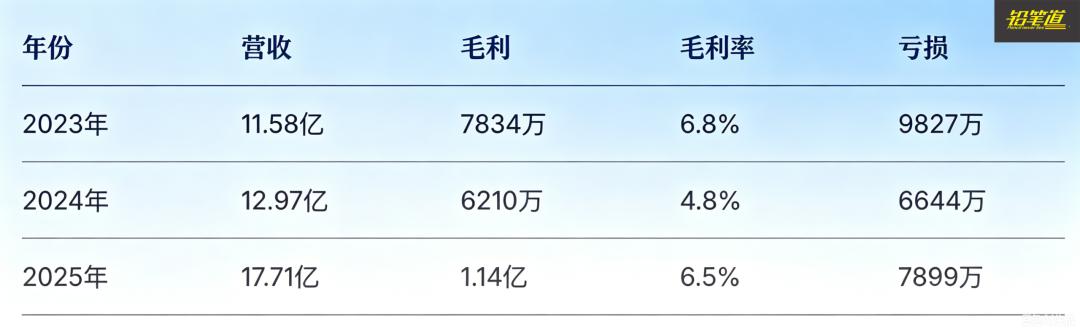
Second, there is a risk of channel dependence. In 2024, the top five suppliers accounted for 57.6% in total, and Xiaomi alone accounted for 41.5%. Although it is good to have a deep - seated relationship with Xiaomi, which is both a shareholder and the largest source of supply, the risk is also concentrated. After Xiaomi launched its own recycling platform in 2022, Flashback Technology had to raise the recycling price to maintain its supply, squeezing its profit space.
03
The industry competition lies in the supply chain
It can be seen from Flashback Technology's prospectus that the profit margin in the second - hand mobile phone industry is very thin. This means that as the industry develops, it is more like a supply - chain business.
The reason is simple: second - hand mobile phones are not standard commodities.
A second - hand mobile phone of the same brand and model may have dozens of states. Whether the screen has scratches, how much battery life is left, whether it has been repaired, whether parts have been replaced, and the degree of damage to the frame will all affect the price.
The biggest challenge in the second - hand mobile phone industry is standardization. The real difficulty is not in receiving the goods but in the subsequent processes: detection, grading, pricing, warehousing, and circulation.
In the second - hand mobile phone recycling industry, the circulation speed is crucial for making a profit.
For example, if a mobile phone purchased for 3,000 yuan stays in the warehouse for 30 days, its price may drop by several hundred yuan. If it stays for two months, the profit may be completely eaten up.
Everyone is competing for a faster turnover speed. By reducing intermediate links, mobile phones can be circulated more quickly.
Chen Xuefeng, the founder of Aihuishou, once summarized this industry as follows: supply - chain capability is the core capability. In the early days when Aihuishou operated offline stores, many people thought it was just opening a chain of stores. However, later it became more like an infrastructure company. Since 2017, it has continuously invested in an automated detection system, regional operation centers, and the B2B platform Paijitang.
Later, Aihuishou built an automated operation center in Dongguan, turning the processes of transportation, detection, grading, warehousing, and shipping into an assembly line. Paijitang also opened an offline flagship store in Huaqiangbei, Shenzhen, moving the "warehouse" directly in front of the trading market, allowing merchants to inspect and pick up goods on - site. According to public information, this can shorten the logistics time by 3 to 5 days.
Flashback Technology is actually doing the same thing, but through a different path. Aihuishou started from the C - end and moved backward, while Flashback Technology directly entered the market through brand stores.
Another issue is trust. China generates hundreds of millions of used mobile phones every year, but the proportion of phones entering the formal recycling system is still relatively low. Users are reluctant to sell because they are afraid of being underpaid, and they are also hesitant to buy because they are afraid of being deceived.
More and more platforms are becoming "heavier", with offline stores and detection centers becoming standard features, which is also to address the trust issue. Users hand over their phones to Huawei and Xiaomi stores because they trust the brands. Stores hand over the phones to Flashback Technology and Aihuishou because they have a stable supply. Platforms then conduct detection, warehousing, and distribution based on the stable supply.
Therefore, the real competition in the second - hand mobile phone industry has three levels: the first level is to compete for traffic; the second level is to compete for the supply chain; the third level is to compete for trust.
Traffic can be bought, and the supply chain can be built, but trust takes the longest time to build.
This article is from the WeChat official account "Pencil News" (ID: pencilnews). The author is Song Ge, and the editor is Huang Xiaogui. It is published by 36Kr with authorization.