Pinduoduo: Temu's growth accelerates while advertising growth slows down against the trend
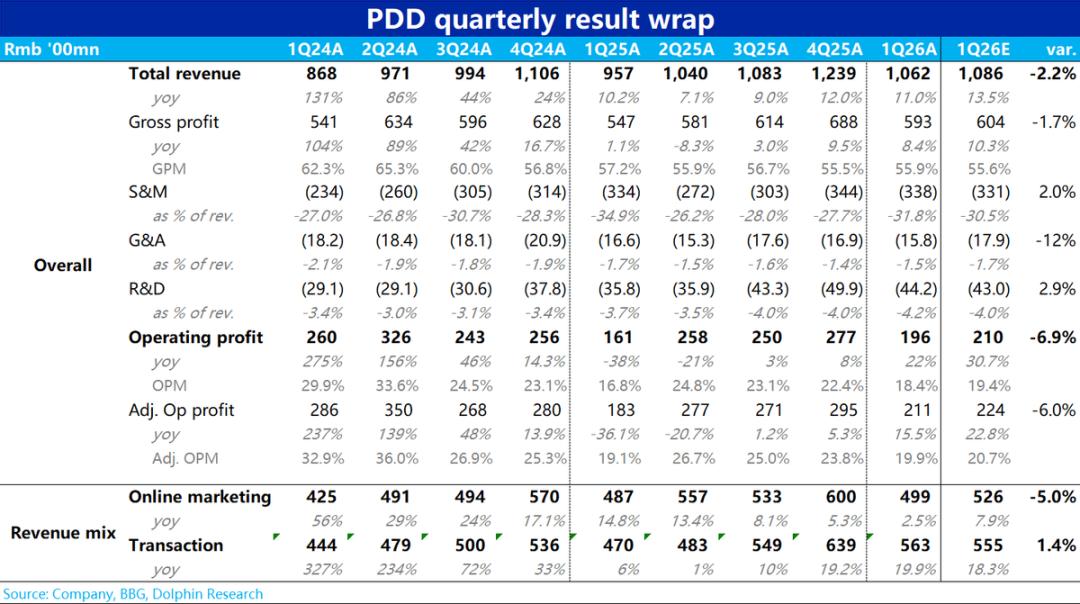
Before the U.S. stock market opened on May 27th, Pinduoduo released its financial report for the first quarter of 2026. Both its revenue and profit fell short of market expectations, making it the "worst performer" in the e-commerce sector. Specifically:
1. Growth "contrarily" weakened: Different from the situation where the growth of the industry and other peers in this quarter improved compared with the previous quarter, Pinduoduo's revenue growth slowed down compared with the previous quarter.
Specifically, the total revenue increased by 11% year-on-year, significantly lower than the market expectation of 13.5% and also lower than the 12% in the previous quarter. What's more serious is that the advertising revenue fell short of expectations, with a growth rate of only 2.5%, far lower than the market expectation of about 8%.
As for the reasons behind this, Dolphin Research believes that on the one hand, the GMV growth rate of Pinduoduo's domestic main website may have continued to slow down contrarily on a quarter-on-quarter basis. But the more important reason should be a significant decline in the platform's advertising monetization rate. Behind this may be the impact of the standardization of e-commerce tax payment on the profitability and advertising investment ability of small and medium-sized merchants.
2. The growth of Temu continued to recover, but it was not a pleasant surprise: In contrast, the transaction commission income was about 63.9 billion, and the year-on-year growth rate slightly accelerated to 20%, higher than the Bloomberg consensus expectation of 18%. Since the growth of the domestic main website was not good this quarter, it can be inferred that the growth of overseas Temu (or/and) Duoduo Grocery was better than market expectations.
According to Dolphin Research's preliminary calculation, Temu's revenue growth rate increased from about 20% in the previous quarter to about 25% this quarter, and it did speed up. However, since Temu is developing in many countries such as Europe, South America, and Southeast Asia, Dolphin Research had higher expectations for Temu, and its actual performance was not very surprising.
3. Marketing expenses did not decline year-on-year: Pinduoduo's gross profit increased by 8.4% year-on-year this quarter, slightly lower than market expectations. However, the gross profit margin reached 55.9%, which has bottomed out and rebounded on a quarter-on-quarter basis, and is also higher than the market expectation of 55.6%. The year-on-year decline in the gross profit margin should continue to narrow in the future.
In terms of expenses, since last year was one of the peak periods when the company itself funded to replace national subsidies, the market originally expected that the marketing expenses this quarter would decline. However, the marketing expenses actually increased by 1% year-on-year. In terms of structure, considering that Temu is expanding on multiple fronts and its growth this quarter was also good, it should be mainly due to the significant increase in Temu's marketing expenses, while the marketing expenses of the main website should have actually decreased.
As for management expenses and R & D expenses, the former decreased year-on-year, while the latter continued to grow rapidly - which reflects the company's investment in AI functions.
4. Profits hit the bottom and returned to growth, but the growth was not strong: Due to the "profit pit" caused by national subsidies in the same period last year, as the impact of national subsidies receded, Pinduoduo's profits have indeed bottomed out and rebounded this quarter, increasing by 22% year-on-year to 19.6 billion.
However, because the revenue growth of the domestic main website fell short of expectations, and the marketing expenses did not decline significantly, the actual profit performance did not meet expectations. Analyzing the reasons behind this by segment, we believe that on the one hand, the extent of Temu's loss reduction this quarter was probably not as much as expected, and the operating profit growth of the domestic main website should also be quite limited, most likely not exceeding 1 billion.
Dolphin Research's view:
As can be seen from the above analysis, Pinduoduo's performance this quarter was obviously not good. The key signals are as follows:
1) First of all, while the performance of e-commerce industry peers generally improved on a quarter-on-quarter basis, Pinduoduo's growth contrarily weakened, which marked that Pinduoduo has changed from an "excellent student" in the sector to a "poor student".
Whether it is the contrarian decline in Pinduoduo's GMV growth rate or the negative impact of the e-commerce tax collection issue on small and medium-sized merchants on the company's platform, which we had previously pointed out, began to be reflected, thus dragging down the company's monetization ability. This performance means that the probability of the scenario where the company's main website revenue and profit growth rates rebound significantly after the withdrawal of national subsidies, which the market had previously expected, has significantly decreased, and the future prospects have become worse.
2) In the case of operating in multiple countries and markets, Temu's growth continued to accelerate, better than expected, and the progress of turning losses into profits was also slower than expected.
2. Future outlook:
1) As mentioned above, our judgment on the prospects of Pinduoduo's domestic main website business is worse than that in the previous quarter:
a. First of all, although the reduction of national subsidy intensity in 2026 helped Pinduoduo's domestic main website's profits bottom out and rebound, the positive impact was not as good as previously expected.
Originally, after the withdrawal of national subsidies, Pinduoduo should have changed from the least beneficiary to a relatively beneficiary (because it was relatively less affected by categories such as 3C and home furnishings). However, in actual performance, Pinduoduo did not show a relatively outperforming trend.
b. In addition, Dolphin Research has repeatedly emphasized before that with the regulatory requirement for e-commerce merchants to pay taxes, instead of self - reporting by merchants, it is now uniformly reported by the platform, which means it will be more and more difficult for merchants to "evade taxes".
This will have the most obvious impact on the numerous small and medium-sized merchants on Taobao and Pinduoduo, affecting the profit margins of merchants and thus dragging down the advertising investment budgets of merchants, which is not conducive to the advertising monetization of e-commerce platforms. This concern seems to have been verified this time.
c. Regarding regulatory issues, after the "beating incident" in April 2026, the regulators finally announced an official penalty decision, imposing a total fine of nearly 3.6 billion on multiple platform companies, including Pinduoduo, Meituan, JD.com, and Taotian. Pinduoduo was punished the most severely, with a fine of 1.5 billion alone.
The main reasons for this penalty include: First, the platform did not strictly review the food business licenses of settled merchants, resulting in a large number of "ghost" stores without physical stores or qualifications selling foods such as cakes; Second, the platform illegally cooperated with a third - party "order transfer platform", causing consumers to place orders in well - known stores, but the orders were "transferred in one click" to unknown and shabby workshops for production.
In addition to having more illegal stores, the "beating" and other behaviors that hindered supervision were important reasons for Pinduoduo to be punished to the maximum extent.
With the implementation of the fine, and the 1.5 - billion fine has a very limited impact on the annual profit of over 100 billion. Moreover, this regulatory action did not emphasize a potentially more serious issue - the issue of banning the mandatory or semi - mandatory requirement for merchants to automatically compare prices across the entire network and report the lowest price. Therefore, it marks that the regulatory risks faced by Pinduoduo have been significantly reduced.
Considering the above points as a whole, Dolphin Research still believes that the profits of Pinduoduo's domestic main website will show a trend of bottom - out recovery and return to growth. However, in the context of the slowdown in the overall e - commerce market growth and the continued pressure on the monetization rate, the recovery strength will not be strong.
2) Since Pinduoduo's domestic main website is basically mature, and the company has not been deeply involved in the two popular directions of instant retail and AI, the elasticity of Pinduoduo's performance and valuation still depends on whether Temu can be independently valued.
According to recent news reports (Temu has become the second - most - used e - commerce website globally) and Temu's continued acceleration of growth this quarter, Dolphin Research believes that the probability of Temu releasing its valuation independently in the future is not small. However, the time node may be postponed. After all, since Temu is operating on multiple fronts, the time node for it to turn losses into profits is also likely to be postponed.
3) As for the "New Pinmu" business line officially announced in the previous quarter's financial report, according to reports, its model is similar to the self - operated brands of overseas supermarkets, such as Kirkland under Costco.
Currently, the tested categories include clothing, home furnishings, and outdoor products. New Pinmu is responsible for all duties such as design/product selection, pricing, promotion and sales, and fulfillment. Only the production of goods is outsourced to external partners. The target market is limited to overseas, starting from the United States and gradually expanding to markets in Europe, Southeast Asia, etc. And according to experts, the product pricing logic of New Pinmu will be cost - plus, only seeking a limited low gross profit margin in order to have sufficient price competitiveness in the overseas market.
In terms of strategy, different from Shein's small - order and quick - response model, which continuously launches new products to chase consumer hotspots, according to reports, New Pinmu's product selection will focus on "classic big single products" with continuous demand.
Therefore, it is believed that "New Pinmu" can be regarded as a self - operated version of Temu on the one hand, and on the other hand, it can also be regarded as adding a more independently managed supplier to the Temu platform, but it will also relatively occupy more funds and management energy.
3. In terms of value analysis, Dolphin Research still analyzes the domestic main website and overseas Temu separately:
For the main website, after this quarter's performance, the growth target of the main website's GMV in 2026 has been lowered from over 10% to about 8% - 9%. As for the profit margin of the main website, considering that the impact of the standardization of merchant tax collection on the monetization rate seems to be higher than previously expected, the growth rate expectation of the main website's operating profit in 2026 has also been lowered to about 10%.
Therefore, overall, it is conservatively expected that the total operating profit of the main website in 2026 will be about 114 billion (considering that interest income and other income can basically offset taxes, so no tax is deducted). It can be said that after this decline, Pinduoduo's valuation premium compared with peers such as JD.com and Taotian has been squeezed out, and the company's recent performance is indeed no longer worthy of enjoying a premium.
The main points that can promote the company's recovery in the future are still two: Temu's segment is given a valuation, and the company starts to attach importance to shareholder returns, conducts share buybacks or dividends, releases the value of the over 500 - billion - yuan cash on its books (the company's market value is only 800 - billion - yuan), and lists in Hong Kong. The second point may be an easier path.
Of course, we believe that more importantly, when the company's performance has become mediocre and it has almost no advantages compared with its peers, if the management continues to maintain an "arrogant" attitude of not communicating and not providing dividends & buybacks, Dolphin Research believes that it will be difficult to attract investors' favor.
Detailed interpretation of this quarter's financial report
I. The growth of advertising contrarily slowed down. Has Pinduoduo become the "worst performer" in e - commerce?
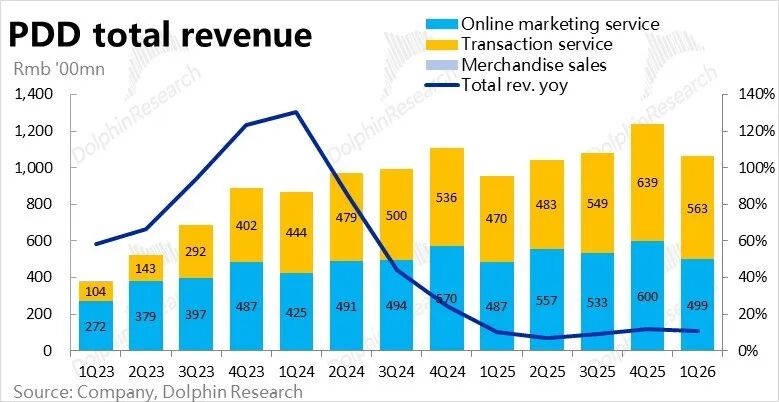
This quarter, Pinduoduo's total revenue was about 106.2 billion yuan, a year - on - year increase of 11%, significantly lower than the market expectation of 13.5%. And in terms of trend, it also slowed down compared with 12% in the previous quarter, which is exactly the opposite of the situation where the industry data and e - commerce peers generally had better growth in the first quarter of this year than in the fourth quarter of last year.
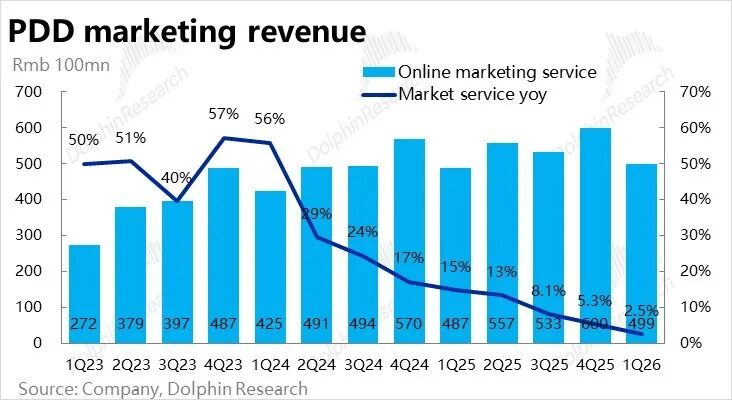
What's more serious is that the advertising revenue reflecting the domestic business fell short of expectations. This quarter, the year - on - year growth rate was only 2.5%, far lower than the market expectation of about 8% and 5% in the previous quarter.
Considering that the industry's GMV growth rate has accelerated on a quarter - on - quarter basis, even if the GMV growth rate of Pinduoduo's domestic main website is still declining on a quarter - on - quarter basis, it should not be only about 2.5%. Therefore, the extremely low growth rate of advertising revenue is most likely due to a significant decline in the platform's advertising monetization rate.
Although the specific reasons behind this need to be explored, Dolphin Research believes that the previously mentioned standardization of e - commerce tax payment, which has a greater impact on the profitability and advertising investment ability of small and medium - sized merchants, is a possible reason.
II. Temu's growth accelerated. It's good but not a pleasant surprise
This quarter, the transaction commission income was about 63.9 billion, and the year - on - year growth rate slightly accelerated to 20%, higher than the Bloomberg consensus expectation of 18%. Since the growth of the domestic main website was not good this quarter, it can be seen that the growth of overseas Temu and Duoduo Grocery was better than market expectations.
According to Dolphin Research's preliminary calculation, Temu's revenue growth rate increased from about 20% in the previous quarter to about 25% this quarter, and it did speed up.
However, since Temu is developing rapidly in many markets such as Europe, South America, and Southeast Asia, and there have been recent reports that the number of global independent visitors to the Temu website has reached 366 million, making it the second - most - visited e - commerce platform globally (second only to Amazon). Therefore, Dolphin Research had higher expectations for Temu, and its actual performance this quarter was not very surprising to us.
