Two Faces of Du Xiaoman: Luring Customers with Low Interest Rates and Lending at High Interest Rates
"Sisters Who Make Waves" cannot help Du Xiaoman achieve real breakthroughs. What it needs to cross is not the waves of entertainment public opinion, but the deep - water area formed by supervision, reputation, scenarios, and trust.
Du Xiaoman has recently been desperately trying to gain attention, but in an extremely contradictory way.
On the big screen, it exclusively sponsored "Sisters Who Make Waves 2026" (the seventh season of "Sisters Who Make Waves") with real money, trying to secure a prominent position for itself in the mainstream entertainment field. In the short - video information flow, the advertisements of its "Youqianhua" are widely promoted. The copy "Taking an annualized interest rate of 6.6% as an example, the interest for borrowing 10,000 yuan for one day is 0.98 yuan" is extremely alluring, stirring the nerves of the public.
In addition, it has publicly released an AI payment solution and an open - source financial reasoning large - model. However, on the other hand, it has become the target of more than 40,000 complaints on the Black Cat Complaint platform about "violent debt collection" and "front - end fees". According to the data from the Consumer Protection Platform, in 2025 alone, there were 3,355 complaints related to Du Xiaoman, with a total amount approaching 70 million yuan.
This extremely contradictory "two - faced" situation is the true portrayal of Du Xiaoman at present. It is wandering at the junction of light and darkness, trying to use the brand illusion created by S - level variety shows to cover up the fact that at its core, it is still a traditional credit intermediary that relies on high - interest rates to cover high customer acquisition costs.
With the strict implementation of regulatory policies and the irreversible macro - cycle, the game of using the traffic funnel to pursue arbitrage dreams is coming to an end. Du Xiaoman's attempt to reverse its reputation through entertainment advertising and boost its valuation by leveraging AI is facing unprecedented challenges.
Part.1
The Rhetoric of Annualized Interest Rates
How the Low - Interest Bait Turns into a High - Interest Trap
Before analyzing Du Xiaoman's business predicament, let's first take a look at this widely - promoted short - video advertisement.
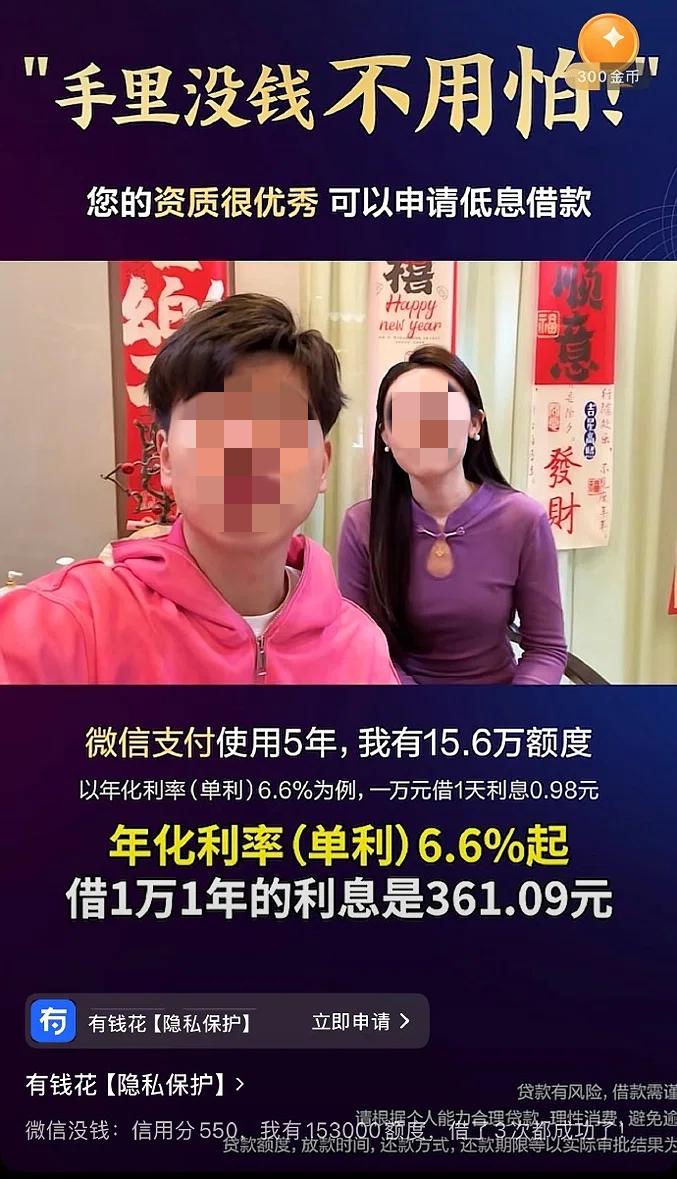
In this advertisement, the most powerful expression is "Annualized interest rate from 6.6%", which is very delicate.
"6.6%" is used to create the perception of low - interest rates, and "from" leaves room for interpretation. It can reduce users' vigilance during the advertising stage and allow the platform to re - price according to users' qualifications in the contract stage.
The problem is that users who can actually get a 6.6% interest rate are usually high - quality customers on the whitelist in the risk - control model. This group of people can often obtain credit loans at a lower cost from state - owned banks, joint - stock banks, or licensed consumer finance companies. In other words, they are not the core target group of Du Xiaoman's advertisements.
Those who are really attracted by the slogan "Don't worry if you have no money" are usually people with greater capital turnover pressure, weaker financial bargaining power, and less sensitivity to annualized interest rates. After these users enter the loan process, the actual interest rate they finally get may be close to or even exceed the 24% regulatory red line.
This is the classic funnel of Internet credit advertisements. It uses low - interest numbers to lower the psychological threshold, strengthens the sense of convenience with "fast fund arrival" and "no collateral required", creates an immediate sense of satisfaction with the credit limit, and finally re - prices according to the user's risk in the actual approval stage.
In addition, the advertisement claims that "the interest for borrowing 10,000 yuan for one year is 361.09 yuan". This figure is the absolute interest amount calculated based on the equal - principal - plus - interest repayment method and a specific repayment schedule. What ordinary people actually need to bear may be a more complex comprehensive financing cost.
More importantly, many people do not understand the conversion relationship between the equal - principal - plus - interest method, daily interest rate, annualized interest rate, late - payment fees, service fees, and guarantee fees. As long as the platform breaks down, delays, and packages the costs, borrowers will underestimate the real burden at the time of decision - making.
This is also the reason why a large number of Du Xiaoman's complaints are concentrated on issues such as "the advertised interest rate does not match the actual interest rate", "the comprehensive cost is too high", and "penalties are still charged for early repayment".
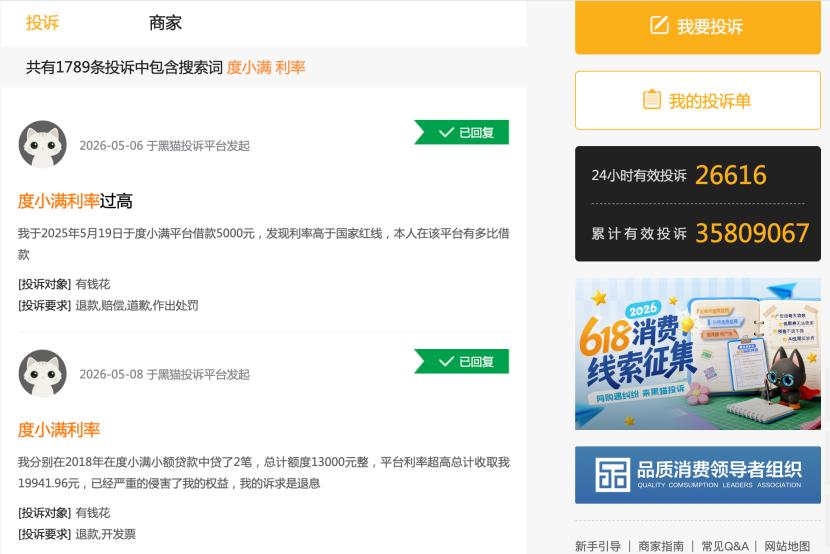
On the Black Cat Complaint platform, a user disclosed the details of his loans. The actual annualized interest rates of the two loans were as high as 42.56% and 38.86% respectively.
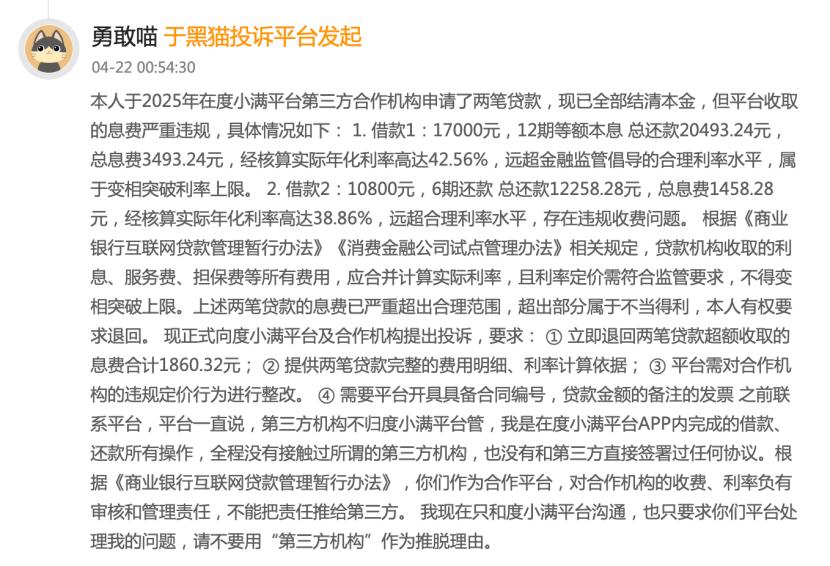
Another user's last installment of 3,764.87 yuan was overdue for 212 days. The late - payment fee was calculated at an annualized rate of 35.1%, far exceeding the judicial protection upper limit of 24%.
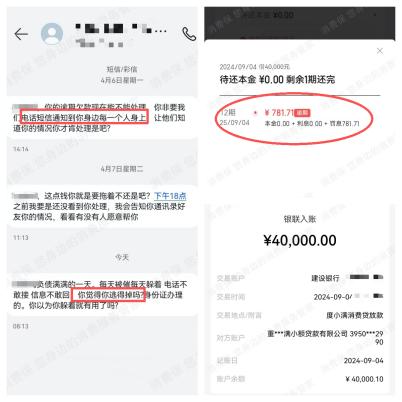
Some users were charged a penalty of 3% - 4% of the remaining principal by Du Xiaoman for early repayment.
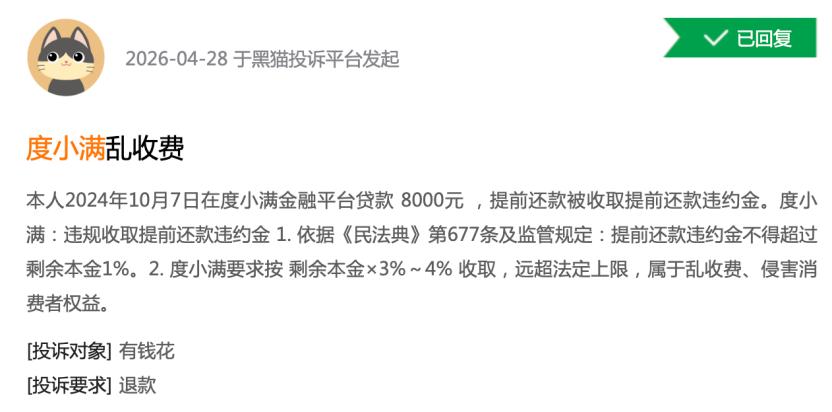
These individual cases may not all directly mean that the platform has violated regulations, but they all point to a problem. When Du Xiaoman uses low - interest rates as a customer - acquisition strategy and leaves risk - pricing for the later stage, there will be a huge gap between users' perception and the real cost.
And this gap is an important source of the profit model of loan - assistance platforms in the past few years.
Part.2
The Marketing Strategy of Two - Facedness
Heavy - Investment Sponsorship and Traffic Hunting
If the interest - rate rhetoric is the first hidden side of Du Xiaoman, then using glamorous entertainment marketing to cover up the nature of loan - assistance hunting is its second hidden side.
This approach is not accidental. It not only reflects the profound public - relations background of Du Xiaoman's core management team but also exposes the inherent lack of a native consumption scenario in Baidu's traffic structure.
Zhu Guang, the current CEO of Du Xiaoman, has a deep background in public relations and marketing. He once served as the senior director of public relations and integrated promotion in the Greater China region of Lenovo Group. After joining Baidu in 2008, he has long been in charge of market public relations, government affairs, and other sectors. This resume has left a strong mark of public - relations - driven and marketing - dependent strategies in Du Xiaoman's market approach.
By sponsoring popular variety shows, appearing in sports events and entertainment programs, and constantly building public awareness with the help of celebrities, champions, and variety - show IPs, from "Sisters Who Make Waves 2026" to "The Rap of China", from snooker events to Olympic champions, Du Xiaoman has almost saturated brand exposure, trying to package itself as a formal, trustworthy, and technology - driven financial service brand in communication.
However, brand advertising in the financial industry is different from that of ordinary consumer goods.
When a mobile - phone brand sponsors a variety show, it aims to increase terminal sales conversion. When a credit platform sponsors a variety show, it essentially aims to reduce users' guard against borrowing. It needs to make users believe that borrowing is not a dangerous thing but a daily financial service endorsed by mainstream brands, platforms, and programs.
This is the deep - seated logic behind Du Xiaoman's heavy - investment advertising. It outsources trust for its credit products, dilutes the risk perception of financial products through the relaxation of entertainment content, and covers the sensitivity of borrowing products through the popularity of variety shows.
However, this also exposes the shortcoming in Du Xiaoman's business model: the lack of a strong self - owned consumption scenario.
After Du Xiaoman became independent from the Baidu system, although it inherited certain traffic and technology genes, it does not have a high - frequency, high - transaction, and closed - loop consumption scenario like Alipay, WeChat, Meituan, or JD.com. To acquire users, it relies more on advertising, information - flow conversion, channel cooperation, and external traffic purchase.
This means that Du Xiaoman's growth naturally depends more on two variables. First, whether the traffic is cheap enough. Second, whether the comprehensive loan income can cover the customer - acquisition cost and bad - debt risk.
In the past few years, the rapid expansion of the Internet loan - assistance industry was due to the simultaneous fulfillment of these two conditions. The mobile - Internet dividend was still there, and platforms could reach a large number of lower - tier users at a low cost. At the same time, the industry supervision had not fully enforced the requirement of transparent comprehensive financing costs, and platforms could obtain income through various means such as interest, service fees, and guarantee fees.
However, now both conditions have changed. Traffic is becoming more expensive, supervision is getting stricter, and borrowers' repayment ability is also affected by the macro - cycle.
The more high - profile Du Xiaoman's advertising is, the more it shows that it still needs to continuously acquire new users from the external market. When a credit platform's customer acquisition becomes more and more dependent on buying traffic, the quality of its profits will inevitably be questioned. Because the users bought are usually more expensive, riskier, and less loyal.
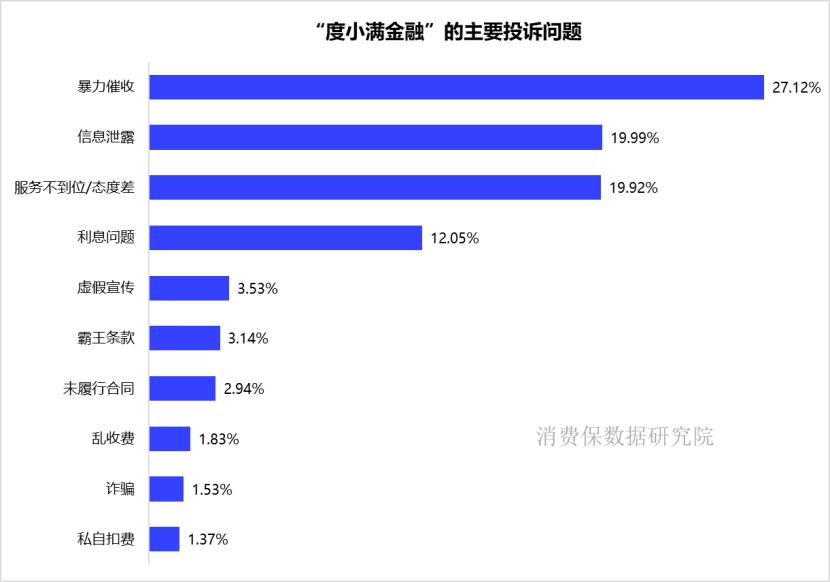
If the low - interest advertisement is the starting point for users to enter the funnel, then debt collection is the end of this chain. On the Consumer Protection Platform in 2025, debt - collection issues accounted for the highest proportion of complaints related to Du Xiaoman.
More sensitively, some media reported that Du Xiaoman's debt - collection business is mainly undertaken by its subsidiary, "Chongqing Jinrong Zhonghui Business Information Consulting Co., Ltd.", in which senior executives hold shares.
Business registration information shows that Zhu Guang and Sun Yunfeng, the senior vice - president of Du Xiaoman, indirectly hold 100% of the shares of Jinrong Zhonghui through "Chongqing Du Xiaoman Youyang Technology Co., Ltd.", with Zhu Guang holding 51% and Sun Yunfeng holding 49%.
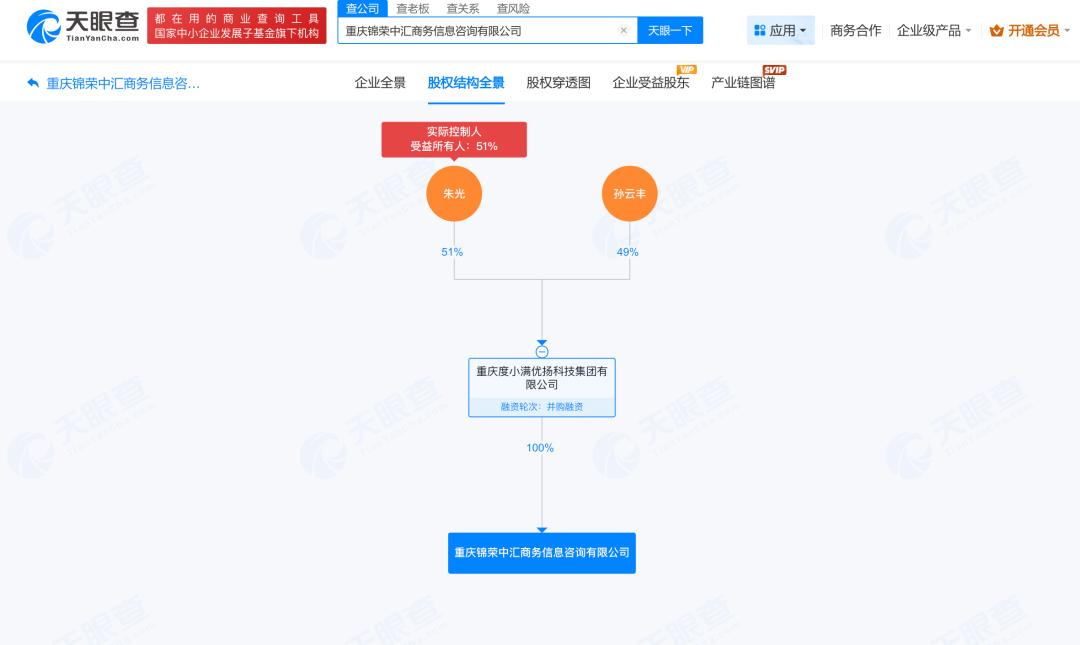
This equity arrangement means that Du Xiaoman earns interest by lending on one hand and completes post - loan collection through the affiliated debt - collection company on the other hand, forming an integrated closed - loop between the lending end and the debt - collection end.
In the front - end, there are heavily - sponsored variety - show IPs and warm - hearted advertisements. In the middle - end, there is a profit funnel with high - interest rates covering high risks. At the end of the chain, there is an affiliated debt - collection company squeezing the residual value of overdue assets.
With the same core of interests, different links of low - interest bait, high - interest lending, and debt - collection pressure complete the layer - by - layer harvesting of commercial value.
Part.3
The Cards Revealed When the Tide Recedes
Hard - Core AI Can't Solve Soft - Core Business
The biggest variable Du Xiaoman faces is the collapse of the regulatory arbitrage space in the loan - assistance industry over the past few years.
In recent years, regulatory documents represented by "Document No. 9" have been intensively implemented, clearly requiring that the comprehensive financing cost should not exceed 24%; platforms should not directly charge borrowers any interest or fees in any name; banks must conduct independent risk control, and core processes cannot be outsourced.
This is like taking away the firewood from under the cauldron for platforms like Du Xiaoman that heavily rely on credit intermediation.
In the past, platforms could increase the per - customer revenue through a complex fee structure. Now, the comprehensive cost is out in the open, and the fee - charging space is compressed. In the past, platforms could rely on high interest - rate spreads to cover high customer - acquisition costs and high risks. Now, the interest - rate cap and fee transparency make this model increasingly difficult to work.
The problem thus becomes very acute. If Du Xiaoman can no longer cover the more expensive traffic cost with higher comprehensive revenue, can its high profit margin continue?
When its main business is under pressure, like other Internet veterans, Du Xiaoman is trying to tell a new story with AI.
Xuan Yuan large - model, financial reasoning model, intelligent risk - control Copilot, anti - fraud system, AI payment solution... It is trying its best to join the ranks of fintech companies.
Supported by Baidu's AI ecosystem, this narrative does have a technological basis. The financial industry is also an early and relatively easy - to - implement scenario for AI applications. Risk control, anti - fraud, customer service, debt - collection quality inspection, pre - loan review, and post - loan early warning can all improve efficiency through models.
However, the question is whether AI can change Du Xiaoman's fundamental business. At least for now, artificial - intelligence technology is mainly optimizing the existing chains such as customer - acquisition conversion, risk - control scoring, and post - loan management, rather than reconstructing the business model.
AI cannot replace real consumption scenarios, cannot naturally reduce the cost of funds, and cannot eliminate users' resistance to high - interest borrowing.
In other words, AI can make Du Xiaoman's old business more efficient, but it cannot automatically turn the old business into a new one. AI is a tool, not a business model. The technological narrative can improve the valuation imagination, but it cannot replace the evolution of